Search

Enter keywords to search for products, blog posts, and more.

Factory Portable Air Conditioner — Spot Cooling for Machine Operators, Production Lines, and Process Areas

Factory Portable Air Conditioner — Spot Cooling for Machine Operators, Production Lines, and Process Areas


Heat Sources in Factories — and Why They Require a Different Cooling Approach

Factory cooling is fundamentally different from cooling an office or a warehouse because the heat is generated inside, continuously, by the equipment. Smaller workshops — fabrication shops, repair garages, woodworking shops, prototype labs — face the same machinery heat in tighter, less-ventilated spaces that are often rented, making permanent HVAC impractical. Cooling demand also varies by shift and season, which suits portable units that scale up and down with need. Three heat characteristics shape the right approach:

Radiant heat from machinery

A warehouse is hot because the building absorbs solar heat; a factory is hot because the equipment produces heat continuously. Radiant heat travels in straight lines from hot surfaces — mold platens, furnace housings, motor casings, welding arcs — heating the worker directly, independent of air temperature. A worker 1 m from a 200°C platen receives radiant heat on one side while the air is only 30–35°C. General ventilation lowers air temperature but does nothing for radiant heat; a directional spot cooler aimed at the operator counteracts the radiant load. The original 1980s concept was to cool the worker, not the space.

Heat loads are localized, not uniform

Heat concentration varies dramatically zone to zone. A CNC center may add 3–5 kW to its surroundings while the aisle five meters away is noticeably cooler; a welding bay can create a 40–45°C pocket inside an otherwise 30°C shop. Central HVAC treats the whole building as one thermal zone — overcooling the cool areas and undercooling the hot spots. Portable spot coolers placed at the hot zones correct this imbalance at a fraction of the cost and energy of whole-building conditioning.

Process cooling requirements

Some processes need a controlled ambient around the workpiece, not just worker comfort. Adhesive curing, paint application, precision measurement, plastic film handling, and electronic soldering all have temperature-sensitive windows where quality degrades if the air is too hot. A portable AC directed at the process area can hold the local temperature in range — for example 22–25°C at an adhesive bonding station while the rest of the floor runs at 32°C.

SHISHUO Portable Air Conditioners for Factory and Workshop Use

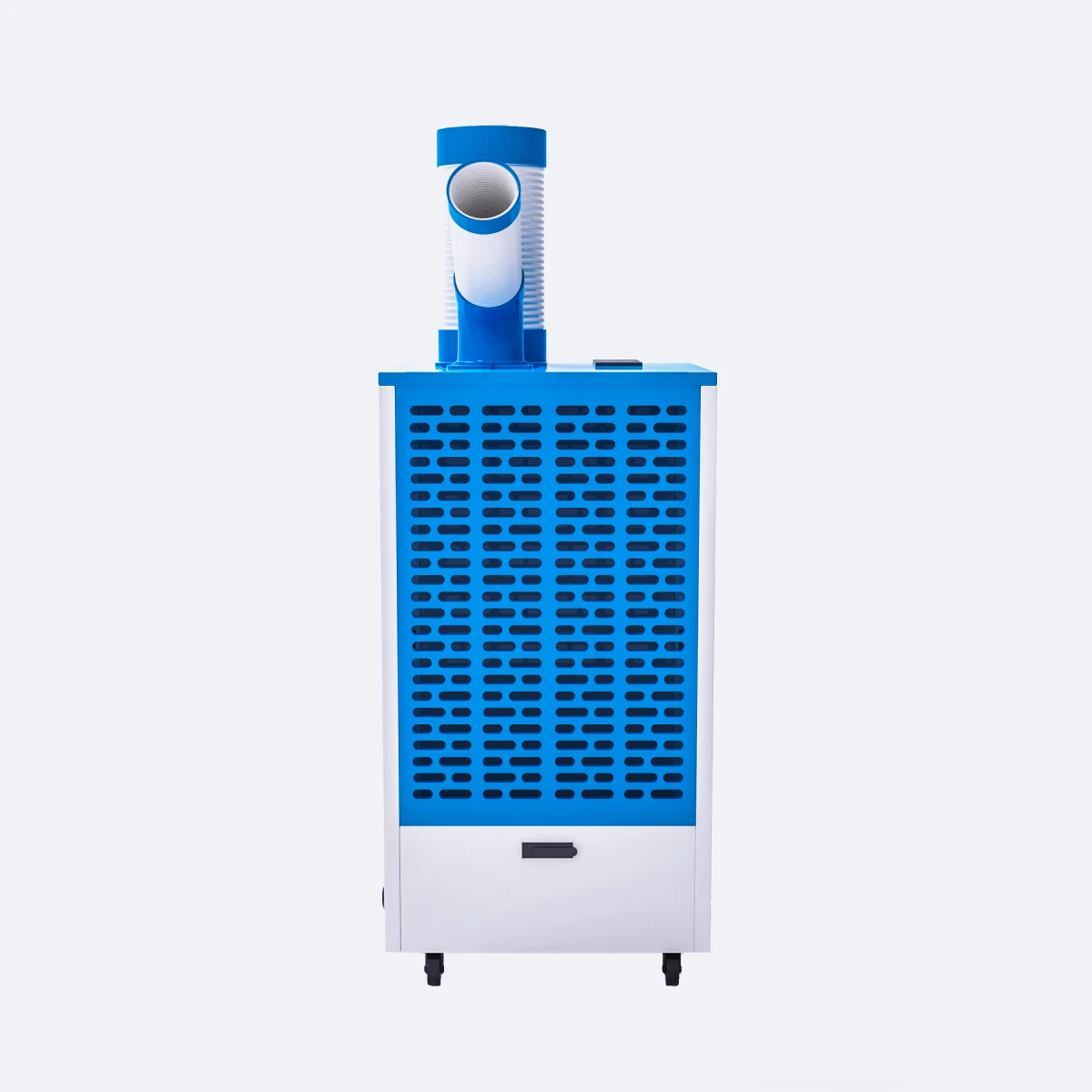
The SSPAC series provides compressor-based spot cooling in five capacity levels. Every model includes a directional cold air outlet (120 mm), a hot air exhaust duct (180–220 mm), a 24-hour cycle timer, a touch screen with automatic temperature control, high/low fan speed, and heavy-duty casters for movement across factory floors. All models run on 220V/50Hz single-phase power (refrigerant R32 or R290), with a 10 L or 20 L internal condensate tank and auto-shutoff, plus an external drain hose connection.

Option 1 — SSPAC Portable Spot Cooler for Factory Floors

For factories needing fast, localized cooling at specific workstations without ducting a whole building, our SSPAC spot coolers deliver targeted relief in minutes:

Moveable without complex installation, with built-in air filtration that removes dust, pollen, and bacteria for cleaner shop-floor air. Lower upfront and maintenance cost than central AC.

SSPAC-27

SSPAC-27
Air Circulation (m³/h):500

Applicable Area:10m²

Power:220V / 50Hz

view details

SSPAC-40

SSPAC-40
Air Circulation (m³/h):1200

Applicable Area:20m²

Power:220V / 50Hz

view details

SSPAC-50

SSPAC-50
Air Circulation (m³/h):1500

Applicable Area:30m²

Power:220V / 50Hz

view details

Matching Portable AC Models to Factory and Workshop Scenarios

The right SSPAC model depends on the heat challenge at each station and how the unit is deployed. The matrix below maps common factory and workshop scenarios — from CNC operators and injection molding to welding bays and adhesive bonding — to the recommended model and key deployment notes.


Factory / Workshop ScenarioHeat ChallengeRecommended ModelDeployment Notes
CNC machine operator station3–5 kW radiant + convective from spindle motorSSPAC-35 or SSPAC-40Aim cold outlet at operator, not at machine
Injection molding operator5–15 kW radiant from platen; ambient 35–40°CSSPAC-45 or SSPAC-50Position between mold and operator; highest-capacity model
Welding bay (MIG/TIG)Arc radiant heat + PPE trapping body heatSSPAC-40 or SSPAC-45Cold air to operator torso; exhaust away from welding area
Assembly line workstationModerate heat; sustained standing/manual workSSPAC-27 or SSPAC-35One unit per 2–3 stations; lower capacity sufficient
Quality control / inspection tableWorker comfort + product temp-sensitivitySSPAC-27 to SSPAC-35Directed at both inspector and workpiece
Adhesive bonding / paint applicationProcess requires 22–25°C local ambientSSPAC-35 to SSPAC-45Cold air over process area; monitor with thermometer
Small workshop (<100 m²)Single dominant heat source (oven, laser, welder)SSPAC-40 to SSPAC-50Can partially condition the whole space if semi-enclosed
Electronic assembly / solderingLow heat load; needs stable temp + low humiditySSPAC-27Smallest model sufficient; also provides dehumidification
Temporary production setup / seasonal lineVariable location, variable heat loadSSPAC-35 to SSPAC-50Roll into position; no installation; move with production


How to Size a Portable AC for Factory Use

Sizing depends on the goal. For worker comfort (most applications), you are cooling a person, not a room — the key variables are the number of workstations and the distance from unit to worker. For process temperature control, estimate the heat load entering the zone and pick a unit whose capacity exceeds it; a semi-enclosed zone holds temperature more precisely. The five SSPAC tiers below cover both modes.
01

SSPAC-27 (2,700 W)

~9,200 BTU/h · 500 m³/h · ~10 m²

1–2 workers; assembly, QC, electronic soldering

02

SSPAC-35 (3,500 W)

~11,900 BTU/h · 800 m³/h · ~15 m²

CNC operator, assembly line, light spot cooling

03

SSPAC-40 / SSPAC-45 (4,000–4,500 W)

~13,600–15,400 BTU/h · 1,200 m³/h · ~20–25 m²

Welding bay, adhesive/paint, group of 3–5 workers

04

SSPAC-50 (5,000 W)

~17,100 BTU/h · 1,500 m³/h · ~30 m²

Injection molding, forging, high radiant-heat stations

Key considerations for factory spot cooling:

Four principles get the most out of factory spot cooling: aim at the worker, choose the right sizing mode, plan one unit per zone, and scale deployment with the season.
Cool the worker, not the machine — aim the cold outlet at the operator's upper body; blowing cold air at a hot machine just wastes capacity.
Two sizing modes: worker comfort (cool a person, sized by workstation count and distance) vs process control (cool a zone, sized by the local heat load).
A practical rule: one SSPAC unit per workstation or process zone, or roughly one unit per 10–20 m² of active work area on a line.
Portable units scale with demand — deploy several at summer peak, drop to one in shoulder season, store in winter; no idle infrastructure or fixed downtime cost.

Need a Sizing Calculation for Your Greenhouse?

Send us your greenhouse dimensions, cultivation stage, target humidity, and operating temperature. Our engineering team will recommend the right SHISHUO model and capacity.

Request Sizing Download Catalog amy@shishuodehu.com

Deployment and Operation Notes for Factory Environments

Positioning Relative to Heat Sources

Place the unit between the heat source and the operator, cold outlet aimed at the worker — not the machine, which would just absorb the cooling. The goal is a cooled air envelope around the operator while the machine keeps rejecting heat to the factory ambient. For a stationary worker (press, grinding station), position the cold outlet 1–2 m away at upper-body height.

Heat Exhaust Routing

Factories have more exhaust options than offices — roll-up doors, louvers, wall fans, roof ventilators, open bays. Route the hot exhaust duct toward the nearest exit, or into the airflow path of existing extraction so it is carried out. If no direct exterior path exists, point the exhaust toward an uninhabited area away from the operator and the cold stream; the building's general ventilation will carry the heat out through roof ventilators.

Welding Area Considerations

In welding bays, aim the cold air at the welder's torso and back, never at the arc or puddle — cross-draft disrupts MIG/TIG shielding gas and causes porosity defects. Position the unit behind or beside the welder so cooled air reaches the person without disturbing the gas shield, and keep the unit and cord out of the spatter fall zone. With a fume extraction hood, deliver cold air at lower-body level while the hood draws fumes upward.

Unit Protection & Noise

Factory floors expose equipment to metal chips, grinding dust, welding spatter, oil mist, and forklift traffic — shield the unit from direct contact and keep it out of forklift paths. Clean the intake filter every 1–2 weeks in dusty/oily shops (vs 30–60 days in clean areas) and degrease the condenser coil monthly where oil mist is present. In quieter shops (electronics, metrology), use the low fan speed; the SSPAC-27/35 are the quietest models.

Frequently Asked Questions

Can a portable AC cool a factory floor?

Not the entire floor, no. A portable air conditioner is a spot cooler — it delivers targeted cooling to a specific workstation or process zone, typically within 3–5 meters of the cold air outlet. For an entire factory floor, you would need central HVAC or evaporative cooling infrastructure. The advantage of a portable unit is that it provides immediate, effective cooling exactly where workers or processes need it, at a fraction of the cost of conditioning the whole building.

How do I cool a worker next to a hot machine?

Position the portable AC between the machine and the worker, with the cold air outlet aimed at the worker's upper body. The cooled air creates a convective cooling effect on exposed skin that counteracts the radiant heat from the machine. Do not aim the cold air at the machine itself — the machine absorbs heat faster than the unit can remove it. For high radiant heat loads (injection molding, forging, heat treatment), use the SSPAC-45 or SSPAC-50 to deliver higher airflow and greater cooling capacity.

Is it safe to use a portable AC near welding operations?

Yes, with proper positioning. Aim the cold air at the welder's body, not at the welding arc. Airflow across the weld zone can disrupt the shielding gas envelope (MIG and TIG processes), leading to porosity defects in the weld. Position the unit behind or beside the welder. Keep the power cord and unit body outside the spatter fall zone.

How often should I clean the filter in a factory environment?

Every 1–2 weeks in dusty or oily environments (metalworking, woodworking, grinding, die-casting). In cleaner assembly or electronics workshops, every 30–60 days is sufficient. A clogged filter reduces airflow and cooling performance. If the factory has airborne oil mist, also inspect and clean the condenser coil monthly with a degreasing solution.

Can a portable AC help with process temperature control?

Yes, within its capacity range. If the process zone is semi-enclosed (booth, partition, curtain wall), the SSPAC can maintain a local temperature several degrees below the surrounding factory ambient. For example, an adhesive bonding station enclosed by curtain walls can be held at 22–25°C while the factory runs at 32°C. For fully open process areas, expect a 5–10°C reduction at the point of delivery, not a controlled set-point.

I rent my workshop — can I install this without modifying the building?

Yes. SHISHUO SSPAC units are fully portable and require no building modification. They plug into a standard 220V outlet and roll on casters. The hot exhaust can be routed through an existing window, door, or ventilation opening. When you relocate, the unit moves with you.

How does factory spot cooling compare in cost to central HVAC?

An SSPAC-40 draws 1,800 W and costs approximately $1.80 per 10-hour shift at $0.10/kWh. Deploying five units across a factory floor totals roughly $9 per day. Central HVAC for the same factory might require 50–150 kW of cooling capacity with proportional installation and energy costs. Spot cooling is typically 80–90% less expensive than whole-building conditioning for the same worker comfort outcome.

Do SHISHUO units support OEM and ODM?

Yes. We manufacture all units at our Jiaxing production base and support OEM branding and ODM modifications — voltage adaptation, custom duct configurations, color changes, and control interface adjustments. Contact our team with your specifications and volume.

Get the Right Climate Control
Solution for Your Application

We support industrial temperature and humidity control projects with clear specifications, stable equipment, and practical system advice. Share your application details and capacity requirements—our team will respond with a suitable solution and quotation.

Get a Quick Quote

Amy

General Manager