Search

Enter keywords to search for products, blog posts, and more.

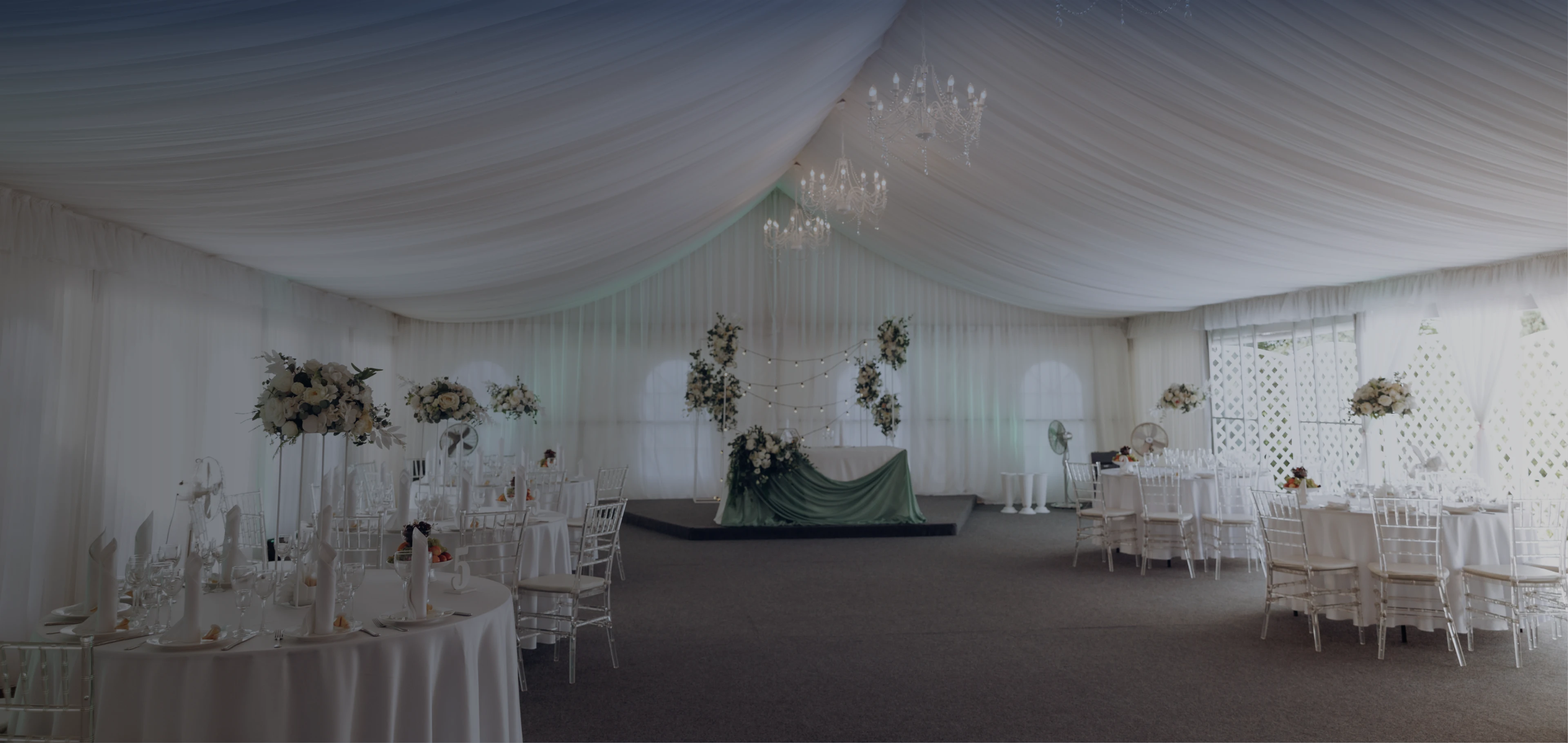
Portable Air Conditioner for Tents and Events — Cooling for Wedding Marquees, Corporate Canopies, and Outdoor Gatherings

Portable Air Conditioner for Tents and Events — Cooling for Wedding Marquees, Corporate Canopies, and Outdoor Gatherings


Why Tents Get Hot — and What It Takes to Cool Them

A tent behaves nothing like a building thermally. It has almost zero thermal mass, so the interior heats up within minutes when the sun comes out and cools just as fast when the system shuts off — which means the AC must run continuously through the event and the tent must be pre-cooled 30–60 minutes before guests arrive. Power supply is often the limiting factor, since AC is usually the largest electrical load at an outdoor venue. Three heat characteristics shape the cooling approach:

Solar gain through fabric is the dominant heat source

A solid building blocks most solar radiation with insulated walls and roof; a tent does neither. The fabric canopy absorbs solar energy and re-radiates it as heat into the interior. White or light tops reduce absorption versus dark fabric, but even a white tent transmits substantial heat, and a clear-top tent creates a greenhouse effect during afternoon setup. The cooling system must overcome this continuous solar load for the entire event.

People are the second-largest heat source

A seated adult at rest generates ~100 W; standing, dancing, or moving guests produce 150–250 W each. At a 150-person reception with active dancing, the crowd alone contributes 20–30 kW — like running ten-plus space heaters in a fabric enclosure. This people-density load is what distinguishes tent cooling from warehouse or factory cooling, where machinery dominates and occupancy is low.

Enclosed sidewalls are required for air conditioning to work

An open-sided canopy cannot be effectively air-conditioned: cold air is denser, sinks to the floor, flows out under open walls, and is replaced by hot air drawn in from the top. For a portable AC to hold a meaningful temperature reduction, the tent needs solid or windowed sidewalls on at least three sides forming a semi-enclosed volume. The entrance can stay open for guest passage, but the rest of the perimeter should be walled. Without walls, fans or misting are the only practical options — AC needs a contained volume.

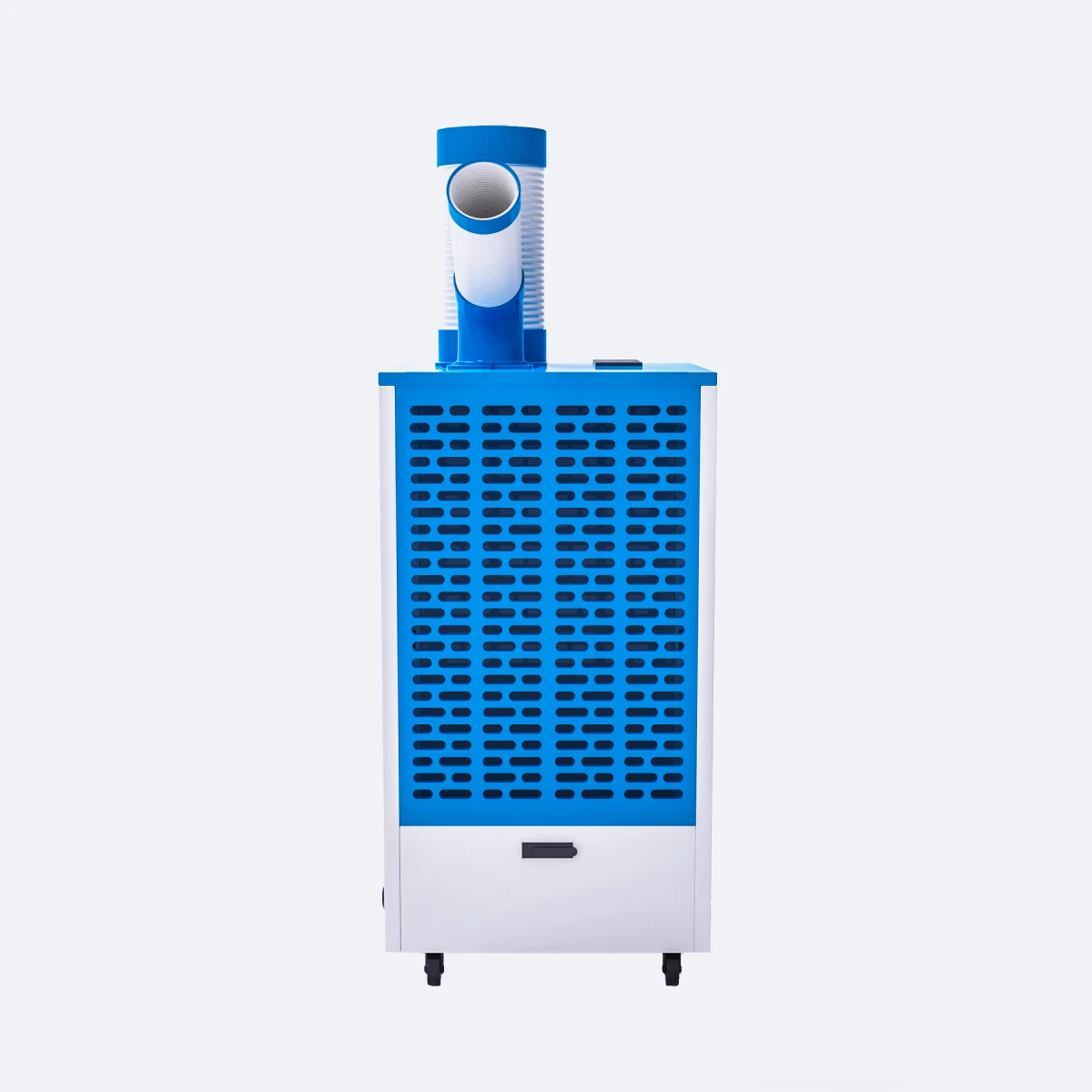
SHISHUO Portable Air Conditioners for Tent and Event Use

The SSPAC series provides compressor-based cooling in five capacity levels: SSPAC-27 (2,700 W, ~8–15 m² walled), SSPAC-35 (3,500 W, ~12–20 m²), SSPAC-40 (4,000 W, ~15–25 m²), SSPAC-45 (4,500 W, ~17–28 m²), and SSPAC-50 (5,000 W, ~20–33 m²). Each has a directional cold air outlet (120 mm), a hot air exhaust duct (180–220 mm), a 24-hour timer, touch-screen automatic temperature control, high/low fan speed, and heavy-duty casters. Area estimates assume a walled tent with 2.5–3 m ceilings at 30–35°C; in hotter conditions, higher guest density, or clear-top tents, reduce the area by 30–40% or add units.

Option 1 — SSPAC Portable Spot Cooler for Event Tents

For temporary event tents and outdoor structures needing on-demand spot cooling without ductwork:

Fully moveable with no fixed installation required, built-in air filtration, energy-efficient localized cooling ideal for temporary structures.

SSPAC-27

SSPAC-27
Air Circulation (m³/h):500
Applicable Area:10m²

Cooling Capacity:2700W
Power:220V / 50Hz

view details

SSPAC-40

SSPAC-40
Air Circulation (m³/h):1200
Applicable Area:20m²

Cooling Capacity:3500W
Power:220V / 50Hz

view details

SSPAC-50

SSPAC-50
Air Circulation (m³/h):1500
Applicable Area:30m²

Cooling Capacity:4000W  
Power:220V / 50Hz

view details

Matching SSPAC Models to Event Types

The right configuration depends on the event, the tent size, and the heat factors involved. The matrix below maps common event types — from an intimate ceremony to an outdoor banquet — to a typical tent size, the key heat factors, and a suggested SSPAC configuration.


Event TypeTypical Tent SizeKey Heat FactorsSuggested Config
Intimate ceremony or VIP lounge15–25 m²Low guest count; comfort critical1 × SSPAC-45 or SSPAC-50
Wedding reception (50–80 guests)50–70 m²Dancing, catering, lighting3–4 × SSPAC-50
Corporate conference / seminar30–60 m²Seated audience; AV equipment2–4 × SSPAC-45 or SSPAC-50
Product launch or trade show booth15–30 m²Lighting rigs; electronics; foot traffic1–2 × SSPAC-40 to SSPAC-50
Festival food vendor tent10–20 m²Cooking equipment adds major heat1–2 × SSPAC-50
Medical / emergency field shelter20–40 m²Patient comfort; equipment temp limits2–3 × SSPAC-45 or SSPAC-50
Outdoor dining / banquet40–80 m²Chafing dishes, guests, afternoon sun3–5 × SSPAC-50
Temporary construction site office15–30 m²Semi-enclosed; moderate heat load1–2 × SSPAC-35 to SSPAC-45


How to Size Portable AC for Your Tent or Event

Tent cooling follows a different rule than building cooling: the industry guideline is roughly 1 ton (12,000 BTU/h) per 10–15 m² (100–150 sq ft) of walled tent — about 3–4× the density an insulated building needs, because the fabric shell transmits solar heat directly. The four tent sizes below show typical configurations; adjust upward for afternoon sun, dark or clear tops, dense seating, and hot catering.
01

3 × 6 m (18 m²)

~12,000–18,000 BTU/h

1 × SSPAC-50, or 1 × SSPAC-40 + 1 × SSPAC-27

02

6 × 9 m (54 m²)

~36,000–56,000 BTU/h

3–4 × SSPAC-50

03

6 × 12 m (72 m²)

~48,000–72,000 BTU/h

4–5 × SSPAC-50

04

9 × 15 m (135 m²)

~90,000–135,000 BTU/h

6–8 × SSPAC-50 (above ~100 m², trailer-mounted AC may be more practical)

Key considerations for tent and event cooling:

Four factors decide whether a tent stays comfortable: enclosed sidewalls, pre-cooling, a realistic power budget, and knowing the scale at which portable units give way to trailer-mounted systems.
Sidewalls on at least three sides are mandatory — an open-sided canopy lets cold air escape at floor level and cannot be air-conditioned.
Pre-cool 30–60 minutes before guests arrive — a tent has almost zero thermal mass, so it heats and cools within minutes and cannot coast.
Plan the power budget early — AC is usually the largest electrical load; a 15 kW generator supports about four SSPAC-50 units plus lighting and catering.
Above ~100 m², the unit count gets high — a rental trailer-mounted AC (5–25 ton) may be more practical; SSPAC suits tents up to ~80–100 m² or zone cooling.

Need a Sizing Calculation for Your Greenhouse?

Send us your greenhouse dimensions, cultivation stage, target humidity, and operating temperature. Our engineering team will recommend the right SHISHUO model and capacity.

Request Sizing Download Catalog amy@shishuodehu.com

Deployment and Operation Notes for Tent and Event Use

Tent Preparation: Walls & Sealing

Before deploying AC, fit solid sidewalls on at least three sides — open canopies cannot be air-conditioned. Stake or weight the walls to the ground to close floor-level gaps where cold air escapes; keep the door panel closed or use a split curtain that allows passage while reducing air exchange. The more enclosed the tent, the less capacity you need and the lower the temperature you can hold.

Unit Placement, Cold Air & Exhaust

Place units around the perimeter, evenly spaced, cold outlets aimed inward toward the guest area — away from the head table, podium, or stage. The 120 mm outlet is effective at 3–5 m, so space units every 5–7 m for overlapping coverage. The hot exhaust must exit the tent: route it through a slit or port in the sidewall, or place the unit just outside and duct only cold air in. Never discharge exhaust inside the tent.

Pre-Cooling & Power Planning

Start cooling 30–60 minutes before guests arrive to displace the superheated air a sun-baked tent holds (zero thermal mass means it won't coast). Calculate total electrical load first — each SSPAC-50 draws 2,300 W, so four units need ~9.2 kW plus lighting/sound/catering. If venue power is limited, rent a generator (a 15 kW unit supports four SSPAC-50 with headroom); use ≥2.5 mm² cable and cover runs to prevent trip hazards.

Noise & Condensate Management

For quiet moments (speeches, ceremonies) use low fan speed, or place units outside the tent and duct only cold air in to remove compressor noise entirely; the SSPAC-27/35 are quietest, and a generator should sit far from the tent behind a sound barrier. Each unit produces significant condensate in humid air — run the drain hose to a container or a gravel/landscaped area outside, away from walkways and the dance floor, and check it mid-event.

Frequently Asked Questions

Can you air-condition an open-sided tent?

Not effectively. Air conditioning requires a semi-enclosed volume to work. Cold air sinks and flows out under open walls, while hot air is drawn in from above. For a tent air conditioner to maintain a noticeable temperature reduction, the tent needs solid or windowed sidewalls on at least three sides. Open-sided canopies are better served by misting fans or high-velocity air circulators.

How many portable AC units do I need for a wedding tent?

It depends on tent size, guest count, and weather conditions. The industry guideline is approximately 1 ton (12,000 BTU/h) per 10–15 m² (100–150 sq ft) of walled tent area. A 54 m² (580 sq ft) wedding tent for 60–80 guests would need approximately 36,000–56,000 BTU/h — roughly 3–4 SHISHUO SSPAC-50 units. Add more if the reception includes a dance floor, hot catering, or takes place during peak afternoon sun.

Will the AC units be noisy during speeches?

Compressor and fan noise is noticeable in a quiet tent. Two strategies: use the low fan speed setting during speeches and ceremonies, which reduces airflow noise at the cost of some cooling; or position the units outside the tent and duct only the cold air inside through a wall panel, which removes compressor noise from the guest space entirely. The SSPAC-27 and SSPAC-35 have the smallest compressors and produce the least noise.

Can the units run on a generator?

Yes. All SSPAC models operate on 220V/50Hz single-phase power. A portable generator with adequate capacity and clean power output (inverter-type generators produce the most stable voltage) can power the units at venues without electrical infrastructure. A 15 kW generator can support four SSPAC-50 units plus typical event lighting and sound loads.

How far in advance should I start cooling the tent?

30–60 minutes before guests arrive. A tent that has been absorbing solar heat all day contains a large volume of hot air that takes time to displace. Starting early ensures the interior reaches a comfortable temperature before anyone walks in. For afternoon events in hot weather, allow the full 60 minutes. For evening events where the tent was sealed and cooling since late afternoon, 30 minutes is typically sufficient.

Where does the hot exhaust go?

Out of the tent. Route the exhaust duct through a slit, flap, or pre-installed port in the tent sidewall. The hot air discharges outside the tent structure. If the unit is placed outside the tent, the exhaust problem is eliminated entirely — only the cold air duct enters the tent. Never discharge exhaust inside the tent; this adds heat and produces no net cooling.

Can a portable AC protect the wedding cake and flowers?

Yes. Maintaining interior temperature below 25–27°C prevents buttercream and fondant from softening, keeps chocolate decorations firm, and extends the life of cut flowers. Position a unit near the cake and floral display area for direct cooling. If the tent has distinct zones (ceremony area, dining area, cake/bar area), deploy a dedicated unit at each zone rather than relying on a single unit to cool the entire space.

Do SHISHUO units support OEM and ODM?

Yes. We support OEM branding and ODM modifications including voltage adaptation (110V/60Hz for North America), custom colors to match event or rental fleet branding, and duct configuration changes. Contact our team with requirements and volume.

Get the Right Climate Control
Solution for Your Application

We support industrial temperature and humidity control projects with clear specifications, stable equipment, and practical system advice. Share your application details and capacity requirements—our team will respond with a suitable solution and quotation.

Get a Quick Quote

Amy

General Manager