Search

Enter keywords to search for products, blog posts, and more.

Warehouse Dehumidifier — Moisture Control for Commercial and Industrial Storage Facilities

Warehouse Dehumidifier — Moisture Control for Commercial and Industrial Storage Facilities


Why Humidity Control Matters in Warehouses

Warehouses differ from climate-controlled office or retail spaces in ways that make humidity harder to manage. Beyond the three moisture mechanisms below, stored goods set the target: electronics and circuit boards corrode above 60% RH, pharmaceuticals require 30–60% RH, paper and cardboard lose strength above 50% RH, metal parts rust above 55% RH, and textiles and leather develop mold above 65% RH. A warehouse dehumidifier sized for the most sensitive category protects the entire inventory.

Large volume, minimal insulation

Most warehouses have high ceilings (8–15 m), metal roofing, and thin wall insulation, so interior air temperature tracks outdoor conditions closely. When warm humid outside air meets cooler interior surfaces — steel racking, concrete floors, stored metal goods — the air reaches its dew point and condensation forms directly on those surfaces. This is the primary mechanism behind floor sweating and surface corrosion.

Loading dock operations introduce outside air constantly

Every time a dock door opens for loading or unloading, a large volume of unconditioned outside air enters the facility. In humid climates or summer months, a single bay door opening can introduce substantial moisture that passive ventilation cannot remove. High-traffic facilities — distribution centers, e-commerce fulfillment warehouses — face this continuously throughout the operating day.

Concrete slab moisture emission is ongoing

Warehouse concrete floors release moisture vapor from the ground below for years after construction, particularly on high water tables or in heavy-rainfall regions. The moisture migrates upward through the slab, raising the humidity of the air immediately above the floor — exactly where palletized goods sit. Floor sealing helps but does not eliminate the problem.

SHISHUO Dehumidifiers for Warehouse Applications

SHISHUO offers three coordinated dehumidification platforms for warehouse and distribution center installations — the GDH floor-standing series for general large warehouses, the GDH-CE ceiling-mounted ducted series where full-floor racking or forklift traffic makes floor placement impractical, and the XR large industrial desiccant series for cold storage warehouses where refrigerant units lose efficiency below 5°C. Selection depends on facility size, ceiling height, layout, and operating temperature.

Option 1 — GDH Floor-Standing for Large Warehouses

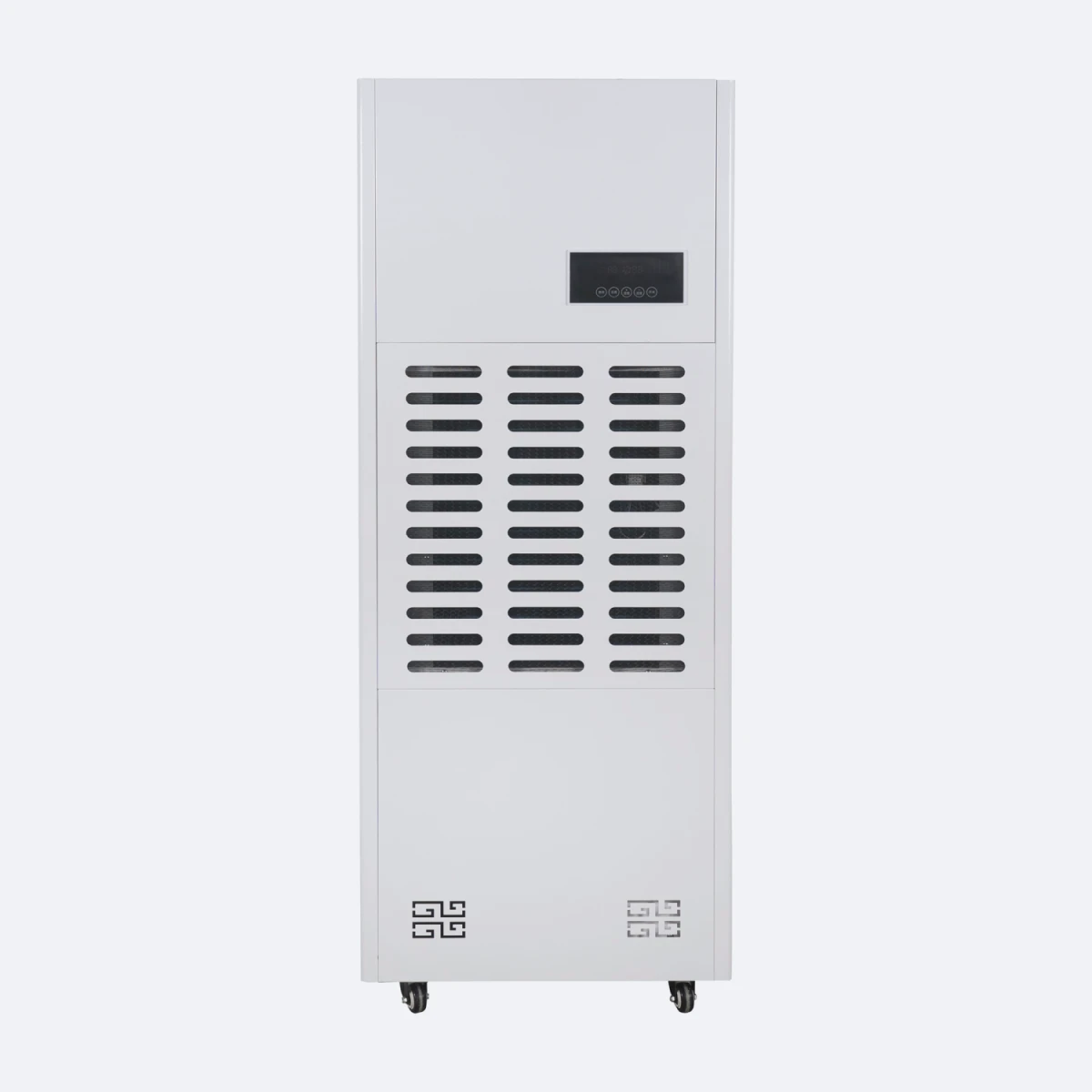
Applicable to warehouses, workshops, archives, storage rooms, basements, vaults, switchgear rooms and garages, our floor-standing series covers 180-1440 L/day:

All units ship with copper condenser and evaporator, thickened moisture-proof sheet metal cabinet, automatic defrosting, continuous hose drainage, and LCD touchscreen control. Working temperature 5-38C, refrigerant R32/R290.

GDH-180E

GDH-180E
Capacity (L/day):180
Coverage Area:180–240 m²
Power:220V/380V

view details

GDH-240E

GDH-240E
Capacity (L/day):240
Coverage Area:200–300 m²
Power:220V/380V

view details

GDH-288E

GDH-288E
Capacity (L/day):288
Coverage Area:260–350 m²
Power:380V/50Hz

view details

Option 2 — GDH-CE Ceiling-Mounted for Warehouse Storage

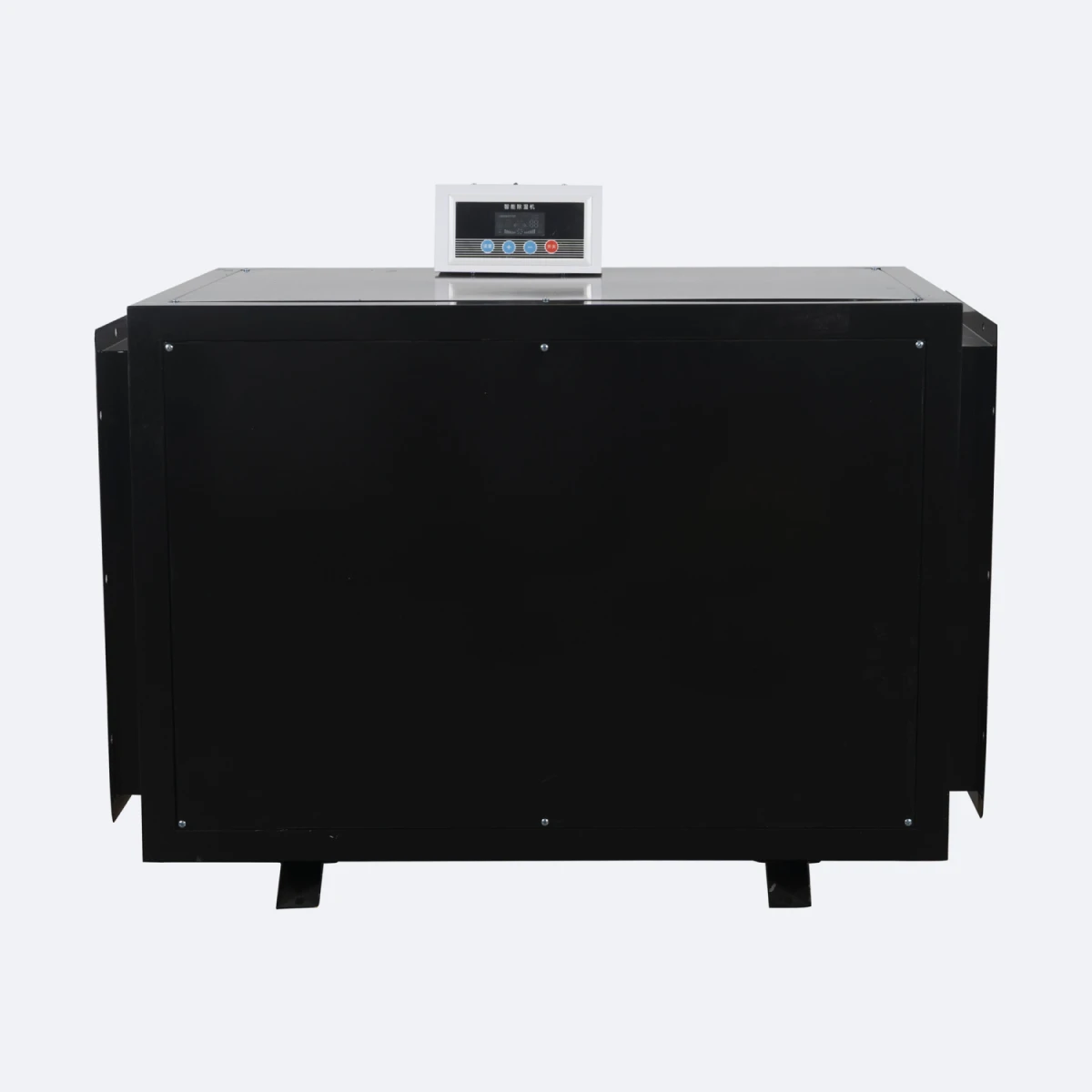
For warehouses where floor space is at a premium, our ceiling-mounted GDH-CE series delivers the same moisture control overhead:

Concealed ceiling installation with all-copper heat exchanger for corrosion resistance and long service life, intelligent humidity sensing, timer function, and fault alarm protection, saves floor space in racking areas.

GDH-CE180

GDH-CE180
Capacity (L/day):180
Coverage Area:180–240 m²
Power:220V/380V

view details

GDH-CE240

GDH-CE240
Capacity (L/day):240
Coverage Area:200–300 m²
Power:220V/380V

view details

GDH-CE288

GDH-CE288
Capacity (L/day):288
Coverage Area:260–350 m²
Power:380V/50Hz

view details

Option 3 — XR Large Industrial Desiccant Dehumidifier for Cold Storage Warehouses

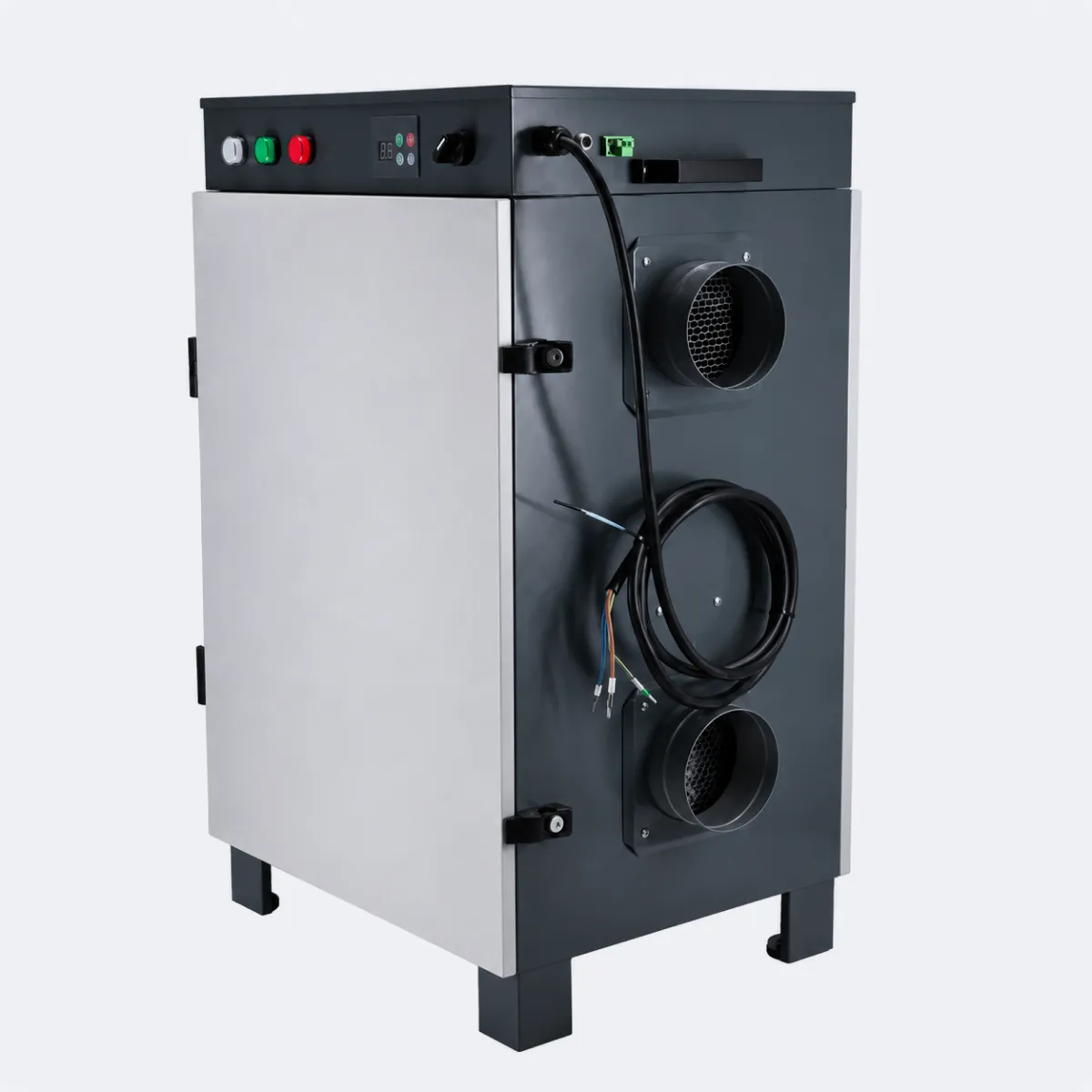
For cold storage warehouses, refrigerated distribution centers, and unheated warehouses in cold climates where refrigerant dehumidifiers struggle below 15°C:

Four 380V three-phase rotor units from 10 to 20 kg/h, process airflow up to 3,000 m³/h — enough dry-air delivery to hold low, stable humidity across an entire cold-storage or refrigerated distribution facility where a compressor unit stops working.

XR-1500XF-01

XR-1500XF-01
Capacity (Kg/h):10
Regeneration Airflow:550 m³/h
Power:380V/50Hz

view details

XR-2000XF-01

XR-2000XF-01
Capacity (Kg/h):13
Regeneration Airflow:780 m³/h
Power:380V/50Hz

view details

XR-2500XF-01

XR-2500XF-01
Capacity (Kg/h):15
Regeneration Airflow:900 m³/h
Power:380V/50Hz

view details

How to Choose the Right Dehumidifier for Your Warehouse

The correct warehouse dehumidifier depends on four variables: facility size, operating temperature, stored goods sensitivity, and installation constraints. The matrix below maps common warehouse scenarios to the SHISHUO series most frequently specified for each.


Warehouse ScenarioOperating TempRecommended SeriesWhy
Small storage room, archive, vault5–38°CGDH commercial220V plug-and-play, wheeled, 50–156 L/day capacity
Medium warehouse, general goods5–38°CGDH industrial floor-standingHigh capacity (180–480 L/day), 380V continuous operation
Large distribution center5–38°CGDH industrial floor-standing480–1,440 L/day, multiple units for zone coverage
Warehouse with full-floor racking5–38°CGDH-CE ceiling-mountedOverhead install avoids floor conflicts and forklift damage
Cold storage / refrigerated warehouseBelow 5°CXR-1500XF-01 to XR-2500XF-01 large desiccantCompressor units lose efficiency below 5°C; desiccant unaffected
Pharmaceutical / electronics warehouse15–25°CGDH-CE or GDH industrialPrecise humidity targets; continuous drainage; 24-hour operation
Unheated warehouse, winter climateBelow 10°CXR-1500XF-01 to XR-2500XF-01Maintains extraction at low ambient temperature


Warehouse Dehumidifier Sizing — How Much Capacity Do You Need?

Warehouse sizing depends on the volume of air (floor area × ceiling height), the target RH, the ambient climate, and operational factors like dock door frequency and envelope quality. Floor area alone is insufficient — a 500 m² warehouse with 12 m ceilings holds four times the air volume of the same area with 3 m ceilings. The figures below are starting points at the 30°C, 80% RH catalog test condition.
01

40–80 m² (3–5 m ceiling)

50–90 L/day starting capacity

GDH-50E to GDH-90E

02

80–160 m² (3–5 m ceiling)

90–168 L/day starting capacity

GDH-90E to GDH-168E or GDH-CE90 to GDH-CE168

03

160–350 m² (5–10 m ceiling)

180–380 L/day starting capacity

GDH-180E to GDH-380E or GDH-CE180 to GDH-CE288

04

350–700 m² (8–12 m ceiling)

380–720 L/day starting capacity

GDH-380E to GDH-720E (may need multiple units)

Factors that require sizing larger than the baseline estimate:

For a precise model recommendation, share your warehouse dimensions (length, width, ceiling height), number of dock doors, goods category, target RH, climate zone, and building age. Our engineering team will return a sizing calculation with the matching SHISHUO model or multi-unit layout.
Frequent loading dock door openings — each event introduces a large volume of unconditioned outside air.
Tropical or subtropical climates where outdoor RH regularly exceeds 80%.
Poor envelope sealing — gaps around doors, windows, and roof joints raise the infiltration load.
Concrete slabs less than two years old that are still releasing construction moisture; or storage of moisture-sensitive goods requiring RH below 50%.

Need a Sizing Calculation for Your Greenhouse?

Send us your greenhouse dimensions, cultivation stage, target humidity, and operating temperature. Our engineering team will recommend the right SHISHUO model and capacity.

Request Sizing Download Catalog amy@shishuodehu.com

Installation and Operation Notes for Warehouse Use

Placement

Position the intake near the highest moisture concentration — close to loading docks, near the concrete slab in older buildings, or in poorly circulated corners. Direct the discharge toward the center of the storage zone to maximize air mixing. In large warehouses, deploy multiple units in a distributed layout rather than concentrating capacity in one location. Ceiling-mounted GDH-CE units duct dry air to areas floor units cannot cover uniformly.

Drainage

All SHISHUO industrial and commercial models support continuous drainage through a hose connection. Route the drain line to a floor drain, collection sump, or exterior discharge. The condensate is clean water and disposes through standard drainage. Maintain a downward slope and never let the hose dip below the discharge level — this prevents airlocks that stop drainage flow.

Power and Defrost Behavior

GDH-50E through GDH-156E and GDH-CE38 through GDH-CE168 use 220V single-phase; GDH-288E and above and GDH-CE180 and above require 380V three-phase (GDH-180E/240E accept both). XR-750XF-01 and above also require 380V. Compressor models include automatic defrosting and work down to 5°C; below 5°C they defrost more often and lose capacity — switch to the XR desiccant series for cold facilities.

Multi-Unit Deployment

Warehouses above 500 m² often benefit from two or more units in a zone-based configuration rather than a single high-capacity unit. Zone deployment shortens the distance dry air must travel, provides redundancy if one unit is offline for maintenance, and allows different humidity targets for different storage areas within the same facility.

Frequently Asked Questions

What is the ideal humidity level for a warehouse?

The ideal range depends on what is stored. For general goods storage, ASHRAE guidelines suggest 30–60% RH. Electronics and circuit boards typically require below 60% RH. Pharmaceuticals often require 30–60% RH per Good Storage Practice (GSP) guidelines. Paper and packaging should stay below 50% RH to prevent moisture absorption. Metal parts and machinery benefit from below 55% RH to prevent corrosion. Museums and archival storage may require a narrow 40–45% RH. Size your warehouse dehumidifier for the most sensitive category of goods in your facility.

How do I calculate the dehumidifier size I need for my warehouse?

Start with the volume of air in your facility (floor area × ceiling height). Factor in local climate, especially peak summer humidity. Add loading dock traffic frequency — a warehouse with 10 dock doors opening 50 times per day introduces far more outside moisture than a sealed storage vault. Account for building envelope quality: newer, well-sealed buildings require less capacity than older facilities with gaps. For a specific recommendation, send us your warehouse dimensions and operating details and our engineering team will provide a sizing calculation.

What is the difference between a commercial and industrial warehouse dehumidifier?

Commercial dehumidifiers (SHISHUO GDH-50E through GDH-168E) are commercial, wheeled units for spaces up to ~220 m². They run on 220V single-phase power and offer 50–168 L/day. Industrial dehumidifiers (GDH-180E through GDH-1440E) are larger floor-standing cabinets for facilities from 180 m² to 1,600 m². They operate on 380V three-phase power and provide 180–1,440 L/day. The choice depends on your facility size and electrical infrastructure.

Can a dehumidifier work in a cold warehouse or refrigerated storage?

Standard compressor dehumidifiers operate effectively above 5°C. Below that, the evaporator coil approaches freezing and the unit spends increasing time in defrost mode, reducing net extraction. For cold storage warehouses, refrigerated distribution centers, or unheated facilities during winter, a desiccant dehumidifier is the correct choice. SHISHUO XR desiccant units use adsorption rather than condensation, so performance is not reduced by low temperature.

Should I use a floor-standing or ceiling-mounted warehouse dehumidifier?

Floor-standing units are simpler to install and can be repositioned; choose them when floor space is available and the layout allows adequate air circulation. Ceiling-mounted ducted units (GDH-CE series) are better when floor space is fully occupied by racking or pallets, when forklift traffic could damage a floor unit, or when ductwork is needed to distribute dry air across a large storage zone. Both types deliver the same dehumidification performance per unit of capacity.

How often does a warehouse dehumidifier need maintenance?

Routine maintenance is straightforward. Clean or replace the air filter every 30–60 days depending on dust levels. Inspect the drain hose monthly to confirm it is not kinked or clogged. Check the condenser and evaporator coils quarterly for dust accumulation and clean with compressed air or a soft brush if needed. SHISHUO units include fault self-protection that alerts operators to abnormal conditions, reducing the risk of undetected problems.

Can I run the dehumidifier 24 hours a day in my warehouse?

Yes. All SHISHUO commercial and industrial dehumidifiers are designed for continuous operation. The units feature automatic humidity control — they cycle on when RH rises above your set-point and cycle off when the target is reached. Continuous drain hose connection eliminates the need to empty a water tank manually, enabling unattended 24-hour operation.

Do SHISHUO warehouse dehumidifiers support OEM and ODM customization?

Yes. We support both OEM (your branding on our standard models) and ODM (custom specifications, voltage, control interface, or housing design). Share your requirements and quantity with our team to discuss customization options and lead time.

Get the Right Climate Control
Solution for Your Application

We support industrial temperature and humidity control projects with clear specifications, stable equipment, and practical system advice. Share your application details and capacity requirements—our team will respond with a suitable solution and quotation.

Get a Quick Quote

Amy

General Manager