Search

Enter keywords to search for products, blog posts, and more.

Indoor Pool Dehumidifier — Humidity Control for Natatoriums, Spa Rooms, and Aquatic Centers

Indoor Pool Dehumidifier — Humidity Control for Natatoriums, Spa Rooms, and Aquatic Centers


Why Pool Spaces Need Dedicated Dehumidification

Indoor pool environments behave differently from offices, warehouses, or even greenhouses, and the differences matter when specifying equipment. Standard HVAC cannot hold the 50–60% RH window that ASHRAE recommends for pool spaces.

The pool surface is a permanent evaporation source

A typical commercial pool surface evaporates 4 to 8 liters of water per square meter per day, depending on water temperature, room temperature, and bather activity. Unlike a moisture event in a warehouse, which ends, pool evaporation continues 24 hours a day and only slows when the room reaches saturation — at which point condensation begins.

The air is chemically aggressive

Chlorinated water releases hypochlorous acid, chloramines, and trace HCl into the air above the pool. These compounds attack standard aluminum fins, galvanized steel cabinets, and ferrous fasteners. A dehumidifier installed in a pool space without corrosion protection typically fails at the coil within 2–4 years. SHISHUO pool-suitable units use copper tube heat exchangers paired with titanium foil treatment and moisture-proof cabinet coating to extend service life.

Dew point — not RH alone — drives condensation damage

A pool space at 28°C and 60% RH has a dew point of approximately 19.5°C. Any surface below that temperature will form condensate. Building damage in pool rooms is almost always a dew point problem, not an RH problem. A correctly sized pool dehumidifier keeps the dew point below the coldest exposed surface temperature.

SHISHUO Dehumidifiers Suitable for Indoor Pool Applications

SHISHUO manufactures a dedicated Indoor Swimming Pool Dehumidifier line — all units in the range share the same anti-corrosion construction (epoxy-coated 100% copper condenser, stainless-steel-treated cabinet, titanium-foil coil fins) engineered specifically for the chlorine, chloramine, and hypochlorous acid atmosphere of pool rooms. The three Options below cover the full capacity ladder from residential and hotel spas (60 L/day) to municipal natatoriums and water parks (1,440 L/day). Selection depends on pool surface area, deck area, activity intensity, and whether the room has significant cold glazing that requires oversizing.

Option 1 — GDH Anti-Corrosion Dehumidifier for Indoor Pools

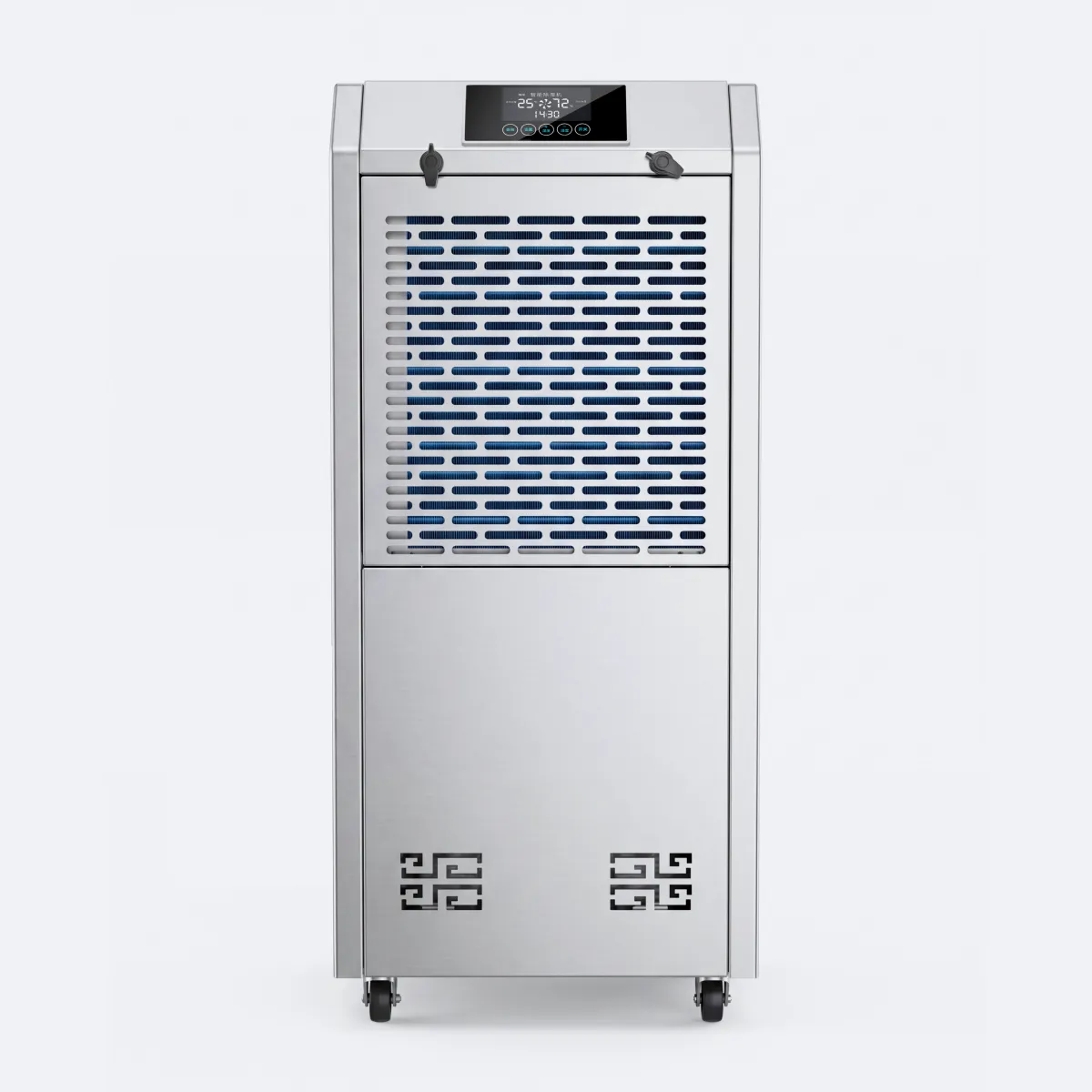
Rated for indoor swimming pools and hotel spas, this 60-156 L/day range suits small to mid-size pool rooms:

Epoxy-coated copper condenser and stainless-steel-treated cabinet resist chlorine corrosion, intelligent humidity control, automatic defrost.

GDH-60E

GDH-60E
Capacity (30°C / 80% RH):60
Coverage Area:40 – 80 m²
Power:220V/50Hz

view details

GDH-90E

GDH-90E
Capacity (30°C / 80% RH):90
Coverage Area:80 – 120 m²
Power:220V/50Hz

view details

GDH-156E

GDH-156E
Capacity (30°C / 80% RH):156
Coverage Area:140 – 160 m²
Power:220V/50Hz

view details

Option 2 — GDH Anti-Corrosion Dehumidifier for Commercial Pools

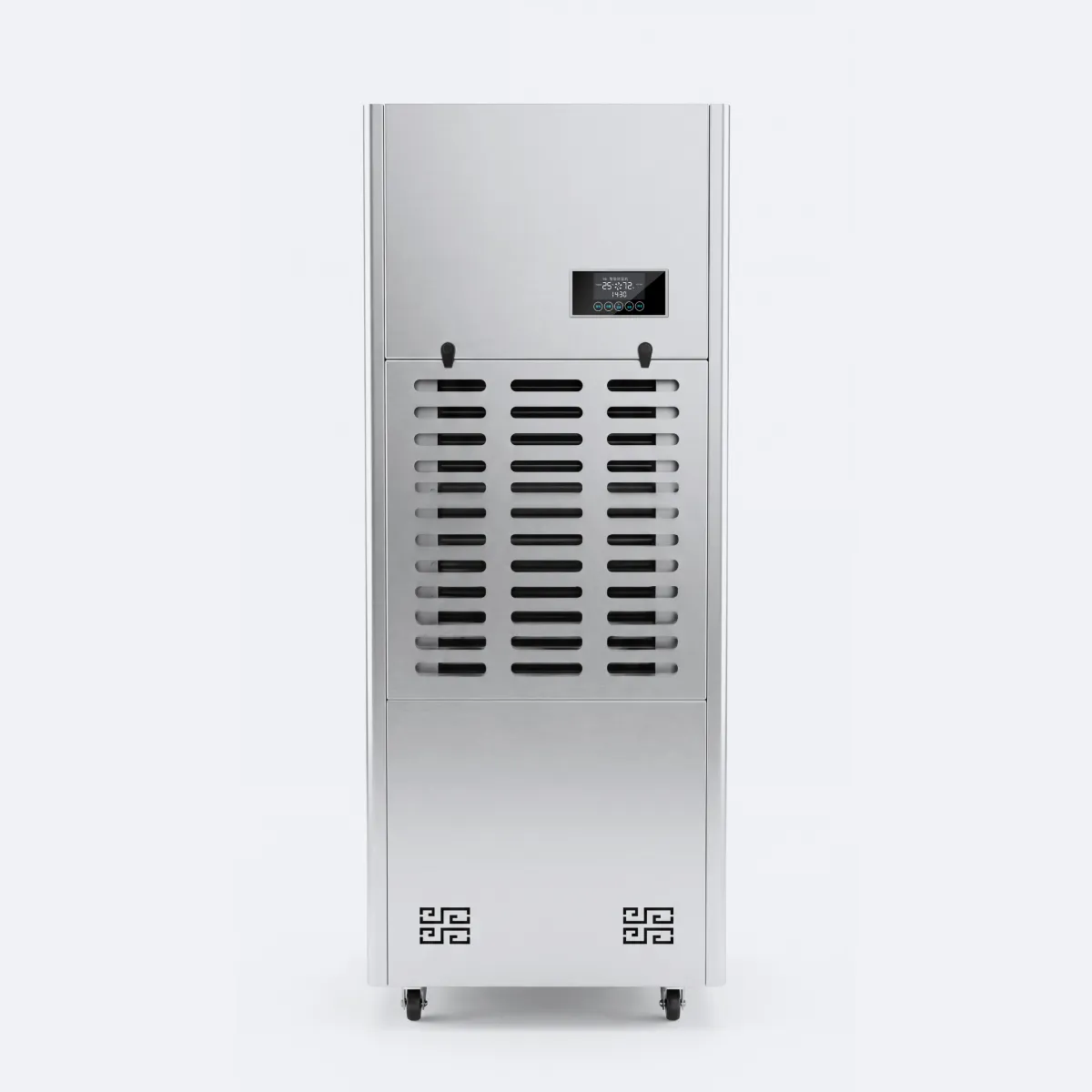
For commercial and hotel pool facilities needing 180-288 L/day of sustained moisture removal:

Stainless steel cabinet with epoxy-coated 100% copper condenser, up to 380V power options, continuous hose drainage built for constant poolside humidity load.

GDH-180E

GDH-180E
Capacity (30°C / 80% RH):180
Coverage Area:180–240 m²
Power:220V / 380V / 50Hz

view details

GDH-240E

GDH-240E
Capacity (30°C / 80% RH):240
Coverage Area:200–300 m²
Power:220V / 380V / 50Hz

view details

GDH-280E

GDH-280E
Capacity (30°C / 80% RH):288
Coverage Area:260–350 m²
Power:380V / 50Hz

view details

Option 3 — GDH Anti-Corrosion Dehumidifier for Large Aquatic Centers

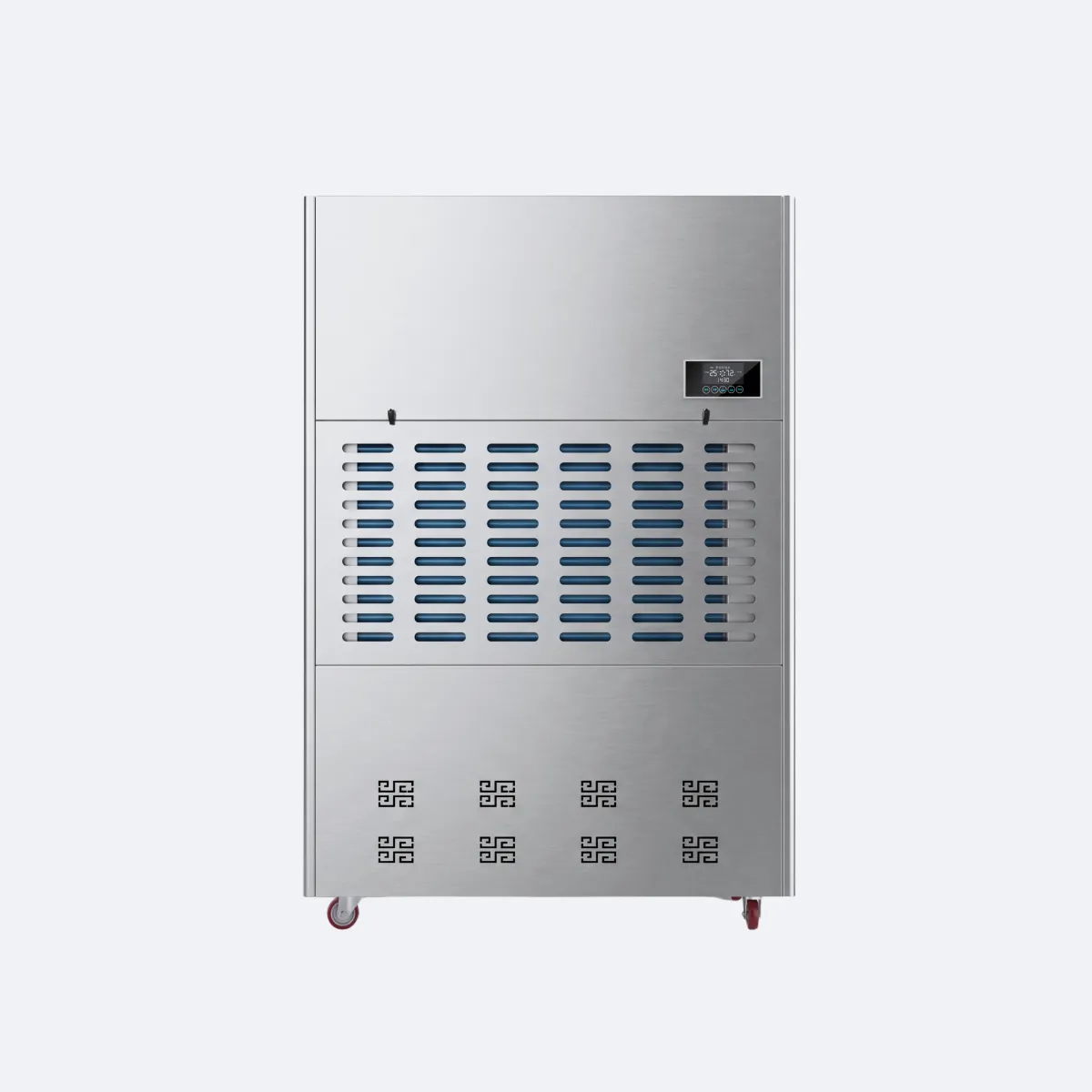
Scaling to 380-1440 L/day, this range serves water parks and large indoor aquatic centers:

Industrial-scale anti-corrosion construction, R290/R32 refrigerant, continuous hose drainage engineered for water park and large aquatic center loads.

GDH-960E

GDH-960E
Capacity (30°C / 80% RH):960
Coverage Area:1000 – 1200 m²
Power:380V / 50Hz

view details

GDH-1200E

GDH-1200E
Capacity (30°C / 80% RH):1200
Coverage Area:1200 – 1500 m²
Power:380V / 50Hz

view details

GDH-1440E

GDH-1440E
Capacity (30°C / 80% RH):1440
Coverage Area:1600 m²+
Power:380V / 50Hz

view details

How to Select a Pool Dehumidifier

Pool dehumidifier selection depends on five variables: pool surface area, deck area, ceiling height, presence of glazing, and operating mode (continuous vs. operating hours only). The matrix below maps common pool installation scenarios to the SHISHUO series most often specified.


Pool ScenarioPool SurfaceRecommended SeriesWhy
Hotel guest pool with adjacent spaUp to 80 m²GDH-60E to GDH-90E anti-corrosion floor-standingCompact floor-standing footprint fits utility room next to pool; anti-corrosion cabinet resists chlorinated air
School or community indoor pool80–250 m²GDH-138E to GDH-280E anti-corrosion floor-standingMid-capacity floor-standing, 220V or 380V depending on model
Municipal natatorium or competition pool250–600 m²GDH-380E to GDH-720E anti-corrosion floor-standingDedicated mechanical room installation with continuous drainage; multiple zones often paralleled
Water park or large aquatic centerAbove 600 m²GDH-960E to GDH-1440E anti-corrosion, multiple unitsSingle mechanical room with parallel units; redundancy for off-line maintenance
Residential indoor poolUp to 50 m²GDH-60E anti-corrosion, single-phase 220VSingle-phase 220V; portable allows seasonal repositioning
Spa room, hydrotherapy, hot tub enclosure10–30 m²GDH-60E to GDH-138E anti-corrosion; higher water temp (35–40°C) increases evaporation, size up one stepHigher water temperature (often 35–40°C) increases evaporation rate; size up one step
Pool space with major glazing on cold facadeAny sizeSize 20–30% above baseline calculationCold glass dew point risk; airflow must wash interior glass surface


Pool Dehumidifier Sizing — How to Calculate the Right Capacity

Pool dehumidifier capacity is determined by the evaporation rate from the water and wet deck surfaces, not by the room volume. The standard ASHRAE evaporation equation calculates moisture load from the water surface area, the vapor pressure difference between water and room air, and an activity factor (0.5 unoccupied, up to 1.0 competitive use). The figures below are starting-point guidance; exact sizing requires the ASHRAE calculation using your specific water and air conditions.
01

Residential / Low Activity

0.1–0.2 L/m²/hour (residential pools, low activity, spa rooms)

GDH-60E to GDH-138E anti-corrosion (60–138 L/day)


02

Hotel / Moderate Use

0.15–0.25 L/m²/hour (hotel guest pools, moderate use)

GDH-138E to GDH-280E anti-corrosion (138–280 L/day)


03

School / Community Pool

0.2–0.3 L/m²/hour (school and community pools, regular class use)

GDH-380E to GDH-720E anti-corrosion (380–720 L/day)


04

Competitive Natatorium

0.3–0.4 L/m²/hour (competitive natatoriums, water parks, continuous high-load use)

GDH-960E to GDH-1440E anti-corrosion (960–1,440 L/day, multiple units in parallel)

Several factors require sizing above the baseline:

For an accurate sizing recommendation, share your pool surface area, deck area, water temperature, target room air temperature, target RH, ceiling height, and glazing percentage. Our engineering team will return the calculated load and the matching SHISHUO model.
Pool water temperature above 30°C — every 1°C increase raises evaporation by roughly 8–10%.
Air temperature held below water temperature drives evaporation up sharply; ASHRAE recommends air 1–2°C above water.
Single-pane glazing in cold-climate locations adds a significant winter condensation load.
Water features, fountains, splash pads, and slides add wet surface area and raise the total evaporation load.

Need a Sizing Calculation for Your Greenhouse?

Send us your greenhouse dimensions, cultivation stage, target humidity, and operating temperature. Our engineering team will recommend the right SHISHUO model and capacity.

Request Sizing Download Catalog amy@shishuodehu.com

Installation and Operation Notes for Pool Environments

Air Distribution

Discharge air should be directed along the glazing line and any cold exterior wall surface — the single most important rule for pool dehumidifier installation. Window condensation is the most visible failure mode, and washing the glass with dry supply air prevents it. Return air should pull from the warmest, highest-RH zone, typically the ceiling above the deep end.

Cabinet Corrosion Protection

All SHISHUO Indoor Swimming Pool Dehumidifier models share the same anti-corrosion package — epoxy-coated 100% copper condenser and evaporator, stainless-steel-treated cabinet, titanium-foil coil fins, moisture-proof sheet metal treatment. For maximum service life, install the unit in an adjacent mechanical room or utility corridor and duct the supply and return through the pool room wall rather than placing the cabinet directly on the pool deck. Direct-deck installation is acceptable for smaller units (GDH-60E, GDH-90E) but shortens coil life in high-chlorine environments.

Drainage

All models support continuous gravity drainage through a hose connection. Pool room condensate is typically routed to the deck floor drain or a condensate pump basin. The drain line must not loop below the discharge level, or an airlock will back up the drain pan. Condensate from a clean coil is essentially distilled water and contains no chlorine — it can go to sanitary drain.

Power and Integration

GDH-60E through GDH-138E use 220V single-phase and can run from a standard building circuit; GDH-180E through GDH-280E support both 220V single-phase and 380V three-phase; GDH-380E and above use 380V three-phase. Most commercial natatoriums have 380V available in the mechanical room. For projects that need integration with an existing pool HVAC air handler, GDH units can be positioned in the return-air path as supplemental dehumidification.

Frequently Asked Questions

What is the ideal humidity level for an indoor swimming pool?

ASHRAE recommends 50–60% relative humidity for indoor pool spaces, with 55% RH and an air temperature 1–2°C above water temperature as the typical design target. Below 50% RH, evaporation rate accelerates (raising operating cost and chemical consumption) and swimmers feel cold when leaving the water due to evaporative cooling. Above 60% RH, the dew point approaches the temperature of cold building surfaces and condensation begins to form on glazing, fasteners, and structural steel.

How do I calculate the right size for a swimming pool dehumidifier?

Pool dehumidifier sizing is based on the evaporation rate from the water surface, not the room volume. The ASHRAE Applications Handbook gives a formula using pool surface area, the vapor pressure differential between water and air, and an activity factor (0.5 unoccupied, up to 1.0 competitive use). For most commercial pools, evaporation falls between 0.15 and 0.3 liters per m² of water surface per hour, or roughly 4–8 liters per m² per day. Multiply by water surface area to get the daily moisture load, then add ventilation air and occupant loads. We provide free sizing for any project — send your pool dimensions, water temperature, and target RH.

Can I use a standard commercial dehumidifier in a pool room?

A pool dehumidifier needs three things a standard commercial unit does not always include: copper tube heat exchangers (not aluminum), corrosion-protected fin treatment, and a moisture-proof cabinet coating. Pool air is chemically aggressive — chloramines, hypochlorous acid, and trace HCl will attack standard aluminum fins and galvanized cabinets within 2–4 years. SHISHUO industrial GDH and GDH-CE units use copper coils with titanium foil fin treatment and sealed cabinet construction for this reason.

Should the pool dehumidifier be ceiling-mounted or floor-standing?

The SHISHUO Indoor Swimming Pool Dehumidifier line is floor-standing anti-corrosion construction across the full capacity range — from the compact GDH-60E for small hotel spas up to GDH-1440E for large aquatic centers. Floor-standing units are preferred for pool spaces because the cabinet can be positioned in an adjacent utility room and ducted through the pool room wall, keeping the copper coils and cabinet electronics away from direct pool-deck chloramine exposure. For projects that specifically require concealed overhead installation (some hotel guest pools with architectural constraints), our GDH-CE ceiling-mounted ducted range can be specified with the same anti-corrosion coil treatment — contact our sales team to discuss pool-specific configuration of the GDH-CE series.

Where should the dehumidifier discharge air be directed in a pool room?

Supply air should be directed along the glazing line and across any cold exterior wall surface. Window condensation is the most visible failure mode in indoor pool rooms, and continuous airflow over the glass surface prevents the room dew point from condensing there. Return air should pull from the warmest, highest-humidity zone — usually the ceiling above the deep end of the pool. This pattern is sometimes called "wash the windows, pull from the ceiling" and is the standard design pattern for natatorium HVAC.

How is condensate water from a pool dehumidifier handled?

All SHISHUO industrial models include continuous gravity drainage through a hose connection. In a pool room, the drain is typically routed to the deck floor drain or to a small condensate pump if the unit is located above the slab. Condensate from a clean dehumidifier coil is essentially distilled water and contains no chlorine — it can be discharged to the sanitary drain or, in some jurisdictions, reused as cooling tower make-up.

Does the dehumidifier also need to heat or cool the pool air?

A standalone dehumidifier (SHISHUO GDH-CE or GDH industrial series) controls humidity only. Pool space heating and cooling, outdoor air ventilation (required by ASHRAE 62.1 for indoor air quality and chloramine dilution), and pool water heating are typically handled by separate equipment. For projects that need integrated dehumidification with heat recovery to the pool water, share your project specifications and we will discuss combined-system options. Most SHISHUO pool projects use a separate dehumidifier alongside an air handler with outdoor air and heating/cooling coils, which is the most flexible configuration for retrofits.

What is the typical service life of a pool dehumidifier in a chlorinated environment?

SHISHUO industrial GDH-CE and GDH units installed in correctly designed pool spaces — meaning the unit pulls from a ducted return rather than directly from the deck atmosphere, and the room is operated within ASHRAE 55% RH guidance — typically deliver 8–10 years of service before the heat exchanger requires inspection or replacement. Service life drops significantly in poorly ventilated rooms, in pools with elevated free chlorine levels, or where the unit is installed directly on the pool deck with intake air drawn from the wet zone.

Do your pool dehumidifiers comply with CE / RoHS for export to the EU?

Yes. The SHISHUO Indoor Swimming Pool Dehumidifier line holds CE and RoHS certifications, and all anti-corrosion construction — epoxy-coated copper condenser, stainless-steel-treated cabinet, titanium-foil coil fins — is designed for the chemically aggressive atmosphere of chlorinated pool rooms. Specific compliance documentation per model is available on request — contact our sales team and we will provide the certificate matching your destination market and project specification.

Get the Right Climate Control
Solution for Your Application

We support industrial temperature and humidity control projects with clear specifications, stable equipment, and practical system advice. Share your application details and capacity requirements—our team will respond with a suitable solution and quotation.

Get a Quick Quote

Amy

General Manager