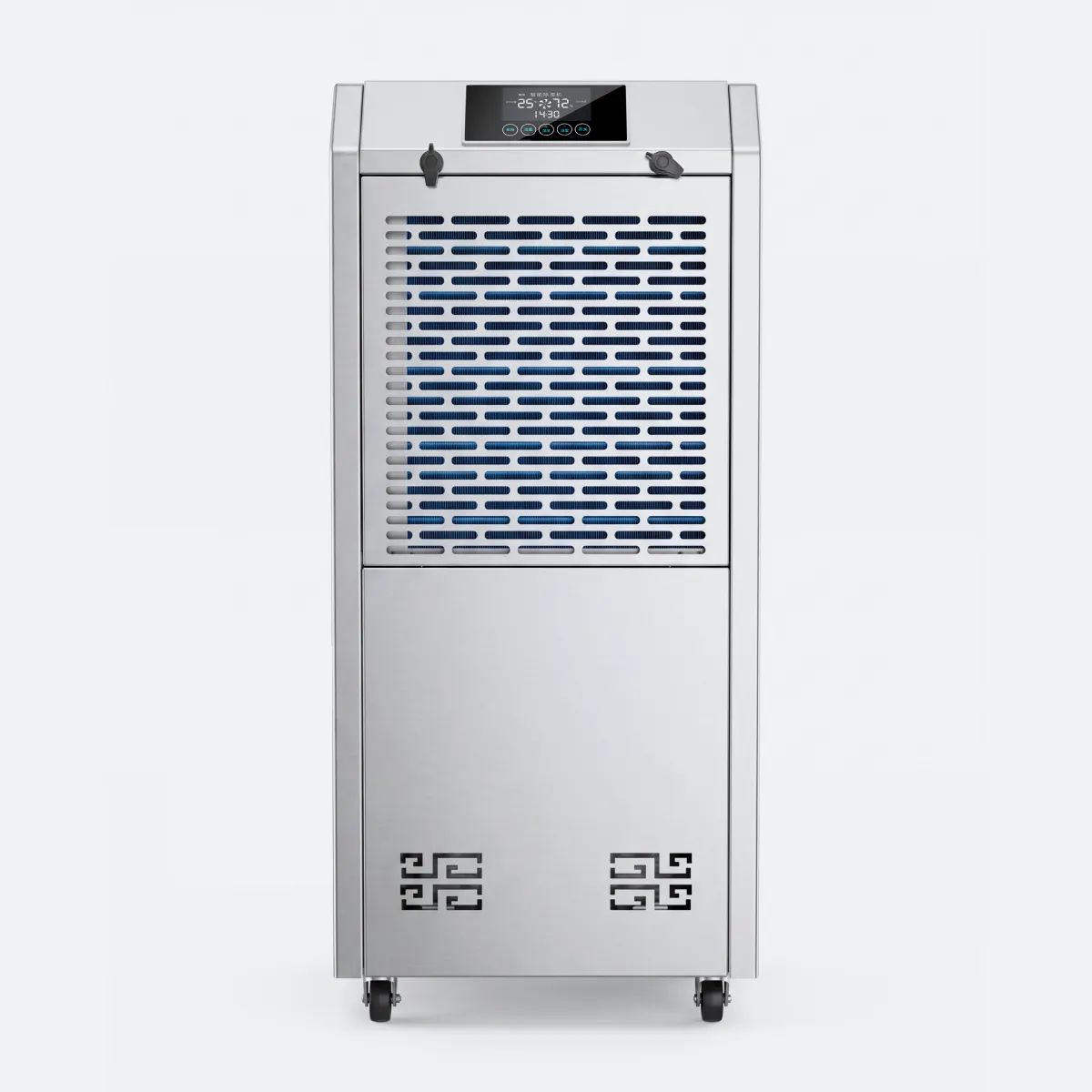
Where the GDH Anti-Corrosion Series Fits Best
The GDH Anti-Corrosion indoor swimming pool dehumidifier series is sized for indoor pool environments in the 40–160 m² room range — private and small commercial pools, hotel spa and wellness suites, aquatic sport centers, water park guest facilities, and medical rehabilitation pools. The four capacity tiers map to typical pool room dimensions: GDH-60E for small spa rooms and private indoor pools (40–80 m²), GDH-90E for mid-sized hotel pools and fitness club facilities (80–120 m²), GDH-138E for larger guest pool rooms (120–140 m²), GDH-156E for the upper end of single-pool installations (140–160 m²).
For larger commercial pools beyond 160 m² or with multiple water features, the commercial swimming pool dehumidifier series (180–288 L/day) is the right tier. For aquatic centers and water parks with 350+ m² pool halls, the industrial swimming pool dehumidifier range covers it.
Why Pool Rooms Destroy Standard Dehumidifiers
An indoor swimming pool releases roughly 0.3–0.5 L of water vapor per square meter of water surface per hour at typical 27–29 °C water temperature with 50 % RH air. The numbers are higher with water features, splash play, or warmer water. That moisture has to go somewhere — and what comes with it is the real problem.
Free chlorine in pool water reacts with nitrogen compounds from bather contaminants (sweat, urine, cosmetics) to form chloramines — monochloramine (NH₂Cl), dichloramine (NHCl₂) and nitrogen trichloride (NCl₃). These compounds off-gas into the pool room air along with elemental chlorine. The resulting air mix has three corrosive components: water vapor (mechanical corrosion), chlorides (electrochemical corrosion), and acidic chloramines (chemical attack).
Standard dehumidifiers built with powder-coated carbon steel cabinets show surface rust within 6–12 months in this environment, deeper pitting in 18 months, and structural compromise of the housing in 2–3 years. Bare copper coils show pinpoint corrosion (formicary corrosion) within 12–18 months, with refrigerant leaks following. Saltwater pools accelerate every failure mode because chloride concentration in the air is significantly higher than in chlorinated pools.
Anti-Corrosion Engineering — Stainless Steel Cabinet
The GDH Anti-Corrosion series uses a stainless steel cabinet, replacing the powder-coated carbon steel housing on standard dehumidifier models. Stainless steel resists chloride corrosion through the passive chromium oxide layer that forms on its surface — a self-repairing barrier as long as oxygen is available to maintain the oxide layer.
The standard grade for indoor pool environments is austenitic stainless steel with sufficient chromium and nickel content for chloride resistance. For severe environments — saltwater pools, salt-chlorinated systems with elevated chloride levels, or mineral spa water — 316L grade with molybdenum addition is the recommended specification. The grade can be specified at order for OEM buyers serving severe-environment markets. Standard production uses austenitic stainless steel suitable for chlorinated freshwater pools; specify 316L explicitly if your installation environment is saltwater or aggressive spa water.
Epoxy-Coated 100% Copper Condenser — The Coil Treatment
The condenser coil is 100% oxygen-free copper with an epoxy coating applied to both tube and fin surfaces (e-coating, electrophoretic deposition). The coating fills the gap between the corrosion resistance of bare copper (poor in chloride atmospheres) and the cost of all-titanium coils (excessive for most pool installations). Epoxy coating thickness is typically 15–30 microns applied uniformly across the heat exchanger surface, including hard-to-reach fin spaces that spray coating misses.
The trade-off is a small reduction in heat transfer rate — roughly 3–5 % vs bare copper — but in exchange the coil holds up against the chloramine-laden air that destroys bare copper in 12–18 months. Coated copper coils in pool environments typically maintain capacity for 6–8 years before measurable degradation, more than 4x the service life of uncoated coils.
For installations with extreme chloride exposure (saltwater pools, ocean-adjacent facilities), all-titanium coils are available as a special-order ODM option from MOQ 50 units. Titanium is electrochemically inert in chloride environments and outlasts everything else, but at materially higher cost.
Sizing the Four Capacity Tiers to Your Pool Room
Pool room dehumidifier sizing depends on three numbers: water surface area, pool room air volume, and target RH. ASHRAE 62.1 and CIBSE Guide G both recommend 50–60 % RH in indoor pool rooms, with 55 % RH the most common design target. The air temperature should be 1–2 °C above water temperature to suppress evaporation from the pool surface.
Rough sizing guidance from typical pool room conditions:
- GDH-60E (60 L/day) — small spa rooms, private indoor pools up to roughly 25–30 m² water surface area, pool room volumes up to 200 m³
- GDH-90E (90 L/day) — mid-sized indoor pools with 30–45 m² water surface, hotel spa suites, fitness club pool rooms with limited splash activity
- GDH-138E (138 L/day) — larger hotel guest pools with 45–60 m² water surface, rehabilitation pools with continuous bather activity
- GDH-156E (156 L/day) — upper end of single-unit pool installations, 60–75 m² water surface with moderate splash and bather load
These are starting points. Actual sizing should account for water temperature (warmer water = more evaporation), bather load (more swimmers = more moisture and chloramine generation), and any water features that increase evaporative surface area. For installations near the boundary between two tiers, sizing up the next tier rather than down is the safer engineering choice — chronic undersizing causes mold and material damage that cost orders of magnitude more than the capacity upgrade.
Compressor-Cycle Refrigeration in Pool Service
The series uses a sealed R32 compressor refrigeration cycle. Air enters through the side intake grille, passes across the epoxy-coated copper evaporator coil where moisture condenses to liquid water, is reheated across the condenser coil, and exits back into the room. The reheat function matters specifically in pool rooms — removing latent heat without cooling the air helps maintain the warm comfortable atmosphere pool users expect (28–30 °C air temp is typical).
The all-copper coil construction with epoxy coating costs more than the aluminum-fin assemblies common in lower-cost units, but aluminum has no real future in pool air — chloride attack on aluminum is rapid and irreversible, and aluminum-tube coils typically fail within 8–12 months in indoor pool environments.
R32 Refrigerant — Standard Charge, Regulated-Market Compliance
All four models use R32 refrigerant (HFC single-component, GWP 675, A2L mildly flammable) with factory-sealed circuits as the standard configuration. R32 is the established compliance choice across regulated global markets — EU under the revised F-gas Regulation (EU 2024/573), UK, Japan under the Fluorocarbons Emissions Control Law, Australia, and increasingly across North America, China, and other markets phasing out legacy HFC blends. Single-component composition eliminates the fractionation risk associated with blended refrigerants during charge and top-up service — a meaningful maintenance advantage for precision equipment operating on multi-year service cycles in mission-critical cleanroom, pharmaceutical, and data center installations. R32 charge volumes are compact — below the IEC 60335-2-40 charge limits for the installation category, with exact charge specified per model in the technical documentation package provided at order. For facility safety policies that require additional ventilation analysis for A2L refrigerant in confined cleanroom or laboratory installations, we provide the charge and ventilation reference data required for the assessment.
For facility safety standards that specifically prohibit any flammable refrigerant in occupied production areas — a policy still applied in certain pharmaceutical validated cleanrooms, sterile manufacturing suites, and legacy-specification data centers — R410A is available as an ODM configuration from MOQ 200 units. R410A (HFC blend, GWP 2088, non-flammable) remains a valid selection where facility policy overrides GWP considerations, though it is under phase-down schedules across the EU, UK, US, and other regulated markets — most new-build projects specify R32 or absorb the safety analysis needed to permit R32 in occupied spaces to align with 2027–2032 regulatory milestones.R290 is not offered on the pool series — flammability risk in confined pool plant rooms with potential refrigerant accumulation makes the safety case unfavorable.
Drainage Variations Across the Four Models
Drainage configuration changes across the four capacity tiers, reflecting different deployment patterns:
- GDH-60E — Water tank with float-switch shutoff plus drain hose option. Suitable for installations where continuous plumbing is not pre-arranged, but at 60 L/day the tank fills in roughly 90 minutes, so drain hose connection is the practical operating configuration.
- GDH-90E / GDH-138E — Direct drain only via G1/2" rear port. Continuous gravity drainage to a floor drain or sump, no internal tank.
- GDH-156E — Drainage pipe via G3/4" rear port. Larger drain size to handle the higher condensate volume reliably.
None of the four models include a built-in condensate pump. For installations where the drain endpoint sits above the unit, fit an external condensate pump rated 100–200 L/h between the unit and the drain, or specify a built-in pump as an ODM modification.
Operating Temperature
Working temperature ranges narrow as rated capacity climbs: GDH-60E and GDH-90E rate 5–38 °C; GDH-138E narrows to 5–35 °C; GDH-156E rates 5–30 °C. For typical indoor pool rooms operating at 28–30 °C air temperature, all four models work comfortably inside the envelope. For tropical or unconditioned plant rooms reaching above 30 °C, specify the GDH-60E or GDH-90E (which both have the 38 °C upper limit).
Build and Safety
1.0 mm stainless steel cabinet with welded seams and corrosion-resistant fasteners throughout. Internal electrical components receive moisture-proof conformal coating before assembly — important in pool environments where ambient humidity sits at 60–75 % during operation. Each unit is leakage-tested at full extraction conditions before shipping. Built-in safety: high-pressure cut-out, overcurrent protection, defrost interlock, fault self-protection logic and compressor thermal cut-out.
OEM and ODM Service
OEM MOQ is 10 units per model — branding, plug type for the destination market, packaging artwork. ODM scope covers stainless steel grade upgrade (316L specification for saltwater or aggressive spa environments), all-titanium coil for extreme chloride exposure, alternative refrigerant (R32 from MOQ 200), control firmware language and BMS integration (Modbus RTU from MOQ 50). Production lead time is 30–40 days after artwork sign-off, slightly longer than standard models due to additional fabrication time for stainless steel and the epoxy coating cure cycle on the condenser. FOB Ningbo or Shanghai.
For larger commercial installations, see the commercial swimming pool dehumidifier range. For other categories, browse the full commercial dehumidifier lineup.