
Search

Enter keywords to search for products, blog posts, and more.

Dehumidifier for Food Storage — Stop Condensation, Frost, Mold and Powder Caking in Cold Stores, Dry-Goods Warehouses and Processing Rooms

Dehumidifier for Food Storage — Stop Condensation, Frost, Mold and Powder Caking in Cold Stores, Dry-Goods Warehouses and Processing Rooms


Why Moisture Costs the Food Supply Chain

Humidity in food storage is a direct cost. Above the level a product needs, moisture in the air condenses on cold surfaces, cakes dry ingredients, softens packaging, and feeds the mold and bacteria behind spoilage and recalls. Refrigeration and air conditioning cool the space but aren't built to control moisture — in humid weather they leave the air damp the moment they cycle off, and in a cold store they actively turn that moisture into frost and ice. A dehumidifier controls humidity directly, and it protects a food operation in three ways:

It Stops Condensation, Frost and Ice at the Source

In a cold store or freezer, moisture is the cause of frost and ice. Warm humid air infiltrating through doors and openings condenses on cold coils, floors, racks, and product — icing evaporators, hiding barcodes, creating slip hazards, and dripping onto stock. Defrost cycles and heater strips fight the symptom at high energy cost; removing the moisture stops the ice forming in the first place. Hold the space below the condensation threshold and the frost, fog, and pooled water simply don't appear.

It Protects Product Quality and Prevents Spoilage

Above about 60% RH, mold grows on grains, pallets, and packaging; powders like flour, sugar, salt, and spice absorb moisture and cake into unusable lumps; crackers and cereals go soft; and bacteria multiply on damp surfaces, risking contamination and recalls. Holding the correct low humidity keeps dry goods free-flowing, packaging intact, and surfaces hygienic — protecting both saleable product and food-safety compliance.

The Right Unit Matches Every Storage Environment

Food storage isn't one environment. An ambient dry-goods warehouse or packaging room needs bulk moisture removal at moderate temperature; a processing area that must hold both temperature and humidity needs a combined unit; a cold store, freezer, or low-dew-point powder room needs a desiccant unit that keeps working where a compressor frosts up. SHISHUO covers each with a matched platform, so every space holds its target without over- or under-sizing.

SHISHUO Dehumidifiers for Food Storage, Processing and Cold Chain

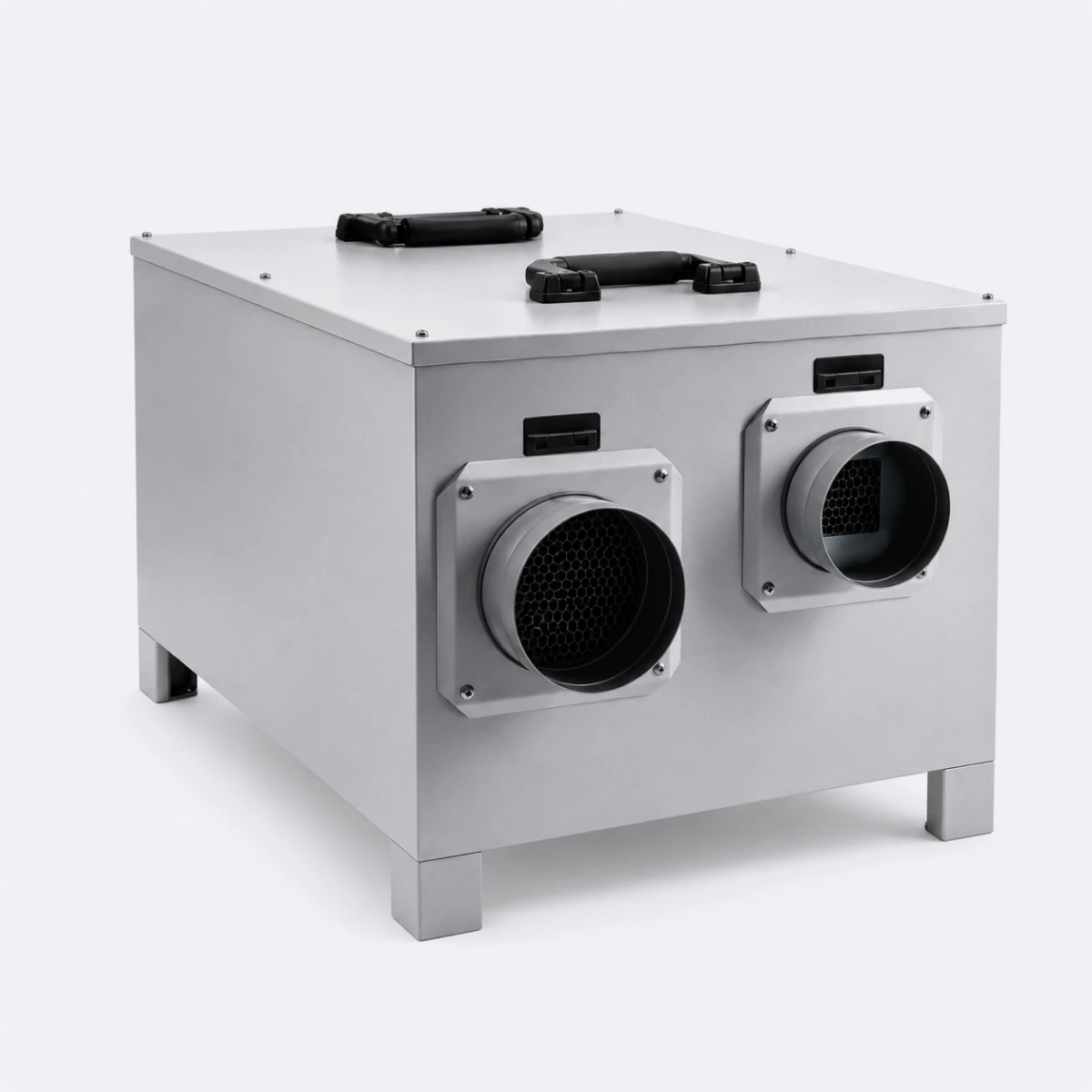
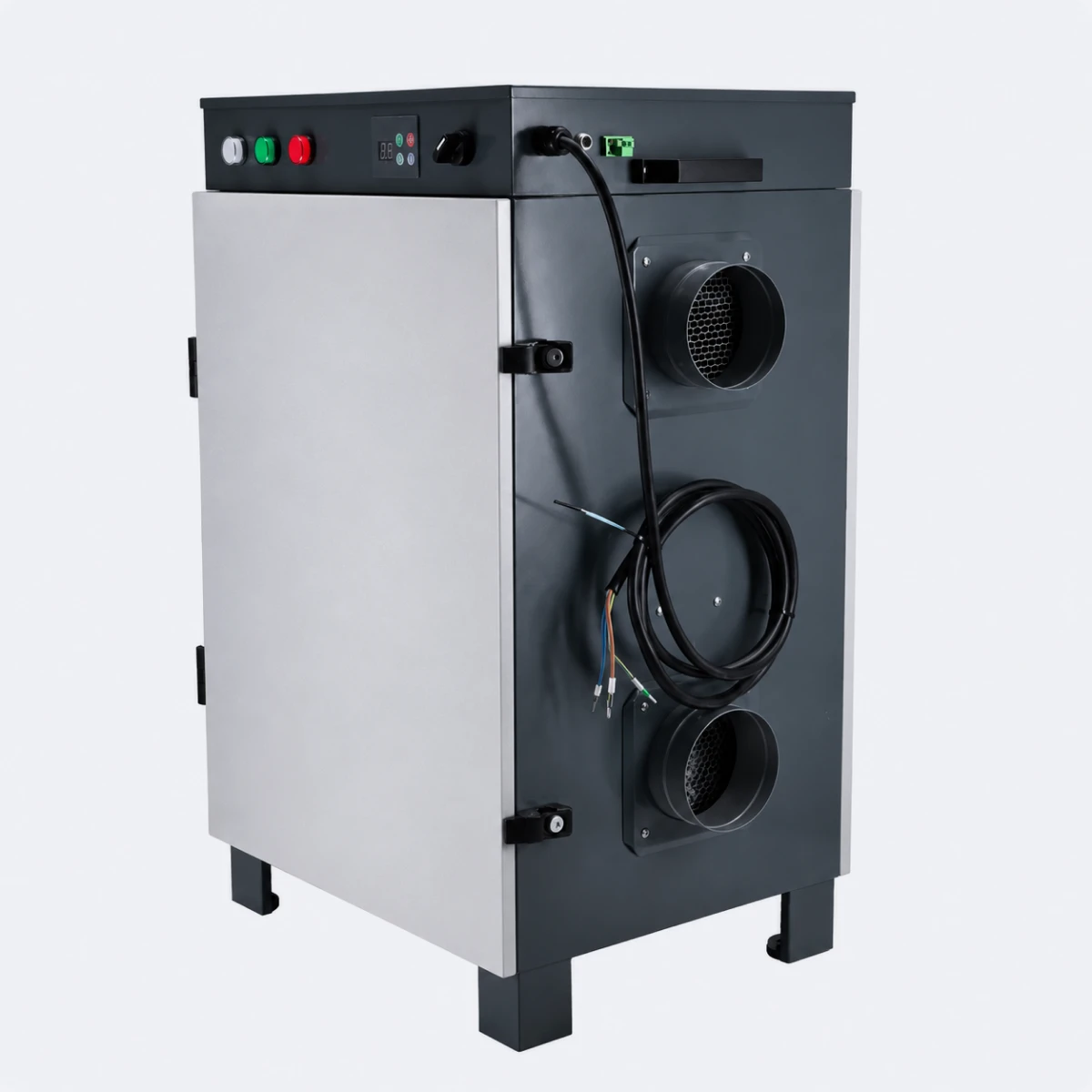
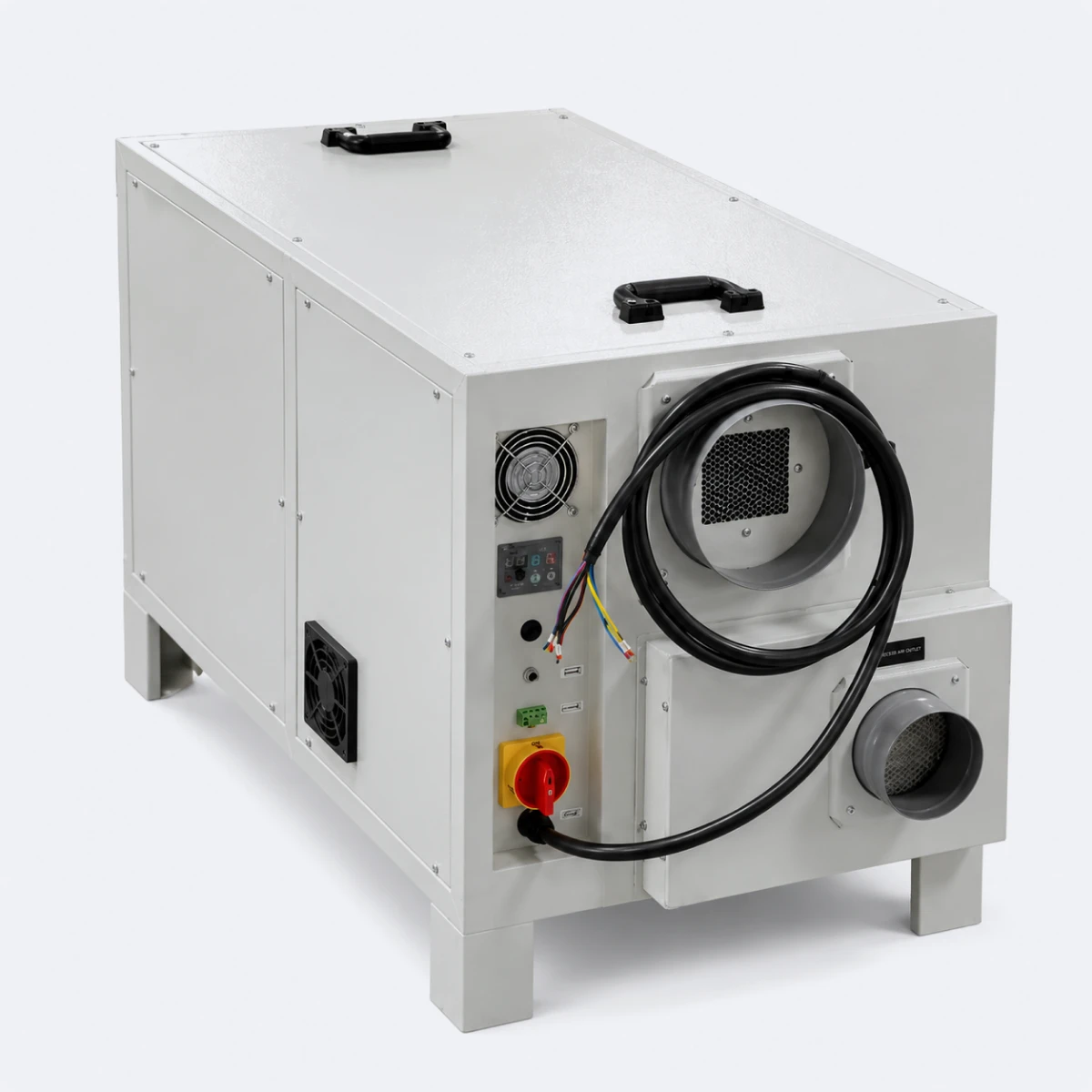
Three platforms cover food storage end to end, organized by the environment and how much moisture has to be removed. Rotary desiccant units hold a low humidity target in cold stores, freezers, and moisture-sensitive powder handling, where a refrigerant coil loses efficiency and frosts. All support continuous drainage and OEM/ODM customization, with food-compatible stainless-steel construction available. High-capacity refrigerant floor-standing units handle ambient warehouses, dry-goods stores, and processing and packaging rooms at moderate temperature. Constant temperature-and-humidity units hold both temperature and RH within tight tolerances for processing and GMP areas that need them locked together.

Option 1 — XR Industrial Desiccant Dehumidifier for Low-Humidity Food Processing

For food processing operations where the target RH is below 50% — powder and starch handling, freeze-drying, chocolate tempering, hard candy production, dry pasta and biscuit lines, spice packaging, milk powder production:

Most food processing lines need RH held below 50% — often much lower for powder handling, freeze-drying, hard candy, chocolate tempering, and dry pasta production. A refrigerant dehumidifier tops out around 45-55% RH and can't reach these targets; a desiccant rotor adsorbs moisture on a fire-resistant wheel and holds RH from 5% to 95% under fully automatic control. Five 220V/380V models from 2.5 to 8 kg/h, stainless-steel or powder-coated construction, RS-485 Modbus for line integration, CE and RoHS certified.

XR-350-02

XR-350-02
Capacity (Kg/h):2.5
Airflow:400 m³/h
Power:220V / 50Hz

view details

XR-600XF-01

XR-600XF-01
Capacity (Kg/h):3
Airflow:600 m³/h
Power:220V / 50Hz

view details

XR-750XF-01

XR-750XF-01
Capacity (Kg/h):4.5
Airflow:750 m³/h
Power:380V / 50Hz

view details

Option 2 — High-Capacity Floor-Standing for Ambient Warehouses, Dry-Goods Stores and Processing Rooms

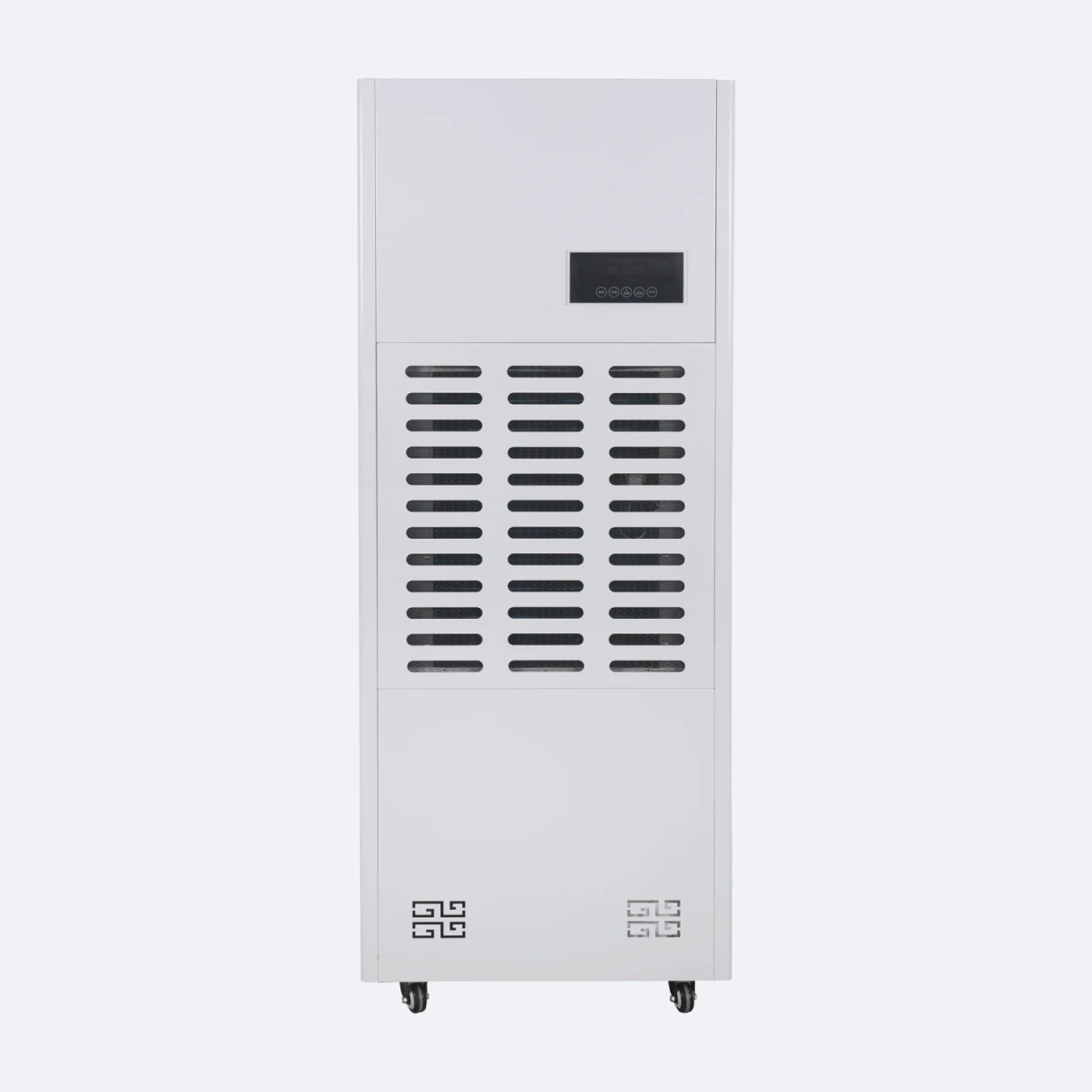
For ambient dry-goods warehouses, packaging and labeling rooms, dough-mixing and dry-ingredient storage, and general food processing areas held above about 15°C, our high-capacity floor-standing refrigerant series covers 180 to 1,440 L/day:

All units in this series ship with copper condenser and evaporator, wide working range up to 38°C for warm processing and packaging rooms, continuous hose drainage for unattended operation, automatic defrosting, precision humidity sensor, and LCD touchscreen control. Built for demanding food-industry environments; plug-and-play on 220V or 380V by model.

GDH-180E

GDH-180E
Capacity (L/day):180
Coverage Area:180–240 m²
Power:220V/380V

view details

GDH-480E

GDH-480E
Capacity (L/day):480
Coverage Area:450–600 m²
Power:380V / 50Hz

view details

GDH-1440E

GDH-1440E
Capacity (L/day):1440
Coverage Area:1600 m²
Power:380V / 50Hz

view details

Option 3 — DXHW Constant Temperature-and-Humidity Unit for Fermentation, Aging & Curing Rooms

For food processes where both temperature AND humidity must be held simultaneously to a tight window — dough proofing, chocolate tempering, cheese aging caves, dry-cured meat rooms, sausage fermentation chambers, mushroom fruiting rooms, brewing and yeast propagation:

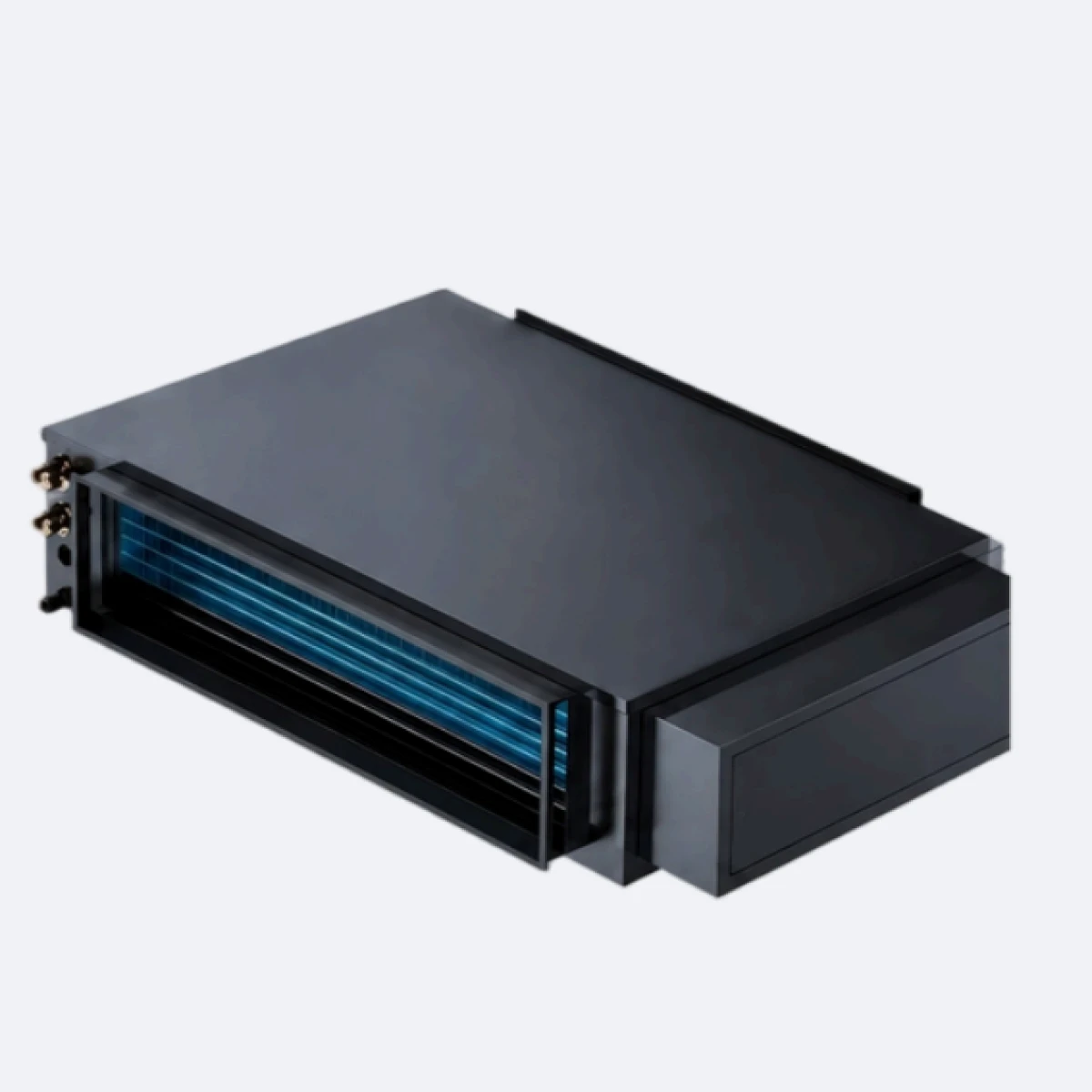
Many food processes fail if either temperature or humidity drifts — dough proofing needs 27-30°C at 75-85% RH, chocolate tempering needs 18-20°C at 45-50% RH, cheese aging needs 10-14°C at 85-95% RH, dry-cured ham needs 12-16°C at 65-75% RH, sausage fermentation needs 20-24°C at 88-92% RH. A separate dehumidifier and thermostat fight each other; DXHW locks both variables on one coordinated PLC system with 7-inch touchscreen, ceiling-concealed ducted or floor-standing vertical configurations, industrial-grade components rated for 24/7 continuous operation.

DXHW-9

DXHW-9
Cooling Capacity (KW):9
Airflow (m³/h) :2200
Power:220V/50Hz

view details

DXHW-25

DXHW-25
Cooling Capacity (KW):22
Airflow (m³/h) :6000
Power:380V/50Hz

view details

DXHW-70

DXHW-70
Cooling Capacity (KW):68
Airflow (m³/h) :12500
Power:380V

view details

Recommended Humidity by Food Storage Environment

The right humidity depends on the product and the space. The table below maps common food storage and processing environments to a target RH and the platform that holds it. Ambient dry areas need moderate RH from a refrigerant unit; areas that must hold temperature and humidity together need a combined unit; cold and low-dew-point spaces need a desiccant unit that keeps working where a compressor frosts.
Food Storage EnvironmentMoisture ProblemTarget RHRecommended Platform
Dry-goods warehouse (grains, pasta, dried foods)Mold growth, insect activity, cakingBelow 60% RHGDH refrigerant floor-standing
Packaging & labeling roomSoft cartons, peeling labels, weak seals50–55% RHGDH refrigerant floor-standing
Dough mixing roomDamp ingredients, inconsistent process50–55% RHGDH refrigerant floor-standing
Powder handling (flour, sugar, milk, protein)Caking, clumping, blocked chutes40–50% RHXR desiccant
Dry-ingredient storage (flour, spice, sugar)Hygroscopic material clumping, cakingBelow 45% RHXR desiccant
Proofing, chocolate, dairy maturationNeeds both temperature and RH heldSet point, tight toleranceDXHW constant temp & humidity
Cold store & chillerCondensation, frost, icing, slippery floorsBelow condensation pointXR desiccant
Freezer room & blast-freeze anteroomIce buildup, fog, barcode obscuringLow, at sub-zero temperatureXR desiccant
Refrigerated dock & transition zoneSevere moisture infiltration, condensationBelow condensation pointXR desiccant


Matching a Dehumidifier to a Food Storage Space

Choosing a food storage dehumidifier comes down to the space temperature, the moisture load, and how low a humidity the product needs. Temperature decides the technology first: above about 15°C a refrigerant unit is efficient; in cold and freezer spaces a desiccant unit is the reliable choice. Then size to the room volume and moisture entering it — from doors, air changes, wet processes, and the product itself. The four cases below show how the environment sets the platform.
01

Ambient Dry-Goods Warehouse

Ambient dry-goods warehouse

A GDH floor-standing refrigerant unit, sized to the warehouse volume, holds below 60% RH to stop mold and caking. These spaces run at ambient temperature where a compressor is efficient; size for the floor area and air changes, and route condensate to a drain for unattended running. For a large warehouse, several units in parallel give even coverage.

02

Cold Store or Freezer Room

Cold store or freezer room

A XR desiccant unit, because a refrigerant coil loses efficiency and frosts below about 5°C. The desiccant rotor holds a low RH down to -20°C, stopping condensation and ice at the source rather than fighting it with defrost cycles. Size to the door traffic and infiltration that drive the moisture load, and protect the drain against freezing.

03

Powder Handling or Packaging Room

Powder handling or packaging room

For moisture-sensitive powders that need a low dew point, a XR desiccant unit holds the dry air weighing and filling require; for ambient packaging and labeling at moderate temperature, a GDH refrigerant unit holding 45–55% RH keeps cartons firm and seals reliable. Size to the room and its moisture load, and supply dry air where the process is most sensitive.

04

Processing Area Holding Temperature and Humidity

Processing area holding temperature and humidity

A DXHW constant temperature-and-humidity unit, where the process needs both locked to a set point — proofing, chocolate tempering, dairy maturation. The PLC system holds temperature and RH together within a tight band, ducted through a ceiling-concealed design, built for continuous production.

Key Considerations for Food Storage Dehumidification

Four things set the specification: match the technology to the temperature, hold the right target for the product, keep the equipment food-compatible, and plan for continuous unattended running.
Match technology to temperature — above about 15°C a refrigerant unit removes moisture efficiently; below 5°C it frosts and loses output, so cold stores, freezers, and low-dew-point rooms need a desiccant rotor that holds its target from -20°C to 50°C.
Hold the right target for the product — dry goods below 60% RH to stop mold and caking, packaging at 45–55% RH for firm cartons and reliable seals, cold stores below the condensation point to stop frost and ice, and processing areas at a locked set point where both temperature and humidity matter.
Keep it food-compatible and hygienic — stainless-steel construction is available for wash-down and food-contact-adjacent environments, and holding a low RH itself suppresses the mold and bacteria behind contamination and recalls, supporting HACCP and food-safety compliance.
Plan for continuous, unattended operation — all units support continuous hose or pump drainage so staff never empty a tank, run 24/7 with fault self-detection, and can tie into a facility monitoring system for verifiable humidity logging.

Need a Sizing Calculation for Your Greenhouse?

Send us your greenhouse dimensions, cultivation stage, target humidity, and operating temperature. Our engineering team will recommend the right SHISHUO model and capacity.

Request Sizing Download Catalog amy@shishuodehu.com

Deployment Notes for Food Storage and Cold-Chain Environments

Placement and Air Distribution

Place units so dry air reaches the whole space and moves across the surfaces where moisture collects — cold coils, floors, and racks in a cold store; chutes and fill points in a powder room. Still corners hold damp air where mold and condensation start. In a large warehouse, several units in parallel give even coverage.

Drainage for Cold and Continuous Use

All units support continuous gravity drainage or a condensate pump so no tank needs emptying. In cold stores and freezers, route and protect the drain line against freezing so it can't block and back up; a rotary desiccant unit discharges moisture with its hot regeneration airstream ducted outside, which avoids much of the freezing risk.

Targeting Moisture Infiltration Points

Moisture enters worst at doors, dock levelers, and the transition zone between a cold store and ambient air. Position units to treat these infiltration points, and pair with strip curtains, air curtains, or vestibules where possible so the dehumidifier isn't fighting an open door.

Hygiene and Maintenance

Choose stainless-steel construction for wash-down and food-contact-adjacent areas, and clean or replace filters on schedule so airflow stays high and the unit doesn't recirculate dust. A well-maintained dehumidifier holds RH reliably and supports the hygiene and documentation food-safety audits require.

Frequently Asked Questions

Why do I need a dehumidifier if my cold store is already refrigerated?

Because refrigeration controls temperature, not humidity — and in a cold store it actively turns infiltrating moisture into frost and ice. Warm humid air entering through doors condenses on cold coils, floors, and product, icing evaporators, hiding barcodes, and making floors slippery. Defrost cycles fight this at high energy cost; a dehumidifier removes the moisture before it can condense, so the ice never forms. Refrigeration keeps the space cold; the dehumidifier keeps it dry.

What humidity should a dry-goods food warehouse be kept at?

Keep a dry-goods warehouse below 60% RH. Above that, mold grows on grains, pallets, and packaging, insects become active, and powders and dry foods absorb moisture and cake. Holding below 60% keeps stock free-flowing and mold-free; moisture-sensitive powders and freeze-dry products often need lower still, closer to 40–50% RH or a controlled low dew point. A refrigerant floor-standing unit holds ambient warehouses well; powder rooms needing a low dew point use a desiccant unit.

Which dehumidifier works in a freezer or cold store below 5°C?

A rotary desiccant unit. A refrigerant dehumidifier condenses water on a cold coil, so below about 5°C it frosts and spends its run time defrosting instead of drying — in a freezer it barely works. A desiccant rotor adsorbs moisture onto a wheel and regenerates it with heat, with no cold coil, so it holds a low RH down to -20°C. For cold stores, freezer rooms, blast-freeze anterooms, and refrigerated docks, the desiccant unit is the reliable choice.

How do I stop frost and ice building up in a cold store?

Frost and ice are condensation, and condensation is moisture meeting cold surfaces. The lasting fix is to remove the moisture — hold the space below the condensation point with a desiccant dehumidifier and the frost, ice, and fog stop forming. This is more effective and cheaper to run than heater strips and frequent defrost cycles, which only manage the symptom. Position the unit to treat the door and dock transition zones where humid air infiltrates worst.

How do I keep flour, sugar, and other powders from caking?

Powders like flour, sugar, salt, milk, and protein absorb moisture from the air and cake into lumps that block chutes and fill lines. The fix is to hold the handling area at a low humidity — typically 40–50% RH, or a controlled low dew point for the most sensitive powders. A desiccant unit supplies the dry air weighing and filling need; an ambient store at moderate temperature can use a refrigerant unit. Keep the dry air aimed at the weighing, mixing, and fill points.

Are the dehumidifiers food-safe and suitable for wash-down areas?

Stainless-steel construction is available for wash-down and food-contact-adjacent environments, and holding a low RH itself suppresses the mold, yeast, and bacteria behind spoilage and contamination — which supports HACCP and food-safety compliance. The units remove airborne moisture rather than treating the product, and continuous drainage keeps them hygienic. Tell us the area and its wash-down and hygiene requirements and we'll specify the right construction.

Can one system cover a large warehouse or multiple rooms?

Yes. For a large warehouse, several units run in parallel, sized to the building's volume and air changes and placed for even coverage across the floor. For a facility with different rooms at different targets — an ambient store, a packaging room, and a cold store — each space gets the platform and set point it needs, and all units can tie into a facility monitoring system for central control and verifiable humidity logging. We design the unit count, placement, and control as part of sizing.

Do SHISHUO food storage dehumidifiers support OEM and ODM?

Yes. We support OEM branding and ODM changes: stainless-steel and food-compatible construction, voltage adaptation (220V/50Hz standard, 380V three-phase, and 110V/60Hz for North America), duct and drainage configuration, filter grade, control interface and data logging, and custom colors and labeling. Units are built to CE, ETL, and RoHS with ISO 9001 manufacturing, and we export worldwide. Contact our team with your storage environment, temperature, target RH, and quantities for a specification and quotation.

Get the Right Climate Control
Solution for Your Application

We support industrial temperature and humidity control projects with clear specifications, stable equipment, and practical system advice. Share your application details and capacity requirements—our team will respond with a suitable solution and quotation.

Get a Quick Quote

Amy

General Manager