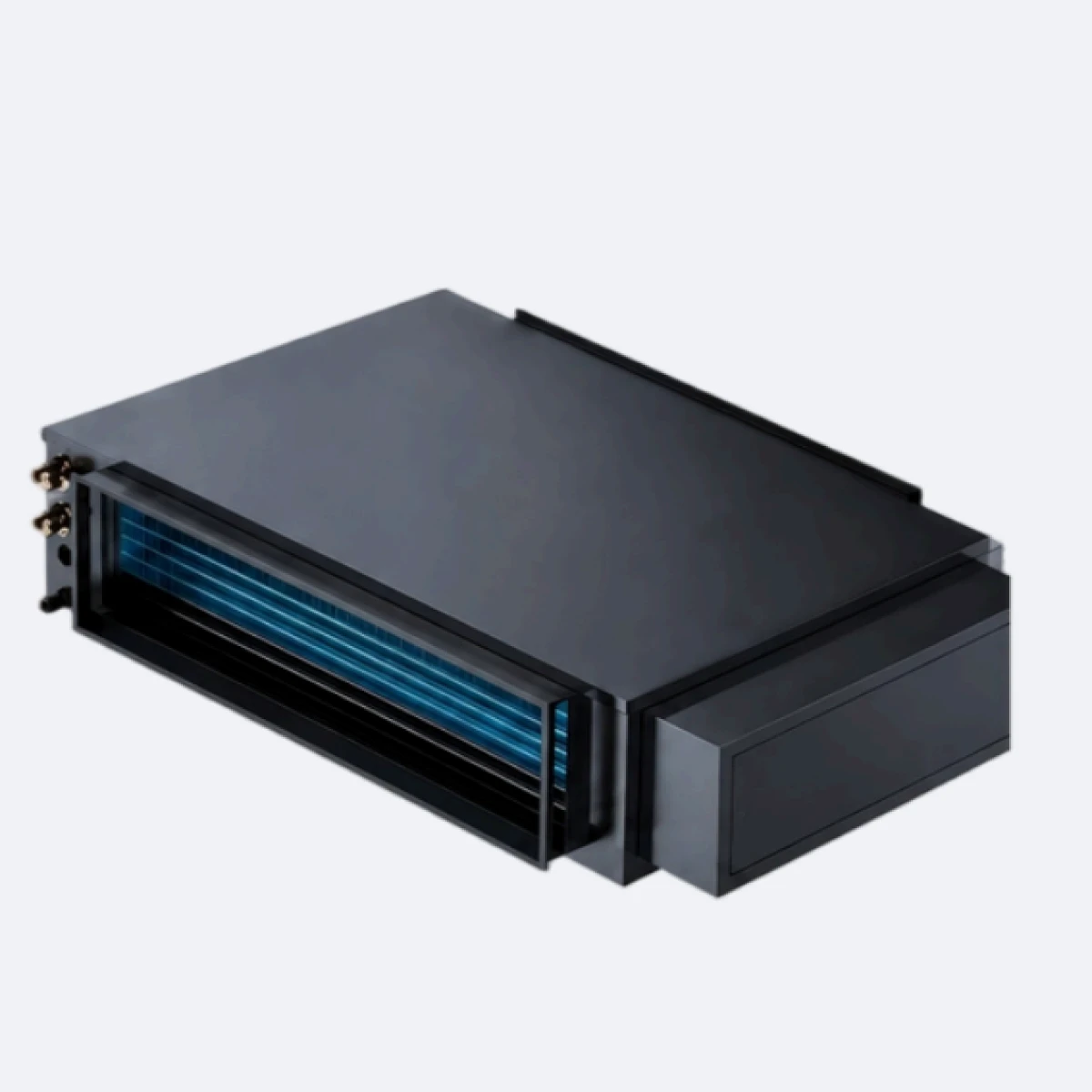
Structural Space Efficiency: The Value of Ceiling Concealed Duct Engineering
In modern industrial and commercial environments, floor space directly impacts operational yield. Traditional floor-standing close-control air conditioning infrastructure requires large service footprints, limiting usable room for manufacturing tooling, laboratory benches, or vertical racking layers. The DXHW series addresses this challenge through a low-profile, horizontal ceiling-concealed structural format. Installed completely within the overhead ceiling void or joist framework, the unit interfaces with the target space solely through localized supply and return air duct systems.
This overhead horizontal execution provides distinct thermodynamic and mechanical advantages. By introducing conditioned air through ducted ceiling diffusers, the system minimizes localized thermal stagnation zones and hot spots common with standard console equipment. Air distribution patterns are calculated based on external static pressures ranging from 100 Pa on lower tiers to a powerful 200 Pa on systems starting from the DXHW-25 tier. This static pressure headroom allows the system to overcome resistance across extensive duct configurations, cleanroom filters, or terminal dampening mechanisms, providing uniform environmental equalization across wide areas.
The Thermodynamic Challenge: Balancing Four Mechanical Cycles and Maintaining Tighter Envelopes
Maintaining a constant temperature of 18–30 °C (±1 °C variance) and an absolute relative humidity profile of 50–70% (±5% RH variance) simultaneously requires continuous calculation of sensible-to-latent cooling ratios. In typical comfort-cooling heat pumps, moisture extraction is a passive byproduct of temperature drops across the indoor coil. When cooling cycles terminate, relative humidity inevitably spikes—creating catastrophic fluctuations harmful to moisture-sensitive components, organic cultures, or calibration instrumentation.
The DXHW series operates on an integrated four-stage thermodynamic cycle managed directly by a central programmable logic controller (PLC). Rather than treating variables as isolated inputs, the controller calculates psychrometric dew point offsets in real-time. If ambient moisture content exceeds the 50–70% boundary while temperatures remain optimal, the system activates a dedicated dehumidification loop utilizing top-tier hermetic scroll/rotary compressors supplied by industry leaders including GMCC, LG, Highly, and Gree. As the cooling cycle removes latent heat, air temperatures decrease; the PLC immediately calculates the offset and modulates the industrial PTC electric heating element array to introduce precise sensible heat compensation, maintaining the target temperature without causing thermal overshoot.
Conversely, during low-humidity windows or cold-season operations, the system relies on an active electrode-type or steam-injected humidification array with electrical capacities scaling from 1.5 kW up to 15 kW. Sourced by a 1/2-inch pressurized water inlet line, this module converts incoming clean water into ultra-fine moisture vapor, injecting it directly into the high-velocity discharge airflow stream. Because the air handling system handles cooling, heating, dehumidifying, and humidifying inside a single insulated cabinet, the target room avoids the turbulent temperature and moisture stratification caused by deploying standalone secondary heaters and humidifiers.
Multi-Circuit Configurations and Component Durability Metrics
System reliability is the foundational metric for B2B procurement channels managing critical continuous production lines. The high-capacity systems in the DXHW lineup—specifically the DXHW-45 (15 HP), DXHW-60 (20 HP), and DXHW-70 (25 HP) models—utilize dual independent refrigeration loops powered by independent dual-compressor installations. This structural choice provides dual benefits: stepped capacity staging and robust mechanical redundancy.
Under partial-load operations, the PLC system operates only one refrigeration loop, matching the building's internal thermal loads while cutting power draws by up to 50% compared to full-capacity cycling. In the event of an external mechanical block or component fault on one loop, the secondary refrigeration circuit functions independently, maintaining up to half of the total cooling capacity to protect high-value process inventories from sudden environmental collapse. Each refrigeration circuit is managed by heavy-duty thermal expansion valves (TXV) that precisely throttle R22 refrigerant flow according to evaporator load variations, preventing dangerous liquid slugging back to the compressor shell under continuous operational stresses.
The mechanical structural components are selected for continuous 24/7 runtimes across extended service lives:
- All-Copper Heat Exchangers: Both the condenser and evaporator coils utilize heavy-wall, inner-grooved copper tubing mechanically bonded to high-density aluminum fins. All-copper loops provide significantly greater corrosion resistance and thermal conductivity compared to aluminum microchannel options.
- Moisture-Resistant Cabinet Treatment: The indoor enclosure is built from heavy-gauge industrial sheet metal treated with electrostatic powder coating. Internal panels are lined with high-density closed-cell insulation material to eliminate casing condensation risks while isolating acoustic vibrations.
- Comprehensive Protection Matrix: Each unit incorporates localized hardwired safety loops, including high/low pressure manual-reset cutoff switches to protect the refrigeration lines from airflow blockages, and dedicated PTC heater thermal protection sensors to eliminate overheating possibilities.
Industrial Cross-Sector Implementations
The operational profile of the DXHW ceiling concealed series makes it highly effective across distinct commercial and industrial application sectors:
1. Controlled Environment Agriculture: Grow Rooms & Greenhouses
Commercial plant cultivation facilities (such as specialized grow rooms, greenhouses, and mushroom farming operations) generate heavy internal moisture loads due to constant crop transpiration. If humidity levels spike beyond strict parameters, pathogen outbreaks such as powdery mildew can destroy whole crops. Standard commercial HVAC units are unable to manage these intense latent moisture loads, shutting off when room temperatures drop while leaving humidity dangerously high. The DXHW series counters this by operating continuous dehumidification pathways, running active heating elements simultaneously to match the exact transpiration heat curve of the canopy, while running quiet air circulation cycles up to 12,500 m³/h to eliminate stagnant air pockets.
2. Precision Laboratories & Mechanical Calibration Areas
Metrology chambers, testing laboratories, and precision electronic cleanrooms require unwavering environmental baselines to prevent material expansion or calibration drift in highly sensitive equipment. The PLC system in the DXHW series monitors return air feeds via industrial sensors, providing steady climate boundaries across shifts with a narrow ±1 °C and ±5% RH variance margin, shielding internal processes from external weather changes.
3. Archival Repositories, Cigar Environments & Fine Wine Cellars
Organic materials housed within document archives, museums, premium cigar cellars, and wine storage facilities require strict preservation climates to prevent structural rot, mold development, or wrapper drying. Fluctuations in moisture cause immediate expansion and contraction cycles that damage structural integrity. The overhead ducted layout allows facilities to maintain laminar air movement through concealed ceiling panels, ensuring uniform preservation conditions while keeping mechanical hardware entirely outside the room's aesthetic space.
4. Industrial Processing & Mechanical Server Bays
Food processing complexes, electronic board assembly facilities, and network server closets deal with varying sensible heat spikes from heavy equipment loads. High temperatures paired with elevated moisture can cause corrosion on circuit contacts or disrupt food drying parameters. The DXHW series handles cooling duties ranging up to 68 kW, shifting dynamically between latent and sensible cooling modes to maintain steady dry-bulb readings and stable vapor pressure metrics across the facility floor.
Manufacturer-Direct OEM & ODM Specializations
As an established industrial climate control manufacturer, we provide international B2B buyers with comprehensive engineering customization options directly from our production facility. Our engineering division adapts the standard DXHW framework to satisfy distinct destination market standards and regional code requirements. Customizations include alternative electrical designs (such as 460V/60Hz three-phase configurations tailored for North American industrial projects) and building management system (BMS) integration protocols, supporting native Modbus RTU or BACnet cards for centralized facility automation.
For global markets requiring compliance with specific environmental updates, we offer alternative eco-friendly refrigerant configurations including factory-certified R290 and R32 compressor architectures. Our custom manufacturing services encompass cabinet alterations, custom discharge plenum designs, high-efficiency MERV/HEPA filter tracks, and complete component branding packages for international distribution networks. Standard factory build windows average 30–40 days for lower-capacity units (DXHW-3 to DXHW-18) and 40–60 days for large-scale multi-circuit platforms, shipped securely via FOB Ningbo or FOB Shanghai ports.