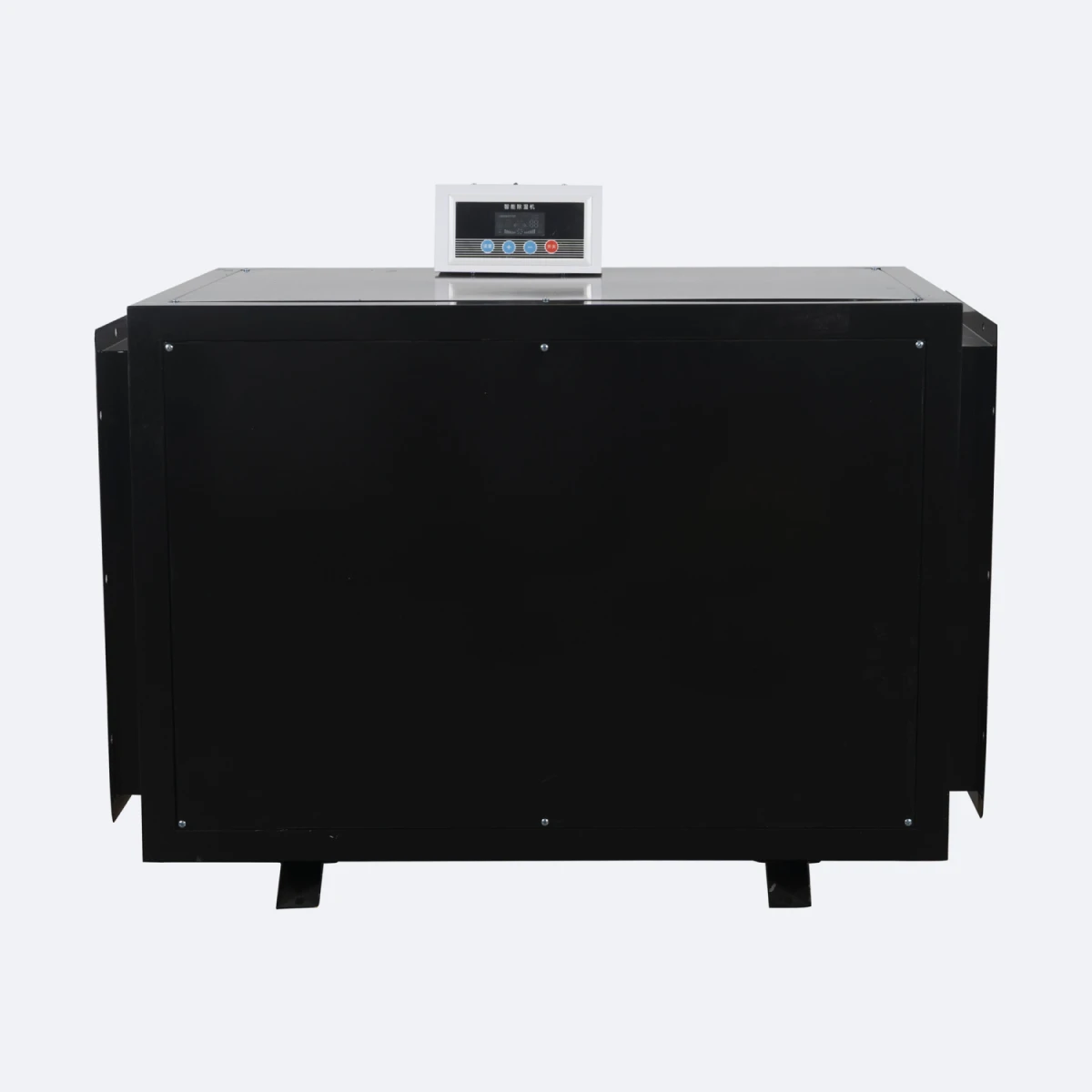
Where the GDH-CE180 / CE240 / CE288 Series Fits Best
The series is built for the kind of installation context where a floor-standing industrial dehumidifier would be in the way: active warehouses with forklift and pallet jack traffic, factory floors with operational equipment everywhere, archive and document storage facilities where floor area is fully racked, basement storage with low equipment access tolerance, and switchgear rooms where floor equipment competes with electrical cabinets for space.
The applicable scenarios from the product specification — warehouses, workshops, archives, storage rooms, basements, vaults, switchgear rooms and garages — describe environments where ceiling-mounted installation delivers measurable operational benefits beyond just humidity control. The three capacity tiers (180, 240, 288 L/day) cover the typical industrial dehumidifier for warehouse use case — single-zone industrial spaces from 180 to 350 m² floor area. For larger warehouse coverage, multi-unit deployment of two or three CE-series ceiling units distributed across the space typically outperforms a single oversized floor-standing unit on both moisture removal coverage and floor area preservation.
Concealed Ceiling Installation — The Space-Saving Logic for Warehouses
Industrial dehumidifier for warehouse installations face a specific design conflict: warehouses need every square meter of floor space for racking, palletizing, forklift travel paths, and inventory staging, but warehouses also need substantial dehumidification capacity to prevent moisture damage to stored goods. Floor-standing industrial dehumidifiers — even high capacity industrial dehumidifier units — consume that valuable floor space, block aisles, and sit directly in forklift damage paths.
The ceiling-mounted format solves the conflict by moving the equipment entirely into the ceiling structure space. Specific operational benefits:
- Zero floor footprint. A floor-standing equivalent industrial dehumidifier for warehouse use at the 180–288 L/day capacity range occupies 0.4–0.6 m² of floor area plus service clearance — often more than 1 m² of effectively unusable floor space per unit. The ceiling-mounted format consumes zero floor area.
- Removed from forklift damage paths. Floor-standing equipment in busy warehouses takes forklift impact damage regularly, particularly during peak loading periods. Ceiling installation eliminates this damage path entirely.
- Better air distribution in high-ceiling warehouses. Warehouses typically have 4–8 m ceilings; ceiling-mounted equipment positioned at ceiling level distributes conditioned air downward through natural convection patterns, achieving better humidity uniformity than floor-mounted equipment that has to fight the natural stratification of warm humid air rising.
- Distributed deployment across large spaces. Multiple ceiling units across a large warehouse ceiling provide more uniform coverage than one or two large floor-standing central units, with the additional benefit that maintenance on one unit does not require taking the entire facility's dehumidification offline.
Three Capacity Tiers — Sizing for Warehouse Coverage
The three-tier structure maps to typical industrial dehumidifier warehouse and workshop installation sizes:
- GDH-CE180 (180 L/day, 180–240 m²) — small-to-mid warehouses, single-zone industrial workshops, dedicated archive and document storage rooms, switchgear bays. Typical deployment: one unit per zone in smaller operations.
- GDH-CE240 (240 L/day, 200–300 m²) — standard commercial warehouses, mid-sized manufacturing spaces, vault and secure storage facilities. The most common configuration in mid-sized operations.
- GDH-CE288 (288 L/day, 260–350 m²) — large warehouses, full industrial workshop floors, multi-bay storage facilities. A true large industrial dehumidifier for warehouse use at this single-unit coverage scale.
For warehouses above 350 m² floor area, distributed multi-unit deployment is the standard engineering approach — two or three CE-series units distributed across the ceiling provide better humidity uniformity than oversizing a single point. For facilities above roughly 600 m², the floor-standing industrial dehumidifier range with capacities up to 1440 L/day offers higher single-unit coverage when ceiling installation is impractical or when floor space is available for the equipment.
Why an Industrial Dehumidifier for Warehouse Use Differs from Standard Equipment
Warehouse environments combine three operational conditions that demand industrial-grade dehumidification rather than commercial or residential equipment:
- Continuous duty cycle. Warehouses operate 24/7 — moisture intrusion from loading dock door openings, weather fluctuations, and stored goods off-gassing happens continuously, not in discrete cycles. Industrial-grade equipment is designed for sustained operation across multi-year service intervals.
- High moisture intrusion loads. Loading dock door openings during peak shipping periods can introduce thousands of liters of outdoor air per hour. Cardboard packaging, pallets, and stored goods themselves release moisture. A residential or light commercial dehumidifier cannot keep up with these intrusion rates.
- Material damage prevention requirements. Warehouse damage modes include metal corrosion above 50 % RH, cardboard compressive strength loss above 80 % RH, paper yellowing and mold above 60 % RH, wood warping above 60 % RH, and electronics moisture damage above 65 % RH. ASHRAE generally recommends warehouse RH below 50 % for moisture-sensitive storage — a target the GDH-CE series meets across its full coverage range when properly sized.
The combination of high airflow (2200–2400 m³/h per unit), continuous-duty refrigeration components, and industrial-grade safety protections distinguishes this industrial size dehumidifier from lighter commercial equipment that operates intermittently. Standard equipment running continuously at warehouse duty cycles typically fails within 12–18 months; industrial-grade equipment built for the application reaches 8–10 year service lives in the same conditions.
Compressor-Cycle Refrigeration with All-Copper Coil
All three models use sealed R32 compressor refrigeration cycles with all-copper evaporator and condenser coils. The high-performance compressor is specified for continuous industrial duty, and the all-copper coil construction (versus aluminum-tube assemblies common in lower-cost units) provides better thermal conductivity, longer service life, and resistance to formicary corrosion that affects aluminum coils in damp warehouse air over time.
The High Efficiency Rotary Fan delivers 2200–2400 m³/h airflow through the unit — significantly higher than the airflow rates on comparable-capacity residential or light commercial equipment. The higher airflow drives faster room air turnover, which is what produces uniform humidity distribution across large warehouse spaces. The intelligent humidity sensing system maintains target RH within ±3 % of setpoint, and the integrated timer function allows scheduling for lower-humidity overnight setpoints during periods of minimal facility activity.
R32 Refrigerant — Standard Charge, Regulated-Market Compliance
All three models use R32 refrigerant (HFC single-component, GWP 675, A2L mildly flammable) with factory-sealed circuits as the standard configuration. R32 is the established compliance choice across regulated global markets — EU under the revised F-gas Regulation (EU 2024/573), UK, Japan under the Fluorocarbons Emissions Control Law, Australia, and increasingly across North America, China, and other markets phasing out legacy HFC blends. Single-component composition eliminates the fractionation risk associated with blended refrigerants during charge and top-up service — a meaningful maintenance advantage for precision equipment operating on multi-year service cycles in mission-critical cleanroom, pharmaceutical, and data center installations. R32 charge volumes are compact — below the IEC 60335-2-40 charge limits for the installation category, with exact charge specified per model in the technical documentation package provided at order. For facility safety policies that require additional ventilation analysis for A2L refrigerant in confined cleanroom or laboratory installations, we provide the charge and ventilation reference data required for the assessment.
For facility safety standards that specifically prohibit any flammable refrigerant in occupied production areas — a policy still applied in certain pharmaceutical validated cleanrooms, sterile manufacturing suites, and legacy-specification data centers — R410A is available as an ODM configuration from MOQ 200 units. R410A (HFC blend, GWP 2088, non-flammable) remains a valid selection where facility policy overrides GWP considerations, though it is under phase-down schedules across the EU, UK, US, and other regulated markets — most new-build projects specify R32 or absorb the safety analysis needed to permit R32 in occupied spaces to align with 2027–2032 regulatory milestones.
380V Three-Phase Power and Installation Requirements
All three models run 380V three-phase only. At rated power inputs of 2800–3400 W, single-phase operation would require dedicated 16–20 A branch circuits — possible but impractical for most warehouse electrical infrastructure designed around three-phase distribution. Three-phase operation provides better motor efficiency at this power level, lower inrush current at startup, and balanced load distribution across the warehouse's three-phase service.
For North American markets without 380V/50Hz infrastructure, 460V/60Hz three-phase specification is available as an ODM modification from MOQ 50 units. Each unit needs a dedicated three-phase branch circuit sized per the rated input current (roughly 6–7 A per phase at rated input for the GDH-CE180, scaling to 8–9 A per phase for the GDH-CE288). The two voltage versions are not field-convertible after delivery.
Structural Mounting in Warehouse Ceilings
At 70–85 kg net weight per unit, ceiling mounting requires structural support beyond standard T-bar suspended ceiling rails. Recommended mounting approaches:
- Threaded rod from structural beam — four M10 or M12 threaded rods from overhead steel structure or reinforced concrete beam, with vibration-isolation mounts at the unit attachment points. This is the standard approach in warehouses with open structural ceilings.
- Steel angle frame bolted to beam — for warehouses with deeper beam spacing or where threaded rod span exceeds practical limits, a steel angle frame distributes the load across multiple structural members.
- Custom bracket from ODM — for specific installation patterns or non-standard mounting requirements, custom brackets can be specified as ODM additions from MOQ 50 units.
The drain port is on the side of the cabinet; allow access to the drain side during installation planning. Service access is also from below — the bottom panel removes for filter access and compressor service, so install with adequate clearance below the unit (typically 600 mm minimum for service work).
Continuous Hose Drainage
All three models drain by continuous hose connection — no internal water tank. At 180–288 L/day extraction, continuous unattended drainage is the only practical mode. Each unit ships with a corrosion-resistant drain hose suitable for industrial use.
For ceiling-mounted installations, the drain endpoint typically sits below the unit (warehouse floor drains, mechanical room sumps), making gravity drainage straightforward. Route the drain hose with continuous downward slope at 1–2 % gradient to the drain endpoint. For unusual installations where the drain endpoint is at or above the unit's outlet height (rare in ceiling installations), an external condensate pump rated 200–400 L/h is required between the unit and the drain. The condensate pump is not included; specify it in the OEM BOM if your installation channel needs it factory-bundled.
Distinguishing from Other Industrial Dehumidifier and Ceiling Variants
We offer multiple industrial dehumidifier formats across our range. Choose by installation context and capacity:
- This series (ceiling-mounted industrial commercial dehumidifier, 180–288 L/day) — Right for: active warehouses, factory floors, archive storage where floor space matters, switchgear rooms and similar industrial environments where ceiling installation removes the equipment from operational paths.
- Industrial dehumidifier floor-standing (180–1440 L/day, 10 capacity tiers) — Right for: industrial installations where floor space is available, larger capacity needs above 288 L/day per unit, or installations where ceiling structural support is inadequate for ceiling mounting.
- Industrial swimming pool dehumidifier (anti-corrosion, 380–1440 L/day) — Right for: corrosive industrial environments including pools, marine industrial, chemical processing, food production with chlorinated cleaning. Stainless steel cabinet and epoxy-coated copper coil protect against the corrosion conditions that destroy standard powder-coated equipment.
- Ceiling mounted dehumidifier (small, 38 L/day) — Right for: small commercial offices, hotel guest rooms, small retail spaces, and other applications where the much larger industrial CE-series is over-specified.
- Ducted dehumidifier (90–168 L/day, 4 capacity tiers) — Right for: commercial HVAC-integrated installations where dehumidification is part of the building's central air handling, rather than standalone industrial operation.
Same engineering principles across the range, different form factors and feature sets matched to the installation environment.
Build and Safety
1.0 mm cold-rolled steel cabinet with electrostatic powder coating in standard industrial finish. Internal electrical components receive moisture-proof conformal coating before assembly. Each unit is leakage-tested at full extraction conditions before shipping. Multiple safety protections are integrated: high-pressure cut-out, overcurrent protection on each phase, defrost interlock, fault alarm with real-time operational alerts, compressor thermal cut-out, phase-loss detection on the three-phase input, and refrigerant low-charge protection. The fault alarm system provides specific error codes on the LCD panel and (with ODM addition) dry-contact alarm relay outputs for integration with warehouse BMS or fire alarm control panels.
OEM and ODM Service
As a Chinese industrial dehumidifier manufacturer with full-spectrum OEM and ODM capabilities for the ceiling-mounted industrial range, we support brand customization from MOQ 10 units per model. OEM scope covers branding, cabinet color (any RAL or Pantone for visible surfaces, though the standard black finish is widely accepted for warehouse installations), plug type or terminal block configuration for the destination market's three-phase standard, control firmware language, and packaging artwork. Common OEM additions for installation-channel buyers include extended power cord length, factory-bundled condensate pump and drain hose kits, custom mounting brackets sized to the destination's ceiling structure standards, and pre-fitted return-air filters with documented replacement schedules.
ODM scope covers alternative refrigerant (R32 from MOQ 200), 460V/60Hz North American specification from MOQ 50, BMS integration (Modbus RTU from MOQ 50, BACnet/KNX from MOQ 200), control firmware customization for facility-specific automation, custom mounting bracket designs from MOQ 50, and certification routing (CE, RoHS, ETL, SAA, GS depending on target market). Production lead time is 30–40 days after artwork sign-off, FOB Ningbo or Shanghai.
For other capacity tiers and configurations, browse the full commercial dehumidifier lineup.