Search

Enter keywords to search for products, blog posts, and more.

Humidifier for Textile Industry — Humidity Control for Spinning, Weaving, Knitting, and Yarn Processing

Humidifier for Textile Industry — Humidity Control for Spinning, Weaving, Knitting, and Yarn Processing


Why Humidity Is a Production Variable in Textile Manufacturing

In most industries humidity is a comfort parameter; in textiles it is a process variable as fundamental as furnace temperature or mold pressure. Every stage — opening, carding, spinning, winding, warping, weaving or knitting, finishing — is affected by the moisture of the air around the material. Inadequate humidity raises the yarn-break rate, and each break stops a machine, cutting utilization across a shed of hundreds of looms; it also releases more fiber fly and dust into the air and onto machine surfaces. Three principles explain why humidity drives both quality and revenue:

Fiber strength and elasticity depend on moisture content

Natural fibers (cotton, wool, linen, silk) absorb moisture into their structure, lubricating the molecular chains and making the fiber more pliable. Cotton at 65% RH has measurably higher tensile strength and elongation than the same fiber at 40% RH; wool shows ~15% greater elasticity at 70% vs 60% RH (American Institute of Textile Technology). This directly determines the breakage rate in spinning and weaving. Synthetics are less affected in strength but far more prone to static at low humidity.

Static electricity accumulates below 50–55% RH

As fibers and yarns move at high speed over guides, rollers, and needles, friction generates electrostatic charge. Above ~55% RH the surface moisture provides a conductive path that dissipates charge as fast as it builds. Below that, resistance rises and static accumulates: fibers repel each other and resist drafting, yarn sticks to machine parts, lint and fly cling to charged surfaces, and fabric shows clinging and uneven drape. Every yarn break stops a machine — even a small rise in break rate cuts production across a shed of hundreds of looms.

Textile weight is standardized at 65% RH and 20°C

The international standard for weighing textiles (ISO 139) specifies 65% RH and 20°C. Yarns and fabrics are sold by weight, so when the floor runs drier, moisture regain drops and the product weighs less than it would at standard. For a mill producing 80 tonnes of yarn per day, a 2–4% regain shortfall is 1.6–3.2 tonnes of 'missing' weight daily — product made but never paid for. Holding 65% RH in processing and storage ensures the product reaches its standard weight.

SHISHUO Ultrasonic Humidifiers for Textile Applications

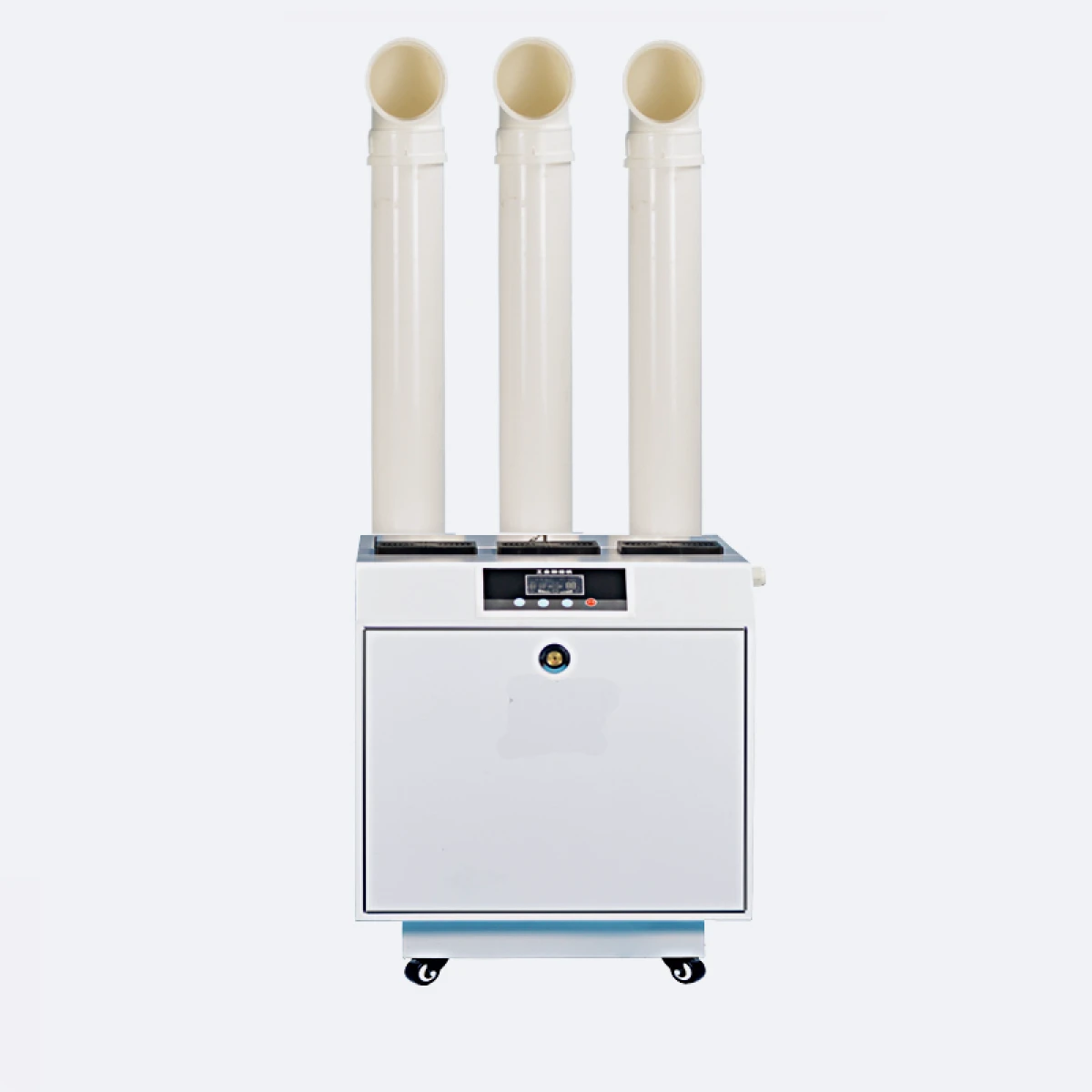
The UH-DS series produces a fine mist of 0.5–5 micron droplets that evaporates rapidly in the ambient air without wetting yarn, fabric, or machinery — a critical requirement in mills where surface moisture on the product is unacceptable. The droplets discharge through vertical mist outlets and disperse naturally with the production hall's air circulation. For large halls, multiple smaller units distributed across the floor give more uniform humidity than one large unit in a corner.

Option 1 — UH-DS Heavy-Duty Humidifier for Textile Mills

For weaving and spinning floors where static and lint directly affect yield, our 15-21 kg/h tier is purpose-built for textile environments:

Reduces lint and static while improving product yield in textile production; quiet operation supports fixed or pipeline installation across production floors.

UH-DS-15E

UH-DS-15E
Capacity (Kg/h):15
Atomizing Particles (μm): 0.5-5
Power:220V/50Hz

view details

UH-DS-18E

UH-DS-18E
Capacity (Kg/h):18
Atomizing Particles (μm): 0.5-5
Power:220V/50Hz

view details

UH-DS-21E

UH-DS-21E
Capacity (Kg/h):21
Atomizing Particles (μm): 0.5-5
Power:220V/50Hz

view details

Option 2 — UH-DS Ultra-Large Humidifier for Textile Production Lines

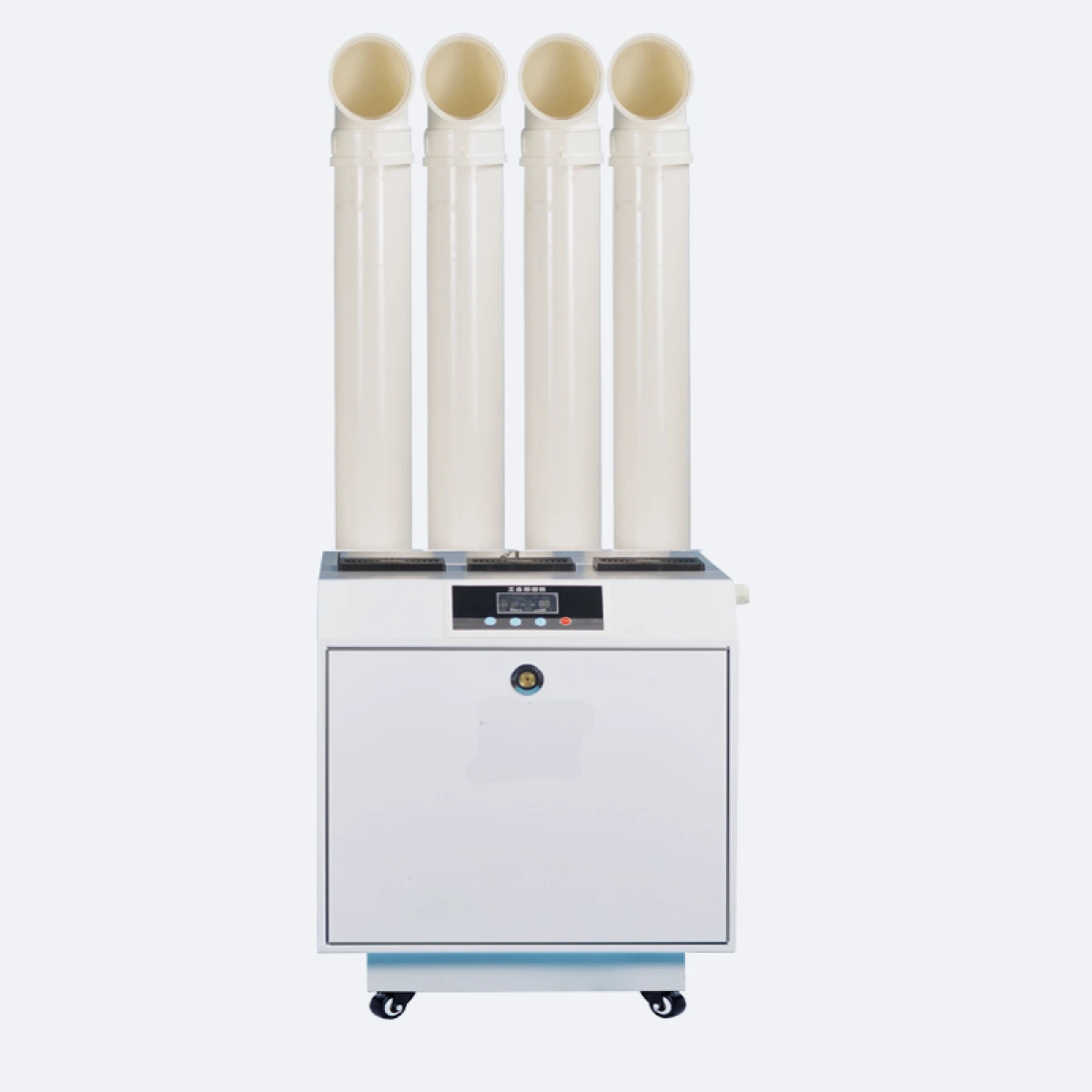
Scaling to entire production halls, our 24-30 kg/h units maintain consistent RH across large textile facilities:

Highest atomization output in the lineup for large open-floor mills; low energy use per kg of moisture added.

UH-DS-24E

UH-DS-24E
Humidification Capacity (kg/h):24
Atomizing Particles (μm):0.5-5
Power:220V/50Hz

view details

UH-DS-27E

UH-DS-27E
Humidification Capacity (kg/h):27
Atomizing Particles (μm):0.5-5
Power:220V/50Hz

view details

UH-DS-30E

UH-DS-30E
Humidification Capacity (kg/h):30
Atomizing Particles (μm):0.5-5
Power:220V/50Hz

view details

Recommended Humidity Levels by Textile Process

Each process and fiber type runs with minimum defects in a specific humidity window. The table below maps the major textile processes to their recommended RH range and the primary benefit of holding it. The exact target within each range depends on local climate, ventilation rate, machine speed, and fiber grade; a humidity controller integrated with the humidifier maintains the chosen set-point.


Process / AreaFiber TypeRecommended RH RangePrimary Benefit
Opening, blowing, cardingCotton55–65% RHReduce fiber breakage; suppress dust and fly
CombingCotton, wool55–65% RHMaintain fiber length; reduce nep formation
Ring spinning, rotor spinningCotton55–65% RHReduce end breaks; improve yarn evenness
Ring spinningWool65–75% RHIncrease elasticity; reduce drafting breaks
Winding and warpingAll fibers60–70% RHMinimize static; reduce package defects
Weaving (shuttle or rapier)Cotton, blends65–75% RHReduce warp breaks; decrease loom stoppages
WeavingSilk65–70% RHMaintain pliability; prevent splitting
WeavingSynthetics55–65% RHControl static; reduce clinging
KnittingAll fibers55–65% RHPrevent needle breakage; reduce dropped stitches
Yarn storage / conditioningAll fibers60–70% RHAchieve standard regain weight before sale


Matching Humidifier Capacity to Textile Mill Requirements

Humidification capacity (kg/h of water evaporated) depends on the air volume, the ventilation rate that continuously removes humidified air, the target RH, and the local climate — a mill in a dry inland climate needs far more capacity than the same mill on a humid coast. The four representative facilities below show typical model selection.
01

Small Workshop (single process)

100–300 m² · 2–6 kg/h

UH-DS-02E to UH-DS-06E

02

Medium Spinning Mill Section

300–600 m² · 6–12 kg/h

UH-DS-06E to UH-DS-12E

03

Large Spinning Mill / Weaving Shed

600–1,500 m² · 12–21 kg/h

UH-DS-12E to UH-DS-18E or multiple smaller units

04

Large Weaving / Knitting Hall

1,000–2,000 m² · 18–30 kg/h

UH-DS-18E to UH-DS-30E or multiple units

Key considerations for textile humidification:

Four factors determine whether a textile humidification system pays for itself: matching RH to the fiber and process, controlling static, achieving standard weight regain, and protecting the units with good water quality.
Match RH to the fiber and process — cotton spinning 55–65%, cotton/blend weaving 65–75%, wool 65–75%, synthetics 55–65% for static control.
Hold humidity above 55–60% RH to dissipate static — below that, charge builds faster than it dissipates and yarn fights the machine.
Maintain 65% RH (ISO 139) in processing and storage so the product reaches standard weight regain — under-humidification is direct revenue loss.
Use purified or softened water to prevent mineral dust on yarn/fabric and to extend atomization plate life toward the rated 3,500–5,000 hours.

Need a Sizing Calculation for Your Greenhouse?

Send us your greenhouse dimensions, cultivation stage, target humidity, and operating temperature. Our engineering team will recommend the right SHISHUO model and capacity.

Request Sizing Download Catalog amy@shishuodehu.com

Installation and Operation Notes for Textile Mill Use

Placement and Distribution

Place units near the machines with the highest humidity demand — the ring/rotor spinning section in a mill, the loom aisles in a weaving shed where warp tension and friction peak. The vertical outlets discharge mist upward to mix with ambient air and disperse with building circulation. Avoid placing units directly above open yarn packages or fabric rolls; too short an evaporation distance risks localized wetting in very humid conditions.

Integration with Ventilation

Every air exchange removes humidified air and replaces it with drier outdoor air, so the humidifier must be sized to overcome continuous loss. High-air-change areas (carding, blowroom dust removal) carry a correspondingly higher load. Position units downstream of the air supply diffusers so the mist mixes with incoming air and is carried across the production zone rather than immediately exhausted.

Water Quality and Maintenance

Ultrasonic units atomize water as-is — minerals, chlorine, and particulates carry into the mist. Hard water leaves white dust on surfaces (including yarn and fabric) and clogs plates faster. Feed purified (RO/DI) water for best results, or softened water at minimum. Clean the basin weekly to prevent biofilm/scale, and replace atomization plates proactively at the rated 3,500–5,000 hours rather than waiting for visible output loss.

Monitoring and Seasonal Adjustment

All UH-DS models include automatic control. Install the sensor at the point of use — near the frames or looms at yarn height, not at the ceiling or near a supply vent — and set the target to the midpoint of the process range (e.g. 65% RH for cotton weaving). Demand swings by season: winter outdoor air at 20–30% RH needs heavy humidification, while monsoon humidity may instead call for SHISHUO GDH dehumidifiers, switched seasonally.

Frequently Asked Questions

What humidity level should a textile mill maintain?

It depends on the fiber type and process stage. Cotton spinning typically requires 55–65% RH. Cotton and blend weaving runs best at 65–75% RH. Wool processing benefits from 65–75% RH. Synthetic fiber processing needs 55–65% RH primarily for static control. Yarn storage and conditioning rooms should maintain 60–70% RH to achieve standard weight regain. The specific target within these ranges depends on your machine speeds, fiber grade, and local conditions.

Will the mist wet the yarn or fabric?

No, under normal operating conditions. SHISHUO UH-DS humidifiers produce droplets of 0.5–5 microns. At this size, the droplets evaporate in the ambient air before they can settle on surfaces. The purpose is to raise the moisture content of the air, not to apply water to the product. The yarn and fabric reach the correct moisture level by equilibrating with the humidified air. Maintain a minimum distance of 1.5–2 meters between the mist outlet and the nearest yarn or fabric surface to ensure complete evaporation.

How does humidity reduce static electricity in textile processing?

Static charge builds on fiber surfaces when friction occurs at low humidity. The fiber's surface moisture provides a conductive path that dissipates charge as it forms. Above approximately 55% RH, most textile fibers have sufficient surface conductivity to prevent significant static accumulation. Below this level, charge builds faster than it dissipates, causing fibers to repel each other, attract to machine surfaces, and generate visible sparking in extreme cases. Maintaining humidity above 55–60% RH eliminates static as a processing problem.

How much water does a textile mill humidifier use?

Usage depends on the humidification capacity needed. A UH-DS-12E running at full output consumes 12 liters of water per hour, or approximately 96 liters in an 8-hour shift. A larger UH-DS-30E at full output uses 30 liters per hour, or 240 liters per shift. Actual consumption is lower when the humidity controller cycles the unit off after reaching the set-point. In humid seasons, water consumption drops significantly.

How often do the atomization plates need to be replaced?

SHISHUO atomization plates are rated for 3,500–5,000 hours of operation. At 16 hours per day (two shifts), this is approximately 7–10 months. Using purified or softened water extends plate life toward the upper end of this range. Hard water accelerates plate wear and mineral buildup. Plates are replaceable consumables — the sealed, waterproof atomization core is designed for easy plate swap without replacing the entire unit.

Can I use tap water in the humidifier?

The unit will operate with tap water, but mineral content affects both the air quality and the plate lifespan. Hard water minerals are atomized into the air and can deposit as white dust on surfaces, including on yarn and fabric. For textile applications where product cleanliness matters, purified water (RO or deionized) is recommended. At minimum, use softened water to extend atomization plate life.

Can SHISHUO humidifiers be installed in a fixed position or through a pipeline?

Yes. The UH-DS series supports fixed, mobile, and pipeline installation setups. For large textile production halls, a pipeline distribution system carries humidified air from the unit to multiple discharge points across the floor. Contact our team for pipeline configuration options.

Do SHISHUO humidifiers support OEM and ODM?

Yes. We manufacture all units at our Jiaxing production base. We support OEM branding and ODM modifications including capacity customization, voltage adaptation, control system changes, and housing modifications for integration into existing textile HVAC systems.

Get the Right Climate Control
Solution for Your Application

We support industrial temperature and humidity control projects with clear specifications, stable equipment, and practical system advice. Share your application details and capacity requirements—our team will respond with a suitable solution and quotation.

Get a Quick Quote

Amy

General Manager