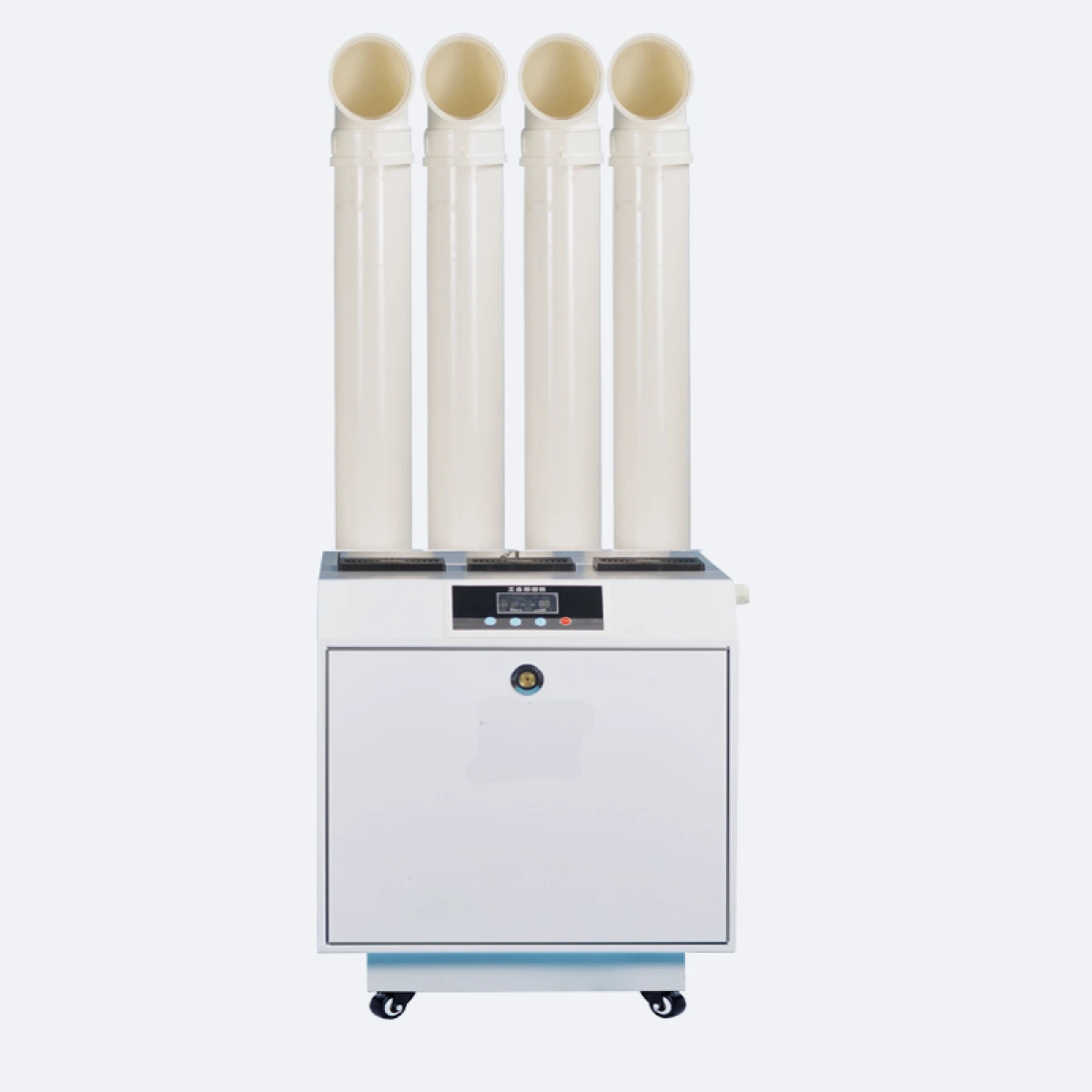
How Does an Ultra-Large Capacity Industrial Ultrasonic Humidifier Achieve High Volumes?
As documented in our technical spec manuals like image_6eb200.jpg, an ultra-large capacity industrial air ultrasonic humidifier operates via high-density mechanical oscillations to maintain high volume output. Rather than heating large bodies of water to boil them into steam or utilizing high-pressure pump spray grids that are susceptible to mineral clogs, this robust equipment incorporates an open fluid reservoir tank. Positioned inside this tank is a massive multi-transducer core array featuring 8, 9, or 10 independent high-grade atomizing plates vibrating at ultrasonic speeds.
This mechanical oscillation shatters the surface layer of incoming water, producing an incredibly dense, cool vapor cloud composed of 0.5–5 micron mist particles. A series of heavy-duty built-in blowers drive this mist upward into four separate 110 mm diameter outlets. Because the atomized particles are microscopic, they mix into local plant air currents near-instantly, increasing relative humidity evenly across vast footprints without creating any water pooling or dampness on machinery, electronic panels, or floors.
Why Choose an Ultrasonic Mist Maker Core System Over Conventional Steam Humidifiers?
When B2B logistics engineers and sourcing managers contrast an industrial humidifier ultrasonic layout against traditional steam-boiler options or high-pressure nozzle loops using references like image_6eb200.jpg, the efficiency metrics become compelling. High-pressure hydraulic mist systems yield uneven droplet patterns that fall out of suspension quickly, creating slick floors and causing corrosion on structural iron columns. Thermal steam injection designs require immense electricity to constantly boil water, driving facility overhead higher.
Our commercial ultrasonic mist humidifier flagship series strikes a smart operational balance. By maintaining an unheated micro-mist output, it guarantees total air absorption with zero condensation fallout risk. Furthermore, because the piezoelectric mechanism uses mechanical energy rather than heat to break up water molecules, the high-capacity UH-DS-24E, 27E, and 30E units achieve maximum output using only 2400W to 3000W of power. This low energy consumption helps optimize facility operating costs while maintaining static-free manufacturing.
Cross-Sector Industrial Applications: Eradicating Static, Dry Air, and Fuzz
The extensive capacity thresholds and heavy-duty configurations highlighted in our analytical blueprints make this series exceptionally well-suited for massive manufacturing environments, warehouses, workshops, and large storage rooms:
- Semiconductor Cleanrooms and Electronics Plant-Wide Assembly: Completely neutralizes Electrostatic Discharge (ESD) risks by maintaining precise relative humidity levels across major automated surface-mount lines.
- Large-Scale Textile Mills and Spinning Halls: Minimizes loose airborne fibers and dust while maintaining moisture levels in natural and synthetic yarns to prevent thread breakages on rapid industrial looms.
- Paper Mills and Commercial Printing Complexes: Stabilizes large paper stock sheets to prevent curling, shrinkage, web-tears, and print misalignments caused by rapid moisture loss.
- Agricultural Cultivation and Food Storage Systems: Delivers high-volume, reliable moisture support for large industrial fungus cultivation rooms, commercial greenhouse zones, and extensive vegetable preservation storage.
Water Quality Management and Maintenance Optimization for Peak Lifespan
To maximize the long-term ROI of an industrial ultrasonic humidifier manufacturer layout, adopting a structured water treatment plan is essential. Because the ultrasonic transducers atomize the liquid pool completely, feeding hard tap water into the system will cause dissolved mineral solids (calcium and magnesium carbonates) to be thrown into the air, settling over time as fine white dust. This white dust can clog pre-filters, foul optical sensors, and form scale crusts over the atomizing plates, reducing operational lifespans.
Our engineering team strongly recommends feeding the stainless steel cabinet with a reverse osmosis (RO) or deionized (DI) purified water loop. Supplying the system with purified water ensures that the multi-plate internal waterproof cores maintain their 3,500 to 5,000 hour operational thresholds without performance loss. Combined with simple weekly cleanouts through the built-in drainage port, this setup ensures clear, scaling-free performance year after year across heavy industrial operations.