How Does a Heavy-Duty Ultrasonic Humidifier Optimize Plant-Wide Air Saturation?
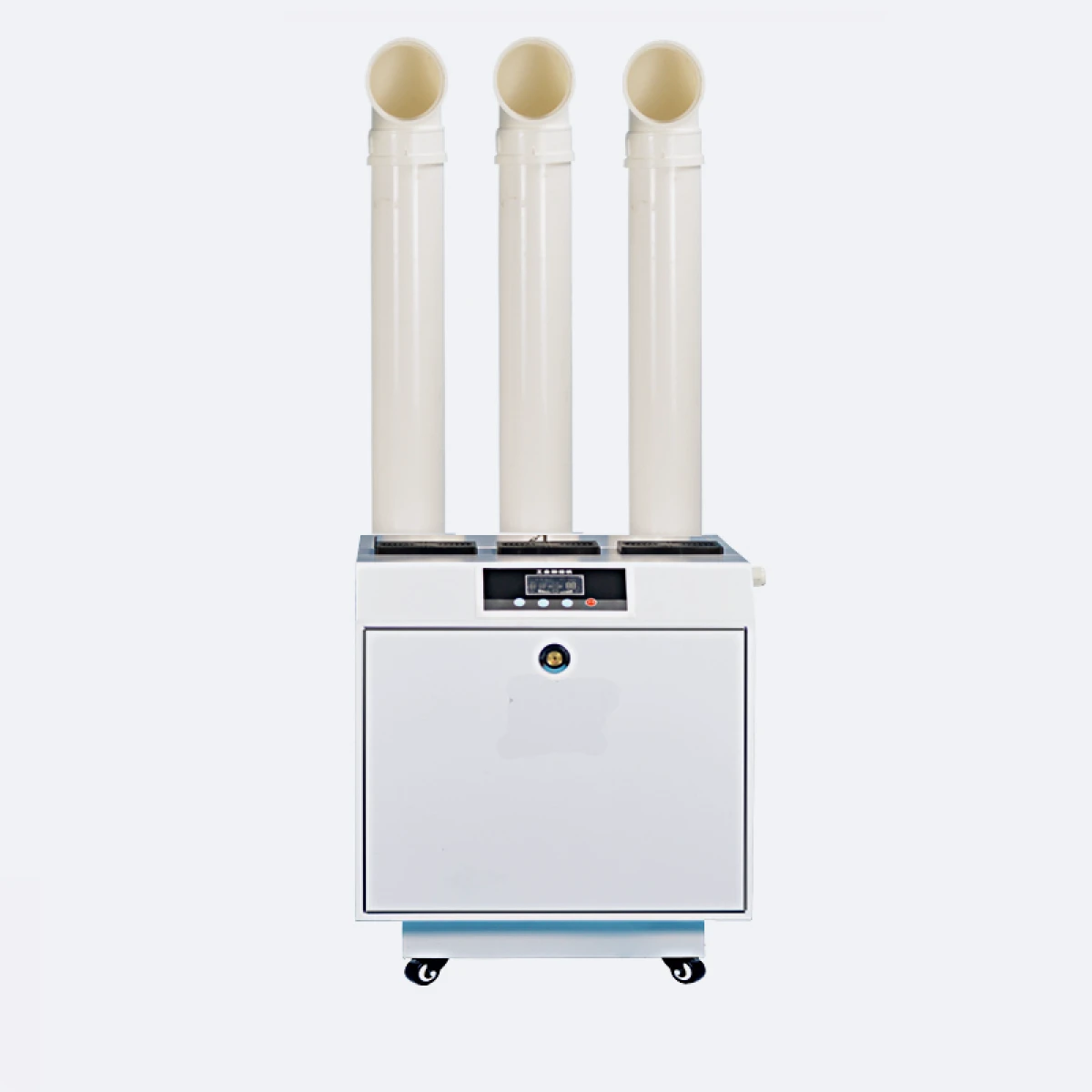
As illustrated in the comprehensive technical guidelines of image_6eae1e.jpg, a heavy-duty industrial humidifier ultrasonic system relies on intense ultrasonic cavitation fields to process bulk fluid volumes. Rather than forcing water under high pressures through tiny orifices that are prone to scaling and clogging, or consuming massive currents to boil water into steam, this equipment maintains an integrated unheated tank. Submerged within this tank are multi-plate transducer configurations (5, 6, or 7 plates depending on the exact model) vibrating at ultrasonic frequencies.
This mechanical shaking tears the fluid boundary apart into an incredibly dense, non-scalding vapor stream containing microscopic droplets between 0.5–5 microns. High-volume internal blowers route this mist upward through three independent 110 mm diameter outlets. Because these droplets are microscopic, they dissolve into ambient air currents almost instantly, lifting local relative humidity without leaving wet spots or pools on nearby automation setups, delicate electronics, or processing equipment.
Why Choose an Ultrasonic Mist Maker Configuration Over High-Pressure Spray Alternatives?
When B2B procurement teams and facility managers cross-reference keyword tables across image_562ca3.jpg and image_6eae1e.jpg, the efficiency advantages of choosing an industrial ultrasonic humidifier become clear. Traditional high-pressure impinging nozzle sprayers or centrifugal mist disks yield highly uneven droplet distributions. These heavy droplets frequently fall out of suspension before vaporizing, causing dangerous floor puddles, corrosion on racking, and micro-short risks inside floor-mounted electrical cabinets.
Our heavy-duty commercial ultrasonic humidifier series solves this fallout challenge completely. The ultra-fine 0.5–5 micron mist guarantees air suspension and rapid drying, offering total environmental protection. Furthermore, because the piezoelectric transducer arrays require far less energy to divide water particles than a thermal steam boiler needs to break down latent heat boundaries, the UH-DS-15E, 18E, and 21E systems extract peak performance using only 1500W to 2100W of power. This low energy consumption significantly lowers long-term commercial operating costs.
Cross-Sector Industrial Applications: Eradicating Static, Dry Air, and Fuzz
The large-scale parameters and robust construction details shown in our image_6eae1e.jpg documentation make this machinery well-suited for diverse commercial ecosystems, warehouses, workshops, archives, storage rooms, basements, vaults, switchgear rooms, and garages:
- Electronics and Semiconductor Cleanrooms: Eliminates Electrostatic Discharge (ESD) threats by holding plant-wide humidity at exact setpoints, protecting multi-layer PCBs and boosting automated assembly line yields.
- Textile Mills and Spinning Floors: Captures airborne dust and lint while preserving the intrinsic moisture content of natural and synthetic fibers to minimize thread breakages on high-speed industrial looms.
- Paper Mills and Printing Houses: Controls room moisture to stop paper curling, dimensional shrinking, or feeding misalignments on high-speed multi-color presses or automated cutting beds.
- Agricultural Cultivation and Food Storage: Provides stable, high-volume humidity support across large industrial fungus cultivation rooms, specialized greenhouse planting bays, bird-nesting complexes, and seafood fresh-keeping lines.
Water Quality Management and Maintenance Routines for Heavy Industrial Systems
To maximize the long-term ROI of an industrial ultrasonic humidifier manufacturer layout, establishing a proper water treatment protocol is essential. Because the ultrasonic transducers atomize the liquid pool completely, using hard, untreated municipal tap water causes dissolved mineral elements (such as calcium and magnesium) to be thrown into the air, settling out over time as fine white dust. This white dust can clog pre-filters, foul optical sensors, and form hard scale crusts over the atomizing plates, reducing operational lifespan.
Our application engineering team recommends pairing the UH-DS-15E, UH-DS-18E, and UH-DS-21E systems with a dedicated reverse osmosis (RO) or deionized (DI) purified water supply. Supplying the stainless steel cabinet with purified water allows the internal waterproof cores to easily achieve their 3,500 to 5,000 hour operational design thresholds. Combined with routine flushes through the bottom drain port, this proactive maintenance keeps your system running at maximum efficiency without mineral buildup or scale degradation.