How Does an Industrial Ultrasonic Humidifier Operate and Maximize Vaporization?
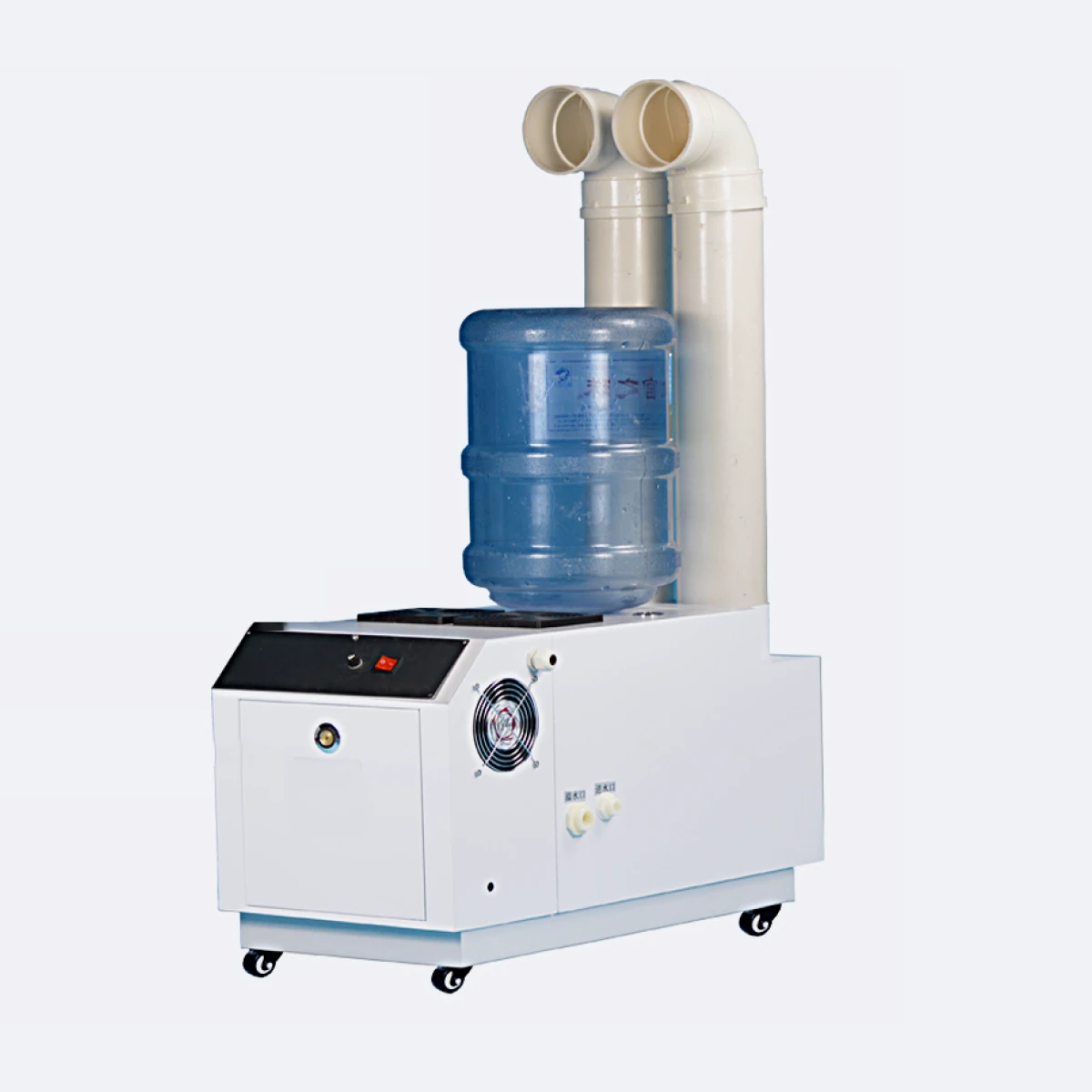
As captured in our primary layout records such as image_601285.jpg, an industrial air ultrasonic humidifier operates via high-frequency mechanical oscillations. Rather than boiling water to form steam or forcing liquid through narrow, clogging orifices under intense hydraulic pressures, this machinery features an integrated reservoir pool backed by an array of high-durability piezoelectric transducers. These atomizing plates vibrate at ultrasonic frequencies, causing localized cavitation bubbles to form and collapse rapidly along the liquid surface.
This mechanical action shatters the surface tension of the water, throwing off a highly concentrated, non-scalding vapor stream consisting of 0.5–5 micron mist particles. A built-in water-level protection circuit acts as a continuous safety cutoff, preventing dry burning faults if the incoming water pressure drops. The vapor stream is directed upward by heavy-duty internal blowers into dual 110 mm diameter mist outlets, allowing the micro-droplets to mix seamlessly into plant-wide HVAC ducts or diffuse directly into open production floors via specialized pipeline setups.
Why Choose an Ultrasonic Mist Maker Configuration Over Traditional Misting Methods?
For global industrial buyers cross-referencing keyword datasets across image_562ca3.jpg and image_601285.jpg, choosing an industrial humidifier ultrasonic setup over alternative humidification systems presents measurable bottom-line improvements. High-pressure atomizers or centrifugal sprayers often create large, heavy water droplets that drop straight to the floor, resulting in dangerous slippery surfaces, corrosion on structural steel columns, and micro-shorts inside nearby control cabinets. Steam-injection boilers completely eliminate this risk but incur massive electrical bills due to the constant latent heat requirements of water vaporization.
Our commercial ultrasonic mist humidifier series combines the best of both configurations. By maintaining a highly refined, low-temperature micro-mist output, it guarantees total air saturation without any risk of condensation fallout or wetting. Furthermore, because the piezoelectric mechanism generates high-density vapor with minimal mechanical resistance, it draws a fraction of the power required by steam-generating boilers. This high efficiency cuts down daily facility operating overhead while ensuring complete environmental safety across static-sensitive manufacturing cells.
Cross-Sector Industrial Applications: Eradicating Static, Dry Air, and Fuzz
The technical parameters and heavy-duty capabilities outlined in our analytical files make the UH-DS-09E and UH-DS-12E lines exceptionally well-suited for diverse commercial ecosystems:
- Electronics Assembly and Semiconductor Cleanrooms: Eliminates dangerous Electrostatic Discharge (ESD) threats by maintaining a constant relative humidity environment. This prevents micro-faults on bare multi-layer PCBs and boosts final automated wafer-sorting yields.
- Textile Mills, Spinning Liners, and Weaver Halls: Suppresses airborne lint, loose fibers, and dust particles while stabilizing yarn moisture content. This significantly minimizes thread breakage rates on high-speed industrial looms.
- Commercial Printing and Paper Manufacturing: Controls moisture levels to prevent paper curling, shrinkage, web-tears, and misaligned colors caused by moisture imbalances during high-speed multi-color print runs.
- Agricultural Cultivation and Food Logistics: Provides excellent humidity support across industrial fungus cultivation rooms, specialized greenhouse planting bays, bird nesting facilities, and seafood preservation displays.
Water Quality Management and Maintenance Optimization for Long-Term Service
To maximize the long-term ROI of an industrial ultrasonic humidifier manufacturer layout, implementing a structured water quality management plan is essential. Because ultrasonic transducers atomize everything within the liquid pool, feeding raw, hard tap water into the system will cause dissolved mineral solids (calcium and magnesium carbonates) to be thrown into the air, settling out over time as fine white dust. This white dust can foul delicate optical sensors, clog fine mesh pre-filters, and form scale crusts over the atomizing plates, reducing operational lifespans.
Our application engineers recommend pairing the UH-DS-09E and UH-DS-12E systems with a dedicated deionized (DI) or reverse osmosis (RO) purified water loop. Feeding the stainless steel cabinet with purified water ensures that the internal waterproof cores maintain their 3,500 to 5,000 hour operational thresholds without performance loss. Combined with routine cleanout steps via the built-in drainage port, this setup ensures clear, scaling-free performance year after year across heavy industrial operations.