Search

Enter keywords to search for products, blog posts, and more.

Portable Air Conditioner for Warehouse — Spot Cooling for Work Zones, Loading Docks, and Heat-Sensitive Storage

Portable Air Conditioner for Warehouse — Spot Cooling for Work Zones, Loading Docks, and Heat-Sensitive Storage


Why Spot Cooling Makes Sense in Warehouses

Warehouse cooling is best approached as a targeting problem, not a whole-building one. The work zones that actually need cooling — packing stations, loading docks, inspection points, heat-sensitive inventory — are a small fraction of the floor area, so conditioning the entire volume wastes capital and energy. Spot cooling also suits the seasonal nature of warehouse heat: deploy units in the hot months, store them the rest of the year, with no idle infrastructure cost. Three reasons spot cooling fits the warehouse:

Worker heat stress is a safety and compliance issue

Heat-related illness in warehouses is a recognized occupational hazard. OSHA's proposed Heat Injury and Illness Prevention standard (NPRM, August 2024) sets an initial trigger at 80°F (27°C) heat index and a high-heat trigger at 90°F (32°C); California's indoor heat standard (effective July 2024) triggers obligations at 82°F (28°C). Productivity also falls as indoor temperature rises above 25°C — picking, packing, and loading generate metabolic heat that compounds the load. A spot cooler at a workstation or rest area satisfies the cool-area requirement and keeps throughput up.

Cooling the whole building is impractical for most warehouses

A 5,000 m² warehouse with 10 m ceilings holds 50,000 m³ of air. Conditioning that to 25°C when it is 35–40°C outside would need 150–250 kW of cooling plus full commercial HVAC and ductwork. But the actual work zones — packing, loading, inspection — may total only 200–500 m². A portable AC targets just those zones, delivering the same comfort benefit at a fraction of the capital and energy cost.

Heat damages inventory and materials

Beyond worker comfort, heat degrades stored goods: adhesives and labels lose bond strength, chocolate and pharmaceuticals deform or degrade, electronics lose shelf life, and plastic packaging and stretch wrap soften and tear. A spot cooler positioned near temperature-sensitive inventory creates a localized cool zone that protects product quality without conditioning the whole storage area.

SHISHUO Portable Air Conditioners for Warehouse Applications

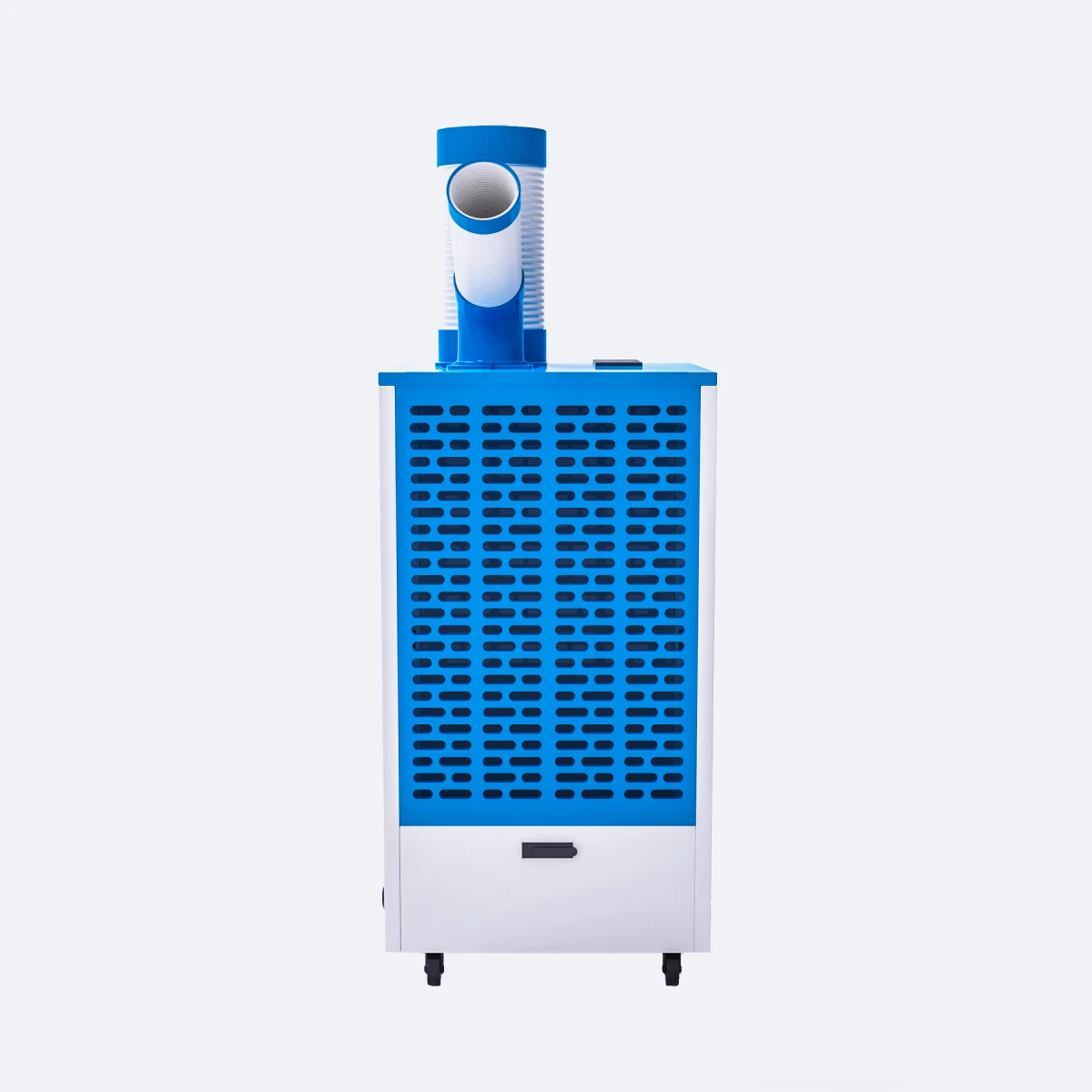
The SSPAC series covers five models from 2,700 W to 5,000 W: SSPAC-27 (~10 m²), SSPAC-35 (~15 m²), SSPAC-40 (~20 m²), SSPAC-45 (~25 m²), and SSPAC-50 (~30 m²). All share compressor cooling with a directional cold air outlet (120 mm), a hot air exhaust duct (180–220 mm), a 24-hour timer, touch-screen automatic temperature control, high/low fan speed, R290/R32 refrigerant, and heavy-duty casters. The 'applicable area' figures are the effective spot-cooling zone immediately around the outlet — in an open warehouse the unit creates a comfortable microclimate at the workstation, not whole-building conditioning.

Option 1 — SSPAC Portable Spot Cooler for Warehouse Work Zones & Loading Docks

The entire range designed for exactly this application: delivering focused cold air to specific work zones, packing stations, and loading dock areas without conditioning the whole 5,000+ m² air volume. Pick the capacity that matches your zone size:

Five capacity tiers from 2,700 W to 5,000 W of directional cooling, rolling on heavy-duty casters and plugging into a standard 220V outlet — no installation, ductwork, or building modification. Built-in air filtration removes dust and particulates common in warehouse air, and cooling can be redirected to whichever work zone needs it that shift.

SSPAC-27

SSPAC-27
Cooling Capacity:2700W
Applicable Area:10 m²
Power:220V/50Hz

view details

SSPAC-40

SSPAC-40
Cooling Capacity:4000W
Applicable Area:20 m²
Power:220V/50Hz

view details

SSPAC-50

SSPAC-50
Cooling Capacity:5000W
Applicable Area:30 m²
Power:220V/50Hz

view details

Option 2 — HSJ Precision Air Conditioner for Heat-Sensitive Storage Zones

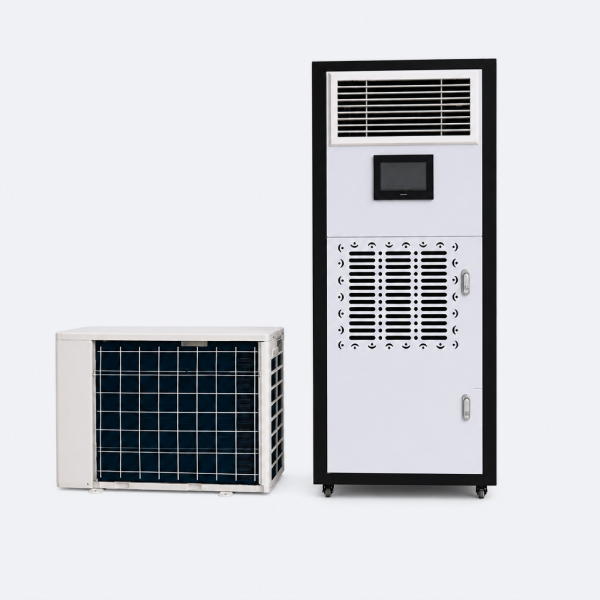
For warehouse zones storing heat- or humidity-sensitive goods — pharmaceuticals, electronics inventory, batteries, packaged food — where a spot cooler alone can't hold a tight setpoint, our HSJ precision units scale from small enclosed storage rooms up to mid-size holding halls:

CPU smart control with self-diagnosis and power-off memory, imported sensors for real-time temperature and humidity monitoring, copper heat exchanger, and auto defrost/drainage/overflow protection — designed for continuous, unattended operation in enclosed storage areas.

HSJ-15

HSJ-15
Cooling Capacity (kW):15
Applicable Area, 3 m Ceiling (m²):35-55
Power:220V/380V

view details

HSJ-20

HSJ-20
Cooling Capacity (kW):20
Applicable Area, 3 m Ceiling (m²):60-80
Power:220V/380V

view details

HSJ-30

HSJ-30
Cooling Capacity (kW):30
Applicable Area, 3 m Ceiling (m²):80-120
Power:380V

view details

How to Choose the Right Portable AC for Your Warehouse

The right model depends on the work zone and its heat challenge. The matrix below maps common warehouse zones — from a single packing station to a heat-sensitive inventory area — to the recommended SSPAC model and deployment. Deploy one unit per zone: the 120 mm outlet is effective within about 3–5 m, beyond which the cooling dissipates into the ambient air.


Warehouse ZoneTypical Heat ChallengeRecommended ModelDeployment
Single packing stationWorker heat stress, 1–2 workersSSPAC-27One unit per station, cold air aimed at worker position
Packing line, 3–5 workersMultiple workers, continuous activitySSPAC-35 or SSPAC-40One unit per 15–20 m² section of the line
Loading dockHot outdoor air infiltration, physical laborSSPAC-45 or SSPAC-50Position at worker staging area, exhaust to exterior
Quality inspection areaProduct temp-sensitivity + worker comfortSSPAC-35 to SSPAC-45Cold air directed at both worker and product
Shipping/receiving office within warehouseEnclosed room, moderate heat loadSSPAC-27 or SSPAC-35Exhaust through window, wall port, or drop ceiling
Temporary seasonal work zoneSeasonal peak, variable locationSSPAC-40 to SSPAC-50Roll into position as needed; store off-season
Break room / cool-down area (OSHA compliance)Worker heat recovery between shiftsSSPAC-35 to SSPAC-45Enclosed or semi-enclosed rest area; runs continuously
Heat-sensitive inventory storage zoneProduct protection from heat damageSSPAC-45 or SSPAC-50Focused on a specific pallet zone or racking section


Warehouse Spot Cooler Sizing — Matching Units to Work Zones

Sizing a warehouse spot cooler differs from sizing a sealed room: you are not lowering the temperature of the whole space, but creating a cooled microclimate around a workstation or storage zone. Expect a 5–10°C reduction within 3–5 m of the outlet versus ambient. The four work-zone types below show typical model selection.
01

Single Workstation (1–2 workers)

5–10 m² zone

SSPAC-27 (2,700 W) — directional cooling of one position

02

Multi-Person Workstation (3–5 workers)

10–20 m² zone

SSPAC-35 or SSPAC-40 — higher airflow (800–1,200 m³/h) covers a wider zone

03

Loading Dock Worker Area

15–25 m² zone

SSPAC-45 (4,500 W) — compensates for hot air infiltration from open dock doors

04

Semi-Enclosed Office / Product Zone

10–30 m² zone

SSPAC-35 to SSPAC-50 — semi-enclosed space sized by area; product protection zones too

Key considerations for warehouse spot cooling:

Four principles set the right expectations: spot cooling creates a microclimate, one unit per zone, the units double as heat-compliance equipment, and they scale with the season.
Spot cooling, not whole-building — expect a 5–10°C reduction within 3–5 m of the outlet versus ambient, not a uniform room temperature.
Deploy one unit per work zone — multiple units at each workstation cover more than one large unit trying to reach a wide area.
A compliance tool — units serve as the cool rest area or workstation cooling OSHA's heat standard and California's indoor heat rule call for.
Seasonal flexibility — deploy in the hot months and store off-season, with no idle infrastructure cost or dormant rooftop maintenance contract.

Need a Sizing Calculation for Your Greenhouse?

Send us your greenhouse dimensions, cultivation stage, target humidity, and operating temperature. Our engineering team will recommend the right SHISHUO model and capacity.

Request Sizing Download Catalog amy@shishuodehu.com

Installation and Operation Notes for Warehouse Use

Heat Exhaust Routing

Warehouses vent exhaust more easily than enclosed rooms: route the duct through a nearby bay door, man-door, window, or wall port, or into a drop-ceiling plenum over an office/mezzanine. In open space with no nearby wall or ceiling, direct the exhaust away from the worker toward an uninhabited area — the worker still feels cooled air from the front while the warm exhaust exits the rear, diluted across the large building volume.

Positioning for Maximum Effect

Place the unit 1–3 m from the worker with the 120 mm cold outlet aimed at the upper body — this is a focused stream, not diffuse room cooling, so alignment matters. For a packing line, position the unit so the cold stream sweeps along the line; for a loading dock, place it between the dock door and the worker staging area so cooled air reaches the worker before mixing with hot incoming air.

Condensate & Power

Humid warehouses produce significant condensate — the 10 L (SSPAC-27) or 20 L tank fills faster in high humidity. For continuous operation, connect an external drain hose to a floor drain or container; without a floor drain, add a backup tray and check it during shifts. All models run on 220V/50Hz single-phase (SSPAC-50 draws 2,300 W); install a dedicated outlet per location — extension cords are not recommended for sustained industrial use.

Mobility & Off-Season Storage

All units have heavy-duty casters and weigh 55–78 kg, so one or two workers can reposition them without mechanical assistance. Off-season, roll the unit to storage, drain any remaining condensate, and cover the exhaust and cold air outlets to keep dust out — there is no idle infrastructure cost when cooling is not needed.

Frequently Asked Questions

Can a portable air conditioner cool an entire warehouse?

No — and that is not the intended use. A portable AC is a spot cooler: it creates a localized cool zone around a specific workstation, loading area, or storage section. Cooling an entire warehouse requires central HVAC infrastructure sized for the full building volume. The advantage of a portable unit is that it delivers effective cooling precisely where it is needed at a fraction of the cost and with no permanent installation.

How many portable air conditioners do I need for my warehouse?

One unit per work zone is the starting point. Count the number of locations where workers spend extended time or where temperature-sensitive goods are stored, and assign one appropriately sized SSPAC unit to each. A 5,000 m² warehouse with four active packing stations and one loading dock might need five units. Contact our team with your layout and we can recommend a multi-unit configuration.

Will a portable AC help with OSHA heat compliance in my warehouse?

Yes. OSHA's proposed Heat Injury and Illness Prevention standard requires employers to provide access to cool-down areas and take measures to reduce heat exposure when indoor temperatures exceed 80°F (27°C). A portable air conditioner can serve as the cooling source for a designated rest area or provide direct spot cooling at a workstation. California's indoor heat standard (effective July 2024, triggered at 82°F / 28°C) has similar requirements. Having portable cooling units on-site demonstrates that engineering controls are in place to manage heat exposure.

Where does the hot air exhaust go in an open warehouse?

Ideally, route the exhaust through a bay door, man-door, window, or wall port to the building exterior. If that is not practical, direct the exhaust away from the worker and the cold air stream. In an open warehouse, the exhaust heat dissipates into the large air volume of the building. The worker still experiences net cooling because the directional cold outlet delivers concentrated cooled air directly to their position, while the exhaust heat is diluted across the much larger warehouse space.

How much does it cost to run a portable AC in a warehouse?

Operating cost depends on the model, hours of use, and local electricity rate. The SSPAC-35 draws 1,500 W. At a typical U.S. commercial electricity rate of $0.10/kWh, running the unit for 10 hours per day costs approximately $1.50 per day, or roughly $30–45 per month for a 5-day work week. This is a fraction of the cost of installing and operating central HVAC for an entire warehouse.

Can the units handle extreme warehouse temperatures above 40°C?

SHISHUO SSPAC compressor units are designed for commercial and industrial environments. Performance decreases as ambient temperature rises — at very high temperatures the compressor works harder and cooling output relative to the heat load is reduced. In warehouses that routinely exceed 40°C, the unit may not achieve the same temperature differential as in a 30–35°C environment. However, even a 5°C reduction at the workstation provides meaningful heat stress relief for workers.

Do SHISHUO warehouse portable ACs support OEM and ODM customization?

Yes. We support OEM branding and ODM modifications including voltage adaptation (110V/60Hz for North America, 220V/50Hz standard), modified duct configurations, custom colors, and control interface changes. Contact our team with your requirements and quantities.

Get the Right Climate Control
Solution for Your Application

We support industrial temperature and humidity control projects with clear specifications, stable equipment, and practical system advice. Share your application details and capacity requirements—our team will respond with a suitable solution and quotation.

Get a Quick Quote

Amy

General Manager