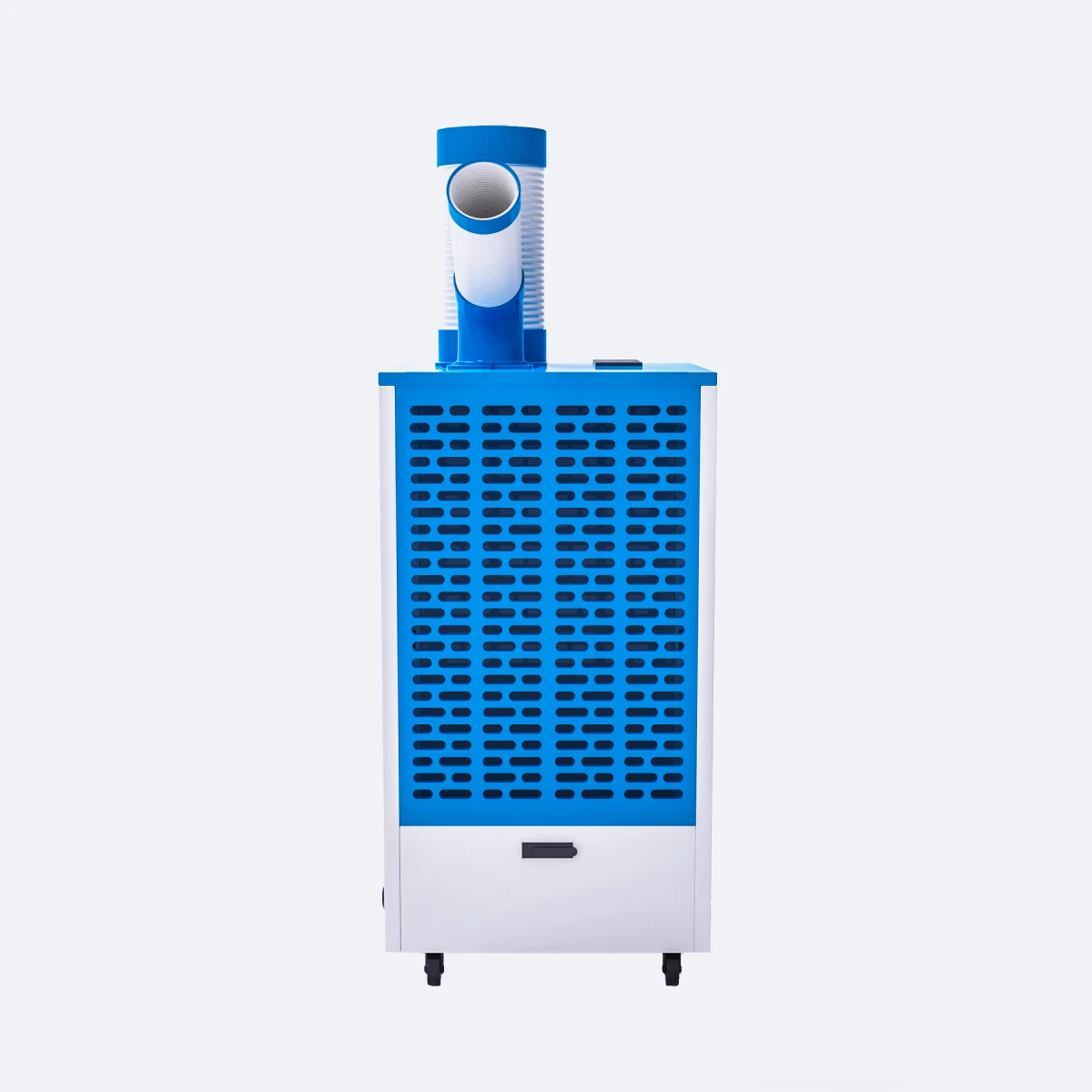
Where the SSPAC Industrial Spot Cooler Series Fits Best
The SSPAC range is sized for industrial spot cooling applications where central air conditioning is impractical, uneconomic, or not deployable on the operational timeline that production requires. Five capacity tiers cover the typical industrial spot cooling load profile from individual workstations (SSPAC-27 at 10 m² coverage) up to multi-station industrial bays and event spaces (SSPAC-50 at 30 m² coverage). The 220V single-phase power supply runs on any standard commercial electrical outlet — no three-phase wiring requirement, no electrical service upgrade, no installation permit process before deployment.
Typical industrial spot cooler installations across the capacity range: heat-stress relief at welding stations, induction furnaces, and casting operations (SSPAC-27 and SSPAC-35); single workshop bay cooling and quality control booth conditioning (SSPAC-40); larger workshop area and exhibition cooling (SSPAC-45); large industrial bay and event space cooling (SSPAC-50). Beyond the industrial setting, the same equipment serves commercial spot cooler use cases — retail back-of-house, kitchen prep areas, server room emergency cooling, and rental fleet deployment.
Why a Portable Industrial Spot Cooler Instead of Central Air Conditioning
Central air conditioning is the right answer for whole-building cooling in new construction or major retrofit. For the majority of industrial spot cooling applications it is the wrong answer for three reasons:
- Deployment timeline. Central AC installation requires architectural planning, electrical service review, ductwork design, permit processing, equipment procurement, and installation labor — typically 6–18 months from decision to operation. An industrial spot cooler ships in 30–45 days from order and operates within 30 minutes of arrival on site. For production environments responding to heat-stress complaints, summer cooling failures, or temporary equipment loads, the timeline difference is operationally decisive.
- Capital cost. Central AC retrofit for an industrial facility typically runs USD 50–200 per square meter installed, plus building permit and electrical service upgrade costs that often double the equipment cost. Spot cooling at point-of-need costs 5–15 percent of equivalent central retrofit for the same effective cooling outcome — because spot cooling targets the actual thermal load rather than conditioning the entire building envelope.
- Operating economics. Central AC operates against the full building thermal load whenever cooling is required anywhere in the building. Industrial spot cooling consumes power only when and where cooling is actually needed — at the worker station during shift, at the equipment during peak load periods, at the event space during use. Annual energy consumption for spot cooling is typically 20–40 percent of equivalent central system operation for the same effective cooling outcome.
For applications where central AC is correct (whole-building cooling, large continuous occupancy spaces, new construction), spot cooling is not a substitute. For point-of-need cooling in industrial and commercial settings, the SSPAC industrial portable spot cooler air conditioner range provides the deployable solution that central AC cannot.
Five Capacity Tiers — Matching Spot Cooler to Thermal Load
The five-tier capacity structure provides fine-grained sizing across the industrial and commercial spot cooling range:
- SSPAC-27 (2700 W cooling capacity, Large 1P compressor, 10 m² coverage) — small zones, individual workstation cooling, small office and meeting room support, point-of-need cooling for heat-stress relief at single equipment positions.
- SSPAC-35 (3500 W, Large 1.5P, 15 m²) — mid-sized rooms, small workshop areas, 1–2 station cooling, retail kiosk and small commercial space cooling.
- SSPAC-40 (4000 W, Small 2P, 20 m²) — single workshop bay cooling, retail back-of-house and storage cooling, single quality control booth, mid-sized server room emergency cooling.
- SSPAC-45 (4500 W, 2P, 25 m²) — larger workshops, exhibition space cooling, restaurant kitchen prep area worker cooling, mid-sized event tents and pop-up retail.
- SSPAC-50 (5000 W, Large 2P, 30 m²) — large industrial bay cooling, event space cooling for tent/awning configurations, multi-station coverage in factories, larger commercial spot cooler deployment.
For zones above 30 m² floor area, distributed deployment of multiple units across the space typically outperforms a single larger unit by providing better local thermal targeting and built-in redundancy. For installations at the 30 m² boundary with high thermal loads (heavy industrial equipment, dense occupancy), the SSPAC-50 with paired deployment of an SSPAC-40 provides headroom for peak conditions.
Compressor Cooling with R32 or R290 Refrigerant
All five models use sealed compressor refrigeration cycles built for low-GWP refrigerant compliance across the world's regulated markets. R32 (HFC single-component, GWP 675, A2L mildly flammable) is the standard refrigerant across the range — the established choice for EU markets under the revised F-gas Regulation (EU 2024/573), Japan under the Fluorocarbons Emissions Control Law, Australia, and increasingly across North America, China, and other markets moving off legacy HFC blends. R32 combines high refrigeration efficiency, roughly one-third the GWP of R410A, and single-component composition that eliminates the fractionation risk associated with blended refrigerants during charge and top-up service.
R290 (propane, GWP 3, A3 flammable) is available as a factory configuration for markets specifying natural-refrigerant equipment — the EU F-gas roadmap toward ultra-low-GWP alternatives, Nordic and Northern European projects with strict natural-refrigerant procurement policies, and buyers targeting long-term regulatory-proof specification. The compact refrigerant charge typical of portable spot cooler equipment (less than 500 g per unit at this capacity tier) keeps R290 installations well within the IEC 60335-2-40 hydrocarbon charge limits for occupied spaces, and the sealed factory-charged circuit eliminates the field-handling risks that constrain R290 use in larger split systems.
For legacy replacement projects in markets still operating existing R410A service infrastructure, R410A remains available as an ODM modification from MOQ 200 units. Note that R410A is under phase-down schedules across the EU, UK, US, and other regulated markets — most new-build projects specify R32 or R290 to align with 2027–2032 regulatory milestones. R22 is not offered; it is prohibited under the Montreal Protocol across all destination markets we serve.
Heat-stress relief is the most common industrial spot cooler application. Welding stations, induction furnaces, casting operations, and other heat-intensive industrial processes create localized hot zones where workers experience elevated thermal loads even when the broader workshop maintains acceptable ambient conditions. Heat stress affects worker productivity (output drops 10–25 percent at sustained elevated WBGT), error rates (defect rates rise with thermal stress), and safety (heat-stress fatigue contributes to injury risk on equipment).
The SSPAC range provides targeted cooling at the worker position without conditioning the entire workshop. The 120 mm cold air outlet directs cooled airflow at the worker; the 180–220 mm hot air outlet routes waste heat to the workshop exterior through a duct extension. For workshops with multiple heat-stress zones, distributed deployment of SSPAC units at each station provides better outcome than oversized central AC trying to cool the entire shop. For 24/7 operations using the 24-hour cycle timer, the equipment runs unattended through unmanned shifts. The industrial spot cooling approach has documented productivity and safety improvement data in published occupational health literature.
Server room and IT equipment cooling typically runs through dedicated computer room air conditioning (CRAC) systems. When the CRAC fails — equipment age, refrigerant leak, control failure, electrical fault — server inlet temperature climbs rapidly toward thermal shutdown thresholds (typically 35 °C for Class A1 environments per ASHRAE TC 9.9). Without immediate supplemental cooling, the data hall faces server shutdown within hours of CRAC failure.
A portable industrial spot cooler provides emergency backup cooling that deploys in 30 minutes from arrival. Position the SSPAC at the rack inlet, route the cold air outlet directly into the cold aisle, exhaust hot air to the corridor or roof access point. Typical emergency deployments use 2–4 SSPAC-45 or SSPAC-50 units to cover a single rack row through the CRAC repair window — far less expensive than the production losses from server shutdown. For data centers with formal emergency cooling protocols, pre-positioned spot cooler units provide the response time that scrambling rental equipment cannot match.
Application: Commercial Spot Cooler for Retail, Hospitality, and Office
Retail and hospitality spot cooling applications include back-of-house storage cooling (where building HVAC underserves the back rooms), kitchen prep area worker cooling (commercial kitchens with significant cooking heat load), boutique shop cooling without HVAC retrofit (storefronts in older buildings without ductwork), event space and pop-up retail cooling (where temporary deployments don't justify HVAC investment), and wine cellar or storage emergency cooling during building HVAC failures.
The commercial spot cooler use case typically favors the SSPAC-35 through SSPAC-45 range — large enough for meaningful commercial space cooling, small enough to move between deployment sites and store between uses. For commercial buyers planning temporary commercial spot cooler deployments (seasonal pop-ups, summer event sites, construction office cooling), the rental-fleet-friendly design (24-hour timer, touch screen, simple operator interface) supports the operational model.
Application: Spot Cooler Rental Fleet Operators and Temporary Cooling Suppliers
Equipment rental companies operating industrial spot cooler rental and rent commercial spot cooler businesses need fleet equipment that survives the rental duty cycle — multiple deployments per month across different sites, operator handling by personnel unfamiliar with the equipment, exposure to varied environmental conditions, and the wear pattern of repeated transport. The SSPAC design supports the rental operation model with simple operator interfaces (touch screen with intuitive controls rather than complex parameter menus), robust wheels and chassis for site-to-site movement, 220V universal outlet compatibility (no three-phase electrical requirements at customer sites), and the 24-hour cycle timer for customer self-service operation.
For rental company OEM and private label arrangements, the SSPAC range supports brand customization at the standard MOQ 10 units per model. Common rental-company OEM modifications include custom cabinet color in fleet identification colors, fleet inventory numbering, control firmware language matching the rental territory, and packaging artwork. The industrial spot cooler rental and rental commercial spot cooler operators we supply typically run mixed fleets across the SSPAC range to serve different customer floor-area requirements with appropriate unit sizing.
Air Filtration — Dust, Pollen, and Bacteria Removal
The air filtration stage in each SSPAC unit captures dust, pollen, and airborne bacteria from the recirculated air stream. The filtration matters in three operational contexts:
- Industrial workshop environments. Manufacturing dust (machining debris, casting particulates, welding fume residue) accumulates in workshop air over time. Spot cooler operation with filtration captures this particulate at the cooling station, providing local air quality improvement at the worker position alongside the cooling function.
- Pollen-sensitive applications. Spring and summer pollen seasons drive elevated allergic-reaction symptoms in commercial spaces with significant outdoor air infiltration. Spot cooler filtration captures pollen as part of the cooling air handling, providing measurable improvement in workspace air quality during pollen seasons.
- Bacterial reduction. The air filtration stage captures airborne bacteria and other microbial particles, providing some hygiene benefit alongside cooling. For commercial applications where air quality matters (retail, hospitality, food service), the combined cooling-plus-filtration approach delivers more value than spot cooling alone.
Filter replacement interval depends on operating environment — typical commercial installations replace filters every 6–12 months; heavily-loaded industrial installations may require 3–6 month intervals. Replacement filters are standard parts available from regional distribution.
Cold Air and Hot Air Routing — Single-Cabinet Architecture
The SSPAC operates on a single-cabinet single-hose architecture: the unit pulls in room air, cools a portion (which discharges through the 120 mm cold air outlet directed at the cooling target), and exhausts the heated waste air through the 180 or 220 mm hot air outlet. The hot air outlet routes through a flexible duct to outside, to an adjacent unconditioned space, or to a discharge point above the cooled zone where the warm air does not interfere with the cooling effect.
This single-cabinet design differs from split system air conditioning (which separates the indoor evaporator unit from the outdoor condenser unit through refrigerant lines) — single-cabinet portable spot coolers do not require the outdoor condenser placement that split systems need, which is the key reason they deploy without installation. The hot air exhaust duct routes through any convenient window, wall penetration, or door opening; the standard duct length supports installations up to 4 meters from the cooled zone to the exhaust point.
For larger installations where the hot air exhaust would consume cooled space, an upgraded duct kit extends hot air discharge up to 6 meters from the unit. Custom duct extensions are available as OEM modifications from MOQ 50 units.
Touch Screen Control with 24-Hour Cycle Timer
The touch screen automatic control provides intuitive operation appropriate for both technically-trained operators and customer-facing rental deployments where the renter operates the equipment. The 24-hour cycle timer supports several operational patterns: scheduled operation during work shifts only (energy savings during unoccupied hours), pre-cooling of zones before shift start, continuous operation with daily filter status reset, and rental customer scheduled-return timing where the unit runs only during the contracted rental period.
The two-speed fan control (High / Low) balances cooling capacity against noise level — High speed for peak cooling performance during high thermal load periods, Low speed for quieter operation in office and commercial spaces where noise matters more than peak capacity. The control system reports water tank status (with automatic shut-off when the condensate tank fills) and fault codes for unattended operation reliability.
Distinguishing the SSPAC from Central AC and Other Cooling Equipment
Different cooling applications need different cooling equipment. Choose based on installation context, deployment timeline, and operational pattern:
- This SSPAC industrial spot cooler series (portable, 2700–5000 W, no installation) — Right for: point-of-need cooling, temporary deployments, rental fleet operations, emergency cooling backup, situations where central AC installation timeline or cost is impractical. The best portable industrial spot cooler configuration for B2B buyers requiring flexible cooling deployment.
- Central air conditioning (building HVAC, ductwork) — Right for: whole-building cooling in new construction or major retrofit, large continuous occupancy spaces, applications where the central system economics justify the installation cost and timeline. Not a substitute for spot cooling at point-of-need.
- Split system air conditioning (indoor + outdoor units) — Right for: fixed-location single-zone cooling in commercial buildings where outdoor condenser placement is available. Lower energy consumption than portable spot cooling for sustained continuous operation, but requires installation work that portable spot coolers do not.
- Window air conditioning — Right for: small fixed zone cooling where window installation is permitted and acceptable. Lower cost than portable spot cooler for single-room residential applications, but lacks the portability and flexibility for commercial spot cooler use cases.
- Spot fans and evaporative cooling — Right for: applications where air movement is sufficient and refrigeration cooling is not required. Lower cost than spot cooler but provides only air circulation, not actual cooling. Suitable for moderate climates and applications where temperature reduction is not critical.
- Industrial dehumidifier — Right for: humidity control rather than cooling. Different application — dehumidifier addresses moisture, not temperature.
- Humidifier and dehumidifier combo — Right for: bi-directional humidity control with air purification. Different application — does not provide cooling.
Build, Refrigerant Compliance, and OEM/ODM Service
Powder-coated steel cabinet with electrostatic finish in standard industrial colors (blue/white the standard combination, custom colors available as OEM modifications). The wheeled chassis supports site-to-site portability with smooth-floor caster wheels and lifting handles for movement over thresholds. Internal electrical components include moisture-proof conformal coating, high-pressure cut-out on the refrigeration circuit, compressor thermal protection, water tank overflow protection with automatic shut-off, and fault self-protection with audible alert on the touch screen interface. Each unit is fully function-tested at the factory including refrigeration circuit pressure verification, fan operation, water tank drainage, control firmware, and air filtration stage before shipping.
As an industrial spot cooler manufacturer with OEM and ODM capabilities, we support brand customization from MOQ 10 units per model. OEM scope: branding (logo, model badge), cabinet color customization in standard or custom RAL colors, fleet inventory numbering for rental company orders, control firmware language for destination market (English, Spanish, French, Arabic, Russian, German, Portuguese available), packaging artwork, and replacement filter media specifications. ODM scope: R32 refrigerant (from MOQ 200), 110V/60Hz North American specification from MOQ 50, alternative duct configurations and extended duct length kits from MOQ 50, BMS communication interface addition (RS-485 Modbus RTU from MOQ 50), custom touch screen interface for branded operator experience from MOQ 100, and certification routing (CE, RoHS, ETL, SAA, GS, UL depending on target market). Production lead time is 30–45 days after artwork sign-off for the SSPAC-27 to SSPAC-50 range. FOB Ningbo or Shanghai.
For other commercial cooling and climate control equipment, browse the full commercial dehumidifier lineup and related categories.