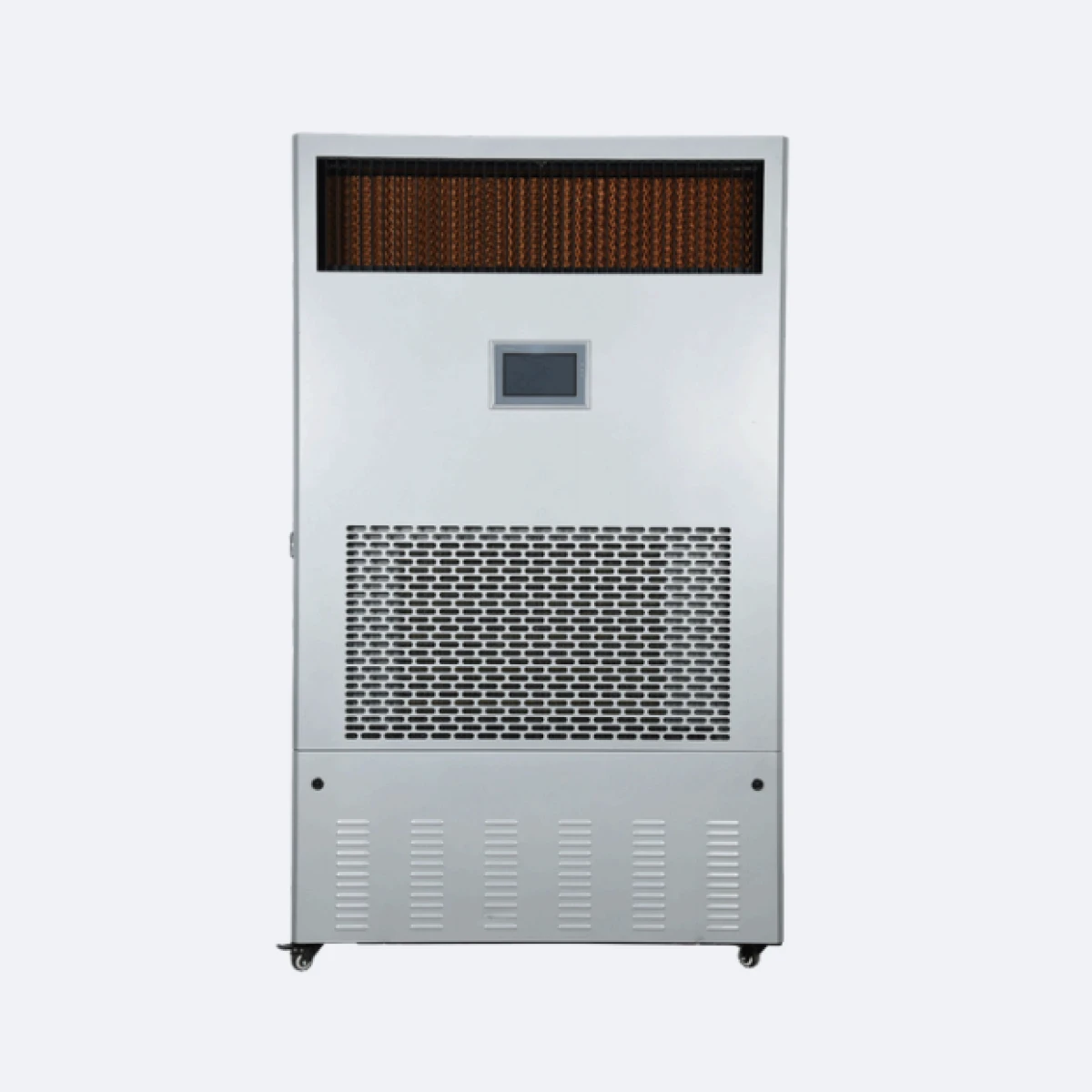
Where the DXSL-60 Combo Unit Fits Best
The DXSL-60 is sized for single-room installations at the 50 to 80 m² floor area scale where a compact humidifier and dehumidifier combo unit handles the full humidity and air quality requirement without the equipment footprint of the larger multi-tier ranges. The applicable scenarios listed on the product specification — telecommunication equipment rooms, switching rooms, network equipment rooms, offices, computer rooms, archives, document storage rooms, and electronic precision manufacturing workshops — describe the typical commercial single-room installations where this scale fits cleanly: a single equipment room, single back-office switching cabinet area, single archive vault, single laboratory room, or single small office floor.
For installations below 50 m², the smaller humidifier and dehumidifier combo tiers (DS-03HS at 10–40 m² and DS-06HS at 30–80 m²) provide lower-cost coverage. For installations above 80 m², the whole-house humidifier and dehumidifier combo range (DXSL-90 to DXSL-480, covering 90–400 m²) provides better capacity per unit cost. The DXSL-60 occupies the specific niche between these two ranges — single-room scale, DXSL-family component grade.
Why a Compact Single-Room Combo Unit Matters
Single-room industrial humidity control faces a procurement gap. Standalone dehumidifiers and humidifiers at this scale are widely available but solve only one direction of the humidity problem. Premium combo ranges typically start at 80–100 m² floor coverage and over-specify for the single-room application. The DXSL-60 fills the gap with a single-unit compact configuration that handles bi-directional humidity control plus air purification in the 50 to 80 m² installation context.
Three operational characteristics make the DXSL-60 the right choice at this scale:
- Bi-directional control in one cabinet. Heated equipment rooms drop to 15–25 % RH in winter; humid summer air pushes RH above 60 % in shoulder seasons. A humidifier and dehumidifier combo unit at this single-room scale handles both directions automatically through the built-in temperature and humidity sensors, maintaining the target RH year-round.
- RS-485 BMS standard. Even at single-room scale, modern facility management increasingly integrates equipment-room monitoring through a building management system. The RS-485 standard interface enables BMS connection without ODM modification — important because single-room procurement budgets often cannot support custom protocol work.
- Energy efficiency through scroll compressor and DC brushless fan. The energy profile at single-room scale is dominated by the fan and compressor; the DXSL-60's scroll compressor delivers good part-load efficiency and the DC brushless fan reduces fan power 30 to 40 percent against equivalent AC centrifugal designs at typical operating airflow.
What's Different: DXSL-60 vs the DXSL-90 to DXSL-480 Range
The DXSL-60 shares the DXSL family approach (wet-media humidification, RS-485 BMS standard, premium component specification) but uses different engineering choices appropriate to single-room scale. Five differences matter when comparing the compact DXSL-60 against the multi-tier whole-house humidifier and dehumidifier combo:
- Compressor. DXSL-60 uses a scroll compressor designed for the variable load typical of single-room application — long off cycles when room RH sits in the deadband, short on cycles when humidity transients drive active dehumidification. Scroll designs match this duty cycle better than the Hitachi rotary used on DXSL-90 to 480, which optimizes for continuous-load operation at larger scale.
- Air purification approach. DXSL-60 uses hydroxyl ion plus negative ion air purification. DXSL-90 to 480 uses UV-C sterilization plus negative ion. Both approaches are valid antimicrobial and air-quality strategies — the hydroxyl ion approach avoids UV lamp replacement (relevant in single-room installations where maintenance access scheduling is harder than in dedicated equipment rooms) and provides VOC breakdown capability that pure UV-C does not deliver.
- Fan. DXSL-60 uses a multi-speed DC brushless fan with variable speed control. DXSL-90 to 480 uses centrifugal fans. The DC brushless approach saves 30 to 40 percent fan power at typical operating speeds (matching the lower airflow needs of 60 m² coverage) and operates with substantially lower noise — important in single-office and archive installations where the equipment shares space with occupants.
- Cabinet and dimensions. DXSL-60 measures 650 × 500 × 1750 mm — narrow enough to fit standard doorways and tight against a wall in equipment rooms or offices. DXSL-90 to 240 measure 610 × 510 × 1600 mm (similar footprint, slightly shorter); DXSL-380 and 480 are substantially larger at 1190 × 450 × 1750 mm. For single-room installations with limited equipment footprint, the DXSL-60 dimensions matter.
- Single-phase 220V power. DXSL-60 runs 220V single-phase only — works on any standard commercial electrical infrastructure without requiring three-phase service. DXSL-90 to 240 offers 220V or 380V; DXSL-380 and 480 are 380V three-phase only.
Hydroxyl Ion Plus Negative Ion Air Purification
The DXSL-60 air purification stage combines two complementary ion technologies. Negative ions (typically O2⁻) settle particulate matter, reduce static electricity buildup, and provide sustained air-quality improvement. Hydroxyl ions (OH⁻ and related reactive species) are highly reactive radicals that break down volatile organic compounds at the molecular level — formaldehyde, benzene, alcohols, ammonia, and similar VOCs are oxidized by hydroxyl reactions into water and carbon dioxide.
Three operational advantages of the hydroxyl ion approach over UV-C sterilization in compact single-room installations:
- No lamp replacement. UV-C lamps require periodic replacement at 8000–12000 operating hours with documented output degradation tracking. Hydroxyl ion generation uses solid-state ionization that operates without consumable components — important in single-room installations where maintenance access requires coordinated downtime that disrupts the room's operations.
- VOC breakdown capability. UV-C is effective against bacteria, mold spores, and many viruses but does not break down VOCs. Hydroxyl ions actively break down formaldehyde, benzene, ammonia, and related airborne pollutants common in new construction, electronic equipment off-gassing, and cleaning chemical residue. For single-room offices in newly-renovated buildings or equipment rooms with significant electronic off-gassing, the VOC capability matters.
- Continuous operation. Both ion generators run continuously when the unit is powered, providing sustained air-quality improvement independent of the humidification or dehumidification cycle. UV-C sterilization also operates continuously, but the consumable lamp service life creates ongoing maintenance scheduling that ion-based approaches do not require.
For installations where UV-C sterilization is specifically required by facility protocol (some hospital, clinical laboratory, and pharmaceutical specifications mandate UV-C), the larger DXSL-90 to 480 range provides UV-C as standard. For applications requiring plasma sterilization (modern museum conservation, advanced pharmaceutical GMP), see the 2-in-1 humidifier and dehumidifier.
Energy-Saving Scroll Compressor for Single-Room Reliability
The DXSL-60 uses a scroll-type sealed refrigeration compressor. Scroll designs offer three operational advantages at single-room scale:
- Lower noise. Scroll compressors operate at lower noise than reciprocating or rotary designs at similar capacity — relevant in single-office and archive installations where the equipment shares space with occupants. The DXSL-60 noise level supports continuous operation in occupied spaces without operator complaint.
- Better part-load efficiency. Single-room dehumidification loads vary widely — the unit might run actively for 20 minutes per hour during humid afternoons, then sit idle through cool evenings and nights. Scroll compressors maintain efficiency across this part-load duty cycle better than reciprocating designs that lose efficiency at low load.
- Long service life. Scroll compressors have fewer moving parts than reciprocating designs and typically achieve longer service life at equivalent operating conditions. For single-room equipment-room installations where unscheduled compressor failure has direct operational consequences, the reliability margin matters.
The refrigeration cycle uses standard refrigerant-cycle condensation — air drawn across the cold evaporator coil, moisture condenses out, dehumidified air discharged through the wet-media humidification stage when humidification is needed or directly when dehumidification-only operation is appropriate. Automatic defrost handles low-temperature operation when ambient conditions drive coil icing.
High-Efficiency Wet-Media Humidification at Compact Scale
The wet-media humidification approach used on the DXSL-60 is the same technology used on the larger DXSL range, sized down to single-room output: 3 to 5 kg/h sustained humidification, equivalent to 72 to 120 L/day. Water saturates the high-efficiency environmental protection humidification film; air passes through the film; evaporation transfers moisture from the film surface to the air stream as vapor — no aerosol generation, no mineral fallout from source water, no contamination carried into the room from the humidification process.
For telecommunication equipment rooms and network equipment installations where airborne mineral residue affects equipment reliability over time, wet-media humidification provides an operational margin that ultrasonic humidification (which generates micro-droplets carrying mineral residues) cannot match. The 20 L water tank supports approximately 5 to 7 hours of peak-load humidification on the manual-fill configuration, or continuous operation on the automatic water supply configuration.
Multi-Speed DC Brushless Fan with Variable Speed Control
The DXSL-60 uses a multi-speed DC brushless fan with variable speed control across the 800 to 1200 m³/h airflow range. The DC brushless design offers two operational advantages over AC-driven centrifugal fans typically used in commercial dehumidification equipment:
- Energy efficiency. DC brushless motors operate 30 to 40 percent more efficiently than equivalent AC induction motors at typical commercial HVAC operating speeds. For 24/7 operation in equipment rooms and IT facilities, the fan power savings compound to meaningful annual energy cost reduction.
- Variable speed without losing efficiency. DC brushless motors maintain efficiency across the operating speed range, where AC motors with variable-frequency drives lose efficiency at speeds significantly below rated. For applications that need lower airflow at night or during light load periods, variable speed control without efficiency penalty matters.
Touchscreen Controller and RS-485 BMS Integration
The intelligent LCD touchscreen controller provides real-time temperature and humidity display, target setpoint adjustment with precision control, multi-speed fan mode selection, automatic vs manual water filling mode selection, alarm status indication including water leakage alerts, and BMS communication status. The RS-485 communication interface uses Modbus RTU protocol by default — the most widely-adopted protocol for industrial HVAC BMS integration.
For telecommunication equipment rooms integrated into the carrier's NOC monitoring platform, the BMS connection enables remote humidity setpoint adjustment, alarm forwarding, and runtime data collection for capacity planning. For multi-room facilities with multiple DXSL-60 units across different rooms, daisy-chained RS-485 connection through the facility BMS allows centralized control of all units from the facility management interface. For BACnet or KNX protocol requirements, firmware customization is available as an ODM modification from MOQ 50 units.
Application: Telecommunication Equipment Rooms and Switching Rooms
Telecommunication and switching equipment generates substantial dry heat year-round, dropping local RH to 15–25 % near the equipment racks even when building HVAC maintains higher RH in adjacent occupied zones. Major telecommunication carrier facility specifications target 45–55 % RH at the equipment level with active humidification. For single-equipment-room installations sized 40 to 80 m², the DXSL-60 provides the right capacity with the right level of facility automation integration — RS-485 BMS standard, audible and visual fault alarms, and water leakage detection for installations with limited unattended monitoring.
The hydroxyl ion plus negative ion purification adds value in equipment rooms with electronic off-gassing (printers, network equipment, server enclosures) where VOC accumulation affects long-term operator comfort and equipment reliability. For multi-room telecommunication facilities, distributed DXSL-60 deployment across rooms with BMS-integrated monitoring is the standard approach.
Application: Server Rooms and Small Computer Rooms
Small computer rooms and server rooms operate under the same ASHRAE TC 9.9 guidance as larger data center installations — 40 to 60 % RH at server inlet for Class A1 environments. The challenge in smaller installations is that the room is too small to justify the larger combo equipment but still needs full bi-directional humidity control. The DXSL-60 fits typical small server room sizes (40–80 m²) with single-unit coverage, RS-485 BMS integration for DCIM platform connection, and quiet operation appropriate for rooms adjacent to office or workspace areas.
For larger data center installations with full halls and equipment-supporting infrastructure, see the larger DXSL range and the standalone industrial dehumidifier for installations where only dehumidification is required.
Application: Archives, Document Storage, and Single-Room Office
ISO 11799 specifies 30–50 % RH ±5 % for paper storage with stability requirements. Small archive vaults, single-room document storage facilities, and dedicated archive zones in larger facilities (50–80 m² typical size) fit the DXSL-60 cleanly. The quiet scroll compressor and DC brushless fan operation support installation in archive zones where ambient noise affects operator productivity. The hydroxyl ion air purification provides VOC breakdown for the off-gassing pollutants that aging paper substrates produce over time.
For larger archive complexes (multiple rooms or single rooms above 80 m²), see the DXSL-90 to DXSL-480 range. For installations where standard combo unit specification meets the requirement at lower cost, see the DS-HS combo range.
Distinguishing the DXSL-60 from Other Combo Configurations
Choose by floor area, sterilization preference, and component specification:
- This DXSL-60 compact unit (40–60 L/24h, 60 m² coverage, scroll compressor, hydroxyl ion) — Right for: single-room installations 50–80 m², facilities where ion-based purification is preferred over UV-C lamp replacement scheduling, applications needing the DXSL family's premium specification approach in a single-room form factor. The best humidifier and dehumidifier combo at single-room scale when DXSL-grade component specification matters.
- DXSL-90 to DXSL-480 (whole-house combo, 90–400 m², Hitachi rotary, UV-C) — Right for: whole-floor or whole-zone installations above 80 m², facilities where UV-C sterilization is specified, applications requiring branded Hitachi compressor and OAK heat exchanger documentation. The right choice when single-unit capacity above 60 L/day or coverage above 60 m² is required.
- Standard humidifier and dehumidifier combo (DS-03HS to DS-20HS, 10–450 m²) — Right for: general-purpose bi-directional humidity control at lower cost than the DXSL premium specification. Lower initial cost when DXSL-grade components and DXSL-family BMS standard are not required for the application.
- 2-in-1 humidifier and dehumidifier (DS-HS advanced, plasma sterilization, formaldehyde removal, RS-485 standard) — Right for: applications requiring plasma sterilization rather than UV-C or hydroxyl ion, modern museum conservation specifications, advanced GMP cleanroom and clinical applications.
- Industrial dehumidifier (standalone) — Right for: applications needing only dehumidification, no humidification.
- Ultrasonic humidifier (standalone) — Right for: applications needing only humidification, no dehumidification.
Build and OEM/ODM Service
Powder-coated cold-rolled steel cabinet, internal electrical components with moisture-proof conformal coating, intelligent LCD touchscreen controller with real-time temperature and humidity display, automatic water tank cleaning function on a programmable schedule, water leakage detection with audible and visual alarm, automatic low-water protection on the humidification stage, and automatic defrost for low-temperature operation. Each unit is fully function-tested at the factory including verification of the wet-media humidification output, refrigeration circuit pressure, RS-485 Modbus communication protocol, hydroxyl ion generator output, and sensor calibration before shipping.
OEM scope from MOQ 10 units: branding, cabinet color (white or black standard, custom RAL available), plug type configuration for the destination market, control firmware language, packaging artwork, and pre-fitted filter media specifications. ODM scope: BMS protocol customization beyond standard Modbus RTU (BACnet MS/TP, KNX from MOQ 50), enhanced filtration stage addition for facilities with specific particulate or VOC targets (HEPA from MOQ 50), 110V/60Hz North American specification from MOQ 50, alternative refrigerant where applicable (R32 from MOQ 200), validation documentation packages (IQ/OQ) for pharmaceutical and clinical laboratory applications quoted per project, structural and cabinet modifications quoted per project, and certification routing (CE, RoHS, ETL, SAA, GS, UL depending on target market). Production lead time is 25 to 35 days after artwork sign-off — shorter than the larger DXSL tiers due to simpler single-model fabrication. FOB Ningbo or Shanghai.
For other capacity tiers and configurations, browse the full commercial dehumidifier lineup.