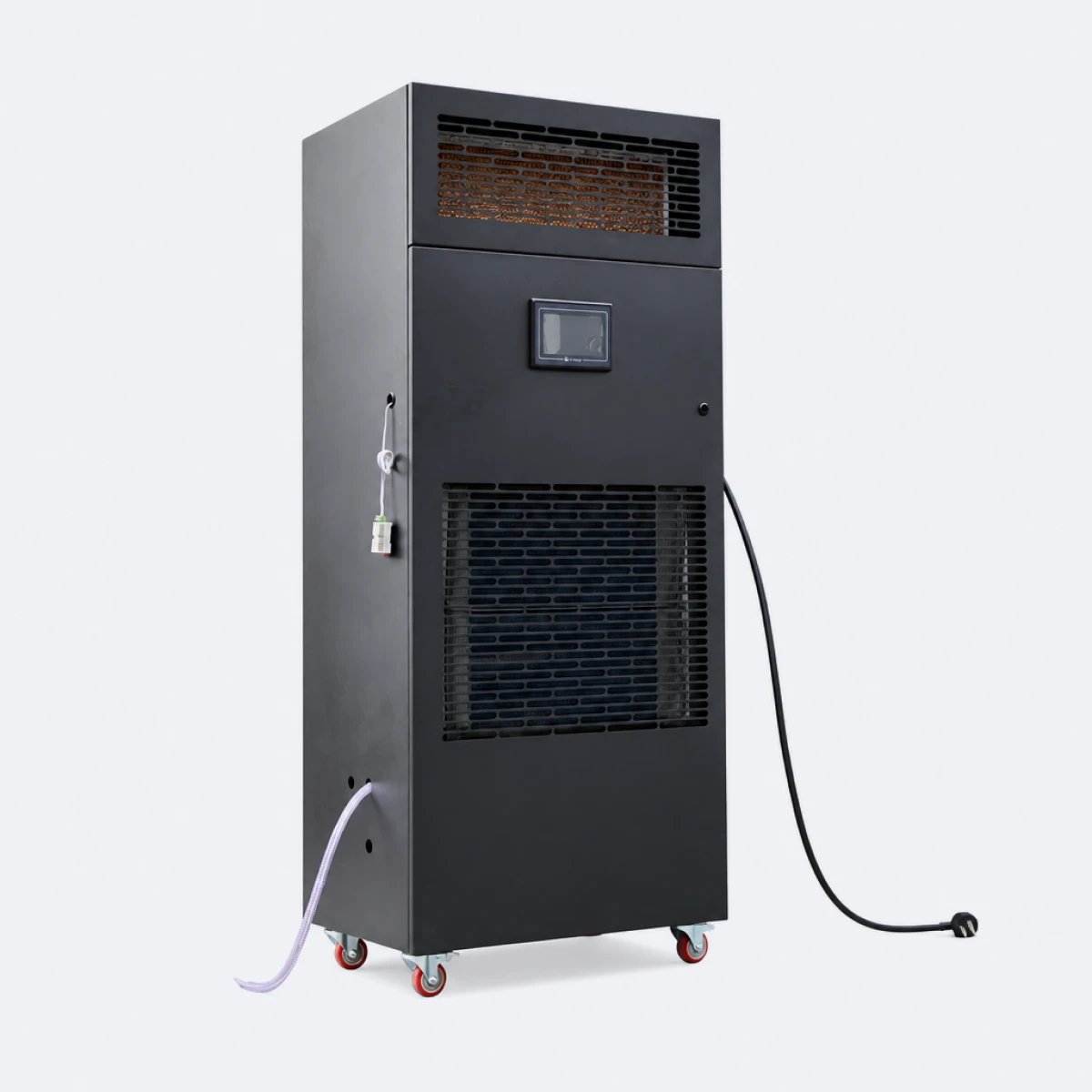
Where the DXSL Whole-House Humidifier and Dehumidifier Combo Series Fits Best
The applicable scenarios on the product specification — telecommunication equipment rooms, switching rooms, network equipment rooms, offices, computer rooms, archives, document storage rooms, and electronic precision manufacturing workshops — share an operational requirement that drives the engineering of this series: high peak humidification capacity to combat dry-air conditions in heated equipment-room environments, paired with reliable dehumidification for the swing seasons when humidity climbs. Telecommunication and network equipment generates substantial dry heat year-round, and the equipment racks themselves create extremely dry local conditions (often 15–20 % RH near the racks) that drive ESD risk and accelerated component aging. Standard combo equipment with lower peak humidification falls behind these loads; the DXSL series with 6 to 40 kg/h wet-media humidification — equivalent to 144 to 960 L/day of sustained moisture addition — keeps the equipment room at the 40–60 % RH target that ASHRAE TC 9.9 specifies for Class A1 environments.
This is the right product for full-floor or whole-building-zone coverage in commercial and light industrial settings. For single-room installations and smaller commercial spaces under 60 m², the compact DXSL-60 serves the application at lower equipment cost. For multi-room office and archive facilities where multiple smaller units distributed across rooms outperform single large equipment, the standard humidifier and dehumidifier combo (DS-03HS to DS-20HS) covers the smaller capacity tiers.
What Sets the DXSL Series Apart in the Combo Product Category
Three engineering decisions differentiate this whole house humidifier and dehumidifier combo from the standard DS-HS combo range and from competing products at similar price points:
- Wet-media high-capacity humidification. Peak humidification ranges from 6 kg/h (144 L/day equivalent) on the DXSL-90 up to 40 kg/h (960 L/day equivalent) on the DXSL-480. This is roughly 2× the peak humidification of equivalent reciprocating-compressor combo units at the same dehumidification rating. Wet-media (evaporative) humidification produces vapor-phase moisture without generating aerosols, unlike ultrasonic humidification which creates micro-droplets that can carry mineral residues and contaminants — important in electronic equipment rooms and clean manufacturing environments where airborne residue affects equipment reliability.
- Branded refrigeration and control components. Hitachi rotary compressor (the same compressor lineage used in commercial Hitachi air conditioning), OAK heat exchanger (USA design produced in Hangzhou), Shinyei Japan humidity sensor, Shanghai Baosteel 1.2 mm cold-rolled steel cabinet, Hefu Electronics 7-inch touchscreen controller. The branded-component bill of materials simplifies spare-parts procurement across the equipment's 8 to 12 year service life and supports regulatory documentation requirements where component-level traceability matters (pharmaceutical and medical facility procurement standards typically require this level of documentation).
- UV-C sterilization as standard antimicrobial control. UV-C disinfection is the established antimicrobial standard in hospital, clinical laboratory, and certain pharmaceutical facility protocols. UV-C lamps have decades of operational data documenting efficacy against bacteria, mold spores, and many viral particles in HVAC applications. The DXSL series uses Minghan UV-C lamps (Chinese commercial UV-C standard) integrated into the air-handling path, with the standard 8000–12000 hour lamp service life. For facilities with established UV-C disinfection protocols and validation procedures, this matches the existing facility specification rather than introducing alternative sterilization technologies that would require new validation work.
Branded Component Specification — Built for Specification-Driven Procurement
The full standard configuration on every model in the DXSL range:
- Hitachi rotary refrigeration compressor — quiet operation, energy-efficient at typical part-load conditions, established global spare parts network. The rotary-type design is well-suited to the on-off cycling typical of bi-directional humidity control.
- Guizhou Dongfang centrifugal fan — purpose-built for HVAC applications, multi-speed operation matches the unit's variable fan modes.
- Shinyei Japan electronic induction-type humidity sensor — precision measurement across the operating range, factory-calibrated against traceable standards. The Shinyei sensor lineage is established in Japanese commercial HVAC equipment with documented long-term accuracy stability.
- OAK heat exchanger (USA design, Hangzhou manufacturing) — copper tube and aluminum fin construction with hydrophilic fin coating for accelerated condensate runoff. The USA-design dimensions follow established commercial HVAC sizing for predictable performance.
- Hefu Electronics 7-inch touchscreen controller — intuitive operator interface with real-time temperature and humidity display, fault diagnostic codes, timer scheduling, multi-mode fan control, and BMS communication status. The 7-inch screen size accommodates simultaneous display of operating mode, setpoint, current measured values, and active alarms.
- Shanghai Baosteel 1.2 mm cold-rolled steel cabinet — industrial-grade steel thickness (compared to typical 0.8–1.0 mm consumer-grade cabinets), electrostatic powder-coated finish. The heavier gauge supports cabinet rigidity across long equipment service life and provides better EMI shielding for the internal electronics — relevant in equipment rooms with sensitive networking and computing equipment.
- Jiangyin Sanxie humidification film — high-efficiency wet-media humidification material with antimicrobial treatment. Service life is typically 18–24 months depending on water quality; replacement is a routine maintenance task.
- Minghan UV-C sterilization lamps — commercial UV-C with documented disinfection efficacy, 8000–12000 hour lamp service life, audible and visual alarm on lamp failure detection.
- Chuangpu Electronics negative ion generator — sustained ion output for air-quality improvement separate from the UV-C sterilization function.
Wet-Media Humidification — High Capacity Without Aerosol Generation
The DXSL series uses wet-media evaporative humidification: water saturates an environmental-protection humidification film (large surface area), air passes through the film, evaporation transfers moisture from the film surface to the air stream, and dry-bulb temperature drops slightly through the evaporation. This is the same fundamental mechanism as commercial-grade evaporative cooling but operated at lower air velocities and tighter humidity control targets.
Three operational advantages favor wet-media over ultrasonic or steam humidification in industrial combo applications:
- No aerosol generation. Ultrasonic humidification creates micro-droplets that carry whatever minerals and contaminants are dissolved in the source water. Steam humidification doesn't generate aerosols but consumes significant energy. Wet-media evaporative humidification produces vapor-phase moisture only — no droplets, no mineral fallout, no carried contamination — important for equipment rooms with sensitive electronics, electronic precision manufacturing where airborne residue affects yield, and pharmaceutical and medical environments where water contamination could affect products.
- Higher peak capacity. The DXSL-480 reaches 40 kg/h sustained humidification output. Reciprocating-compressor combo units typically max out at 480 L/day (20 kg/h equivalent) on equivalent dehumidification ratings. The wet-media humidifier and dehumidifier combo unit format provides headroom for high-load applications where heated indoor air drives sustained moisture demand.
- Self-cleaning characteristics. The humidification film provides some natural mineral capture (visible scale builds on the media rather than in the unit's internal water tank). The automatic water tank cleaning function maintains tank cleanliness on a programmable schedule. Combined, this reduces routine cleaning labor compared to alternative humidification technologies.
Hitachi Rotary Compressor and Refrigeration Cycle
All six models use sealed Hitachi rotary-type refrigeration compressors in standard refrigerant-cycle dehumidification — air drawn across the cold evaporator coil, moisture condenses out, dehumidified air returned to the room through the wet-media (in humidification mode) or directly (in dehumidification-only mode). The rotary compressor design provides quiet operation, good efficiency at the part-load conditions typical of combo unit operation (the compressor runs only when the unit is actively dehumidifying, not during humidification cycles), and reliable cold-starting performance from the automatic defrost cycle.
The OAK heat exchanger uses USA-designed copper tube and aluminum fin construction with hydrophilic fin coating. The hydrophilic coating accelerates condensate runoff from the coil surface, which matters because stagnant condensate is a biofilm growth site that creates the kind of microbial loading that the UV-C sterilization stage is designed to address. Combining the hydrophilic coil and the UV-C sterilization stage provides redundant defense against microbial growth in the wet-media humidifier and dehumidifier combo system.
UV-C Sterilization — The Hospital and Clinical Laboratory Standard
UV-C sterilization at the 253.7 nm wavelength damages microorganism DNA, preventing reproduction. The technology has 50+ years of HVAC application history with documented efficacy data against common bacteria (E. coli, S. aureus, Legionella), most molds and fungi, and many viral particles. Hospital and clinical laboratory facility specifications typically require UV-C disinfection in air handling equipment for patient-area HVAC, laboratory exhaust treatment, and certain pharmaceutical clean utility air systems.
The DXSL series integrates Minghan commercial UV-C lamps into the recirculation air path. Lamps operate continuously when the unit is powered. Standard service life is 8000–12000 operating hours (roughly 12–18 months of continuous operation, longer with intermittent use), with documented output degradation tracking that supports preventive replacement scheduling. The control system reports lamp status to the BMS through the RS-485 interface, and provides audible and visual alarm on lamp failure detection — relevant for validated facilities where loss of sterilization needs documented event capture. For applications where plasma sterilization is preferred over UV-C (modern museums, certain pharmaceutical specifications that prohibit UV-C due to potential off-gassing concerns), the DS-HS advanced range with plasma sterilization provides the alternative technology.
Six Capacity Tiers — Matching DXSL Combo to Whole-Building Zone Coverage
The six-tier structure maps to typical whole-floor and full-building-zone installation sizes:
- DXSL-90 (90 L/24h dehumidification, 6 kg/h humidification, 90 m²) — small office floors, single equipment rooms, archive zones, mid-sized switching rooms.
- DXSL-138 (138 / 10 kg/h, 120 m²) — full-floor office areas in smaller buildings, mid-sized network equipment rooms, larger archive zones.
- DXSL-192 (192 / 20 kg/h, 200 m²) — full-floor office areas in mid-sized buildings, full telecommunication equipment rooms, computer room main floor.
- DXSL-240 (240 / 25 kg/h, 220 m²) — large office floors, full computer rooms, mid-sized data center pods, larger document storage zones.
- DXSL-380 (380 / 35 kg/h, 300 m²) — large full-floor installations, multi-zone telecommunication facilities, large electronic precision manufacturing workshops.
- DXSL-480 (480 / 40 kg/h, 400 m²) — largest single-unit installations in this format, full-building whole house humidifier and dehumidifier combo coverage for commercial offices, full-floor data center installations, large precision manufacturing halls.
For installations above 400 m², distributed multi-unit deployment provides better humidity control across the facility plus built-in redundancy through the BMS connection. Two DXSL-240 units across a 440 m² facility typically outperform a single DXSL-480 in both control fineness (each unit handles its local zone with shorter response time) and operational resilience (single unit failure leaves the facility at 50 % capacity rather than complete loss of humidity control).
Application: Telecommunication Equipment Rooms and Switching Rooms
Telecommunication equipment generates substantial dry heat year-round, and the heat plus elevated equipment surface temperatures drive local RH down to 15–25 % even when the building HVAC maintains 40–60 % RH in occupied zones. Dry conditions accelerate electrostatic discharge events that damage delicate semiconductor components in switching equipment and network routers. Major telecommunication carrier facility specifications typically target 45–55 % RH at the equipment level with active humidification to maintain that target against the equipment heat load.
The DXSL series with its high peak humidification capacity (6–40 kg/h) is sized for telecommunication equipment-room loads where the moisture demand can be sustained at the upper end of the dehumidification rating without falling behind. The branded-component specification supports the documentation requirements of major telecommunication facility procurement standards. The standard RS-485 BMS interface integrates the equipment into the facility's NOC monitoring platform — humidity setpoint, mode, fault codes, and runtime hours all reportable to the central monitoring system.
Application: Computer Rooms and Data Center Support Areas
ASHRAE TC 9.9 specifies 40 to 60 % RH at server inlet for Class A1 environments, with dewpoint between -9 °C and 15 °C. Modern computer rooms and smaller data center installations need humidity control that operates in both directions — humidifying during dry winter heating periods and dehumidifying during humid summer outdoor air infiltration. The DXSL whole house humidifier and dehumidifier combo handles both directions in a single cabinet with continuous operation through the seasonal swing.
For computer room support areas (offices adjacent to compute halls, network operations centers, equipment staging zones), the DXSL also serves the air quality requirements through the UV-C sterilization and negative ion generator stages. Sustained ion concentrations above 1000 ions/cm³ in office environments have documented effects on subjective air-quality perception and reported occupant comfort — relevant in NOC environments where 24/7 staffing requires sustained operator alertness.
Application: Archives, Document Storage, and Office Environments
Archive moisture control is well-established at ISO 11799 — 30 to 50 % RH ±5 % for paper storage. The DXSL series serves the larger archive zones (90 m² and above) where single-unit coverage simplifies the installation and BMS integration compared to multiple smaller units. The UV-C sterilization stage provides defense against mold spore growth on aging paper substrates — well-documented as a long-term archive degradation mechanism.
For office environments adjacent to archives or document storage, the DXSL provides combined humidity control and air quality across the larger office floor area. The 7-inch touchscreen controller and standard BMS interface fit smart-office facility management requirements; the wet-media humidification provides no-aerosol moisture addition that does not affect document substrates in adjacent storage areas. As the best humidifier and dehumidifier combo configuration for premium office and archive integration, the DXSL serves the specification-driven facility manager market where component-level documentation and brand-name procurement matter.
Application: Electronic Precision Manufacturing Workshops
Electronic precision manufacturing operates under IPC J-STD-033 for moisture-sensitive device handling: 20–30 % RH for component storage, 40–60 % RH for assembly areas. The wet-media humidification's no-aerosol characteristic is operationally important here — manufacturing yield is sensitive to airborne contamination, and any humidification approach that generates droplets carries mineral residue from the source water to the production area.
The DXSL-192 through DXSL-480 range covers typical electronic manufacturing workshop sizes from 200 m² up to 400 m² per installation. For multi-shift production environments running 24/7, the dual humidification modes (manual and automatic) allow setpoint scheduling for different process zones at different times. The branded Hitachi compressor and OAK heat exchanger provide the long-service-life characteristics that manufacturing facilities require — typical service life is 8 to 12 years with normal maintenance.
Distinguishing the DXSL from Other Combo and Standalone Products
We offer multiple humidifier and dehumidifier combo configurations across capacity scales and component grades. Choose by required capacity, component specification, and sterilization technology:
- This DXSL series (90–480 L/24h dehumidification, 6–40 kg/h humidification, branded components, UV-C sterilization) — Right for: whole-floor and whole-building-zone coverage, telecom and IT equipment rooms, computer rooms, electronic precision manufacturing, and applications where component-level branded specification matters for procurement documentation. The best humidifier and dehumidifier combo configuration for premium specification-driven projects.
- DXSL-60 (40–60 L/24h, 3–5 kg/h, single-room scale) — Smaller compact unit for single-room installations under 60 m² — telecommunications equipment rooms, single offices, small archive rooms, small switching rooms.
- Humidifier and dehumidifier combo (DS-03HS to DS-20HS, standard configuration) — Right for: smaller capacity needs from 10 m² upwards, general-purpose bi-directional humidity control where the branded-component specification and UV-C are not required. Lower initial cost when DXSL-grade specification is not required.
- 2-in-1 humidifier and dehumidifier (DS-HS advanced, plasma sterilization, formaldehyde removal, RS-485 standard) — Right for: modern museum conservation, GMP cleanroom, archive preservation under contemporary standards, data center DCIM integration, and applications where plasma sterilization is specified over UV-C.
- Industrial dehumidifier (standalone, 180–1440 L/day) — Right for: humid climates where humidity moves only in one direction. Lower cost when humidification is not required.
- Temperature-controlled industrial dehumidifier (-3 to 60 °C envelope) — Right for: precision industrial environments with elevated or low ambient temperatures where standard combo equipment cannot operate.
- Ultrasonic humidifier (standalone) — Right for: dry climates where only humidification is required.
Build, Safety, and OEM/ODM Service
Shanghai Baosteel 1.2 mm cold-rolled steel cabinet with electrostatic powder coating, internal electrical components with moisture-proof conformal coating, 7-inch touchscreen LCD intelligent controller with real-time temperature and humidity display, audible and visual alarm system for fault notification, and automatic water tank cleaning function with scheduled cleaning cycles. Each unit is fully function-tested at the factory including verification of the UV-C lamp output, humidification film saturation behavior, refrigeration circuit pressure, RS-485 communication protocol, and sensor calibration before shipping. Safety protections include high-pressure cut-out on the refrigeration circuit, overcurrent protection, automatic defrost, automatic low-water protection on the humidification stage, UV-C lamp failure alarm, water tank overflow protection, and fault self-protection logic with real-time alerts on the touchscreen and BMS interface.
OEM scope from MOQ 10 units per model: branding, cabinet color (white or black standard; custom RAL colors available), plug type or terminal block configuration, control firmware language, packaging artwork, and pre-fitted filter media specifications. ODM scope: voltage modification (110V or 460V from MOQ 50 on applicable models), BMS protocol customization beyond standard Modbus RTU (BACnet MS/TP, KNX from MOQ 50), enhanced HEPA filtration stage addition (MOQ 50), alternative UV-C lamp specification for hospital-grade applications, validation documentation packages (IQ/OQ) for pharmaceutical and clinical laboratory applications quoted per project, structural and cabinet modifications quoted per project, and certification routing (CE, RoHS, ETL, SAA, GS, UL depending on target market). Production lead time is 35 to 50 days after artwork sign-off for the DXSL-90 to DXSL-240 tiers; 50 to 65 days for the larger DXSL-380 and DXSL-480 tiers. FOB Ningbo or Shanghai.
For other capacity tiers and configurations, browse the full commercial dehumidifier lineup.