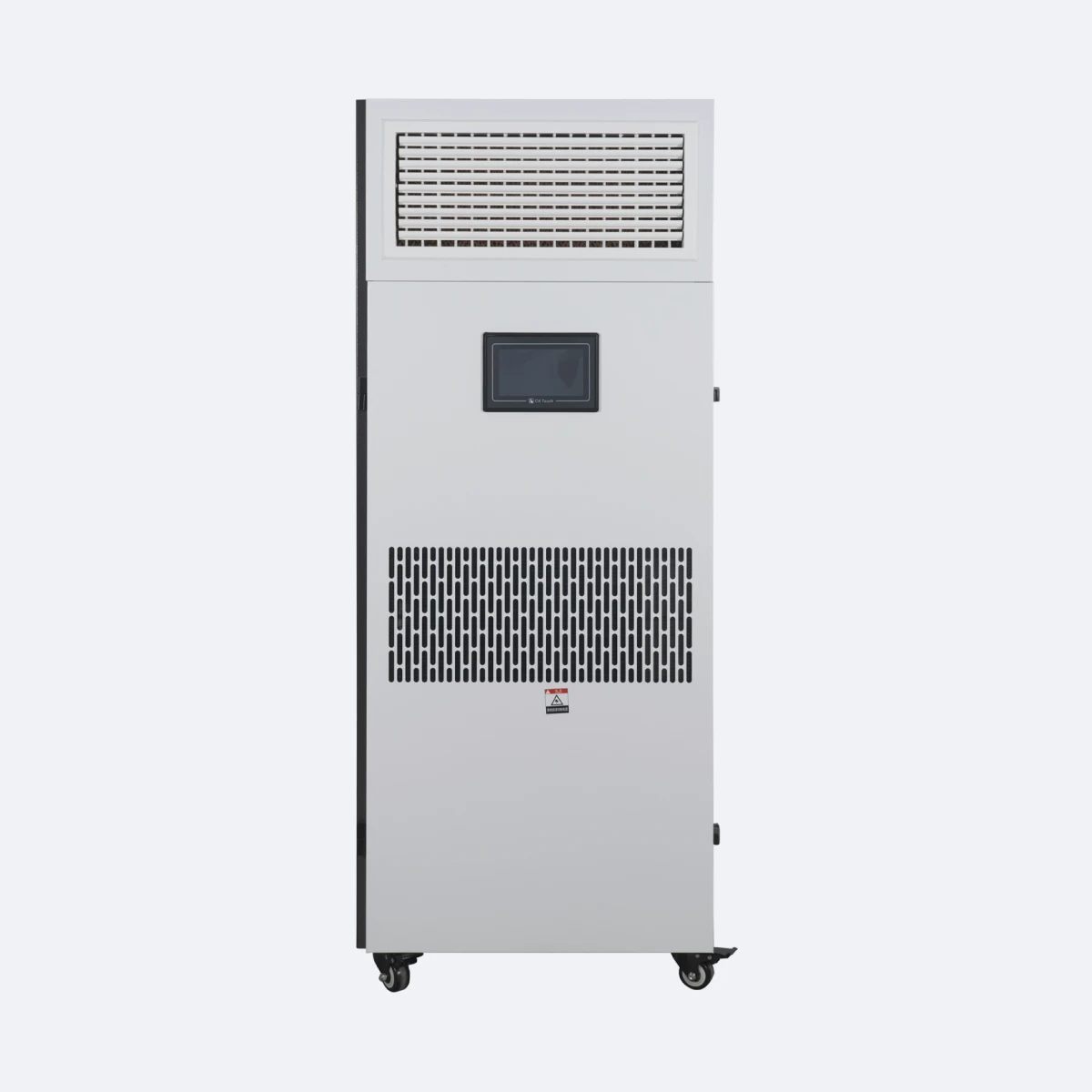
Where the DS-HS Humidifier and Dehumidifier Combo Series Fits Best
The applicable scenarios on the product specification — archives, data centers, offices, GMP cleanrooms, museums, document rooms, electronic precision manufacturing workshops, wine cellars and supermarkets — share one operational characteristic: humidity needs to stay within a narrow band year-round, in both directions. Summer brings humid outdoor air that pushes indoor RH above the target; winter heating dries the building below the target. Standalone equipment solves one direction at a time. A humidifier and dehumidifier combo solves both with a single cabinet, single control system, and single power circuit.
Typical single-unit deployments across the capacity range: small archive rooms and document storage at 30–60 m² use the DS-03HS or DS-06HS; office floors and laboratory complexes at 80–150 m² use the DS-09HS; museum gallery zones and mid-sized data center pods at 150–300 m² use the DS-12HS or DS-15HS; large wine cellars, precision manufacturing halls, and full data center rooms at 300–450 m² use the DS-20HS dual-compressor models. For facilities above 450 m², distributed multi-unit deployment is the standard approach — covered in the sizing section below.
Why a Humidifier and Dehumidifier Combo Unit Matters
The case for combining humidification and dehumidification in one cabinet comes from how humidity actually behaves in the target applications:
- Seasonal swing in temperate and cold climates. Outdoor absolute humidity varies dramatically between summer (20–30 g/kg in humid regions) and winter (1–5 g/kg in heated buildings). Indoor RH at a constant 22 °C swings from 70 %+ in summer to 20 % or lower in heated winter without active control. Sensitive collections, equipment and processes need stable humidity that does not track this seasonal swing.
- Two pieces of equipment, two failure modes, two service contracts. A facility running a standalone dehumidifier plus a standalone humidifier has twice the maintenance burden, twice the controls integration work, and twice the risk of one unit failing while the other runs unnecessarily. A 2 in 1 humidifier and dehumidifier in one cabinet reduces installation footprint, simplifies the control loop, and consolidates the service relationship.
- Bi-directional control around a single setpoint. The built-in temperature and humidity sensors continuously monitor room RH and select the appropriate function automatically — humidify when RH falls below setpoint, dehumidify when RH rises above setpoint, idle the active stages when RH sits within the deadband. The combo unit operates as a closed-loop humidity controller around the target value rather than as two separate machines that need coordinated scheduling.
For facilities where humidity only ever moves in one direction (e.g., a tropical climate basement that needs only dehumidification, or a desert facility that needs only humidification), a standalone industrial dehumidifier or standalone ultrasonic humidifier is more cost-effective. The combo unit pays back when bi-directional control is required.
Four Integrated Functions in One Cabinet
The DS-HS series integrates four functions normally provided by separate equipment:
- Refrigeration dehumidification. Reciprocating compressor with all-copper condenser and evaporator coils, capacity from 72 L/day on the DS-03HS up to 300 L/day on the DS-20HS dual-compressor models. Works through standard refrigerant-cycle condensation — air drawn across the cold coil, moisture condenses out, dehumidified air returned to the room.
- Humidification. Adds moisture to the room when RH falls below setpoint. Capacity from 98 L/day on the DS-03HS to 480 L/day on the DS-20HS dual-compressor models — note that humidification capacity exceeds dehumidification capacity on each model, reflecting the typical pattern in heated indoor air where the air dries faster than it accumulates moisture.
- Air purification. Electronic dust collection (similar in principle to electrostatic precipitator technology) captures fine particles down to PM2.5 level. Activated carbon filtration stage removes volatile organic compounds, odors, and gaseous contaminants. Both filtration stages run continuously regardless of whether the unit is humidifying or dehumidifying.
- Ion sterilization. Negative ion generation stage produces sustained microbial control across the conditioned space. Effective against airborne bacteria and mold spores without requiring chemical additives or UV maintenance — particularly relevant for archive, museum, and GMP cleanroom applications where chemical air treatment is restricted.
The four functions share the same air-handling path (single fan, single intake, single discharge) and the same control electronics, which is what makes the integrated design more compact and lower-cost than four separate machines achieving the same result.
Nine Capacity Tiers — Matching Combo Unit to Room Size
The nine-tier capacity structure provides fine-grained sizing across the small commercial through mid-industrial range:
- DS-03HS (98 L/day humidification / 72 L/day dehumidification, 10–40 m²) — small archive rooms, document storage cabinets, single-bay laboratories, small server rooms, wine cellar zones up to 40 m².
- DS-06HS (156 / 144 L/day, 30–80 m²) — mid-sized archive rooms, single-floor document libraries, small office floors, small data center pods.
- DS-09HS (200 / 160 L/day, 80–150 m²) — full-floor office areas, mid-sized data center rooms, larger archive complexes, mid-sized museum gallery zones.
- DS-12HS Single 3 HP / Single 5 HP (240 / 170 L/day, 150–200 m²) — larger office floors, mid-sized GMP cleanroom suites, larger data center halls, full-floor museum galleries. The 5 HP variant provides higher peak extraction for transient humidity loads.
- DS-15HS Single 5 HP / Dual 3 HP (288 / 180 L/day, 200–300 m²) — large office complexes, full-floor data center installations, larger GMP cleanroom complexes, large museum gallery zones. The dual-compressor variant provides redundancy — single compressor failure still leaves the other operating at partial capacity rather than complete loss of humidity control.
- DS-20HS Dual 3 HP / Dual 5 HP (480 / 300 L/day, 300–450 m²) — large precision manufacturing halls, full data center floors, large commercial wine cellars, multi-zone GMP facilities. The Dual 5 HP variant delivers maximum peak capacity and full redundancy on both compressors.
Application: Archives and Document Storage Rooms
ISO 11799 specifies 30 to 50 % RH for archive paper storage with stability requirements of ±5 % RH. The challenge in most climates is that achieving this range requires equipment that operates in both directions — summer humid air pushes archive RH above 60 % easily, while winter heating drops it below 25 %. Acid hydrolysis of paper accelerates above 60 % RH; brittleness and cracking accelerate below 30 % RH. The damage to long-term archive value comes from the swing as much as from any single extreme.
A humidifier and dehumidifier combo unit at archive scale (typical archive rooms 50–200 m²) holds the RH within ±5 % of setpoint year-round through automatic bi-directional control. The DS-06HS through DS-12HS range covers most archive applications; for large multi-room archive complexes, distributed deployment of multiple DS-HS units controlled through a building management system provides the best operational reliability.
Application: Museums, Galleries, and Wine Cellars
Museum conservation standards vary by collection type. ICOM guidelines and the AICCM museum standards specify 50 % RH ±5 % for mixed collections, 40–45 % RH for photographic and film archives, and very stable 45–50 % RH for paintings and textile collections. The stability requirement is often tighter than the absolute target — a collection at 55 % RH that drifts to 45 % over 24 hours causes more damage than one held steady at 60 %.
Wine cellars need 60–70 % RH continuously to prevent cork dehydration. Below 50 % RH cork shrinks and allows oxygen ingress that oxidizes the wine; above 80 % RH mold grows on labels and corks. A 2 in 1 humidifier and dehumidifier holds wine cellar RH steady in this narrow band regardless of outdoor seasonal swing. The DS-09HS through DS-20HS range covers typical commercial wine cellar sizes from 80 m² boutique cellars to 450 m² restaurant cellars and small private collection facilities.
Application: Data Centers, Server Rooms, and Telecommunications Equipment Rooms
ASHRAE TC 9.9 specifies 40 to 60 % RH at server inlet for Class A1 data center environments. Dry conditions below 40 % RH increase static electricity buildup with risk of ESD damage to server components. Humid conditions above 60 % RH risk surface condensation on cool component surfaces during cooling system transients. The narrow band requires equipment that operates in both directions.
The DS-HS series is sized for single data hall, single pod, or single equipment room installations. For full data center building installations across multiple halls, multi-unit deployment with BMS integration is typical — humidity setpoint, mode and fault status all reportable to the data center building management system through the RS-485 interface (available as an ODM option). For larger data center installations with higher capacity needs, see the larger humidifier and dehumidifier combo equipment in the DXSL-90 through DXSL-480 range.
Application: GMP Cleanrooms and Electronic Precision Manufacturing
Pharmaceutical GMP cleanrooms require humidity control to USP <1116> and EU GMP Annex 1 specifications — typically 30–50 % RH for granulation and drying, 40–60 % RH for tablet compression, and tighter ranges for moisture-sensitive APIs. Electronic precision manufacturing operates under IPC J-STD-033 for moisture-sensitive component handling: 20–30 % RH for component storage, 40–60 % RH for assembly areas.
Both applications share the requirement that humidity stability matters as much as the setpoint — process consistency depends on RH not swinging between batches or shifts. The DS-HS combo unit at 150–300 m² scale fits typical single-suite pharmaceutical and electronics manufacturing zones. The integrated air purification stages (electronic dust collection + activated carbon) provide additional value in these applications by capturing process-related particles and gaseous contaminants that standalone dehumidification cannot address. For pharmaceutical and cleanroom validation requirements, IQ/OQ documentation packages are available as ODM additions quoted per project.
Reciprocating Compressor Technology
All nine models use reciprocating compressor refrigeration cycles. Reciprocating designs deliver good efficiency at the partial-load operation typical of bi-directional humidity control (where the unit cycles between active dehumidification and idle states rather than running continuously at full load), and provide reliable cold-starting performance compared to scroll designs at low ambient temperatures.
Single-compressor models (DS-03HS through DS-15HS Single) use one reciprocating compressor sized to the model's rated capacity. Dual-compressor models (DS-15HS Dual 3 HP, DS-20HS Dual 3 HP, DS-20HS Dual 5 HP) use two compressors that can operate independently or in parallel — the control system stages them based on load demand, running one compressor at low to moderate load and bringing the second online during peak demand. This staged operation reduces electrical demand for typical part-load conditions while still delivering peak capacity when needed. Dual compressor configuration also provides redundancy — single compressor failure leaves the unit operating at approximately 50 % capacity rather than complete shutdown, which is important for archive, museum and data center installations where continuous humidity control matters.
Multi-stage Filtration and Sterilization
The air purification stage in the DS-HS combo unit runs continuously regardless of whether the unit is actively humidifying or dehumidifying, providing sustained air quality control across the conditioned space. Three filtration and sterilization stages operate in series:
- Electronic dust collection. Charged-plate technology captures fine particles down to PM2.5 level and retains them on collection plates. Maintenance involves periodic plate cleaning rather than filter replacement, reducing ongoing operating cost compared to disposable HEPA filtration. For installations requiring HEPA-grade filtration (some GMP cleanroom classes), pre-fitted HEPA filter stages can be added as OEM modifications.
- Activated carbon filtration. Standard activated carbon bed captures volatile organic compounds, odors, smoke residues, and gaseous contaminants. Particularly relevant for archive and museum applications where outgassing from stored materials would otherwise accumulate in the conditioned space, and for office/laboratory applications where staff comfort and air quality matter.
- Ion sterilization. Negative ion generation provides sustained microbial control across the conditioned air. Effective against airborne bacteria, mold spores, and certain viruses without requiring chemical additives or UV lamp maintenance. Particularly relevant for archive and museum installations where chemical air treatment is restricted by conservation policy, and for GMP cleanroom applications where chemical-free sterilization is preferred.
Distinguishing From Other Combo and Standalone Products
We offer multiple dehumidifier and humidifier combo configurations plus standalone equipment for different application contexts. Selecting the best humidifier and dehumidifier combo for a given facility depends on capacity needs, application sensitivity, and whether the building requires single-zone or distributed multi-unit coverage:
- This series (DS-03HS to DS-20HS, 10–450 m²) — Right for: single-zone industrial and commercial installations needing bi-directional humidity control with 4-function integration. Best for archives, museums, GMP cleanrooms, data centers, wine cellars, precision manufacturing.
- DXSL-60 (40–60 L/day, 60 m²) — Smaller single-room humidifier and dehumidifier combo for telecommunications equipment rooms, small switching rooms, single offices, and small archive rooms below the DS-03HS scale.
- DXSL-90 to DXSL-480 (90–480 L/day, 90–400 m²) — Larger humidifier and dehumidifier combo range with scroll compressor technology, UV sterilization, and negative ion generator in a different cabinet format. Right for: installations requiring scroll efficiency at sustained full-load operation rather than the reciprocating partial-load efficiency of the DS-HS range.
- Industrial dehumidifier (standalone, 180–1440 L/day) — Right for: tropical and humid climates where humidity moves only in one direction. Lower cost when humidification is not required.
- Temperature-controlled industrial dehumidifier (-3 to 60 °C envelope) — Right for: precision industrial environments with elevated or low ambient temperatures where standard combo equipment cannot operate.
- Ultrasonic humidifier (standalone) — Right for: dry climates and heated buildings where humidity only needs to be added, not removed.
220V Single-Phase and 380V Three-Phase
The DS-03HS and DS-06HS run 220V single-phase — appropriate for smaller archive rooms, document storage and similar light-commercial installations where three-phase wiring may not be readily available. From the DS-09HS onwards (3500 W rated power and above), the series runs 380V three-phase only — single-phase wiring becomes impractical at these power levels for typical commercial electrical infrastructure.
For North American markets, 460V/60Hz three-phase specification is available as an ODM modification from MOQ 50 units on the three-phase models. The two voltage versions are not field-convertible after delivery. For the 220V single-phase models (DS-03HS, DS-06HS), 110V or 120V/60Hz variants are also available as ODM modifications for North American small commercial installations.
Build and OEM/ODM Service
Powder-coated cold-rolled steel cabinet with industrial finish, internal electrical components with moisture-proof conformal coating, microcomputer LCD automatic control with intuitive operator interface, real-time temperature and humidity display, and 1–24 hour adjustable timer. Each unit is fully function-tested at the factory before shipping. Built-in safety protections include high-pressure cut-out on the refrigeration circuit, overcurrent protection, automatic defrost, water tank overflow protection on the humidification stage, and fault self-protection logic with real-time alerts on the display.
OEM scope from MOQ 10 units per model: branding, cabinet color, plug type or terminal block configuration for the destination market's electrical standard, control firmware language, packaging artwork, custom mounting bases for fixed installations, and pre-fitted filter media specifications. ODM scope: voltage modification (110V or 460V from MOQ 50), refrigerant alternatives (R32 from MOQ 200 where applicable), BMS integration via Modbus RTU (from MOQ 50) or BACnet/KNX (from MOQ 200), HEPA filter stage addition for GMP applications, IQ/OQ validation documentation packages for pharmaceutical installations quoted per project, structural and cabinet modifications quoted per project, and certification routing (CE, RoHS, ETL, SAA, GS, UL depending on target market). Production lead time is 30–45 days after artwork sign-off for the smaller tiers, 45–60 days for the larger dual-compressor tiers. FOB Ningbo or Shanghai.
For other capacity tiers and configurations, browse the full commercial dehumidifier lineup.