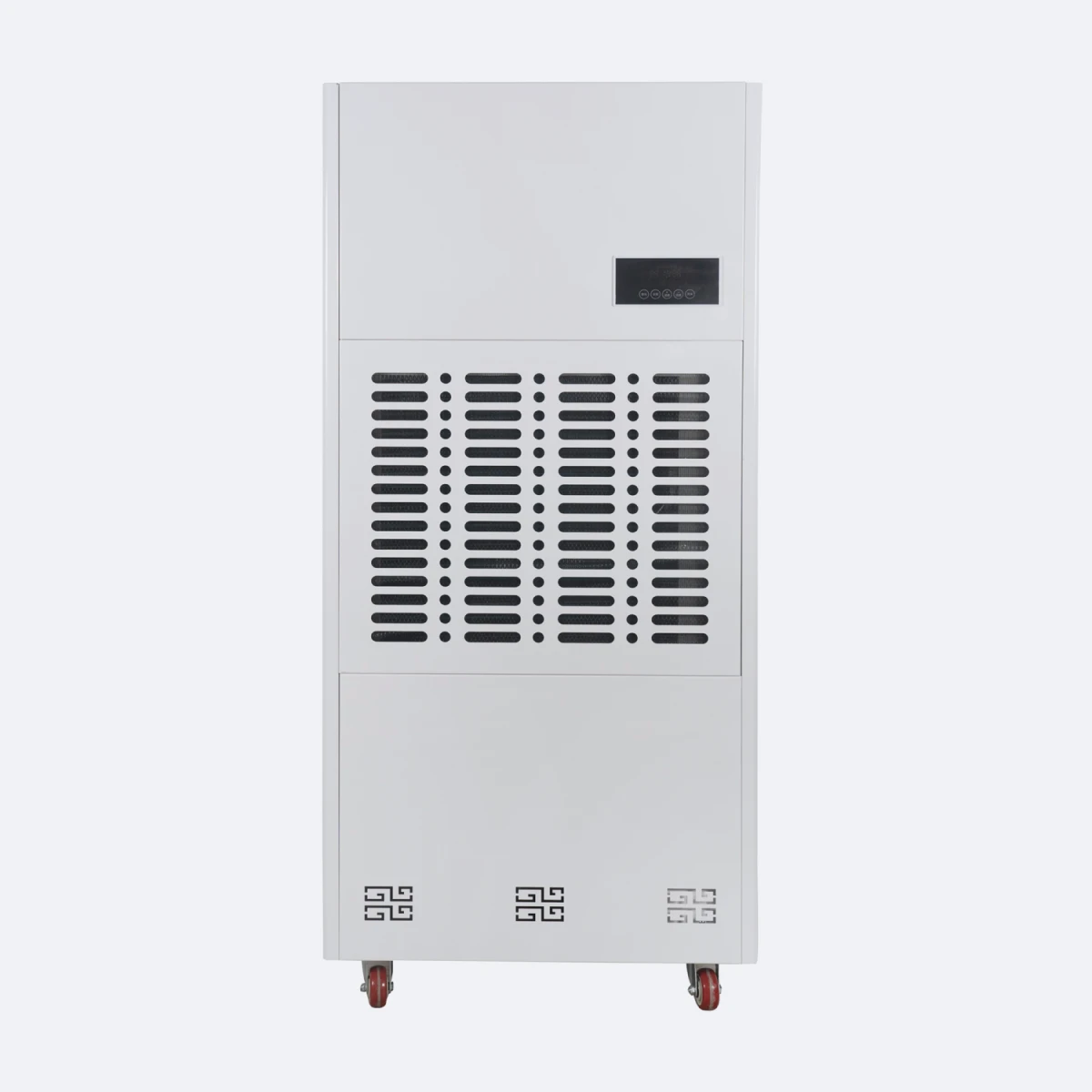
Where the Temperature-Controlled Floor-Standing Series Fits Best
The applicable scenarios on the product specification — data centers, server rooms, laboratories, pharmaceutical manufacturing plants, electronics workshops, battery production facilities, cleanrooms, archives storage rooms, museums, food processing areas and medical equipment rooms — share one operational characteristic: ambient temperatures vary significantly across processes or shifts, and humidity control matters during periods when standard 5 to 38 °C industrial equipment would shut down on thermal protection.
This is not a general-purpose warehouse industrial dehumidifier. For warehouses, archives, basements, switchgear rooms and similar clean industrial spaces operating in the 15 to 30 °C ambient range year-round, the standard industrial dehumidifier range is the correct and more cost-effective choice. The temperature-controlled series adds value specifically in precision industrial environments with elevated or low-temperature operating points: data center hot aisles approaching 45 to 55 °C during peak server load, pharmaceutical drying processes running 35 to 50 °C ambient, battery manufacturing thermal abuse zones reaching 50 to 60 °C, museum environmental backup during HVAC failure events, and laboratory conditioning chambers across the full temperature spectrum.
The -3 to 60 °C Engineering — What Makes the Wide Envelope Work
The -3 to 60 °C operating envelope is the engineering specification that separates this series from standard industrial dehumidifier equipment. Achieving it reliably across multi-year service intervals requires specific design choices in the refrigeration circuit, control electronics, and structural components.
At the upper limit (60 °C ambient):
- Standard refrigerant-cycle equipment fails at 40 to 45 °C ambient because condenser saturation pressure exceeds compressor design envelope, and PCB-mounted electronics on commercial-grade boards reach junction temperature limits
- This series uses higher-pressure-rated compressor specifications designed for elevated condenser temperatures, larger condenser heat exchange surface to maintain pressure differential at high ambient, industrial-grade electronic components rated to 85 °C+ junction temperature, and enhanced internal airflow for compressor and motor cooling
- Sustained operation at 50 to 60 °C ambient is the design point — equipment that standard industrial dehumidifier models would shut down on within minutes runs continuously here
At the lower limit (-3 °C ambient):
- Standard refrigerant-cycle dehumidification stalls below 5 °C ambient because the evaporator coil ices faster than defrost cycles can clear it
- The enhanced hot-gas bypass defrost system uses shorter defrost intervals and longer effective extraction cycles, paired with larger evaporator coil surface that maintains coil temperature above the icing threshold at lower ambient temperatures
- Extraction performance continues through -3 °C ambient — approximately 60 to 70 percent of rated capacity at -3 °C compared to the 30 °C reference condition
- Below -3 °C ambient, desiccant-type rotary dehumidification is the correct technology — see the rotary dehumidifier range for sub-zero applications continuing down past -20 °C
Ten Capacity Tiers — Full Range from 180 to 1440 L/Day
The ten-tier capacity structure provides fine-grained sizing across the precision industrial dehumidifier range. Same capacity tier breakdown as the standard industrial dehumidifier range — chassis platform is shared, thermal engineering is the differentiator:
- GDH-180E (180 L/day, 180–240 m²) — small precision laboratories, single pharmaceutical granulation suites, individual electronics workshop bays, museum gallery zones
- GDH-240E (240 L/day, 200–300 m²) — mid-sized laboratories, multi-station pharmaceutical production rooms, mid-sized electronics workshops, small archive precision zones
- GDH-288E (288 L/day, 260–350 m²) — light industrial precision workshops, mid-sized cleanroom suites, laboratory complexes with multiple equipment rooms
- GDH-380E (380 L/day, 350–500 m²) — mid-sized pharmaceutical production floors, larger electronics workshops, mid-tier data center supporting zones
- GDH-480E (480 L/day, 450–600 m²) — full-size pharmaceutical bulk production, larger electronics fabrication areas, light industrial precision halls
- GDH-600E (600 L/day, 500–700 m²) — large pharmaceutical production halls, full data center rooms, food processing facilities with thermal zones
- GDH-720E (720 L/day, 700–900 m²) — large electronics manufacturing facilities, multi-bay battery production rooms, larger data center halls
- GDH-960E (960 L/day, 1000–1200 m²) — full data center halls, large pharmaceutical bulk production, multi-line battery manufacturing — a true large industrial dehumidifier at this single-unit coverage scale
- GDH-1200E (1200 L/day, 1200–1400 m²) — major precision industrial facilities, large data center halls with significant thermal load, full battery production complexes
- GDH-1440E (1440 L/day, 1600 m²+) — largest single-unit installations; a high capacity industrial dehumidifier for major precision facilities and large industrial processing complexes
For installations exceeding 1600 m² with continuous moisture loads, distributed multi-unit deployment of two or three units typically outperforms oversizing a single point. The distributed approach also provides built-in redundancy critical for cleanroom and data center operations where humidity control failure has direct operational consequences.
Application: Data Center Hot Aisle Humidity Control
ASHRAE TC 9.9 (the technical committee for data center HVAC) recommends 18 to 27 °C dry-bulb temperature and 40 to 60 % RH at server inlet (cold aisle) for Class A1 environments, with dewpoint controlled between -9 °C and 15 °C. Modern high-density rack deployments produce hot aisle temperatures of 35 to 55 °C even with adequate cooling — the air leaving the server's hot-side exhaust is significantly warmer than the inlet specification.
For dehumidification equipment supporting hot aisle return air systems or operating in equipment rooms adjacent to high-density compute halls, sustained 45 to 55 °C ambient is a normal operating condition. Standard industrial dehumidifier equipment rated to 38 °C ambient cannot serve these applications — the unit shuts down on thermal protection during peak load periods, exactly when humidity control matters most. The 60 °C upper rating on this series provides operational headroom for sustained hot aisle deployment plus emergency operation during cooling failures.
For data center perimeter zones, network operations centers, and cold aisle return paths where ambient stays within 20 to 30 °C year-round, the standard industrial dehumidifier range serves at lower cost. Reserve the temperature-controlled series for the hot zones where it provides operational capability that standard equipment cannot.
Application: Dehumidifier for Pharmaceutical Industry
A dehumidifier for pharmaceutical industry use operates under specific regulatory frameworks — USP <1116> for microbial control in pharmaceutical compounding, EU GMP Annex 1 for sterile manufacturing, and ICH Q7 for active pharmaceutical ingredient production. These standards specify humidity ranges for production environments: typically 30 to 50 % RH for granulation and drying operations, 40 to 60 % RH for tablet compression, and tighter ranges for moisture-sensitive APIs.
Many pharmaceutical processes operate at elevated ambient temperatures:
- Fluid bed drying processes — ambient air around the equipment 35 to 50 °C
- Granulation processes with vacuum drying — 40 to 55 °C in the production room
- Spray drying suites — ambient up to 50 to 70 °C in the immediate equipment area
- Pharmaceutical glass washing and depyrogenation tunnels — adjacent areas 40 to 50 °C
- Capsule filling rooms — standard 20 to 25 °C
- Bulk storage with HVAC — standard 18 to 22 °C
This temperature-controlled series serves the elevated-temperature production areas where standard industrial dehumidifier equipment cannot operate continuously. For room-temperature pharmaceutical environments (capsule filling, packaging, finished goods storage), the standard industrial dehumidifier range is the appropriate sizing — using the temperature-controlled series in those rooms is over-specified and adds unnecessary cost.
Application: Battery Production and Electronics Manufacturing
Lithium-ion battery production combines two humidity-related requirements: extremely dry cell assembly areas (target dewpoint -40 to -60 °C, far below what standard refrigerant dehumidification can deliver), and adjacent processing zones at elevated ambient temperatures where standard industrial dehumidifier equipment cannot operate. The temperature-controlled series serves the second category — the adjacent zones where ambient temperature varies from 25 to 60 °C across the process:
- Electrode coating ovens — continuous 80 to 130 °C product temperatures with ambient air around the equipment 40 to 50 °C
- Electrolyte filling stations — 25 to 40 °C ambient
- Formation cycling stations — 35 to 55 °C ambient during peak charging cycles
- Thermal abuse testing chambers — ambient air around the test chambers 50 to 70 °C
- Cell aging rooms — 25 to 45 °C controlled environments
For the cell assembly dry rooms themselves where dewpoint targets sit at -40 to -60 °C, desiccant rotary dehumidification with pretreatment by this refrigerant-cycle equipment is the standard practice — see the rotary dehumidifier range for the desiccant component.
Electronics manufacturing has its own elevated-temperature zones where the temperature-controlled series provides operational coverage: reflow soldering areas with ambient 40 to 50 °C during process operation, burn-in test rooms running 50 to 60 °C for accelerated life testing, component aging chambers across the full temperature spectrum, and PCB final inspection areas. The IPC J-STD-033 standard for moisture-sensitive component handling sets specific humidity targets that this equipment maintains across the variable ambient conditions of electronics production.
Application: Museum and Archive Precision Preservation
ISO 11799 specifies 30 to 50 % RH for archive paper storage with stability requirements typically ±5 % RH. Museum conservation standards vary by collection: 50 % RH ±5 % for mixed collections, 40 to 45 % RH for photographic and film archives, and very stable 45 to 50 % RH for paintings and textile collections. Most museum and archive environments operate at standard room temperature (18 to 22 °C) where the standard industrial dehumidifier range provides adequate control.
The temperature-controlled series adds operational coverage in two specific scenarios: hot storage areas for archival chemicals, photographic processing solutions, or other temperature-elevated stable storage; and climate control failure backup, where the building's primary HVAC has failed and ambient temperature may rise to 40 to 50 °C while emergency humidity control continues protecting irreplaceable collections.
R32 Refrigerant — Standard Charge, Regulated-Market Compliance
All ten models use R32 refrigerant (HFC single-component, GWP 675, A2L mildly flammable) with factory-sealed circuits as the standard configuration. R32 is the established compliance choice across regulated global markets — EU under the revised F-gas Regulation (EU 2024/573), UK, Japan under the Fluorocarbons Emissions Control Law, Australia, and increasingly across North America, China, and other markets phasing out legacy HFC blends. Single-component composition eliminates the fractionation risk associated with blended refrigerants during charge and top-up service — a meaningful maintenance advantage for precision equipment operating on multi-year service cycles in mission-critical cleanroom, pharmaceutical, and data center installations. R32 charge volumes are compact — below the IEC 60335-2-40 charge limits for the installation category, with exact charge specified per model in the technical documentation package provided at order. For facility safety policies that require additional ventilation analysis for A2L refrigerant in confined cleanroom or laboratory installations, we provide the charge and ventilation reference data required for the assessment.
For facility safety standards that specifically prohibit any flammable refrigerant in occupied production areas — a policy still applied in certain pharmaceutical validated cleanrooms, sterile manufacturing suites, and legacy-specification data centers — R410A is available as an ODM configuration from MOQ 200 units. R410A (HFC blend, GWP 2088, non-flammable) remains a valid selection where facility policy overrides GWP considerations, though it is under phase-down schedules across the EU, UK, US, and other regulated markets — most new-build projects specify R32 or absorb the safety analysis needed to permit R32 in occupied spaces to align with 2027–2032 regulatory milestones.
Compressor-Cycle Refrigeration with All-Copper Coils
All ten models use sealed compressor refrigeration cycles with all-copper evaporator and condenser coils. The all-copper construction provides better thermal conductivity than aluminum-tube assemblies — important for maintaining extraction performance across the wide -3 to 60 °C operating envelope where coil temperature differentials change significantly with ambient. The hydrophilic fin coating accelerates condensate runoff from the evaporator surface, which matters in high-humidity precision environments where standing water on coils would create bacterial growth conditions inappropriate for pharmaceutical and food processing applications.
Each unit includes the standard industrial dehumidifier protection set plus enhancements specific to wide-envelope operation: high-pressure cut-out with extended trip threshold for the 60 °C upper operation, hot-gas bypass defrost for sub-zero operation, overcurrent protection on each phase, defrost interlock, fault self-protection logic, compressor thermal cut-out with industrial-grade temperature sensing, and (on three-phase models) phase-loss detection.
220V/380V Dual on Smaller Models, 380V on Larger
The GDH-180E and GDH-240E offer dual-voltage 220V single-phase or 380V three-phase power input. From the GDH-288E onwards, the range is 380V three-phase only — at rated power inputs above 3000 W in temperature-controlled operation, single-phase wiring becomes impractical for most precision industrial electrical infrastructure.
Precision industrial facilities (data centers, pharmaceutical plants, electronics manufacturing) typically have substantial three-phase electrical distribution because their primary equipment loads are three-phase. Adding dedicated branch circuits for temperature-controlled industrial dehumidifier units is straightforward in these facilities. For North American markets, 460V/60Hz three-phase specification is available as an ODM modification from MOQ 50 units.
Distinguishing From Standard and Other Industrial Variants
We offer multiple industrial dehumidifier variants configured for different operating environments. Choose by installation context and temperature envelope:
- This temperature-controlled series (-3 to 60 °C, 10 capacity tiers) — Right for: data centers, pharmaceutical, battery production, electronics manufacturing, cleanrooms, museum environmental backup — precision applications with elevated or low operating temperatures.
- Industrial dehumidifier standard (5 to 38 °C, 10 capacity tiers) — Right for: warehouses, workshops, archives, storage rooms, basements, vaults, switchgear rooms — clean industrial environments operating at standard temperatures. Same capacity tiers, lower cost, broader market.
- Industrial dehumidifier for warehouse (ceiling-mounted CE180–288) — Right for: warehouses and factory installations where ceiling-mounted format removes equipment from operational floor area.
- Industrial dehumidifier for basement (ceiling-mounted CE380–720) — Right for: large commercial basements with significant structural moisture loads.
- Industrial swimming pool dehumidifier (anti-corrosion, 380–1440 L/day) — Right for: corrosive industrial environments including pools, marine industrial, chemical processing facilities.
- Rotary dehumidifier (desiccant-type) — Right for: sub-zero applications below -3 °C ambient, and low-dewpoint applications below 1 % RH where refrigerant-cycle equipment cannot reach.
The temperature-controlled series is the highest-specification floor-standing format in our industrial range. The premium over standard equipment pays back in operational reliability for the specific applications where it matters — facilities running standard equipment in precision applications typically replace failed units within 18 to 36 months at higher lifecycle cost than buying correctly-specified equipment from the start.
Build and Safety
Heavy-duty 1.0 to 1.2 mm cold-rolled steel cabinet with electrostatic powder coating in standard industrial finish. Internal electrical components receive moisture-proof conformal coating before assembly, with industrial-grade temperature rating on the control PCB and motor controller — necessary for sustained 60 °C ambient operation. Each unit is leakage-tested at full extraction conditions before shipping. The precision humidity sensor maintains ±3 % RH measurement accuracy across the full -3 to 60 °C envelope, with sensor calibration verified at factory test conditions.
OEM and ODM Service
As a Chinese industrial dehumidifier manufacturer with full-spectrum OEM and ODM capabilities for the temperature-controlled industrial range, we support brand customization from MOQ 10 units per model. OEM scope covers branding, cabinet color (any RAL or Pantone for visible surfaces, standard white finish typical for precision industrial environments), plug type or terminal block configuration for the destination market's electrical standard, control firmware language, and packaging artwork. Common OEM additions for precision-industry installation channels include extended power cord length, factory-bundled condensate pump and drain hose kits, dedicated mounting hardware, pre-fitted return-air filters with documented replacement schedules, and humidity sensor calibration certificates for regulatory compliance documentation.
ODM scope covers refrigerant selection (R32 from MOQ 200), 460V/60Hz North American specification from MOQ 50, BMS integration (Modbus RTU from MOQ 50, BACnet/KNX from MOQ 200), control firmware customization for facility-specific automation, validation documentation packages for pharmaceutical and cleanroom installations (IQ/OQ protocols quoted per project), and certification routing (CE, RoHS, ETL, SAA, GS, UL depending on target market). Production lead time is 30–40 days after artwork sign-off for the 180 to 720E tier, 40–60 days for the 960E and larger tiers. FOB Ningbo or Shanghai.
For other capacity tiers and configurations, browse the full commercial dehumidifier lineup.