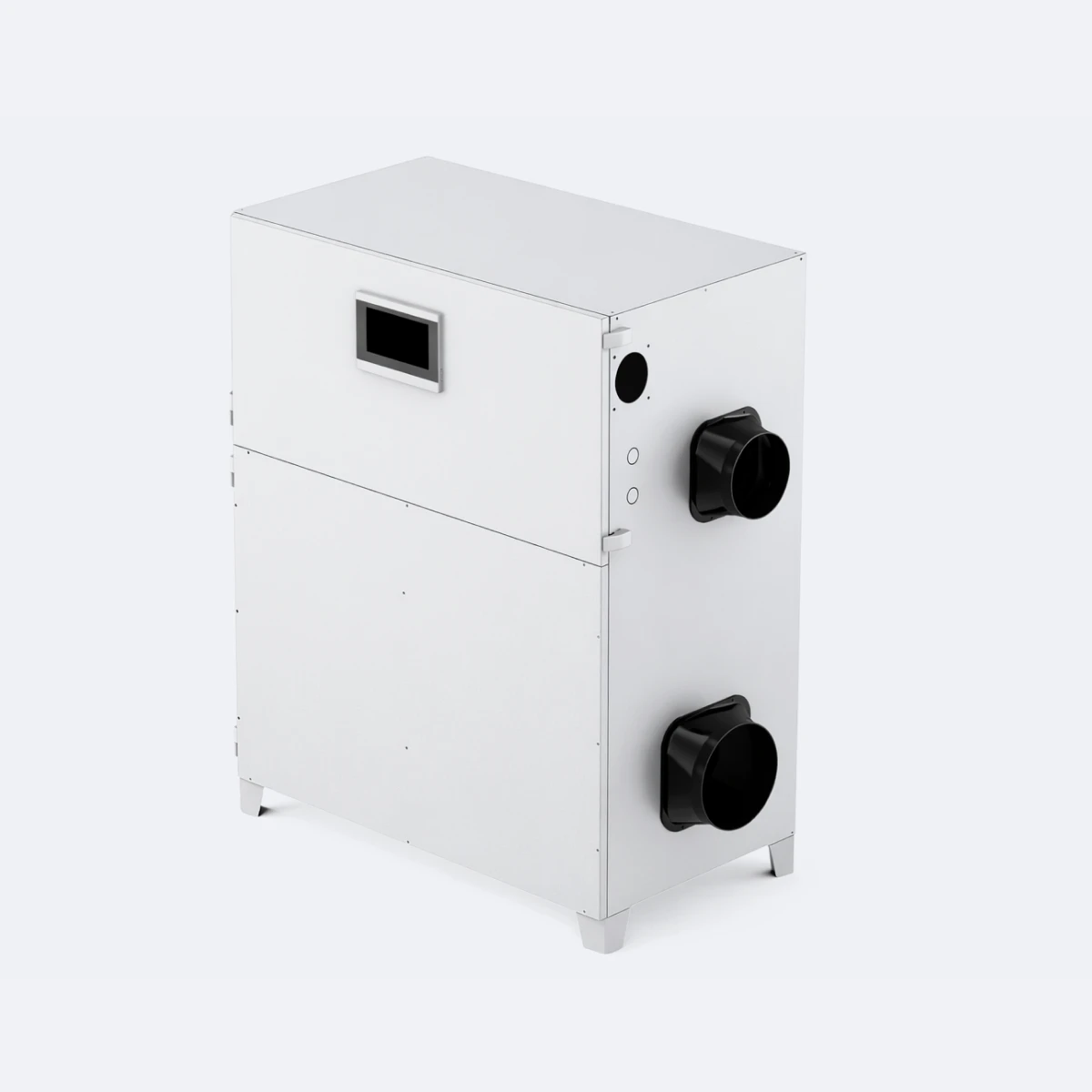
What is a Rotary Dehumidifier and How Does it Process Intricate Airflows?
An industrial rotary desiccant dehumidifier operates on the principle of continuous physical adsorption rather than mechanical refrigeration cycle condensation. At its core sits a structural, slowly rotating honeycomb wheel impregnated with an ultra-porous silica gel desiccant matrix. The unit simultaneously manages two separate air streams through independent, tightly sealed air ducts to guarantee zero cross-contamination: the process air stream and the reactivation (regeneration) air stream.
The process air is pulled from the humid environment and forced through the moisture-absorbing zones of the rotor, where water vapor is instantaneously bound by the desiccant. The resulting deeply dried air is then discharged straight into the targeted space. Concurrently, a smaller reactivation air stream is heated up via an insulated heating chamber incorporating advanced PTC heating elements. This hot air passes through the remainder of the wheel to release the trapped moisture, exhausting it outdoors as warm water vapor. This constant cycling ensures non-stop, deeply stabilized moisture extraction without any drop-offs in performance.
Rotary Dehumidifier vs Compressor Technology: The Ultra-Low Environment Advantage
When selecting a high-capacity system, understanding the deep operational thresholds of a rotary dehumidifier vs compressor-based equipment is essential for B2B engineering applications. Compressor systems rely on creating a cold surface to liquefy airborne moisture; however, when the ambient temperature drops below 15°C, the evaporator coils rapidly accumulate ice, triggering frequent, energy-wasting defrost cycles. Below 5°C, standard mechanical refrigeration systems freeze up completely and cannot function.
Furthermore, compressor-type units are limited by physical dewpoint boundaries; they cannot efficiently drop relative humidity below 30%-40% RH because the vapor pressure differential becomes too low to yield condensate. Our desiccant rotary dehumidifier completely bypasses these physical limits. Because adsorption is chemical and physical rather than temperature-dependent, the ROD-F and ROD-G lines maintain outstanding moisture extraction curves in freezing temperatures or within ultra-low relative humidity demands, achieving a tight 1%-5% adjustable humidity differential that standard compressors simply cannot reach.
Engineered for Precision Applications and Extreme Industrial Contexts
The technical parameters of the ROD-F and ROD-G series make them ideal for niche industrial environments where absolute control over moisture tracking is vital:
- Aerospace, Defense, and Electronics Manufacturing: Essential for stopping surface oxidation on critical alloy avionics components and protecting moisture-sensitive electronics from electrostatic micro-faults during multi-layered semiconductor PCB printing processes.
- Pharmaceutical Storage and Chemical Processing: Prevents hygroscopic chemical compounds, active pharmaceutical powders, and tablet press ingredients from clumping together, directly supporting stringent GMP and compliance standards.
- Cold Storage and Food Preservation: Eliminates ice build-up, heavy frost formations, and condensation on structural columns or packaging inside low-temperature seafood storage and refrigeration facilities.
- Specialized Drying Rooms, Textiles, and Artwork Care: Accelerates curing environments for fiber processing, high-grade wood coatings, and complex artwork restoration drying rooms under strict moisture parameters.
Advanced Temperature Regulation: Advanced PTC Heating & SCR Control
Energy consumption during desiccant wheel regeneration is a critical factor for long-term commercial operating budgets. Our rotary desiccant dehumidifier overcomes traditional high-consumption drawbacks by pairing an insulated heating chamber with advanced PTC heating and SCR (Silicon Controlled Rectifier) power control. Rather than running at full electrical capacity continuously, the SCR control infinitely modulates the electrical input to the heating bank based on the real-time thermal load of the exhaust stream.
This smart power modulation minimizes overall energy spikes, reduces total system wear, and prevents thermal shock within the desiccant matrix, greatly extending the operating life of the core rotor. Coupled with international-brand internal components and a heavy-duty cold-rolled steel cabinet layout, this machinery provides exceptionally stable, low-maintenance performance over years of continuous commercial service.