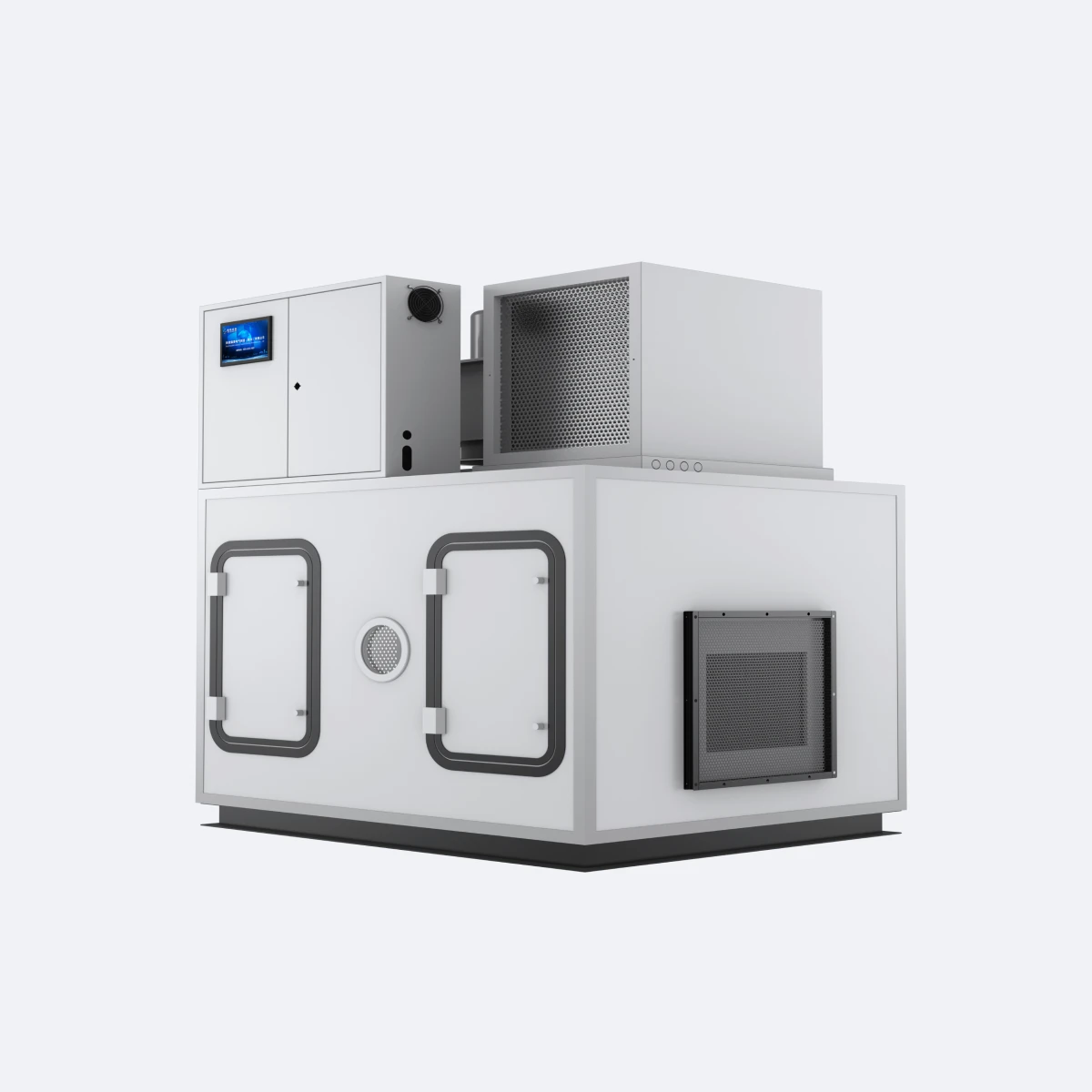
What is a Rotary Dehumidifier and How Does It Serve Large-Scale B2B Facilities?
An industrial high-capacity rotary desiccant dehumidifier manages humidity via physical adsorption rather than mechanical refrigeration cycle condensation. The process centers around a slowly revolving honeycomb matrix wheel saturated with highly active silica gel desiccant. To handle large-scale workflows up to 2000 m³/h, the equipment leverages separate air processing ducts. Process air from the damp industrial interior passes through the wheel's active desiccant structures, which lock in vapor molecules instantly before releasing deeply dry air into the plant floor.
Simultaneously, a distinct regeneration (reactivation) air stream is drawn through an insulated heating chamber. Heated by low-lag PTC modules, this high-temperature airstream drives moisture out of the rotating desiccant wheel and exhausts it outside as water vapor. By separating these streams within airtight, zero-leakage channels, the ROD-H and ROD-I models maintain constant, highly scale-stable moisture extraction rates without performance drops or operational down-time.
Rotary Dehumidifier vs Compressor Technology: The High-Capacity Sizing Choice
For plant managers and engineering agencies evaluating a rotary dehumidifier vs compressor-based refrigeration configuration, the technical differentiator rests on performance at low-temperature or low-humidity boundaries. Compressor setups require a cold internal coil surface to liquefy atmospheric water vapor. When temperatures fall below 15°C, their coils frost up, inducing cyclical defrost periods that stall moisture extraction. In spaces requiring sub-30% relative humidity, compressor-type loops can fail entirely due to minimal vapor pressure differentials.
Our heavy-duty rotary desiccant dehumidifier relies entirely on structural physical absorption, rendering its performance independent of ambient room temperature. Whether deployed in cold storage facilities operating near 0°C or cleanrooms requiring strict, single-digit relative humidity control, the desiccant wheel maintains its moisture extraction profiles. The ROD-H and ROD-I lines ensure reliable climate stability under demanding industrial loads, maintaining a 1%-5% adjustable humidity differential that refrigeration-cycle configurations cannot support.
Engineered for Critical Sectors, Advanced Assembly, and Heavy Industry
With processing volumes handling 240 L/day and 312 L/day, the ROD-H and ROD-I systems are custom-specified for high-demand, large-scale industrial layouts:
- **Defense, Aerospace, and High-Value Asset Preservation:** Essential for shielding military equipment enclosures, aviation storage bays, and strategic component warehouses against moisture-driven oxidation and alloy degradation.
- **Electronics Manufacturing and Cleanrooms:** Maintains the strict environmental basements required by multi-layered semiconductor facilities and lithium-ion battery assembly lines, protecting materials from humidity damage.
- **Pharmaceutical Processing and Chemical Drying:** Controls moisture levels across high-volume granulation rooms, mixing bays, and powder packaging zones to prevent product clumping and support GMP compliance.
- **Cold Storage, Cold Chain Logistics, and Specialized Drying:** Eliminates frost accumulation on structural components, doors, and loading equipment inside low-temperature seafood storage and freezing facilities, while offering high-capacity airflow for industrial fiber, resin, and drying rooms.
SCR Power Modulation: Cutting Overhead in High-Capacity Systems
Managing energy use during desiccant reactivation is a priority for commercial facilities operating high-capacity systems. Traditional desiccant plants draw maximum current continuously to maintain regeneration heat. The ROD-H and ROD-I series address this by pairing an insulated heating chamber with digital PTC heat modules and SCR (Silicon Controlled Rectifier) step-less modulation. The SCR controller analyzes continuous moisture feedback and regulates power to the heating grid to match real-time requirements.
This power modulation eliminates major current spikes, prevents thermal over-stressing of the silica gel matrix, and helps lower operational electricity costs. Built within a heavy steel enclosure featuring reinforced access doors and dual-pressure ports, this machinery provides long service intervals and low operational overhead for high-capacity industrial installations worldwide.