
Search

Enter keywords to search for products, blog posts, and more.

Climate Control for Museums — Constant Temperature-and-Humidity Systems for Artifact Preservation in Galleries, Archives, and Libraries

Climate Control for Museums — Constant Temperature-and-Humidity Systems for Artifact Preservation in Galleries, Archives, and Libraries


How Humidity Damages — and Preserves — Museum Collections

Humidity preservation in a museum is a question of both level and stability. Organic materials — wood, paper, leather, textiles, ivory, adhesives, paint films — are hygroscopic, and they absorb and release moisture at different rates, so a composite object like a painted wood panel holds different moisture contents in its layers at once, creating interface stresses. Most museums hold mixed collections needing a compromise set-point of 45–55% RH, with extreme-requirement materials (metals, photographs) isolated in dedicated rooms. Three principles define the science:

Stability matters more than the absolute number

This is the most important — and most misunderstood — principle. The traditional 50% ±5% target (from early-20th-century MFA Boston research) is sensible, but stability matters more: how little RH varies over a day and across seasons. Conservation Wiki recommends ≤5% daily fluctuation (ideally ≤3%); ASHRAE Chapter 24's top tier calls for ±5% year-round. Every rise swells a wooden panel and every fall shrinks it; if the paint or gesso cannot follow, it cracks. A single excursion may do nothing — thousands of daily micro-cycles over decades accumulate into visible damage.

Low humidity fractures organic materials

Below about 30–35% RH, organic materials contract beyond their elastic limit. Wood cracks along the grain; animal/fish glue and starch paste become brittle and lose bond strength; leather stiffens and crazes; paper becomes brittle and tears; ivory cracks along its layers. Oil and tempera paint films, less elastic than their substrate, develop networks of fine cracks (craquelure). Once formed, these cracks are irreversible.

High humidity enables biological and chemical deterioration

Above about 60% RH, mold germinates on organic surfaces within days to weeks and accelerates above 65–70%, digesting paper, wood, leather, and textiles. High humidity also speeds chemistry: iron corrodes roughly six times faster at 90% RH than at 50%, silver tarnishes, photographic emulsions degrade, and cellulose in paper undergoes acid hydrolysis. The 40–60% target keeps conditions below the mold threshold and above the fracture threshold.

SHISHUO Climate Control Systems for Museum and Conservation Environments

Museum climate control demands more than humidification alone — it requires holding both temperature AND humidity stable within tight tolerances, plus air purification and sterilization in archive environments. SHISHUO offers three coordinated platforms: DXHW constant temperature-and-humidity units as the core climate control system, DXSL combo units integrating humidification, dehumidification, UV sterilization and negative ion purification for archives and multi-gallery institutions, and compact UH-DS ultrasonic humidifiers for display-case-level microclimate adjustment. All platforms support continuous operation, remote monitoring, and OEM/ODM customization.

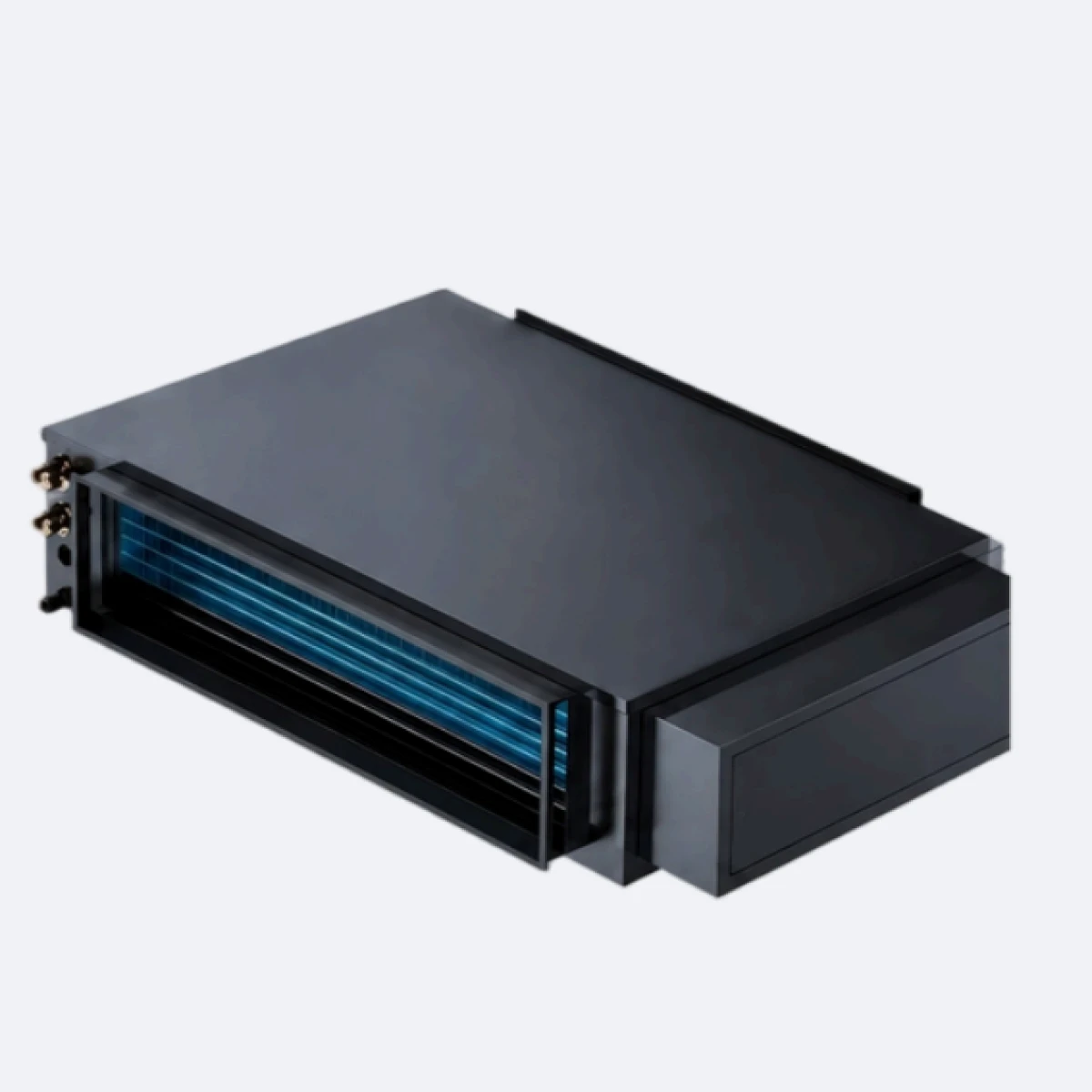
Option 1 — DXHW Constant Temperature-and-Humidity Unit for Galleries, Vaults & Archives

Museum collections demand a stable microclimate — paper, textile, wood, painted, and metal artifacts each have narrow tolerance bands where both temperature AND humidity must be held simultaneously. For gallery halls, collection vaults, archive stacks, and rare book rooms where drift in either variable causes irreversible damage:

The core platform for museum climate control — locks both temperature AND humidity to tight simultaneous set points on one coordinated system, not two separate machines fighting each other. PLC intelligent system with 7-inch touchscreen, ceiling-concealed ducted or floor-standing vertical configurations to keep gallery walls and display cases clear. Industrial-grade components rated for 24/7 continuous operation, continuous drainage, OEM/ODM customization for specific artifact preservation requirements.

DXHW-9

DXHW-9
Capacity (L/day):288
Cooling Capacity (kW):9
Power:380V / 50Hz

view details

DXHW-25

DXHW-25
Capacity (L/day):480
Cooling Capacity (kW):25
Power:380V / 50Hz

view details

DXHW-70

DXHW-70
Capacity (L/day):720
Cooling Capacity (kW):70
Power:380V / 50Hz

view details

Option 2 — DXSL Whole-Building Humidifier & Dehumidifier Combo with UV Sterilization

For institutional archives, document storage, and large multi-gallery museums where climate control must also include microbial and mold suppression (UV sterilization) and airborne particulate reduction — protecting paper and textile collections from biological threats as well as humidity:

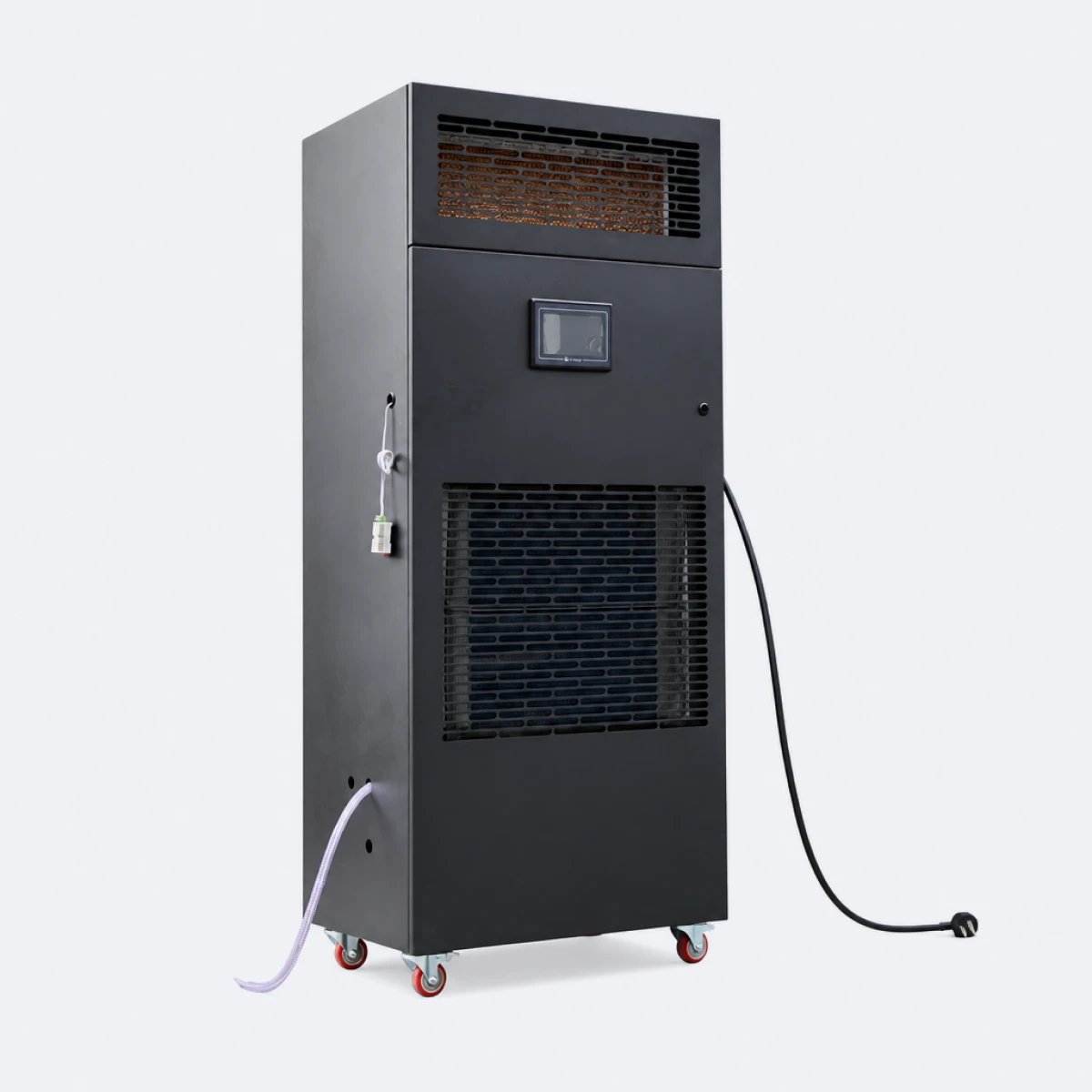
Integrated humidification, refrigeration-based dehumidification, UV sterilization, and negative ion air purification in one unit — the multi-function platform for institutions wanting sterilization and air quality control alongside climate control. RS-485 remote monitoring for unattended galleries, scales from 90 to 480 unit capacity across a full institution.

DXSL-90

DXSL-90
Humidification Capacity (kg/h): 6
Dehumidification Capacity (L/h): 90
Power:220V/380V

view details

DXSL-240

DXSL-240
Humidification Capacity (kg/h): 25
Dehumidification Capacity (L/h): 240
Power:220V / 380V / 50Hz

view details

DXSL-480

DXSL-480
Humidification Capacity (kg/h): 40
Dehumidification Capacity (L/h): 480
Power:380V / 50Hz

view details

Option 3 — UH-DS Compact Ultrasonic Humidifier for Individual Display Cases & Small Vaults

For individual display cases, small collection vaults, and single-room galleries where the main DXHW system needs supplemental humidification to hold a specific artifact's tighter set point (e.g., a single painting or textile requiring higher RH than the surrounding gallery):

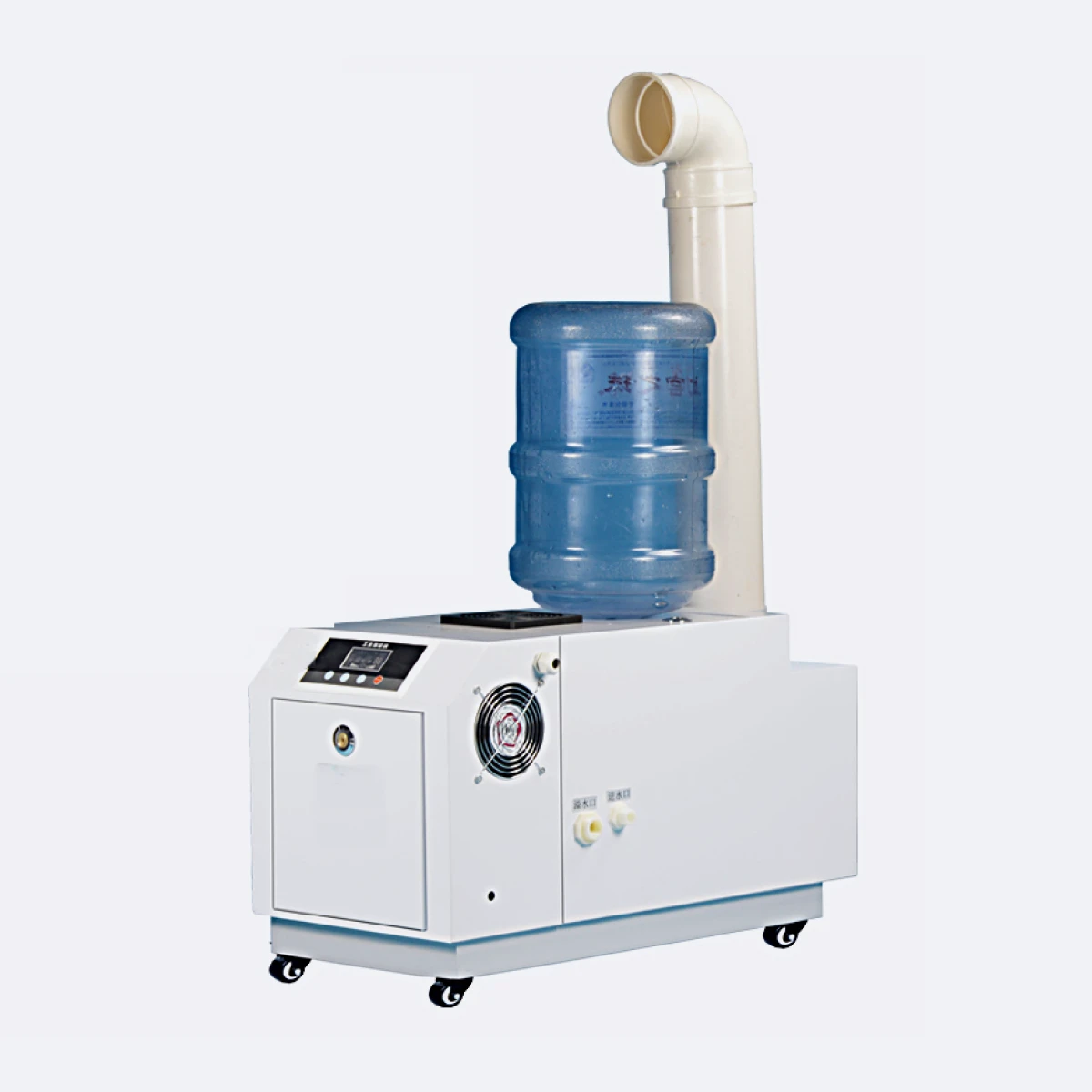
Ultrasonic atomization produces 0.5-5 micron droplets that evaporate in the air without wetting artifact surfaces, display cases, or building finishes — a fundamental requirement where a single water droplet on a painted surface causes irreversible staining. Compact 2-3 kg/h footprint suited to sealed display cases, small vaults, and individual gallery zones. DI or RO water is non-negotiable to avoid mineral dust on artifacts.

UH-DS-02E

UH-DS-02E
Humidification Capacity (kg/h): 2
Atomizing Particles (μm): 6 (Max Output)
Power:220V / 50Hz

view details

UH-DS-03E

UH-DS-03E
Humidification Capacity (kg/h): 3
Atomizing Particles (μm): 10 (Max Output)
Power:220V / 50Hz

view details

UH-DS-06E

UH-DS-06E
Humidification Capacity (kg/h): 6
Atomizing Particles (μm): 20 (Max Output)
Power:220V / 50Hz

view details

Recommended Humidity by Collection Type

The table below maps each collection material to its set-point RH, the maximum daily fluctuation it tolerates, and the key risks at both low and high humidity. These ranges reflect the current conservation consensus (ASHRAE Chapter 24, Conservation Wiki, Michalski/CCI, MFA Boston); individual objects with known vulnerabilities may require tighter control determined by a conservator.


Collection / MaterialSet-Point RHMax Daily FluctuationKey Risk at Low RHKey Risk at High RH
Mixed organic collection (general gallery)45–55%±3–5%Cracking, fracture, delaminationMold, dimensional distortion
Oil paintings on canvas45–55%±3–5%Craquelure, canvas tension lossCanvas sag, mold on back
Oil paintings on wood panel45–55%±3%Panel crack, paint flakePanel warp, paint delaminate
Wooden furniture, sculpture, objects45–55%±5%Splits, joint failure, veneer liftSwelling, glue failure, mold
Paper documents, prints, drawings35–50%±5%Brittleness, curling, tearingFoxing, mold, cockling
Photographic materials (film, prints)30–40%±5%Curl, emulsion crackFerrotyping, mold, staining
Textiles (tapestries, costumes, rugs)40–55%±5%Fiber brittleness, dye crackMold, insect activity
Leather, parchment, vellum45–55%±5%Surface craze, shrinkageMold, red rot (in leather)
Ivory, bone, antler45–55%±3–5%Longitudinal crackingRarely an issue within range
Metals (iron, steel, bronze, copper)Below 40%, ideally <30%StableGenerally safe at low RHCorrosion, tarnish, patina change
Ceramics, stone, glassStable at any moderate level±5%Rarely an issueSalt crystallization cycles on stone
Archives / libraries (chemically stable)35–50%±5%Brittleness, spine crackMold, foxing, adhesive failure
Archives (unstable: newsprint, acetate)Cool/cold storage, 30–50%StableEmbrittlementAcid hydrolysis accelerated


Matching Climate Control System to Museum Facility Type

Different museum facility types have different climate control priorities — a gallery hall needs coordinated temperature and humidity holding; an archive vault demands sterilization and air purification alongside climate control; a single-artifact display case needs precise micro-adjustment. The four representative facilities below show typical platform selection, from a small gallery room to a conservation reserve store.
01

Small Gallery Room

30–80 m² · 45–55% RH

DXHW-9 for coordinated temp+RH control; add UH-DS-02E for individual display case fine-tuning

02

Large Exhibition Hall

200–500 m² · 45–55% RH

DXHW-25 to DXHW-70 for whole-hall climate control; DXSL-90 to DXSL-240 where UV sterilization is required

03

Archive / Manuscript Vault

20–100 m² · 35–50% RH

DXSL-90 or DXSL-240 — combined climate control with UV sterilization protects paper against mold; low set-point suits paper collections

04

Conservation Storage / Reserve Collection

50–300 m² · 45–55% RH

DXSL-240 to DXSL-480 — integrated humidification, dehumidification, UV sterilization for 24/7 unattended reserve storage

Key considerations for museum climate control:

Four factors determine whether a museum climate control system actually preserves a collection: coordinated temperature AND humidity holding, prioritizing stability over absolute values, mandatory DI water for the humidification stage, and continuous monitoring for compliance and early warning.
Coordinate temperature AND humidity — controlling one while letting the other drift still causes cycling damage. Prefer coordinated systems (DXHW/DXSL) over separate temperature and humidity equipment where budget allows.
Stability over absolute level — precise automatic control with responsive sensors matters more than hitting an exact set-point.
Size for stability, not capacity — an oversized unit hunts (short on/off bursts); a right-sized unit runs longer for smoother RH. When in doubt, choose smaller.
DI or RO water is non-negotiable for the humidification stage — tap-water minerals deposit as white dust on artifacts, vitrines, and fixtures, a conservation hazard, not just cosmetic.

Need a Sizing Calculation for Your Greenhouse?

Send us your greenhouse dimensions, cultivation stage, target humidity, and operating temperature. Our engineering team will recommend the right SHISHUO model and capacity.

Request Sizing Download Catalog amy@shishuodehu.com

Deployment Notes for Museum and Conservation Environments

Placement: Ducted DXHW/DXSL vs. Standalone UH-DS

DXHW and DXSL units integrate into the building HVAC and distribute conditioned air through ductwork, so placement is a mechanical design decision rather than a gallery-floor question — coordinate with your HVAC engineer during system sizing. Standalone UH-DS ultrasonic humidifiers, used for display cases and small vaults, must sit away from artifacts: position them where the air handling distributes mist throughout the space (near a supply duct or return grille), never next to an artifact or inside a display case, and keep at least 2–3 m between the outlet and the nearest artifact surface.

Sizing for Stability & Winter Risk

Size for stable RH, not maximum output. An oversized unit cycles in short bursts and makes RH oscillate (hunting); a right-sized unit runs longer and steadier — when in doubt, choose smaller. Winter is the highest-risk season: cold outdoor air heated to 18–22°C falls to 15–25% RH, far below the safe range, so the humidification stage works hardest then. Late-winter cracking or paint flaking usually points to inadequate heating-season humidification.

Monitoring & Loan Compliance

Install calibrated T/RH data loggers in each gallery and store, recording at ≤15-minute intervals; review weekly for daily swings and monthly for seasonal trends. The data verifies the set-point, supplies the environmental evidence lending institutions require for incoming loans, and gives early warning of equipment failure. Place sensors at artifact height (1–2 m), away from supply vents.

Display Cases & Water Quality

Well-sealed display cases form a buffering micro-environment that holds RH steady for days even as the gallery fluctuates — the main climate control system maintains the ambient, the case protects vulnerable objects; conditioned cases with silica gel give object-specific control. Use DI or RO water only for the humidification stage: mineral dust on artifacts is a conservation hazard, and clean the basin weekly to prevent biofilm releasing microorganisms into the gallery.

Frequently Asked Questions

What is the ideal humidity for a museum?

For general mixed organic collections (paintings, furniture, textiles, paper), the widely accepted target is 45–55% RH with daily fluctuation no greater than ±5%. The specific set-point depends on the collection composition and the building's ability to maintain stability. Modern conservation science emphasizes that stability is more important than hitting a precise number — a museum that maintains a steady 48% RH year-round is preserving its collection better than one that swings between 40% and 60% while averaging 50%.

Why is humidity fluctuation more damaging than a steady level?

Organic materials are hygroscopic — they expand when they absorb moisture and contract when they lose it. Repeated cycling fatigues the material at the molecular level, particularly at interfaces between different materials (paint on wood, veneer on substrate, gesso on panel). Over years and decades, thousands of small cycles produce cumulative cracking, delamination, and structural failure. A steady humidity level, even if not at the textbook ideal, eliminates this cycling damage.

Will the humidifier mist damage paintings or artifacts?

No. The SHISHUO UH-DS produces 0.5–5 micron droplets that evaporate in the air before they can reach any surface. The humidification stage raises ambient moisture, not surface moisture. Position the unit at least 2–3 meters from the nearest artifact and use DI water to prevent any mineral residue. Under these conditions, no surface contact occurs.

Do I need a humidifier or dehumidifier for my museum?

Most museums need both — winter heating drops indoor RH dangerously low, humid summers push it above 60% where mold germinates. The SHISHUO DXHW constant temperature-and-humidity unit handles both automatically on one coordinated platform, locking temperature and RH to the target set-points year-round. For archive environments where microbial threats to paper and textiles are a concern, the DXSL combo unit adds UV sterilization and negative ion purification to the same humidification/dehumidification capability.

What about metal collections — don't they need dry conditions?

Yes. Iron, steel, and bronze artifacts are safest at RH below 30–40%, and ideally below 30%. This conflicts directly with the 45–55% target for organic materials. The standard practice is to isolate metal collections in a dedicated dry room maintained by a dehumidifier, separate from the organic collection galleries. If metals and organic objects must share the same space, display metals in sealed cases with internal desiccant packets.

How do I meet loan requirements for incoming exhibitions?

Lending institutions typically require the borrowing museum to demonstrate environmental conditions within a specified range (commonly 45–55% RH, ±5%, with continuous data logging). Install data loggers that record at 15-minute intervals. Provide the lending institution with three to six months of logged data before the loan period to demonstrate your facility's track record. A properly sized climate control system, paired with continuous monitoring, provides the environmental evidence needed to secure incoming loans.

Can I use standalone units in a historic house with no central HVAC?

Yes. The UH-DS is a standalone unit that plugs into 220V power and operates independently of any central system. In historic houses where installing ductwork would damage the building fabric, a portable humidifier placed in an inconspicuous location (behind a screen, in an adjacent service corridor) can provide the necessary humidity supplement. For rooms with fireplaces or radiator heating that severely dry the air in winter, position the unit near the heat source to humidify the driest air first. Where a central HVAC exists, the DXHW or DXSL platform integrates directly for whole-building climate control.

What's the difference between DXHW, DXSL, and UH-DS?

DXHW is a constant temperature-and-humidity unit — the core climate control platform that locks both temperature and RH to tight set-points on one coordinated system. DXSL adds UV sterilization and negative ion purification to the DXHW's humidification/dehumidification function, ideal for archives where mold and microbial threats to paper/textile collections require active sterilization. UH-DS is an ultrasonic humidifier only — used as supplemental humidification for individual display cases or single-artifact micro-environments where the main DXHW system needs local fine-tuning.

Do SHISHUO climate control systems support OEM and ODM?

Yes. We support OEM branding and ODM modifications including custom cabinet finishes for gallery aesthetics, low-noise configurations for exhibition spaces, integration with museum BMS systems, and capacity adjustments. Contact our team with your requirements.

Get the Right Climate Control
Solution for Your Application

We support industrial temperature and humidity control projects with clear specifications, stable equipment, and practical system advice. Share your application details and capacity requirements—our team will respond with a suitable solution and quotation.

Get a Quick Quote

Amy

General Manager