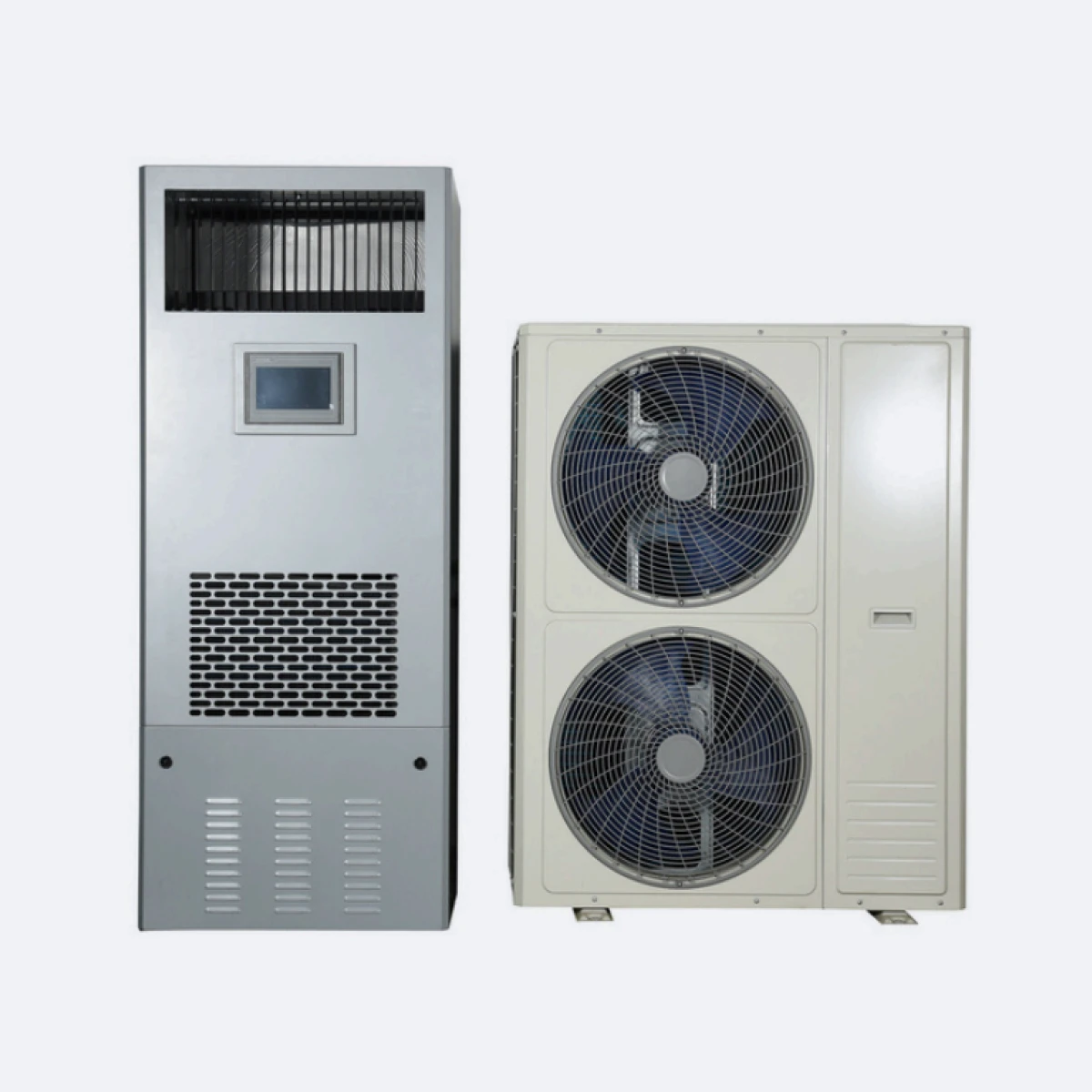
Thermodynamic Balancing: The Precision Air Conditioner Working Principle
Standard comfort cooling air conditioners are fundamentally limited by their reliance on a singular single-variable thermostat logic loop. When comfort systems operate to decrease dry-bulb temperatures, moisture extraction occurs only as a passive, unregulated secondary effect across the cooling coils. This design results in severe relative humidity fluctuations that compromise sensitive technical environments. The DXHW constant temperature and humidity unit circumvents this limitation by operating an integrated, multi-stage thermodynamic cycle managed via an onboard industrial programmable logic controller (PLC).
The precision air conditioner working principle relies on a continuous psychrometric feedback loop that monitors return air composition. The internal air handling loop processes air over an all-copper evaporator coil linked to top-tier hermetic scroll or rotary compressors from GMCC, LG, Highly, and Gree. If sensors register that ambient moisture levels exceed the pre-programmed target while the space temperature remains correct, the PLC executes a dedicated latent heat extraction cycle. As the air cooling sequence dehumidifies the airstream, its dry-bulb temperature drops. The system counters this overshoot by engaging a balanced PTC stainless steel finned electric heating element array, introducing precise sensible heat blocks to hold temperatures stable within a narrow ±1 °C variance.
When ambient humidity drops below target levels, the PLC triggers the active electrode-type steam humidification module. Supplied by a direct 1/2-inch pressurized plumbing water line, this module heats clean water internally to generate pure, mineral-free vapor. This steam is injected directly into the high-velocity air stream behind the fan assembly, eliminating water droplet carryover and ensuring uniform moisture blending before distribution into the ductwork. By calculating latent and sensible heat loads concurrently, the DXHW platform maintains relative humidity tracking inside a steady ±5% RH envelope without system hunting.
Structural Engineering Comparison: Vertical Floor-Standing vs. Ceiling Concealed Layouts
To support varying architectural spatial conditions, the DXHW series is manufactured in two primary structural chassis formats. The horizontal ceiling concealed precision AC layout is engineered specifically to maximize floor utilization inside high-density facilities. Housed entirely within overhead ceiling voids or joist frameworks, these systems interface with target zones exclusively via insulated sheet metal duct runs and ceiling diffusers. This overhead design delivers external static pressures between 100 Pa and 200 Pa, allowing the high-velocity air handler to overcome friction losses from extensive duct paths or integrated secondary HEPA filtration tracks, providing uniform air distribution across large footprints.
For facilities where overhead clearance is restricted or where maintenance access must be localized on the ground floor, the vertical precision air conditioner cabinet configuration offers an optimized solution. The vertical format features an integrated upward or front-facing displacement air pattern, taking return air directly from the floor level where thermal loads consolidate. This vertical cabinet layout centers all mechanical core components—including the compressor assembly, the PLC module, electrical contactors, and expansion valves—behind front-facing, quick-release access panels. This service layout allows field technicians to complete routine preventative filter checks, coil cleanings, and diagnostic logging quickly without accessing overhead building voids.
Component Structural Durability and Thermal Exchange Efficiency
Industrial climate systems must meet strict reliability standards when operating continuously over multi-year lifecycles. The internal components of the DXHW line are selected specifically to withstand continuous thermal expansion and contraction stresses:
- Inner-Grooved All-Copper Piping Loops: Both the condenser and evaporator configurations utilize heavy-wall copper tubing featuring micro-grooved internal geometries that increase internal surface surface-to-refrigerant contact areas. This structural design increases heat transfer efficiency by up to 30% compared to smooth-wall alternatives and resists pinhole galvanic corrosion far better than automotive-grade aluminum microchannel assemblies.
- Thermal Expansion Valve Flow Regulation: Rather than relying on simple capillary tube restrictions, the refrigeration circuit uses heavy-duty mechanical thermal expansion valves (TXV). These valves modulate refrigerant mass flow dynamically based on shifting evaporator thermal loads, protecting the compressor from liquid slugging under low-load conditions.
- Redundant Multi-Circuit Topologies: Higher-capacity configurations—starting from the DXHW-45 (15 HP) tier up to the DXHW-70 (25 HP) platform—are built with dual separate refrigeration circuits driven by matching independent compressor installations. This layout allows the system to scale its cooling output downward to 50% during low-demand periods to optimize energy efficiency, while providing critical mechanical backup to safeguard valuable facility assets from total climate failure during maintenance windows.
Direct Factory Manufacturing, Engineering Adaptations, and B2B Procurement Specifications
As a specialized industrial HVAC manufacturing entity, we offer extensive technical modification capabilities for global commercial projects and B2B volume accounts. Our production lines can adapt standard DXHW physical frame footprints to integrate seamlessly with regional electrical power distribution grids, offering factory configurations for 220V/50Hz single-phase, 380V/50Hz three-phase, and custom 460V/60Hz three-phase industrial infrastructures common across North American territories.
Our engineering division supports advanced facility automation requirements by providing optional factory-installed Building Management System (BMS) communication expansion components, supporting native Modbus RTU or BACnet protocols for comprehensive centralized system monitoring. For countries operating under strict F-Gas updates or similar regional chemical restrictions, we provide certified eco-friendly alternative refrigerant charging profiles including factory-validated R290 and R32 compressor architectures. Our custom engineering support includes tailored external static pressure configurations up to 300+ Pa, specialized high-efficiency MERV/HEPA filter tracks, and custom corporate private-label casing paint configurations. The standard factory manufacturing window ranges from 30 to 40 days for lower-capacity units (DXHW-3 to DXHW-18) and 40 to 60 days for large-scale multi-circuit platforms, with secure containerized ocean shipping managed through FOB Ningbo or FOB Shanghai ports.