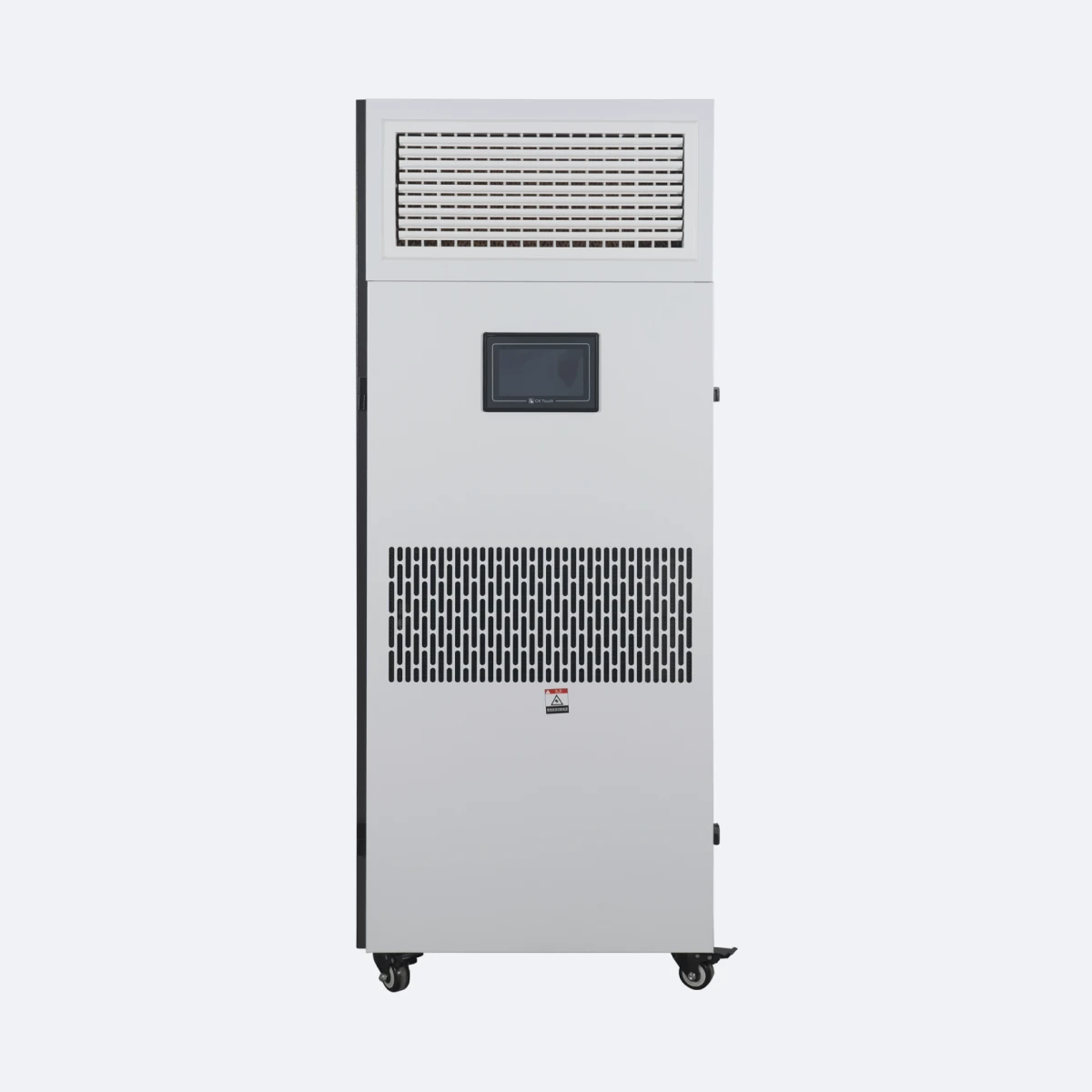
Where the Advanced 2-in-1 DS-HS Series Fits Best
The applicable scenarios listed on the product specification — archives, data centers, offices, GMP cleanrooms, museums, document rooms, electronic precision manufacturing workshops, wine cellars and supermarkets — overlap with the standard humidifier and dehumidifier combo range. What differs is the operational requirement: this advanced 2 in 1 humidifier and dehumidifier serves the same applications when three additional capabilities matter — active plasma sterilization for stricter antimicrobial control, gas-phase pollutant removal (formaldehyde, benzene, ammonia, ozone) beyond standard odor filtration, and standard RS-485 BMS integration ready for facility automation systems.
Specific buyer profiles where the advanced configuration justifies the premium: smart-building data centers integrating equipment into a DCIM platform, hospital and clinical laboratory installations under stricter IAQ regulations, modern museum facilities with conservation policies that explicitly require gas-phase pollutant control, archives storing acid-rich historical paper that off-gases over decades, electronics fabrication facilities with strict ozone and chemical vapor control, and commercial offices in newly-renovated buildings dealing with construction-related formaldehyde and VOC loads.
Why a 2 in 1 Humidifier and Dehumidifier with Plasma Sterilization
The standard combo unit serves bi-directional humidity control well — see the humidifier and dehumidifier combo page for the case for integrated humidification and dehumidification. The advanced configuration on this page is built around the recognition that many of the same facilities needing bi-directional humidity control also need active air quality intervention beyond passive filtration:
- Microbial control is operational, not optional. In archives, museums, and GMP cleanrooms, microbial growth on stored materials is the failure mode that humidity control exists to prevent. Passive humidity targets reduce growth conditions; active sterilization eliminates organisms already present in the recirculating air.
- Gas-phase pollutants are the hidden problem. Activated carbon filtration removes broadly-defined “odors” on most equipment. The advanced configuration specifies removal of formaldehyde (from new construction, particleboard, archival paper degradation), benzene (from solvents and adhesives), ammonia (from cleaning products and biological samples), and ozone (from electronic equipment, particularly photocopiers and laser printers in office environments). These compounds are the actual air-quality risks in modern building environments, not just odors.
- BMS integration is the default in smart facilities. Modern data centers, smart-building offices, hospital facility management systems, and pharmaceutical plants run their HVAC equipment through a centralized building management system. A humidifier and dehumidifier combo that requires custom BMS integration adds project cost and timeline. Standard RS-485 communication on every model in this advanced series removes the integration friction.
Plasma Sterilization — More Aggressive Than Standard Ion Sterilization
The plasma sterilization stage on this advanced configuration uses a high-voltage gas discharge to generate reactive plasma species (mainly hydroxyl radicals and other oxidizing species) that act on airborne microorganisms as they pass through the unit. The mechanism differs from the standard ion sterilization used on the basic combo configuration in three operational respects:
- Antimicrobial spectrum. Plasma sterilization is effective against a broader range of organisms including some viral particles and bacterial spores that resist standard ion sterilization. Reported single-pass kill rates against common test organisms (E. coli, S. aureus, certain mold spore species) typically reach 95 percent or higher, compared to 70–85 percent for standard negative ion sterilization stages.
- Maintenance approach. Plasma sterilization requires periodic electrode cleaning rather than UV lamp replacement (as in UV sterilization) or chemical media replacement (as in some other antimicrobial approaches). Maintenance interval is typically 6–12 months depending on contamination loading. UV lamp replacement on UV-based equipment is required at 8000–12000 operating hours, often with documented degradation in output before the lamp fails — plasma electrodes typically maintain output until cleaning is performed.
- Operational characteristics. Plasma operates continuously when the unit is powered, without requiring warm-up time or controlled ramp. The discharge produces a small quantity of ozone as a byproduct (within indoor air quality limits and removed by the downstream activated carbon stage on this design), and operates at low DC current with minimal electrical demand on the overall unit.
For installations where UV-C sterilization is preferred (some hospital and pharmaceutical applications have specific protocols for UV sterilization), see the DXSL-90 to DXSL-480 range which uses UV sterilization rather than plasma. The two sterilization technologies serve different facility safety policy preferences.
Negative Ion Generation for Air Quality and Occupant Comfort
Separate from the plasma sterilization stage, this advanced 2-in-1 dehumidifier and humidifier configuration includes a dedicated negative ion generator that produces sustained ion output during normal operation. Negative ions in indoor air settle particulate matter (causing larger aggregates that drop out of the breathing zone), reduce static electricity buildup on surfaces, and provide subjective improvement in air quality perception reported by occupants — the most commonly cited measurable effect is reduced reported headache frequency in office environments with sustained ion concentrations above 1000 ions/cm³ at the workstation.
The combination of plasma sterilization plus separate negative ion generation provides two complementary air-quality interventions: plasma handles active antimicrobial control, negative ions handle particulate settling and occupant air-quality perception. Both stages run continuously regardless of whether the unit is humidifying or dehumidifying, providing sustained operation independent of the bi-directional humidity control cycle.
VOC and Pollutant Removal — Formaldehyde, Benzene, Ammonia, Ozone
The activated carbon filtration stage on this advanced configuration is specified for gas-phase pollutant removal beyond the broad “odor control” specification of standard activated carbon stages. Four target pollutants matter in modern indoor environments:
- Formaldehyde (HCHO). Off-gassing from new construction materials (particleboard, MDF, certain insulations), archival paper degradation (cellulose decomposition produces formaldehyde over decades), and certain laboratory chemicals. Indoor air quality limits in most regulatory frameworks set 0.08 to 0.1 mg/m³ as the long-term exposure target. Concentrations 5–10 times higher are routine in newly-renovated buildings and older archives.
- Benzene (C6H6). Off-gassing from solvents, adhesives, and certain laboratory and industrial process emissions. WHO classifies benzene as a Group 1 human carcinogen with no safe lower threshold — the regulatory approach is to minimize exposure as far as practical. Activated carbon adsorption is the standard removal technology for indoor benzene control.
- Ammonia (NH3). Off-gassing from cleaning products, biological samples in laboratories and medical facilities, and certain industrial processes. Particularly relevant in laboratory and medical facility installations where ammonia from sample handling or cleaning protocols accumulates in poorly-ventilated zones.
- Ozone (O3). Generated by electronic equipment, particularly photocopiers, laser printers, and certain UV-based equipment. Ozone is an oxidizing irritant with effects at 0.1 ppm and above; office environments with heavy printing/copying loads can reach measurable ozone concentrations without active control. Activated carbon adsorbs ozone effectively.
The activated carbon bed in this advanced configuration is sized for these target pollutants with industrial-grade carbon media. Carbon replacement interval depends on actual contamination loading — typical office and archive installations achieve 12–18 months between replacements; high-load installations (newly-renovated offices, heavily-equipped electronics workshops) may require 6–12 month intervals.
RS-485 BMS Communication Interface — Standard Equipment
Every model in this advanced series ships with an RS-485 communication interface as standard equipment. The interface supports Modbus RTU protocol by default — the most widely-adopted protocol for industrial HVAC equipment BMS integration — and can be reflashed to other protocols (BACnet MS/TP, KNX, etc.) as ODM modifications from MOQ 50 units. The data points reported through the interface include real-time room RH, room temperature, unit operating mode (humidifying / dehumidifying / idle / filtering only), compressor status (per compressor on multi-compressor models), water tank level (for the humidification stage), filter status, sterilization stage operating status, and fault codes with severity classification.
For data center installations, this enables DCIM (Data Center Infrastructure Management) integration: the humidity control units appear as monitored assets in the DCIM platform with full visibility into operating state, alarm forwarding to the central monitoring system, and historical trend data for capacity planning. For pharmaceutical and laboratory installations, the BMS connection supports validation requirements — the BMS becomes the auditable record of humidity control operation across the facility, with time-stamped data for batch records and regulatory compliance.
Nine Capacity Tiers — Premium Compressor Configurations
The capacity range matches the standard combo configuration but with several compressor variants specific to this advanced series. The most notable: the DS-20HS triple-compressor (3 × 3 HP) configuration not available on the standard combo range. The triple configuration provides three operational advantages:
- Finer-grained capacity control. The control system stages 1, 2, or 3 compressors based on actual load, running 1 compressor at low load (typically 30–35 % of peak demand), 2 compressors at moderate load (60–70 %), and all 3 at peak demand. The result is better part-load efficiency than running a single larger compressor cycling on and off, and tighter humidity control during transient loads.
- Higher redundancy. Single compressor failure leaves 2 of 3 operating at approximately 67 % capacity rather than the 50 % capacity remaining on a dual-compressor unit. For data center, museum, and regulated pharmaceutical installations where humidity control continuity matters, the triple configuration provides additional operational resilience.
- Maintenance staging. Service rotation across compressors prevents any single compressor from accumulating disproportionate runtime, extending overall unit service life. Periodic compressor exercise (running each compressor as primary in rotation) is automated through the control firmware.
The dual 2 HP configurations on DS-15HS and DS-20HS provide an alternative high-redundancy approach at lower peak capacity — appropriate where two-compressor redundancy meets the application requirement and the more compact 2 HP compressors fit the cabinet space efficiency requirements.
Application: Archives with Acid Off-gassing and Document Conservation
Archive moisture control is well-established at ISO 11799 — 30 to 50 percent RH ±5 percent for paper storage, served by the bi-directional humidity control on either the standard combo or this advanced configuration. The case for the advanced configuration in archives comes from a problem the standard equipment cannot address: paper-based collections off-gas formaldehyde and acetic acid over time as cellulose decomposes (the same process that turns old paper yellow and brittle). The off-gassed compounds accumulate in poorly-ventilated archive zones, accelerating degradation of adjacent collections through cross-contamination — well-documented in conservation literature.
The activated carbon stage with explicit formaldehyde removal addresses the off-gassing problem alongside humidity control. The plasma sterilization stage adds defense against mold spore growth on aging paper substrates. Modern conservation policies at major institutional archives increasingly specify both humidity control AND active air quality intervention in the equipment specification — driving the case for this advanced configuration over the basic combo unit. For institutions following modern conservation standards (ANSI/NISO Z39.79 for archival paper containers, ISO 18934 for film storage), gas-phase pollutant control is part of the conservation specification, not an optional add-on.
Application: Modern Museums with IAQ Compliance Requirements
Contemporary museum conservation policy has evolved beyond pure humidity targets. Major museum networks (American Alliance of Museums, ICOM) now publish facility specifications that include indoor air quality requirements: gas-phase pollutant limits (formaldehyde, acetic acid, sulfur dioxide, nitrogen dioxide) alongside the traditional 50 % RH ±5 % humidity specification. The driver is collection preservation evidence accumulated over 30+ years — gas-phase pollutants drive damage to metallic, organic, and certain mineral collection materials independent of humidity, and the damage is irreversible.
The advanced configuration serves modern museum installations where the conservation specification calls for both stable humidity AND active air quality intervention. The plasma sterilization provides microbial control important for organic collections (textiles, leather, paper, wood); the formaldehyde and acetic acid removal protects metal and stone surfaces from acid-driven corrosion. For museum gallery zones 200 to 450 m² in size, the DS-15HS and DS-20HS tiers provide single-unit coverage; for larger galleries, distributed deployment is the standard approach with BMS integration providing centralized control and monitoring.
Application: Smart Data Centers with Integrated BMS Monitoring
Data center humidity control under ASHRAE TC 9.9 is covered in detail on the standard combo page. The case for the advanced 2-in-1 configuration in data center applications is integration: modern data center facilities run all HVAC and power equipment through a DCIM platform that requires standard communication protocols. The RS-485 / Modbus RTU interface ships standard on every model, ready for DCIM integration without custom protocol work.
For data centers concerned with airborne particulate control beyond the standard MERV-rated filtration in the air handling units, the plasma sterilization plus negative ion generation provide additional measurable improvement in server-area air quality — relevant where server reliability data has correlated with airborne contamination levels in long-term operation. The ozone removal capability also matters in equipment rooms with significant networking equipment loads where ozone generation from electronic components accumulates without active control.
Application: GMP Cleanrooms and Electronic Precision Manufacturing with IAQ Specification
Pharmaceutical GMP cleanrooms and electronic precision manufacturing facilities increasingly include indoor air quality specifications alongside the traditional humidity targets. EU GMP Annex 1 specifies microbial control requirements that pure humidity control cannot deliver; ICH Q9 quality risk management frameworks drive facility specifications that include active antimicrobial intervention in HVAC equipment. For electronics manufacturing, IPC J-STD-033 covers humidity requirements for moisture-sensitive devices, but the facility-level specifications from major contract manufacturers and semiconductor companies typically extend to include particulate, VOC, and ozone control.
The advanced 2-in-1 dehumidifier and humidifier configuration serves these specifications with three combined capabilities: plasma sterilization for active antimicrobial control (microbial bioburden monitoring in GMP environments and clean assembly areas in electronics), formaldehyde and benzene removal for the chemical exposure controls required in many pharmaceutical and electronics facility specifications, and standard BMS integration through the RS-485 interface — important for validated systems where the BMS becomes part of the auditable record. For pharmaceutical installations, IQ/OQ documentation packages are available as ODM additions quoted per project, covering the validation requirements for both the humidity control function and the sterilization stage.
Distinguishing From the Standard DS-HS Combo and Other Variants
Choose the appropriate configuration by integration complexity and air quality requirements:
- This advanced series (DS-HS with plasma sterilization, formaldehyde removal, RS-485 BMS) — Right for: regulated applications (modern museum conservation, GMP cleanroom, archive preservation under contemporary standards), data center DCIM integration, hospital and clinical IAQ requirements, smart-building automation, newly-renovated commercial spaces with formaldehyde loads.
- Humidifier and dehumidifier combo (standard DS-HS, ion sterilization, basic filtration) — Right for: general-purpose bi-directional humidity control where basic ion sterilization and odor filtration meet the application requirement and BMS integration is not required (or available as ODM option). Lower initial cost when the advanced features are not required.
- DXSL-60 (40–60 L/day, single-room scale) — Right for: small single-room installations under 60 m² — telecommunications equipment rooms, single offices, small archive rooms, single switching rooms — at smaller capacity than the DS-03HS.
- DXSL-90 to DXSL-480 (scroll compressor, UV sterilization) — Right for: installations where UV sterilization is preferred over plasma (some hospital and pharmaceutical protocols specify UV), or where scroll compressor efficiency at sustained full-load operation outperforms reciprocating compressor designs (continuous high-load applications).
- Industrial dehumidifier (standalone, 180–1440 L/day) — Right for: humid climates where humidity moves only in one direction. Lower cost when humidification is not required.
- Temperature-controlled industrial dehumidifier (-3 to 60 °C envelope) — Right for: precision industrial environments with elevated or low ambient temperatures where standard combo equipment cannot operate.
- Ultrasonic humidifier (standalone) — Right for: dry climates where only humidification is required.
Build and OEM/ODM Service
Powder-coated cold-rolled steel cabinet, internal electrical components with moisture-proof conformal coating, microcomputer LCD intelligent control with intuitive operator interface, real-time temperature and humidity display with sterilization stage status indicators, and 1–24 hour adjustable on/off timer. Each unit is fully function-tested at the factory including verification of the plasma sterilization stage output, activated carbon stage pressure drop, negative ion generator output, and RS-485 communication protocol functionality before shipping. Safety protections include high-pressure cut-out on the refrigeration circuit, overcurrent protection, automatic defrost, water tank overflow and low-water protection on the humidification stage, plasma stage isolation interlock, and fault self-protection logic with real-time alerts on both the local LCD and the BMS interface.
OEM scope from MOQ 10 units per model: branding, cabinet color, plug type or terminal block configuration for the destination market's electrical standard, control firmware language, packaging artwork, custom mounting bases, and pre-fitted filter media specifications. ODM scope: voltage modification (110V or 460V from MOQ 50 on applicable models), R32 refrigerant (from MOQ 200 where applicable), BMS protocol customization (BACnet MS/TP, KNX from MOQ 50), enhanced HEPA filtration stage addition for GMP applications, custom plasma stage output adjustment for specific antimicrobial targets, IQ/OQ validation documentation packages for pharmaceutical applications quoted per project, structural and cabinet modifications quoted per project, and certification routing (CE, RoHS, ETL, SAA, GS, UL depending on target market). Production lead time is 30–45 days after artwork sign-off for the smaller tiers (DS-03HS to DS-12HS), 45–60 days for the larger multi-compressor tiers (DS-15HS Dual and DS-20HS triple/dual). FOB Ningbo or Shanghai.
For other capacity tiers and configurations, browse the full commercial dehumidifier lineup.