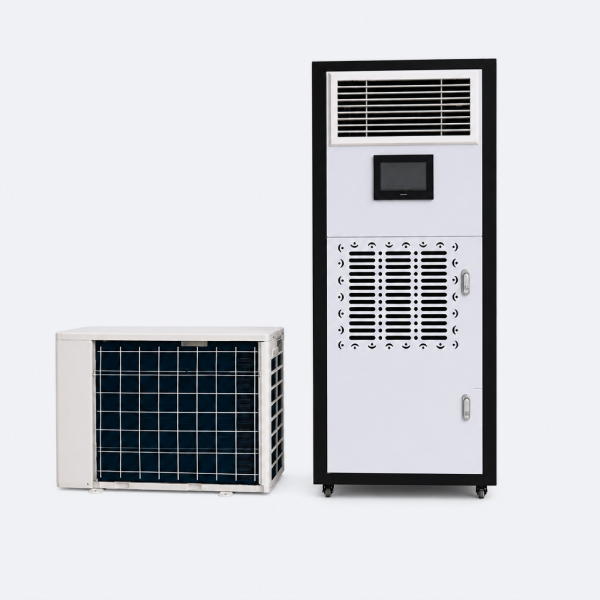
Where the HSJ Precision Air Conditioner Series Fits Best
The applicable scenarios on the product specification — data centers, server rooms, telecommunication rooms, laboratories, archives, cleanrooms, electronics workshops, precision instrument rooms, medical equipment rooms, UPS rooms, and monitoring centers — share an operational requirement that drives the engineering of a precision air conditioner: continuous tight climate control with high sensible heat ratio, year-round operation independent of building HVAC schedule, and built-in redundancy through standard split-system architecture. Comfort air conditioning equipment is not designed for these requirements; the HSJ range is.
Typical installations across the nine capacity tiers: small server rooms and equipment closets (HSJ-03 at 10–15 m², HSJ-06 at 15–25 m²); mid-sized telecom and switching rooms (HSJ-12, HSJ-15); larger server rooms and small data center pods (HSJ-20, HSJ-30); full data center halls and multi-rack equipment rooms (HSJ-40, HSJ-50, HSJ-60). The 9-tier capacity structure provides fine-grained sizing across the 10 to 240 m² installation range — typical commercial data center, telecom, and laboratory environments where this precision air conditioner equipment is specified.
Why a Precision Air Conditioner Instead of Comfort HVAC
Comfort air conditioning serves human thermal preference with deadbands appropriate to occupant tolerance — typically ±2°C temperature swings across day/night cycles, no active humidity control, and operating schedules tied to building occupancy. Mission-critical environments need different control characteristics that a precision air conditioner provides:
- Tight temperature control band. Server equipment per ASHRAE TC 9.9 Class A1 specification operates within an 18–27°C recommended inlet temperature range, with tighter ranges (±1–2°C around setpoint) for stable operation. Comfort HVAC with ±2°C deadband cycles through the entire allowable range; the HSJ precision air conditioner maintains ±1°C around the setpoint continuously.
- Active humidity control in both directions. Server rooms and equipment rooms need 40–60% RH (Class A1) to prevent ESD from too-dry conditions and condensation from too-humid conditions. Comfort HVAC reduces humidity unintentionally during cooling but cannot add moisture in dry seasons. The HSJ integrated electrode humidification stage adds moisture when needed, and the refrigeration cycle removes moisture during cooling — bi-directional humidity control around the same setpoint.
- High sensible heat ratio. Server and equipment rooms produce heat (sensible load) but generate little moisture (latent load). Comfort HVAC is designed for high latent load applications (humans produce moisture); operating comfort HVAC in equipment rooms wastes cooling capacity on unnecessary dehumidification while struggling to handle the sensible heat load. A precision air conditioner is designed with high sensible heat ratio (typically 0.85+) to match the actual load profile of mission-critical environments.
- Continuous operation reliability. Comfort HVAC is engineered for the 8000–10000 operating hour service life typical of building applications; precision air conditioner equipment is engineered for 50000+ operating hour service life with continuous 24/7 duty cycle. The compressor, fans, and electronics are specified for sustained operation rather than the cycling-on-cycling-off pattern that comfort equipment experiences.
For applications where comfort AC is the correct choice (commercial offices, retail spaces, residential), precision air conditioner equipment is over-specified and unnecessarily expensive. For mission-critical environments, comfort AC is under-specified and creates operational risk that the cost difference does not justify.
Nine Capacity Tiers — 3.5 to 60 kW Cooling Power
The nine-tier capacity structure maps to typical mission-critical environment installation sizes:
- HSJ-03 (3.5 kW cooling, 10–15 m²) — small server rooms, equipment closets, single-rack installations, small telecom equipment rooms.
- HSJ-06 (5 kW, 15–25 m²) — small data center pods, mid-sized equipment closets, small laboratory zones.
- HSJ-12 (9.2 kW, 25–35 m²) — mid-sized server rooms, small telecom switching rooms, equipment room precision air conditioner applications.
- HSJ-15 (12 kW, 35–55 m²) — larger server rooms, mid-sized switching rooms, single-floor IT facility cooling.
- HSJ-20 (20 kW, 60–80 m²) — larger telecommunication facilities, mid-sized data center halls, laboratory complexes. First tier with fully hermetic scroll compressor and dual-compressor staging.
- HSJ-30 (30 kW, 80–120 m²) — multi-rack server installations, mid-sized data center halls, larger telecommunication switching rooms.
- HSJ-40 (40 kW, 130–160 m²) — large data center halls, full-floor IT installations, large telecommunication facilities. First tier with two outdoor condenser units.
- HSJ-50 (50 kW, 160–200 m²) — major data center installations, full-floor mission-critical environments, multi-room laboratory complexes.
- HSJ-60 (60 kW, 200–240 m²) — largest single-unit installations, major data center halls, large industrial precision environments.
For installations above 240 m², distributed deployment of multiple HSJ units across the data hall provides better thermal targeting and built-in N+1 redundancy than oversizing a single unit. Distributed deployment also matches the standard data center cooling design pattern where multiple CRAC units share the load with hot-aisle/cold-aisle isolation.
Four-Function Climate Control: Cooling, Heating, Humidification, Dehumidification
The HSJ precision air conditioner integrates all four climate functions in a single cabinet — distinguishing it from comfort HVAC (cooling and heating only), standalone dehumidifiers, and standalone humidifiers:
- Cooling. Refrigeration cycle through copper heat exchanger with thermostatic expansion valve. Capacity ranges from 3.5 kW (HSJ-03) to 60 kW (HSJ-60). Sensible heat ratio of 0.85+ matches the high-sensible-load profile of mission-critical environments.
- Heating. Electric heating stage provides active heating during cold-season operation and reheating during humidity-driven cooling cycles. Heating capacity ranges from 2 kW (HSJ-03) to 32 kW (HSJ-60), sized to match the cooling capacity for symmetric four-quadrant operation.
- Humidification. Electrode or electric heating humidification stage adds moisture when room RH falls below setpoint. Capacity ranges from 2 kg/h (HSJ-03/06) to 15 kg/h (HSJ-40/50/60). The electrode type provides robust operation with standard tap water; the electric heating type provides clean steam output for cleanroom and pharmaceutical applications.
- Dehumidification. Refrigeration cycle dehumidification combined with reheating maintains target temperature while removing moisture — the standard precision air conditioner working principle for sensible/latent load decoupling.
The integration matters operationally: data center, server room, and laboratory installations typically need all four functions across the year. Standalone equipment for each function requires four equipment installations, four control systems, four service contracts, and four sets of integration work to coordinate the operation. A precision air conditioner consolidates the four functions into a single cabinet with unified control, reducing equipment count by 75 percent for the same outcome.
PLC Intelligent Touchscreen Control with ±1°C / ±5% RH Precision
The PLC intelligent touchscreen controller provides centralized control of all four climate functions with real-time temperature and humidity display, four-quadrant operation logic (selecting cooling, heating, humidifying, or dehumidifying based on current conditions vs setpoint), self-diagnosis with fault code reporting, and power-off memory for automatic recovery after electrical interruption. Standard accuracy specification is ±1°C temperature and ±5% RH humidity; customizable to ±2% RH for the most sensitive applications (pharmaceutical cleanrooms, museum conservation, certain electronics manufacturing) as an ODM modification.
The control logic uses imported temperature and humidity sensors with documented long-term accuracy stability, supporting the validation requirements typical of pharmaceutical and regulated laboratory installations. For applications requiring data logging and BMS integration, RS-485 Modbus RTU communication is available as an ODM addition from MOQ 50 units — relevant for data center DCIM platform integration, smart building automation, and pharmaceutical validated environmental monitoring systems.
Compressor Technology: Rotary on HSJ-03 to HSJ-15, Scroll on HSJ-20 and Larger
Compressor technology differs across the capacity range to match the duty cycle and capacity requirements at each tier:
- Rotary compressor (HSJ-03 to HSJ-15). Single rotary compressor with capacity from 1.125 kW input (HSJ-03) to 3.75 kW input (HSJ-15). Rotary designs deliver good efficiency at the part-load conditions typical of smaller equipment rooms and provide reliable cycling performance. Quieter than scroll designs at this capacity range, supporting installation in equipment rooms adjacent to occupied spaces.
- Fully hermetic scroll compressor (HSJ-20 and larger). Two fully hermetic scroll compressors per unit, providing 6 kW (HSJ-20) to 18 kW (HSJ-60) combined input power per compressor pair. Scroll designs provide better sustained-load efficiency than rotary at these capacities, lower vibration for installation in mixed equipment environments, and dual-compressor staging that supports part-load efficiency plus single-compressor failure redundancy.
The compressor crossover at HSJ-20 reflects the practical engineering boundary where scroll designs become more economical and operationally appropriate than rotary. For applications at the HSJ-15 to HSJ-20 boundary, the scroll configuration provides redundancy advantages that often justify the slight capacity increment to HSJ-20.
Refrigerant Options: R32, R290, R134a, R410A
The HSJ precision air conditioner range supports four refrigerant configurations, selected per destination market and application requirement:
- R32 — HFC single-component, GWP 675, A2L mildly flammable. The standard refrigerant across the HSJ range and the established compliance choice for regulated markets: EU under the revised F-gas Regulation (EU 2024/573), UK, Japan under the Fluorocarbons Emissions Control Law, Australia, and increasingly across North America, China, and other markets phasing out legacy HFC blends. Single-component composition eliminates the fractionation risk associated with R410A and R407C during charge and top-up service — a meaningful maintenance advantage for precision equipment operating on multi-year service cycles in mission-critical environments.
- R290 — Natural hydrocarbon (propane), GWP 3, A3 flammable. Available for projects specifying natural-refrigerant equipment under EU procurement targeting ultra-low-GWP compliance, Nordic and Northern European natural-refrigerant policies, and long-term regulatory-proof specifications. Precision air conditioner refrigerant charge is factory-sealed and charge volumes on the HSJ platform are managed to remain within IEC 60335-2-40 hydrocarbon charge limits for the target installation category; larger models may require ventilation analysis per the standard for confined equipment-room installations.
- R134a — HFC single-component, GWP 1430, non-flammable. Retained on the HSJ range for specific applications where R134a is the buyer's specified refrigerant — certain medical equipment rooms operating under facility-specific refrigerant standards, laboratory installations where R134a is validated in the room's environmental protocol, and legacy replacement projects on existing R134a service infrastructure. Note that R134a is on the F-gas phase-down schedule in EU markets and the HFC-phasedown schedule under the US AIM Act; for new-build projects outside application-specific R134a requirements, R32 is the recommended default.
- R410A — HFC blend, GWP 2088, non-flammable. Available as an ODM modification from MOQ 200 units for legacy replacement projects in markets operating existing R410A service infrastructure. R410A is under phase-down schedules across the EU, UK, US, and other regulated markets; most new-build projects specify R32 or R290 to align with 2027–2032 regulatory milestones.
R22 and R407C are not offered on the HSJ range. R22 is prohibited under the Montreal Protocol across all destination markets we serve; R407C is on accelerated phase-down schedules under revised F-gas regulations and is no longer offered on new equipment. Specify the target market and application requirement with your order and we will configure the appropriate refrigerant per local regulatory requirements.
Data center cooling under ASHRAE TC 9.9 specifies 18–27°C recommended (15–32°C allowable) inlet temperature and 40–60% RH recommended humidity for Class A1 environments. The HSJ data center precision air conditioner range maps cleanly to these requirements with its 18–30°C ±1°C temperature control and 50–70% RH ±5% humidity control. The high sensible heat ratio (0.85+) matches the actual heat load profile of compute equipment, and the four-function integration provides the heating capability that data center perimeter zones and small server rooms occasionally need during shoulder-season operation.
For larger data center installations, distributed deployment across the data hall provides better thermal targeting than centralized cooling — a configuration the HSJ range supports through standard split-system architecture. For DCIM integration, the optional RS-485 Modbus RTU communication interface reports operating mode, temperature, humidity, fault status, and runtime hours to the central monitoring platform. Many data center precision air conditioner installations run mixed HSJ tiers across the facility — smaller units in equipment closets and perimeter zones, larger units in compute hall main floors.
Application: Telecommunication Rooms, UPS Rooms, and Monitoring Centers
Telecommunication switching equipment, UPS battery rooms, and 24/7 monitoring center operations share the same fundamental requirement as data centers: tight climate control with high reliability. Telecommunication carrier facility specifications typically target 22–25°C ±2°C with 45–55% RH for the equipment-level environment. UPS battery rooms have specific temperature requirements (battery life depends critically on ambient temperature — every 10°C above 25°C halves expected battery service life per IEEE 1188).
The HSJ precision air conditioner range covers telecommunication switching room sizes from small back-office equipment closets (HSJ-03/06) to large carrier switching facilities (HSJ-40/50). For UPS battery rooms specifically, the ±1°C temperature accuracy directly impacts battery service life economics — the marginal cost of precision air conditioner equipment versus comfort HVAC pays back in extended battery replacement intervals. Monitoring center operations benefit from the same precision plus the integrated humidification that prevents ESD damage to operator workstations and monitoring displays.
Application: Cleanrooms, Electronics Workshops, and Precision Instrument Rooms
Cleanroom and electronics precision manufacturing applications need humidity control as a process variable rather than a comfort consideration. IPC J-STD-033 specifies humidity ranges for moisture-sensitive device handling; pharmaceutical cleanrooms under EU GMP Annex 1 specify production-area humidity targets. The HSJ precision air conditioner range delivers the tight humidity control these applications require, with the ±2% RH accuracy option available for the most sensitive cleanroom and pharmaceutical specifications.
For cleanroom integration, the indoor unit can be installed in the cleanroom return-air plenum or in an adjacent technical space with ducted supply to the cleanroom. The split-system architecture supports outdoor condenser placement in the mechanical area rather than the cleanroom itself — important for ISO 14644 classification where particulate generation from compressor and condenser operation would compromise the cleanroom rating. For pharmaceutical applications, IQ/OQ validation documentation packages are available as ODM additions quoted per project, supporting the validation requirements typical of GMP installations.
Application: Laboratories, Archives, and Medical Equipment Rooms
Laboratory environments span a wide range of humidity and temperature requirements depending on the research domain: analytical chemistry labs often need 30–50% RH for balance accuracy; biology and microbiology labs typically operate 40–60% RH; materials science labs need 30–50% RH for moisture-sensitive specimens. The HSJ range covers typical single-room laboratory installations (HSJ-12 through HSJ-30 for most lab sizes) with the precision needed for analytical work.
Archive environments under ISO 11799 specify 30–50% RH ±5% for paper storage; medical equipment rooms typically require 18–24°C with controlled humidity for sensitive imaging and diagnostic equipment. The four-function integration matters in these applications because year-round humidity stability is the primary value driver, not just summer cooling — winter heating dries archives below the 30% RH minimum, summer humidity pushes above 50%, and a precision air conditioner with active bi-directional humidity control maintains the target year-round in a single equipment installation.
Distinguishing from Comfort HVAC, Portable Cooling, and Other Precision AC
Choose precision air conditioner equipment based on application type, capacity needs, and installation context:
- This HSJ precision air conditioner series (3.5–60 kW, four-function, split-system) — Right for: mission-critical environments needing tight climate control with cooling, heating, humidification, and dehumidification integrated. The best industrial precision air conditioner configuration for data center, telecommunication, laboratory, and cleanroom installations from 10 m² to 240 m².
- Comfort split-system HVAC — Right for: office, retail, and residential cooling and heating where occupant thermal comfort is the requirement. Lower cost than precision air conditioner equipment for these applications. Not appropriate for mission-critical environments because deadbands, sensible heat ratio, and service life are all wrong for that use case.
- Industrial spot cooler (SSPAC portable range) — Right for: portable cooling that deploys without installation, emergency cooling backup during precision AC failure, temporary cooling for construction or event spaces, rental fleet operations. Different application — portable cooling-only rather than fixed integrated climate control.
- Industrial dehumidifier (standalone, 180–1440 L/day) — Right for: dehumidification-only applications without cooling or heating requirements. Lower cost for facilities needing only humidity control.
- Humidifier and dehumidifier combo — Right for: humidity-only bi-directional control with air purification. No cooling or heating function — different application than precision AC.
- Temperature-controlled industrial dehumidifier — Right for: precision dehumidification at elevated ambient temperatures (-3 to 60°C envelope) without cooling. Different application — temperature-tolerant dehumidification rather than precision climate control.
- Competing precision air conditioner brands (Stulz, Liebert, Schneider, Uniflair, Daikin, Emerson) — Established global brands at higher price points. The HSJ range provides equivalent or better technical specifications at substantially lower cost from the same factory base that supplies multiple major brands' OEM contracts.
Build, Refrigerant Compliance, and OEM/ODM Service
Cold-rolled steel cabinet with electrostatic powder coating, internal electrical components with moisture-proof conformal coating, PLC intelligent touchscreen controller with multi-language firmware options, copper heat exchanger with thermostatic expansion valve, metal turbo blower for high external static pressure, and full safety protection suite (high/low-pressure cut-out, compressor thermal protection, auto defrost, drainage failure protection, humidifier overflow protection, electric heating overheat protection). Each unit is fully function-tested at the factory including refrigeration circuit pressure verification, fan operation across speed range, electric heating stage verification, humidification stage water-quality compatibility test, control firmware functional test, and sensor calibration before shipping.
As an industrial precision air conditioner manufacturer with OEM and ODM capabilities, we support brand customization from MOQ 10 units per model. OEM scope: branding (logo, model badge), cabinet color in standard or custom RAL colors, control firmware language (English, Spanish, French, Arabic, Russian, German, Portuguese available), packaging artwork, customer-specific documentation, and replacement filter and humidifier consumable specifications. ODM scope: refrigerant configuration (R32, R407C, R290, R134a per market, R32 from MOQ 200), 460V/60Hz North American specification from MOQ 50, ±2% RH humidity precision upgrade from MOQ 20, RS-485 Modbus RTU BMS communication addition from MOQ 50, BACnet/KNX protocol customization from MOQ 50, IQ/OQ validation documentation packages for pharmaceutical and clinical applications quoted per project, structural and cabinet modifications quoted per project, and certification routing (CE, RoHS, ETL, SAA, GS, UL, CCC depending on target market). Production lead time is 35–50 days after artwork sign-off for the HSJ-03 to HSJ-30 tiers; 50–70 days for the larger HSJ-40 to HSJ-60 tiers. FOB Ningbo or Shanghai. Precision air conditioner price list available on request — pricing varies by model, refrigerant, voltage, and OEM scope.
For other commercial climate control equipment, browse the full commercial dehumidifier lineup and related categories.