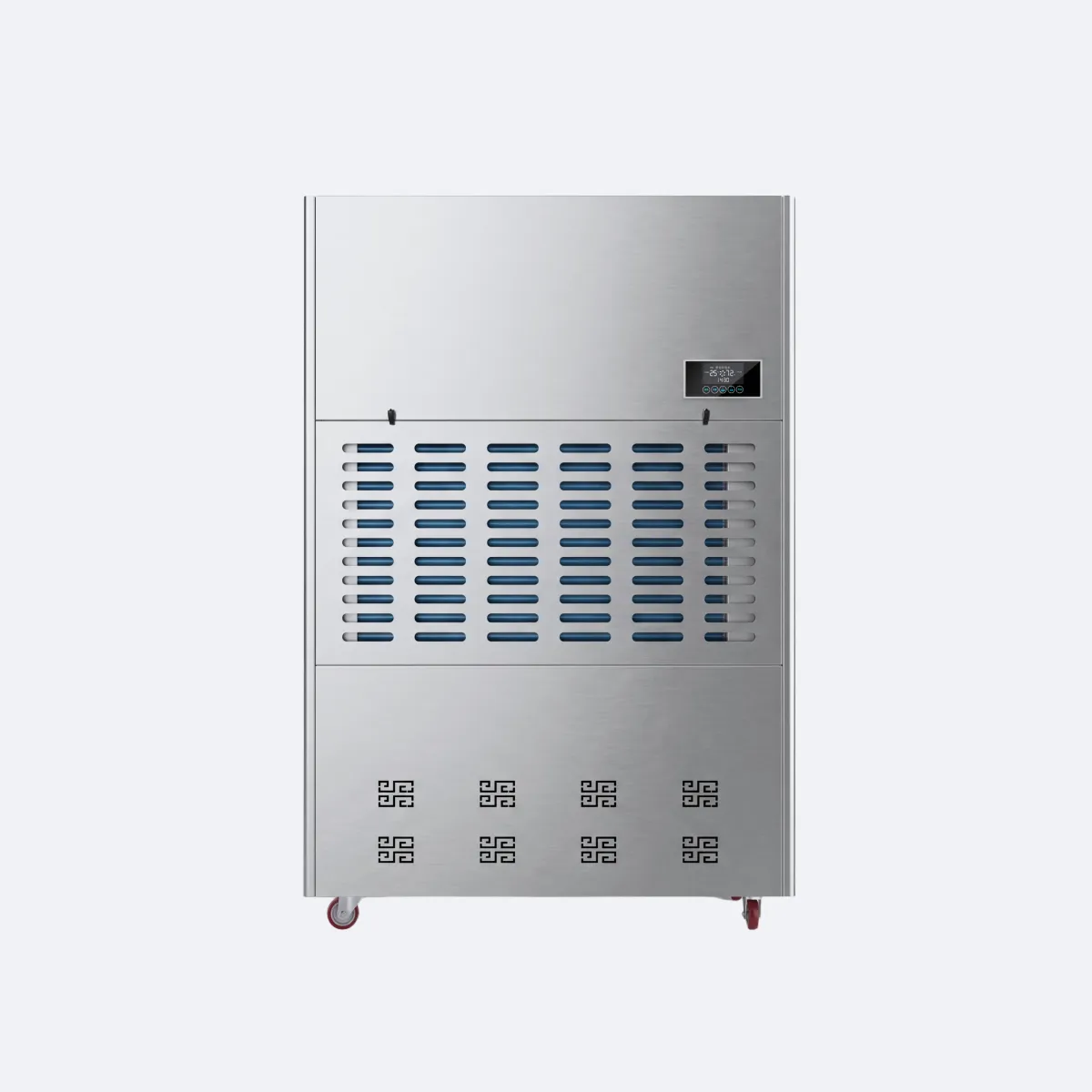
Where the GDH-380E to GDH-1440E Series Fits Best
The series is sized for aquatic facilities with 350–1600 m² pool hall floor area. Typical applications: public swimming pools and aquatic centers in municipal recreation facilities, water parks and resort guest facilities with multiple pools and water features, competitive aquatic centers with 25-meter or 50-meter training pools, school and university aquatic facilities, large hotel pool complexes serving multiple guest wings, and Olympic training facilities. The seven capacity tiers cover most installations from mid-sized aquatic centers through to major water park guest pool halls.
Beyond pool installations, the series also serves heavy industrial dehumidifier needs in environments where corrosive atmospheres and ongoing humidity demand both apply — large coastal warehousing, marine industry production facilities, food processing plants with continuous chlorinated cleaning protocols, paper mills, pharmaceutical bulk manufacturing, and chemical plant utility areas. As a large industrial dehumidifier in the 380–1440 L/day capacity class, this series is among the highest-capacity portable-architecture units in our range; above 1440 L/day, the equipment moves to ducted central plant configurations.
Industrial-Scale Pool Dehumidification — What Changes at This Capacity
The difference between a 180 L/day commercial pool unit and a 380+ L/day industrial unit is not just larger refrigeration. At this scale, several engineering considerations enter the design that smaller equipment does not face:
- Pool hall ventilation interaction. Industrial-scale aquatic facilities require continuous mechanical ventilation per ASHRAE 62.1 (typically 0.5 CFM per square foot of pool deck area, more during peak bather loads). The dehumidifier and ventilation system must be balanced — a dehumidifier that removes moisture faster than ventilation can replace it with conditioned outdoor air will create dry uncomfortable air that complaint logs report within weeks of operation.
- Heat recovery considerations. The condenser side rejects significant heat — the GDH-1440E rejects roughly 25 kW at peak operation. In large pool halls this heat is useful (it warms the air, maintaining the 1–2 °C air-above-water differential). In facilities where the heat must be removed (warmer climates, smaller pool halls), heat rejection ducting or a separate heat recovery loop becomes part of the design.
- Distribution rather than central placement. Above roughly 600 L/day total facility demand, distributed multi-unit deployment provides better moisture removal coverage than a single oversized unit. A pool hall with 100 m² water surface area benefits more from two GDH-480E units placed at opposite ends than one GDH-960E in a single location — air circulation patterns in large halls leave dead zones that distributed equipment treats more uniformly.
Anti-Corrosion Engineering — Industrial Duty Scaling
The corrosion-resistance engineering on the 380–1440 L/day tier uses the same design choices as the smaller pool dehumidifier series — stainless steel cabinet replacing powder-coated carbon steel, and epoxy-coated 100% copper condenser replacing standard bare copper. The full technical case for both choices is covered in the indoor swimming pool dehumidifier documentation; the engineering scales directly to industrial-scale equipment.
At industrial duty cycles in large aquatic facilities (24/7 operation, 200+ bather hours daily, continuous chloramine generation), corrosion protection demands rise further. Internal electrical components receive moisture-proof conformal coating before assembly, the control panel uses sealed pushbuttons, and the larger refrigeration components (compressor, expansion valve, drier filter) sitting in the conditioned airflow path are specified with corrosion-resistant exteriors. For severe environments — saltwater commercial pools, mineral spa water, ocean-adjacent facilities — 316L stainless steel grade and all-titanium coil construction are available as ODM options from MOQ 50 units.
Seven Capacity Tiers — Matching Equipment to Aquatic Facility Size
The seven tiers map to typical aquatic facility moisture loads:
- GDH-380E (380 L/day, 350–500 m²) — mid-sized public pools, smaller aquatic centers, large hotel pool complexes
- GDH-480E (480 L/day, 450–600 m²) — full-size public swimming pools, regional aquatic centers
- GDH-600E (600 L/day, 500–700 m²) — municipal aquatic centers with attached spa pools, large hotel pool complexes
- GDH-720E (720 L/day, 700–900 m²) — competitive training facilities, larger water park guest pool areas
- GDH-960E (960 L/day, 1000–1200 m²) — large public aquatic centers with multiple pool areas
- GDH-1200E (1200 L/day, 1200–1500 m²) — water park guest facilities with significant water feature loads
- GDH-1440E (1440 L/day, 1600 m²+) — largest single-unit installations; Olympic training facilities and major water park guest halls
For facilities above 1600 m² with continuous high moisture loads, distributed multi-unit deployment of two or three lower-capacity industrial dehumidifiers is typically more effective than oversizing a single GDH-1440E. The distributed approach provides better air circulation coverage, built-in redundancy if one unit needs service, simpler maintenance staging (one unit can come down for service without losing facility-wide dehumidification), and easier capacity scaling for seasonal bather load variation.
Three-Phase Power and Electrical Infrastructure
All seven models are 380V three-phase only. At rated power inputs from 5500 W (GDH-380E) through 22000 W (GDH-1440E), single-phase operation is not practical — branch circuit ampacity at single-phase would require dedicated wiring on the order of 60–100 amps per unit, which is impractical for most building electrical infrastructure.
Three-phase 380V is the standard industrial supply outside North America. For North American installations, the equipment can be re-specified at order for 460V three-phase 60Hz, the equivalent industrial supply in those markets — this is an ODM specification with MOQ 50 units. Each unit needs a dedicated three-phase branch circuit sized per the rated input current (the GDH-1440E draws roughly 35 A per phase at rated input, requiring a 60 A breaker for continuous duty per NEC and IEC sizing rules).
R32 Refrigerant — Standard Charge, Regulated-Market Compliance
All seven models use R32 refrigerant (HFC single-component, GWP 675, A2L mildly flammable) with factory-sealed circuits as the standard configuration. R32 is the established compliance choice across regulated global markets — EU under the revised F-gas Regulation (EU 2024/573), UK, Japan under the Fluorocarbons Emissions Control Law, Australia, and increasingly across North America, China, and other markets phasing out legacy HFC blends. Single-component composition eliminates the fractionation risk associated with blended refrigerants during charge and top-up service — a meaningful maintenance advantage for precision equipment operating on multi-year service cycles in mission-critical cleanroom, pharmaceutical, and data center installations. R32 charge volumes are compact — below the IEC 60335-2-40 charge limits for the installation category, with exact charge specified per model in the technical documentation package provided at order. For facility safety policies that require additional ventilation analysis for A2L refrigerant in confined cleanroom or laboratory installations, we provide the charge and ventilation reference data required for the assessment.
Continuous Hose Drainage at Industrial Volumes
All seven models use continuous hose drainage from a G3/4" rear port on the mid-range tier (380E–720E) and G1" on the large-scale tier (960E and larger). At 380–1440 L/day extraction, drainage is continuous mode only — no intermittent operation, no tank emptying.
Standard installation routes the drain to the building's HVAC condensate manifold or to a dedicated drain line connected to the sanitary stack. At industrial volumes, simple floor drain routing is inadequate — the GDH-1440E produces 60 L/hour of condensate at peak, which a standard 75 mm floor drain handles only with proper trap sizing and slope. For installations with the drain endpoint above the unit (typical when the dehumidifier sits in a basement plant room and the building drain manifold is at ground floor level), external condensate pumps rated 500–1000 L/h are required. These pumps are not included with the units; specify them in the OEM BOM if your installation channel needs them factory-bundled.
Multi-Unit Deployment and BMS Integration
Industrial-scale aquatic facilities typically deploy two to four dehumidifier units in coordinated configuration rather than a single oversized machine. Distributed deployment provides better moisture removal coverage across large pool halls, built-in redundancy if one unit requires service, simpler maintenance staging, and the ability to scale capacity up or down based on seasonal bather load.
For coordinated multi-unit control, BMS integration via Modbus RTU output is available as an ODM option from MOQ 50 units. The interface exposes current RH, target RH, operating mode, fault codes and runtime hours for each unit, plus write access for setpoint and operating mode. BACnet IP and KNX integration are available per project for facilities with full building automation infrastructure. For projects without BMS, dry-contact alarm outputs (fault relay, runtime relay) integrate with standard control panels.
As a High Capacity Industrial Dehumidifier in Non-Pool Heavy Industry
The series also serves as a high capacity industrial dehumidifier in non-pool heavy industrial applications where ongoing humidity control combines with corrosive atmospheric conditions. Suitable non-pool applications:
- Marine industry production facilities — shipyards, marine equipment manufacturing, port-adjacent warehousing
- Food and beverage production with continuous chlorinated cleaning protocols
- Pharmaceutical bulk manufacturing with frequent hypochlorite disinfection
- Pulp and paper processing — both production areas and adjacent storage
- Chemical plant utility areas exposed to acid vapor or halogen compounds
- Coastal industrial buildings with salt-laden ambient air
In these applications, the stainless steel cabinet and epoxy-coated copper condenser deliver the same multi-year corrosion resistance as in pool installations. OEM customization options apply identically regardless of application context, and the same lead time and certification routing structure applies.
Build and Safety
1.2 mm stainless steel cabinet on the GDH-960E and larger units (1.0 mm on the GDH-380E through GDH-720E), with welded seams and corrosion-resistant fasteners throughout. Internal electrical components receive moisture-proof conformal coating before assembly. Each unit is leakage-tested at full extraction conditions before shipping. Built-in safety includes high-pressure cut-out, overcurrent protection on each phase, defrost interlock, fault self-protection logic, compressor thermal cut-out, refrigerant low-charge protection, and emergency stop on the control panel. Larger units (GDH-960E and above) include an integrated phase-loss detection circuit on the three-phase power input.
OEM and ODM Service
As a Chinese industrial dehumidifier manufacturer with full-spectrum OEM and ODM capabilities for the heavy industrial tier, we support brand customization from MOQ 10 units per model. OEM scope covers branding, cabinet color of any visible surfaces, terminal block configuration for the destination market's three-phase standard, control firmware language, and packaging artwork. Common OEM additions for industrial installation channels include extended power cord length, factory-bundled condensate pump and drain manifold kits, anti-vibration mounting pads sized for industrial dehumidifiers in the 200+ kg weight class, and pre-fitted return-air filters with replacement schedules documented in the operating manual.
ODM scope covers material upgrades (316L stainless steel, all-titanium coils for extreme chloride exposure), refrigerant selection (R32 from MOQ 200, R22 per project for compatible markets, R744 quoted per project), structural modifications including 460V/60Hz North American specification (MOQ 50), BMS integration (Modbus RTU from MOQ 50, BACnet/KNX from MOQ 200), and certification routing (CE, RoHS, ETL, SAA, GS depending on target market). Production lead time is 40–60 days after artwork sign-off for the larger units due to longer fabrication, refrigeration circuit pressure testing, and electrical certification cycles. FOB Ningbo or Shanghai.
For other capacity tiers and configurations, browse the full commercial dehumidifier lineup.