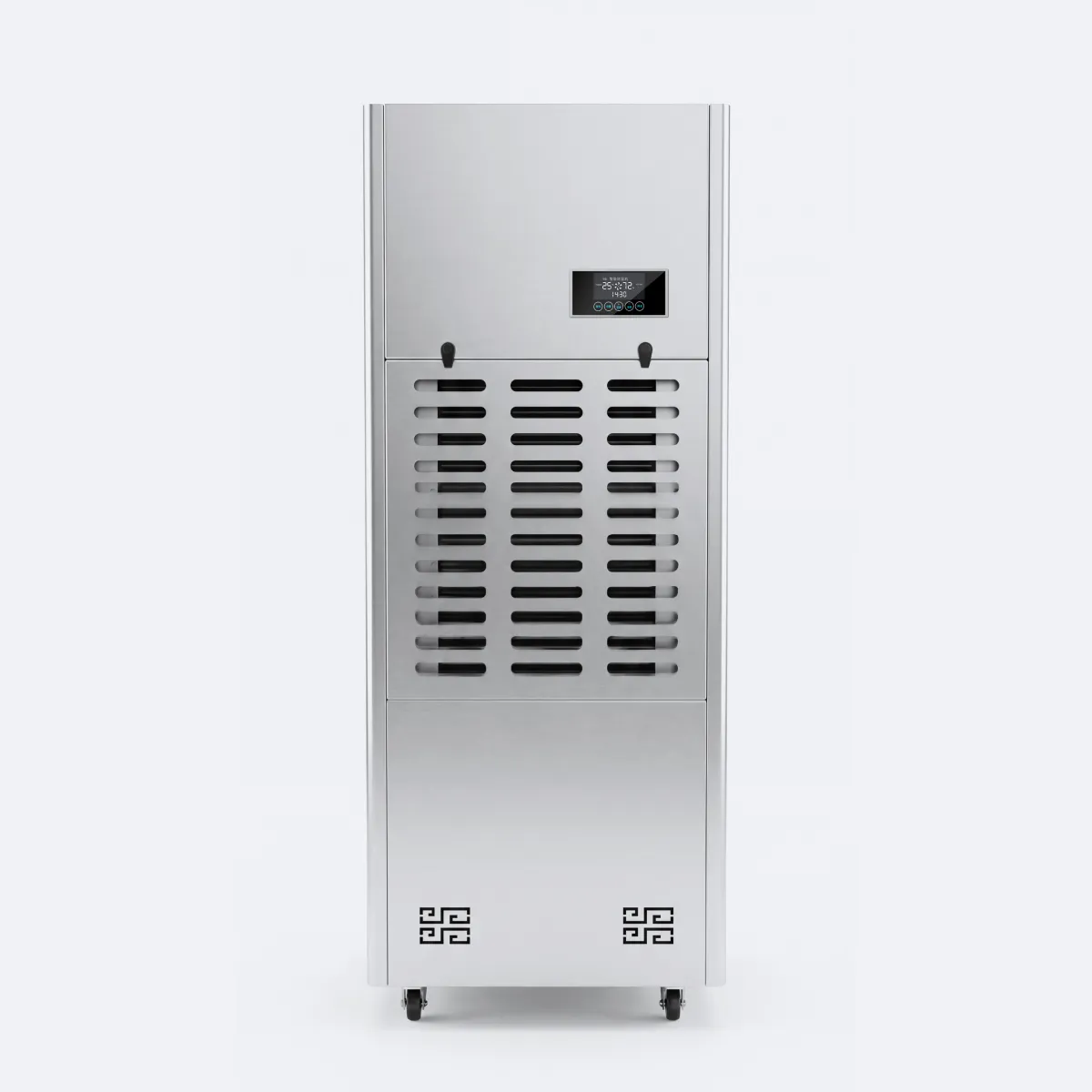
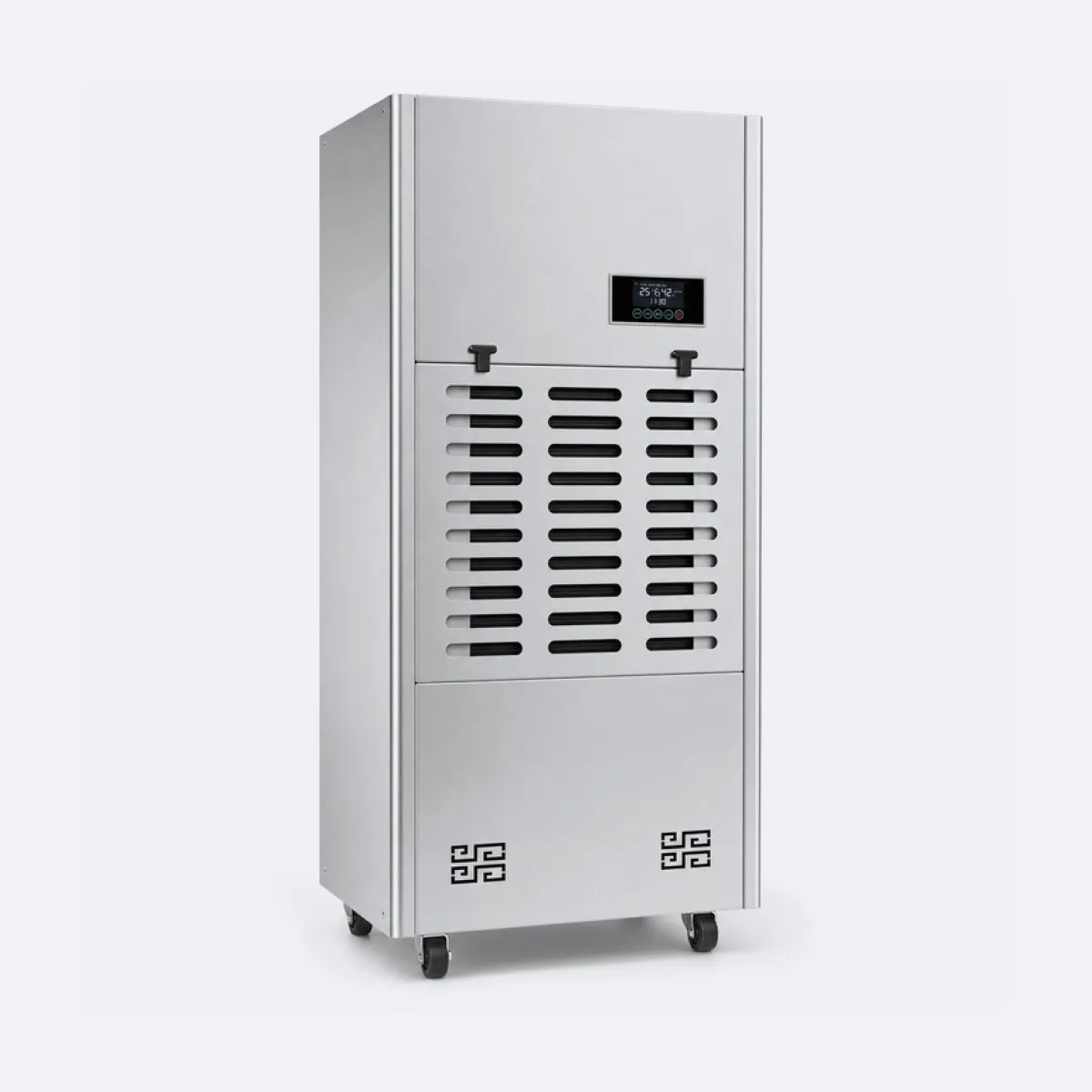
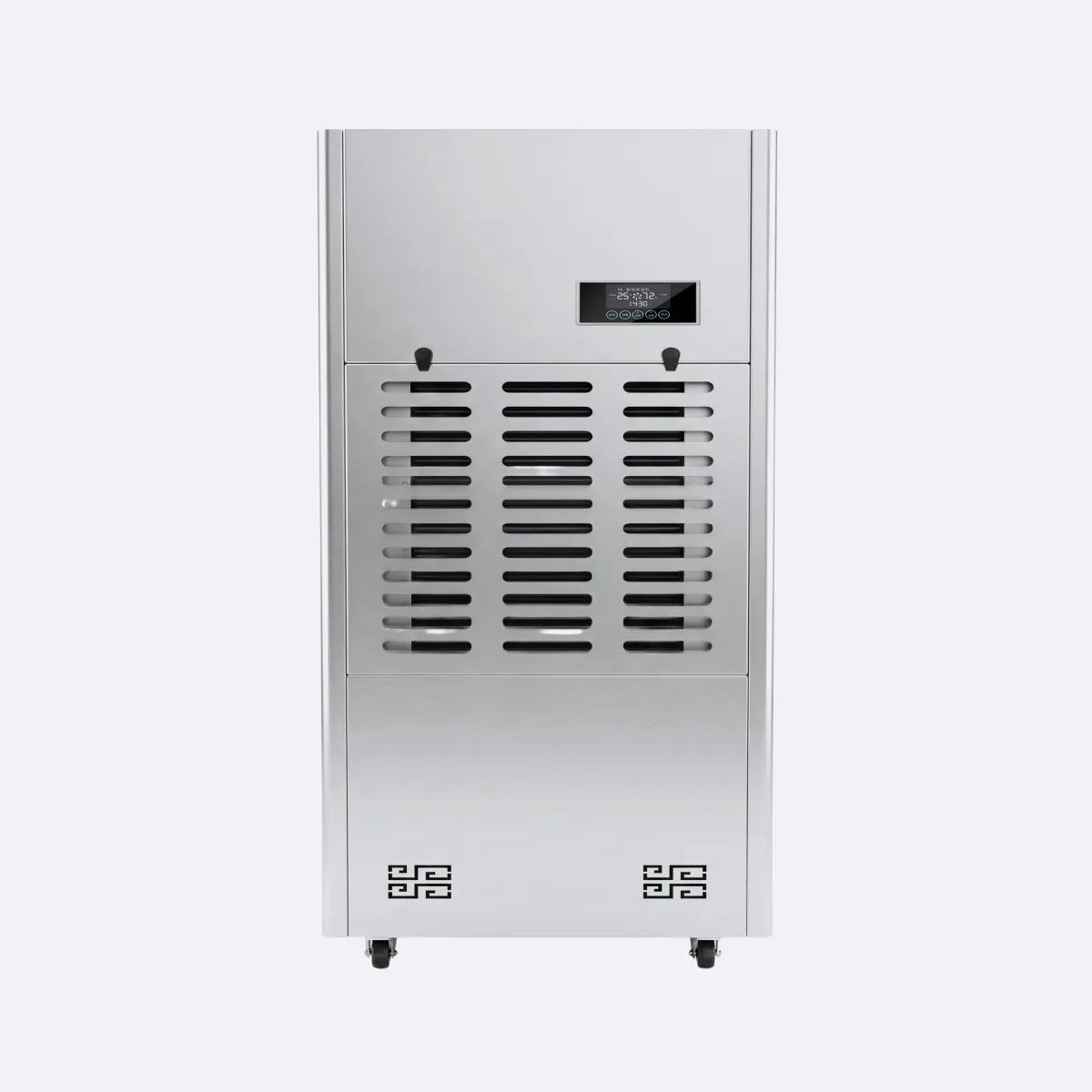
Where the GDH-180E / 240E / 288E Fits Best
The series is sized for commercial pool installations between 180 and 350 m² pool room floor area. Typical applications: hotel pool complexes with attached spa areas, fitness center pool halls, aquatic sport centers with competitive swim lanes, large medical rehabilitation pools, and water park guest pool facilities. The three capacity tiers cover the most common commercial pool sizes: GDH-180E for 180–240 m² hotel and fitness pools, GDH-240E for 200–300 m² mid-large commercial installations, and GDH-288E for 260–350 m² aquatic center pool halls.
Beyond pool installations, the anti-corrosion build also serves general industrial dehumidifier applications in chemical processing facilities, food production with continuous cleaning chemical use, salt-laden coastal industrial sites, marine industry workshops, and any environment where standard powder-coated steel dehumidifiers corrode within 12–24 months. The stainless steel cabinet and epoxy-coated copper condenser are over-specified for clean dry warehouses, but exactly right where corrosive atmospheres meet ongoing dehumidification needs.
The Commercial Pool Tier — Sizing and Duty Cycle
Commercial pool dehumidification differs from residential and small-spa work in three operational dimensions: continuous duty cycle (24/7 operation throughout swim season versus intermittent home pool use), higher bather load (more chloramines per cubic meter of pool room air), and tighter humidity control requirements (commercial pools typically target 50–55 % RH with stricter deviation limits than the looser 50–60 % acceptable in residential).
These commercial duty requirements drive capacity selection up significantly. Where a residential 50 m² pool room handles fine with a 60 L/day unit, the same room in a hotel running 24/7 with 30+ daily bather hours typically needs 90 L/day capacity. The three-tier structure here (180 / 240 / 288 L/day) maps to pool surface areas of approximately 60–100 m², 100–150 m², and 150–200 m² respectively at typical commercial bather loads. Above 200 m² water surface area, the industrial swimming pool dehumidifier range with capacities up to 1440 L/day is the right tier.
Anti-Corrosion Engineering — Same Approach, Scaled Up
The corrosion-resistance engineering on the 180–288 L/day tier uses the same design choices as the smaller indoor swimming pool dehumidifier — stainless steel cabinet replacing powder-coated carbon steel, and epoxy-coated 100% copper condenser replacing standard bare copper. The technical case for both choices is covered in the indoor series documentation; for commercial duty cycles the engineering is essentially the same, just scaled to the larger refrigeration circuit.
One specific note for commercial installations: ongoing chloramine concentrations in continuous-use pool rooms are typically 30–50 % higher than in intermittent residential pools, because off-gassing accumulates faster than ventilation can clear it during peak use periods. This raises the corrosion potential on every internal component, not only the cabinet exterior. The internal electrical components receive moisture-proof conformal coating before assembly, and the control panel uses sealed pushbuttons rather than standard membrane keypads vulnerable to chloramine attack.
For severe environments — saltwater commercial pools, mineral spa water, salt-chlorinated systems with elevated chloride content — the cabinet stainless steel grade can be upgraded to 316L (with molybdenum addition for chloride resistance) and the coil to all-titanium construction. Both are special-order ODM options from MOQ 50 units.
220V Single-Phase or 380V Three-Phase — Power Configuration
The GDH-180E and GDH-240E offer dual-voltage 220V single-phase or 380V three-phase power input. The GDH-288E is 380V three-phase only — its 3400 W rated input exceeds practical single-phase loading for most commercial branch circuits.
Choose by destination market and building electrical infrastructure:
- 220V single-phase — retrofit projects in older buildings without three-phase distribution, smaller commercial sites in jurisdictions where three-phase is uncommon, installations where electrical contractor time for three-phase wiring is hard to schedule.
- 380V three-phase — new construction with three-phase distribution already in place, larger commercial buildings (hotels, fitness centers, healthcare facilities typically have three-phase), any installation where multiple units of this capacity tier will share the building's electrical supply.
Three-phase operation provides better motor efficiency at this power level, lower inrush current at startup, and balanced load distribution across the building's three-phase service. The two versions are not field-convertible after delivery — confirm the destination's electrical infrastructure before ordering.
R32 Refrigerant — Standard Charge, Regulated-Market Compliance
All three models use R32 refrigerant (HFC single-component, GWP 675, A2L mildly flammable) with factory-sealed circuits as the standard configuration. R32 is the established compliance choice across regulated global markets — EU under the revised F-gas Regulation (EU 2024/573), UK, Japan under the Fluorocarbons Emissions Control Law, Australia, and increasingly across North America, China, and other markets phasing out legacy HFC blends. Single-component composition eliminates the fractionation risk associated with blended refrigerants during charge and top-up service — a meaningful maintenance advantage for precision equipment operating on multi-year service cycles in mission-critical cleanroom, pharmaceutical, and data center installations. R32 charge volumes are compact — below the IEC 60335-2-40 charge limits for the installation category, with exact charge specified per model in the technical documentation package provided at order. For facility safety policies that require additional ventilation analysis for A2L refrigerant in confined cleanroom or laboratory installations, we provide the charge and ventilation reference data required for the assessment.
R290 is not offered on the commercial swimming pool dehumidifier series. The refrigerant charges at this capacity tier (above 1 kg equivalent) push installation into IEC 60335-2-40 room ventilation control territory, and propane flammability is unfavorable for pool plant rooms where refrigerant could accumulate undetected.
Continuous Hose Drainage
All three models drain by continuous hose connection to a building drain endpoint. No internal water tanks — at 180–288 L/day extraction continuous unattended drainage is the only practical operating mode. The drain port is G3/4" threaded on the rear cabinet.
Standard installation routes the drain to a floor drain, mop sink or HVAC condensate manifold within 3–5 meters of the unit, with continuous downward slope at 1–2 % gradient. For installations where the drain endpoint sits above the unit (sometimes the case in pool plant rooms where the dehumidifier is at floor level and the building drain is up at the mechanical room ceiling), an external condensate pump rated 200–400 L/h between the unit and the drain is required. The condensate pump is not included; specify it in the OEM BOM if your installation channel needs it factory-bundled.
Working as a Commercial Industrial Dehumidifier in Non-Pool Environments
The anti-corrosion build of the GDH-180E / 240E / 288E makes the series usable as a commercial industrial dehumidifier in non-pool environments where standard equipment would fail too quickly. Suitable applications outside pool installations:
- Chemical processing facilities with continuous low-level acid or chloride vapor
- Food and beverage production using chlorinated cleaning chemicals (CIP/SIP operations)
- Coastal industrial buildings exposed to salt-laden air
- Marine industry workshops and storage facilities
- Pharmaceutical clean rooms with frequent peracetic acid or hypochlorite disinfection
- Pulp and paper processing areas
These are conditions where the standard powder-coated steel cabinet of a regular industrial size dehumidifier corrodes within 12–24 months. The premium for stainless steel construction pays back through extended equipment life and reduced replacement frequency. For these non-pool industrial applications, the same OEM customization options apply (color, branding, plug type, BMS integration); only the application context differs.
BMS Integration for Commercial HVAC
For hotel, fitness center and healthcare facility installations where the dehumidifier integrates with the building HVAC management system, BMS integration via Modbus RTU output is available as an ODM option from MOQ 50 units. The interface provides read access to current RH, target RH, operating mode, fault codes and runtime hours, plus write access to setpoint and operating mode.
For projects without full BMS infrastructure, dry-contact alarm outputs (fault relay, runtime relay) integrate with standard building automation panels at a simpler level. BACnet IP and KNX integration are available per project for larger systems.
Build and Safety
1.0 mm stainless steel cabinet with welded seams and corrosion-resistant fasteners throughout. Internal electrical components receive moisture-proof conformal coating before assembly. Each unit is leakage-tested at full extraction conditions before shipping — leakage-free operation is critical for installations where any water leak would damage building structure or pool deck surfaces. Built-in safety: high-pressure cut-out, overcurrent protection on each phase (three-phase versions), defrost interlock, fault self-protection logic, compressor thermal cut-out, and emergency stop on the control panel.
OEM and ODM Service
As a Chinese industrial dehumidifier manufacturer with full-spectrum OEM and ODM capabilities, we support brand customization from MOQ 10 units per model. OEM scope covers branding, color of any visible cabinet surfaces, plug type or terminal configuration for the destination market, control firmware language, and packaging artwork. Common OEM additions for commercial installation channels include extended power cord length, factory-bundled condensate pump and drain hose kits, anti-vibration mounting pads, and pre-fitted return-air filters.
ODM scope covers material upgrades (316L stainless steel for severe environments, all-titanium coils for extreme chloride exposure), refrigerant selection (R32 from MOQ 200, R22 special-order for compatible markets), structural modifications, BMS integration (Modbus RTU from MOQ 50, BACnet/KNX from MOQ 200), and certification routing (CE, RoHS, ETL, SAA, GS depending on target market). Production lead time is 30–40 days after artwork sign-off. FOB Ningbo or Shanghai.
For other capacity tiers and configurations, browse the full commercial dehumidifier lineup.