search
Search

Enter keywords to search for products, blog posts, and more.


Home > Industrial Desiccant Dehumidifier for Low-Humidity Process Rooms and Manufacturing (2.5–8 kg/h)

Industrial Desiccant Dehumidifier for Low-Humidity Process Rooms and Manufacturing (2.5–8 kg/h)

Industrial Desiccant Dehumidifier for Low-Humidity Process Rooms and Manufacturing (2.5–8 kg/h)

Industrial processes that have to hold a low humidity — pharmaceutical and nutraceutical production, electronics and semiconductor assembly, lithium-battery component areas, coating and printing lines, food processing and packaging, and substation and switchgear rooms — need more than a compressor can deliver. A refrigerant unit is built to hold a comfort band around 45–55% RH; it can't reach the low set points these processes run at, and it loses ground as the space cools.

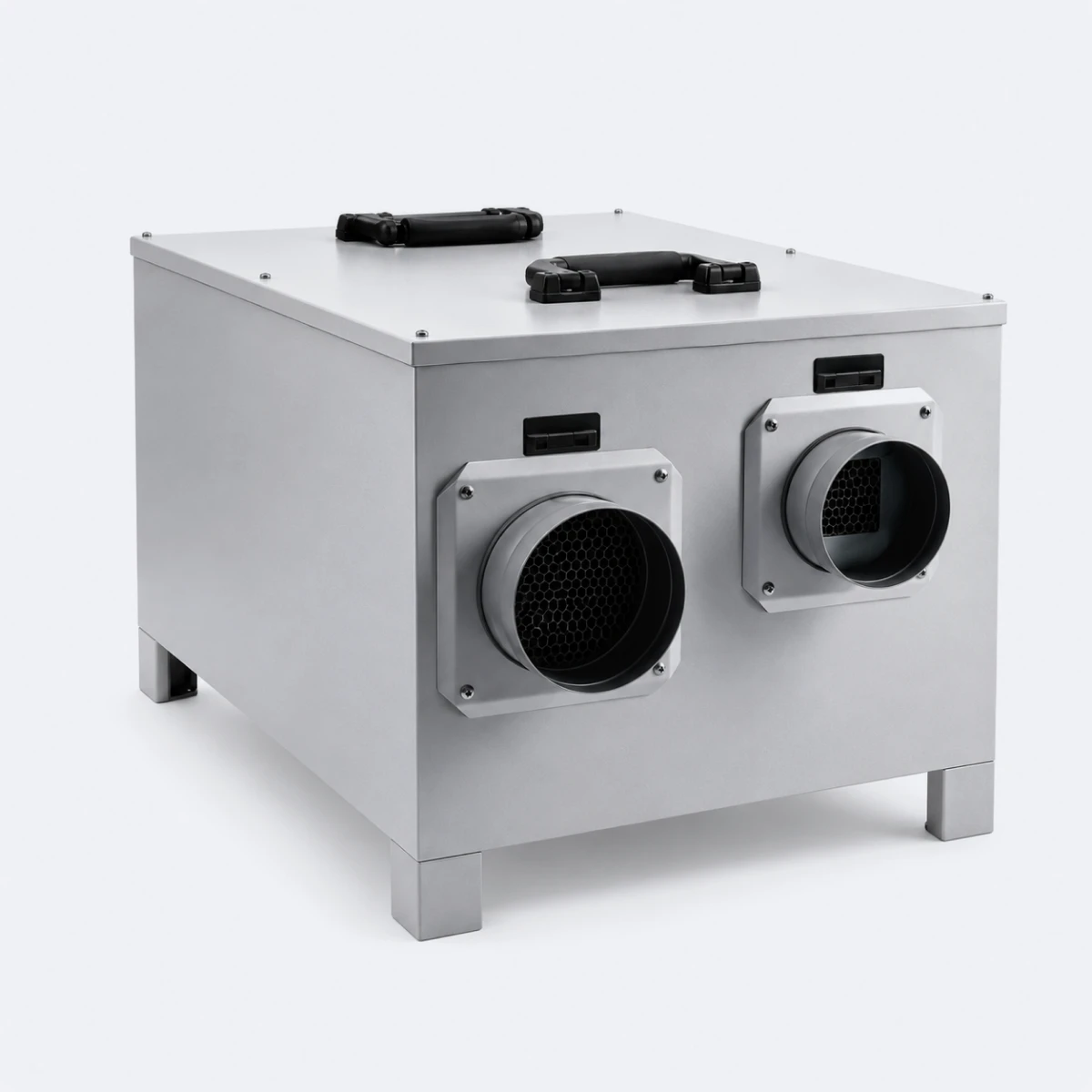
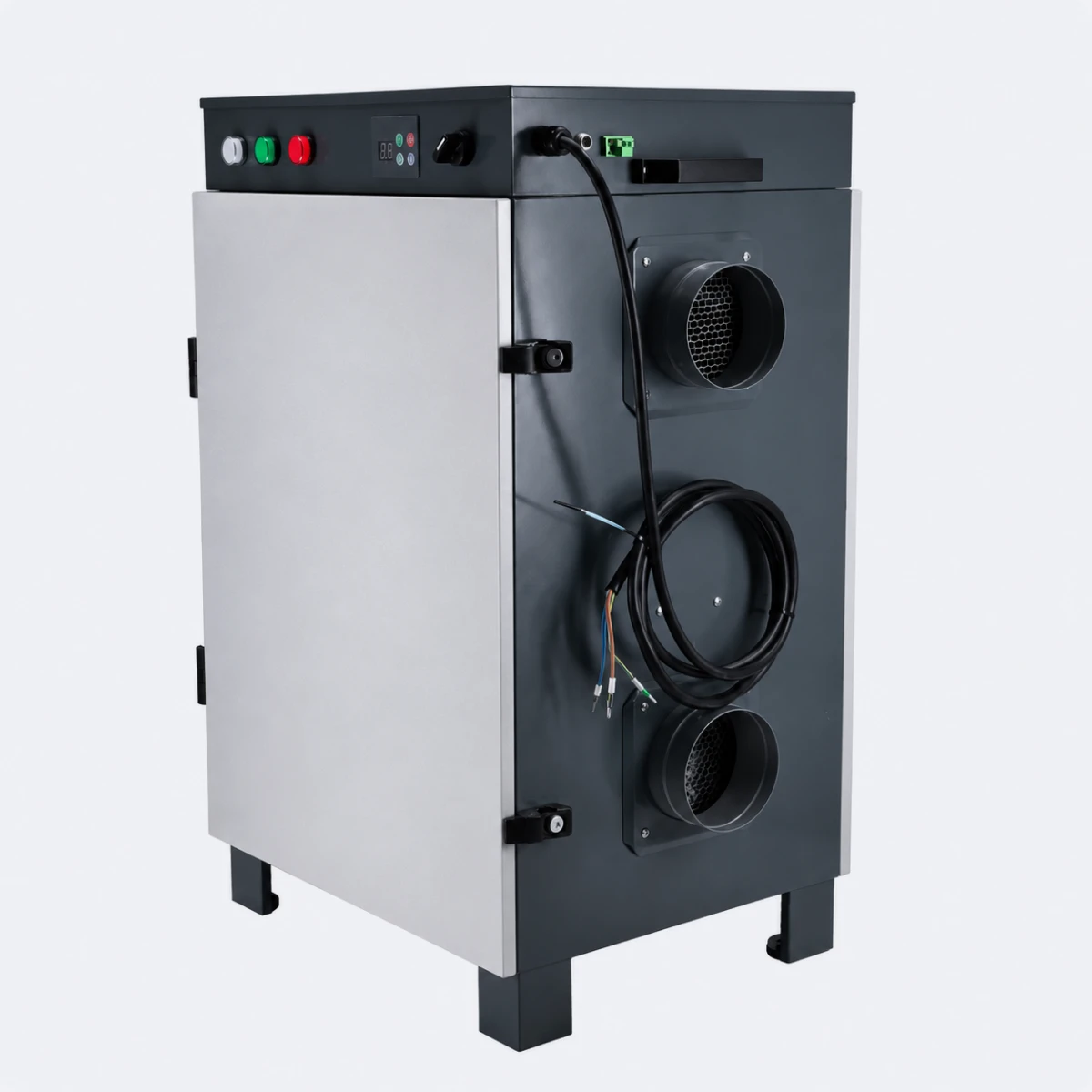
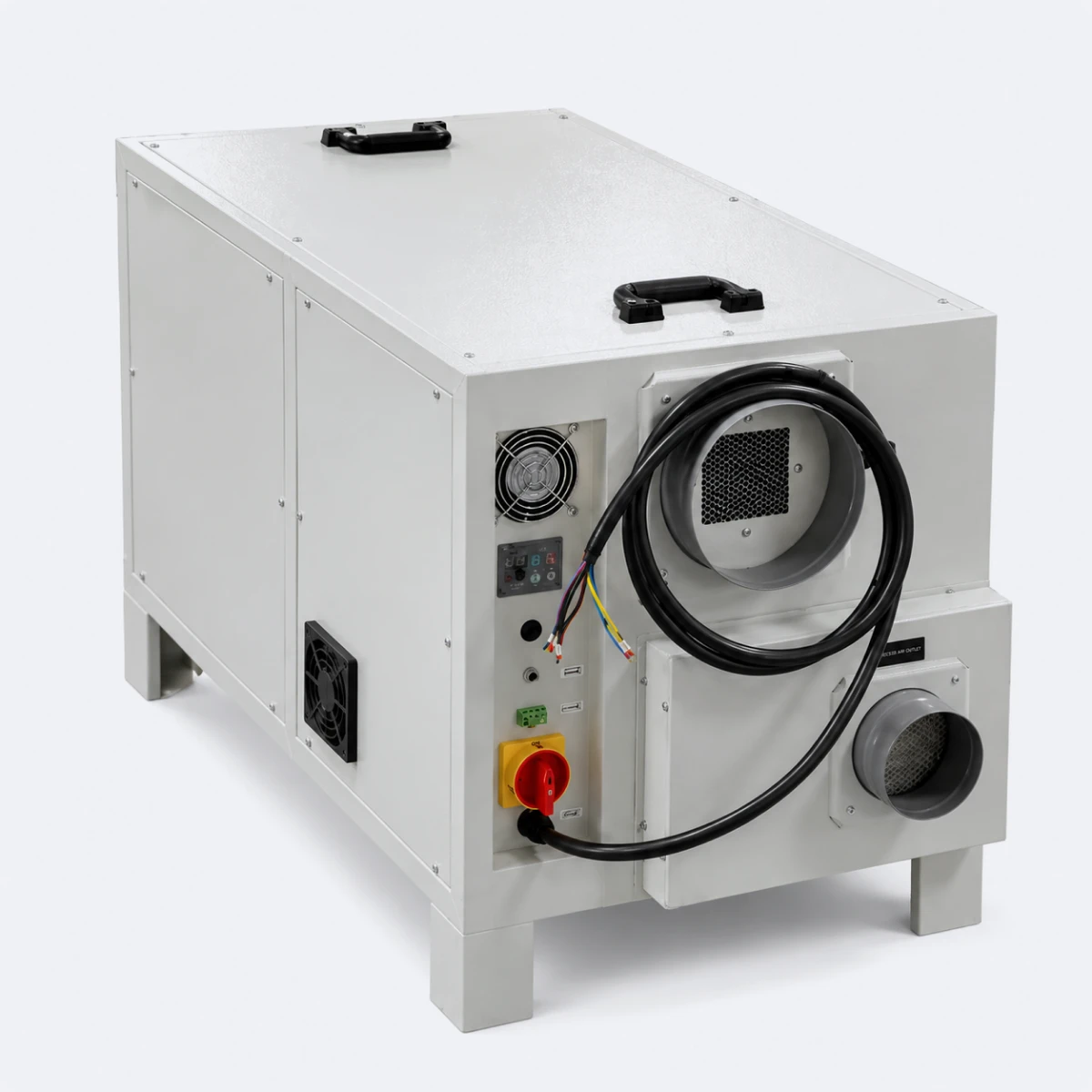
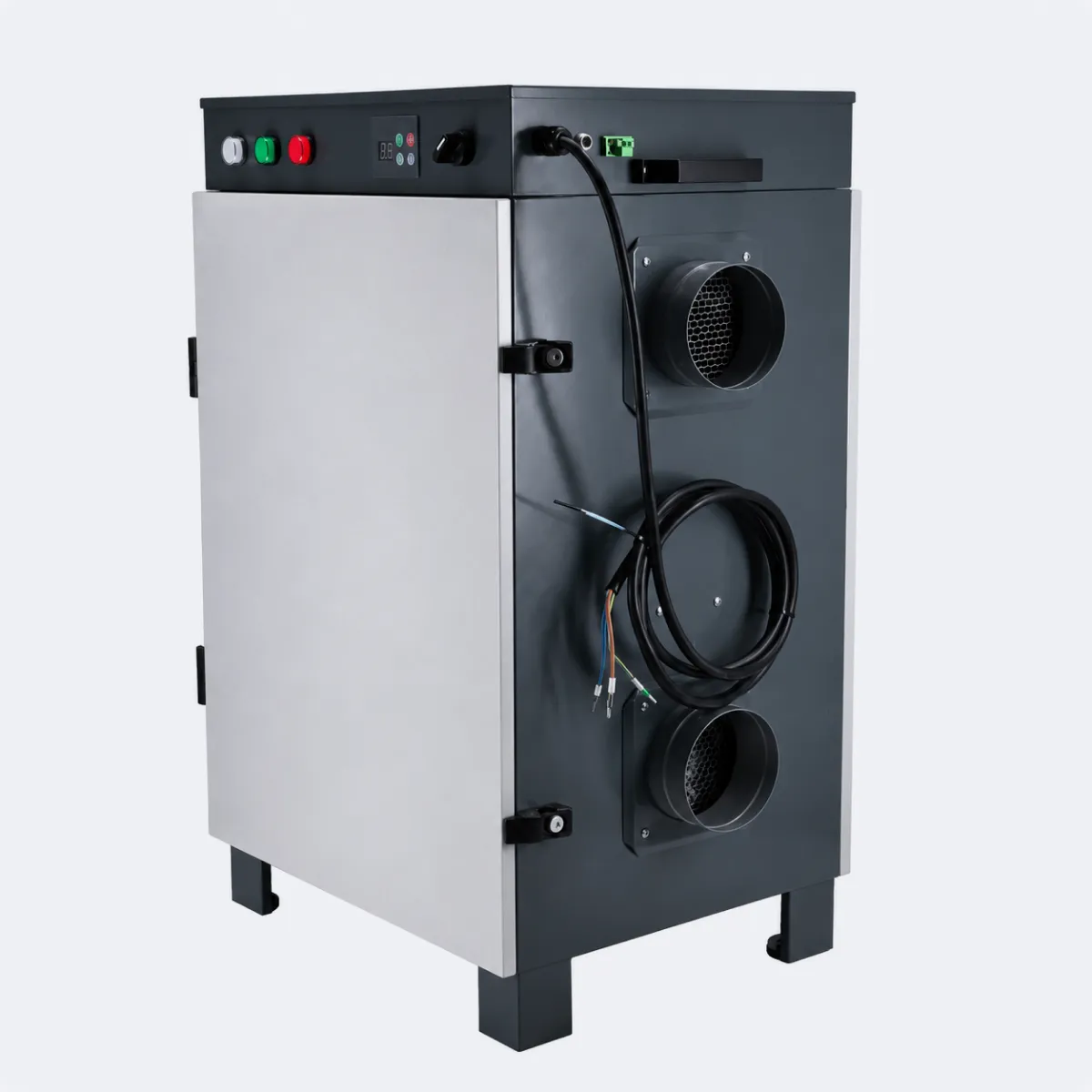
This floor-standing series is our core industrial rotor range: five models from 2.5 to 8 kg/h of moisture removal, with process airflow from 400 to 1,100 m³/h. Smaller models run on 220V; the larger ones on 380V three-phase. They deliver dry air to a whole process room or a dedicated dry area, hold a low RH set point steadily, and keep doing it from -20°C to 50°C where a compressor can't.

Every unit adsorbs moisture on a fire-resistant rotor, controls humidity from 5% to 95% RH under fully automatic operation, and supports RS-485 Modbus and DI signal so it drops into a line or facility control system. Sealed independent process and regeneration ducts, SCR-controlled regeneration heating, IP44/IP54 protection, and stainless-steel or powder-coated construction make it a continuous-duty industrial machine. For smaller rooms, see the compact desiccant dehumidifier range; for warehouse-scale airflow, see the large industrial desiccant dehumidifier range.

Technial Parameters

ModelXR-350-02XR-600XF-01XR-750XF-01XR-800XF-01XR-1000XF-01
Dehumidification Capacity2.5 kg/h3 kg/h4.5 kg/h5 kg/h8 kg/h
Process Airflow400 m³/h600 m³/h750 m³/h880 m³/h1100 m³/h
Power Supply220V/50Hz220V/50Hz380V/50Hz380V/50Hz380V/50Hz
Rated Power2 kW4 kW7 kW9 kW11 kW
Rated Current9 A16 A17 A18 A24 A
Regeneration Airflow130 m³/h200 m³/h120 m³/h350 m³/h400 m³/h
Process Air Pressure (PARP)110 Pa100 Pa200 Pa250 Pa295 Pa
Regeneration Air Pressure (RARP)85 Pa90 Pa90 Pa130 Pa160 Pa
Process Air InletΦ120mm×2Φ150mm×2Φ200mm×2Φ200mm×2Φ200mm×2
Regeneration Air DuctΦ100mm×2Φ100mm×2Φ150mm×2Φ150mm×2Φ150mm×2
FilterG4G4G4G4G4
Operating Temperature-10 to +50°C-10 to +50°C-10 to +50°C-10 to +50°C-10 to +50°C
Overall Size (L×W×H)721×425×403 mm612×433×856 mm1117×600×697 mm820×600×1100 mm820×600×1100 mm
Net Weight45 kg75 kg90 kg110 kg110 kg
DisplayLEDLEDLEDLEDLED

Test condition for all models: T=20°C, RH=60%. Larger 380V models are available for 50Hz or 60Hz supply.

Product Details

Where an industrial rotor is the right tool

These units serve process environments that must hold a low, stable humidity around the clock. Common applications: pharmaceutical and nutraceutical manufacturing and packaging, electronics and semiconductor assembly, lithium-battery component handling and dry areas, coating, printing and lamination lines, powder and hygroscopic-material processing, food processing and packaging, seed and grain conditioning, and substation, switchgear and energy-storage rooms. In each, moisture in the air spoils the process — it clumps powders, fogs coatings, corrodes contacts, and degrades moisture-reactive materials — so the room is held at a low RH the process depends on.

A refrigerant dehumidifier can't do this job. It condenses water on a cold coil, which limits how low an RH it can reach and how well it works as the room cools. A desiccant rotor adsorbs moisture directly, so it holds a much lower set point and keeps holding it in cool spaces. For the deepest dry-room targets — lithium-battery cell assembly at dew points of -40°C and below, for example — a multi-stage or dual-rotor system is specified; this range covers the wide band of industrial low-humidity work above that extreme, and we can advise where a project needs the deeper solution.

Choosing across the five models

Size to the room's moisture load and airflow, then to the supply voltage available:

  • XR-350-02 — 2.5 kg/h, 400 m³/h, 220V, 45 kg. The entry industrial unit, for a small process room or a dedicated dry area on a single-phase supply.
  • XR-600XF-01 — 3 kg/h, 600 m³/h, 220V, 75 kg. More airflow on single-phase, for a mid-size process room or a packaging line.
  • XR-750XF-01 — 4.5 kg/h, 750 m³/h, 380V three-phase, 90 kg. The step up to three-phase, with higher static pressure (200 Pa process) for longer duct runs across a plant room.
  • XR-800XF-01 — 5 kg/h, 880 m³/h, 380V, 110 kg. A higher moisture load for a larger or wetter process room.
  • XR-1000XF-01 — 8 kg/h, 1,100 m³/h, 380V, 110 kg. The top of this tier, for the largest single-room industrial jobs before the large-airflow range takes over.

How the rotor works

Process air is drawn through the 270° process sector of a slowly rotating desiccant wheel (8–12 revolutions per hour). The desiccant adsorbs the water vapor and dry air leaves through the process fan. The remaining wheel sector sits in the regeneration airstream, which is heated to 100–140°C to drive the captured moisture off and carry it outside; the wheel then rotates back into the process air, restored. Because the process never relies on a cold surface, the unit holds its RH target from -20°C to 50°C and reaches far lower humidity than a compressor. The rotor uses a composite of silica gel and molecular sieve material chosen for strong adsorption and clean regeneration.

Build and control

  • Rotor — fire-resistant desiccant wheel, rated -20°C to 50°C, gear-motor driven at 8–12 RPH, with rotation-stop protection; adjustable gear-motor speed on some models.
  • Regeneration — SCR-controlled PTC or fin heating in an insulated heating chamber; the heater starts with the regeneration fan and cuts out automatically if the rotor stops, and sealed independent ducts keep process and regeneration air from mixing.
  • Control — 5–95% RH, fully automatic with manual/automatic switching, real-time RH on the LED display, fault self-detection with a fault code, and running/standby/fault indicators.
  • Protection — IP44 enclosure, electrical protection to IP54, plus over-temperature, overload, phase-sequence, and high/low-voltage protection on three-phase models.
  • Integration — DI signal and RS-485 Modbus for remote monitoring and control, so the unit reports RH, mode, and fault status to a line PLC or facility BMS.
  • Build — stainless-steel or powder-coated housing for corrosion resistance, continuous operation over 720 hours with stable low-temperature performance, 10-year-plus designed service life, components from established brands (Siemens, ABB, Omron, Schneider, Delixi and similar).

Global voltage and OEM/ODM

Smaller models are single-phase 220V; larger models are three-phase 380V, available for 50Hz or 60Hz and for the destination market's voltage. We support OEM branding and ODM changes: cabinet color and layout, control interface and BMS protocol, duct and drainage configuration, filter grade (G4 standard, higher grades on request), heating and rotor selection for the target dew point, and labeling — built to CE, ETL, and RoHS with ISO 9001. Send us the room, its moisture load and target RH, the lowest operating temperature, and the supply available, and our application team will recommend a model or a system layout.

FAQs

Why can't a refrigerant dehumidifier hold a low-humidity process room?

A refrigerant unit removes moisture by condensing it on a cold coil, so how low an RH it can reach is limited by how cold that coil can run without frosting — in practice a comfort band around 45–55% RH. Process rooms run well below that. A desiccant rotor adsorbs moisture onto a wheel and regenerates it with heat, with no cold coil in the loop, so it holds a much lower set point and keeps holding it as the room cools. For any process that needs a low, stable RH, the rotor is the correct technology.

How low an RH can these industrial units reach?

Humidity is adjustable across 5–95% RH, and the rotor can hold a low set point steadily that a compressor cannot approach. Where a process is specified by dew point rather than RH, the achievable dew point depends on the model, the airflow, and the room's seal and load. This range covers the broad band of industrial low-humidity work; for the deepest dry-room dew points (-40°C and below, as in lithium-battery cell assembly), a multi-stage or dual-rotor system is used. Send us your target — as RH or dew point — and we will confirm what the model delivers or specify the deeper solution.

Can this range serve a lithium-battery or pharmaceutical dry room?

It depends on how deep the target is. Many pharmaceutical, electronics, and battery-adjacent process areas run at a low RH — below 20%, sometimes lower — and these units serve that band well, delivering dry air to the room and holding the set point around the clock. The extreme dry rooms used for lithium-battery cell assembly and electrolyte filling run at dew points of -40°C to -60°C and below; those need a purpose-built multi-stage or dual-rotor system rather than a single floor-standing unit. Tell us the process stage and target and we will scope the right approach — a unit from this range, or an engineered system.

How do I choose between the five models?

Size to the room's moisture load and required airflow, then to the supply voltage. XR-350-02 (2.5 kg/h, 400 m³/h, 220V) suits a small process room; XR-600XF-01 (3 kg/h, 600 m³/h, 220V) a mid-size room or packaging line; XR-750XF-01 (4.5 kg/h, 750 m³/h, 380V) steps up to three-phase with higher static pressure for longer duct runs; XR-800XF-01 (5 kg/h, 880 m³/h, 380V) handles a larger or wetter room; and XR-1000XF-01 (8 kg/h, 1,100 m³/h, 380V) is the largest single-room unit in the tier. Send us the room details for a specific match.

Can these units integrate with a line PLC or facility BMS?

Yes. Every unit provides DI signal and RS-485 Modbus communication, so it reports real-time RH, operating mode, and fault status to a line PLC, SCADA, or facility BMS, and can be started, stopped, and set-point-adjusted remotely. The LED display shows RH and a fault code locally. For a specific protocol or register map, we provide the documentation and can verify integration before shipping; protocol conversion is available as an ODM option.

What protection do the three-phase models have for industrial supply?

The 380V three-phase models carry the protection an industrial supply needs: phase-sequence protection (so the rotor and fans can't run reversed), high/low-voltage protection, overload protection, and over-temperature protection on the heating circuit, plus electrical protection to IP54. The regeneration heater cuts out automatically if the rotor stops turning, and the unit self-detects faults and shows a fault code for quick diagnosis.

What voltages are available, and do you support OEM/ODM?

Smaller models are single-phase 220V; larger models are three-phase 380V, buildable for 50Hz or 60Hz and for the destination market's voltage. We support OEM branding and ODM changes including cabinet color and layout, control interface and BMS protocol, duct and drainage configuration, filter grade, and rotor and heating selection for the target dew point — all to CE, ETL, and RoHS with ISO 9001. Contact us with your process, target, and quantities for a specification and quotation.

Specifying humidity control for a process room or manufacturing area? Send us the room dimensions and ceiling height, the process and what it's sensitive to, the target RH or dew point and its tolerance, the lowest operating temperature, how the room is sealed and how much fresh air it needs, the supply voltage available (220V single-phase or 380V three-phase), the control system it must talk to (PLC, SCADA, BMS, and protocol), and where regeneration air and condensate can be routed. Our application team will recommend a model or a system layout, with technical drawings, a sizing calculation, and a BMS register map before you order. For smaller rooms, see the compact desiccant dehumidifier; for warehouse-scale airflow, see the large industrial desiccant dehumidifier. Where a project needs the deepest dry-room dew points, we scope an engineered multi-stage system. Quotation within one working day.

Amy

General Manager