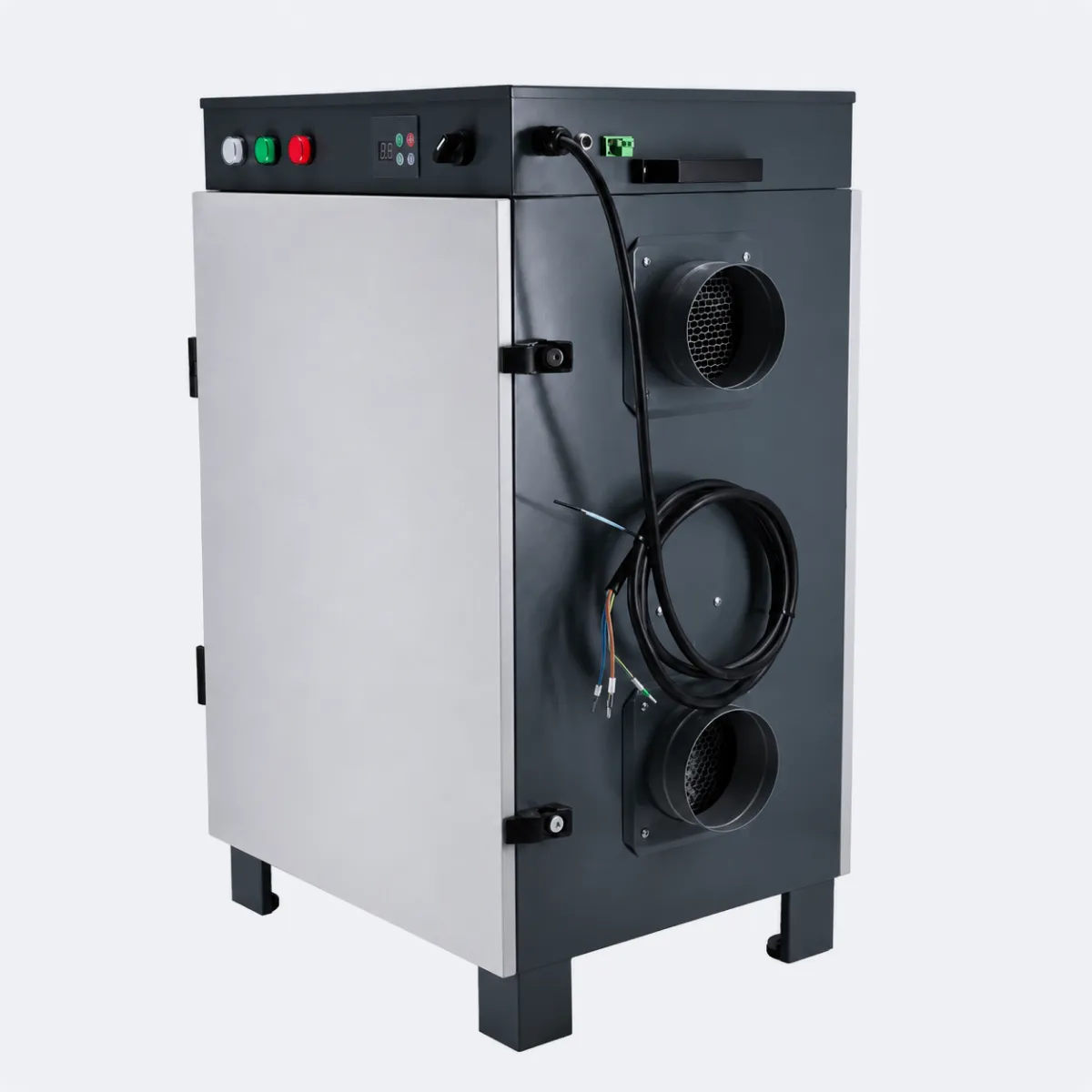
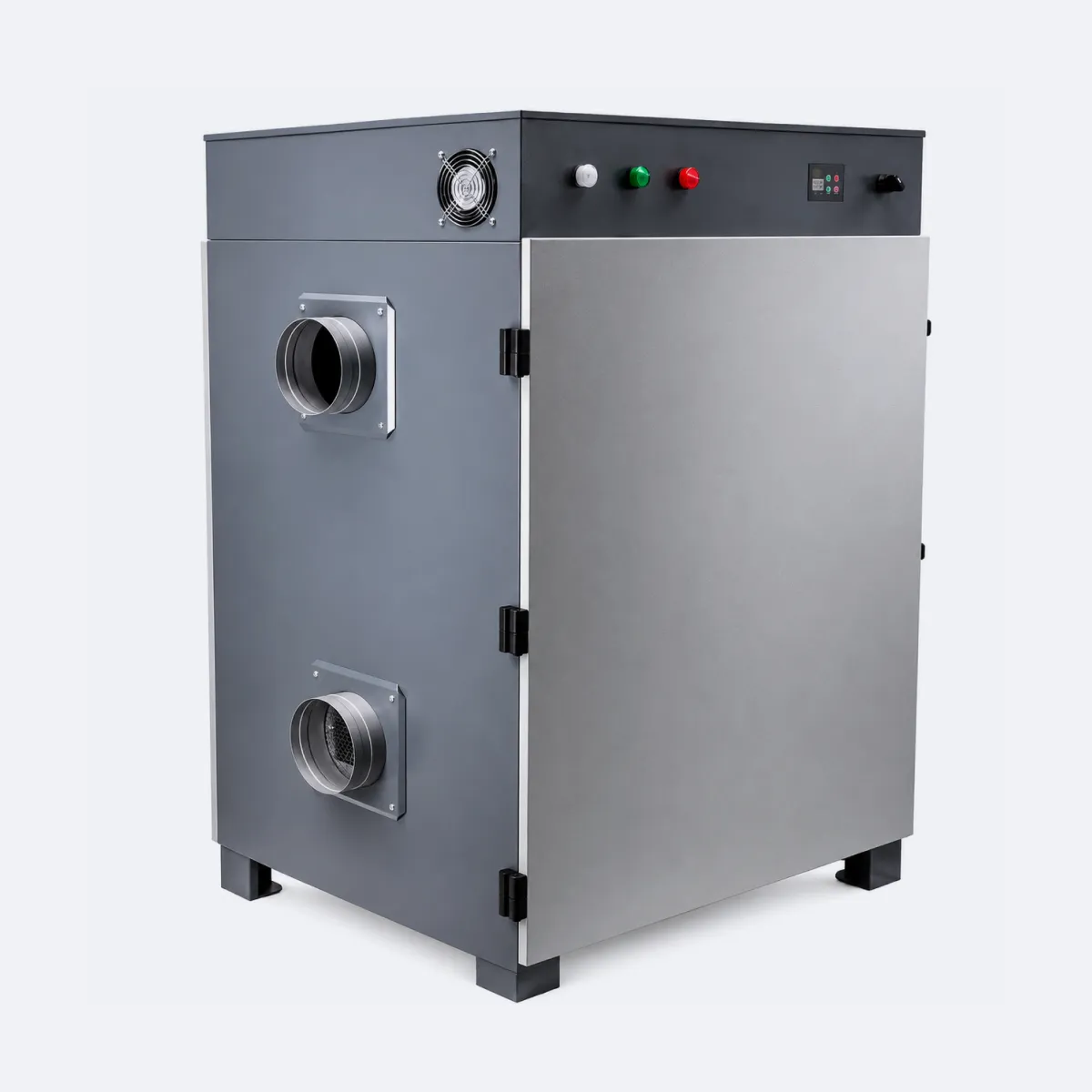
Built for warehouse and hall scale
These units target large spaces that must hold a low humidity across their whole volume, or several zones at once. Typical applications: distribution and logistics warehouses, bulk material and powder storage halls, large electronics and semiconductor production areas, pharmaceutical and nutraceutical manufacturing halls, food processing and packaging plants, large coating, printing and lamination lines, grain and seed conditioning, and energy-storage, battery, and substation buildings. In a big space, the challenge is not just capacity but coverage — getting dry air to every corner so no zone drifts wet. High process airflow and multiple units in parallel are what deliver that.
Choosing across the range
Airflow and capacity step up in line with the space; all four are 380V three-phase:
- XR-1500XF-01 — 10 kg/h, 1,580 m³/h, 15 kW, 210 kg. The entry large unit, for a single big hall or a smaller warehouse.
- XR-2000XF-01 — 13 kg/h, 2,100 m³/h, 18 kW, 210 kg. More airflow for a larger footprint or a higher moisture load.
- XR-2500XF-01 — 15 kg/h, 2,500 m³/h, 20 kW, 280 kg. Larger process ports (Φ400mm×2) for high-volume dry-air delivery across a wide space.
- XR-3000XF-01 — 20 kg/h, 3,000 m³/h, 23 kW, 300 kg. The top of this tier, for the largest single-unit warehouse and hall jobs before the high-airflow range takes over.
For spaces larger than one unit can cover, or for multi-zone plants, run several in parallel — sized to the building's air changes and laid out so dry air reaches the whole floor evenly.
Why the rotor holds a large space
Process air passes through the 270° process sector of a slowly rotating desiccant wheel (8–12 revolutions per hour); the desiccant adsorbs the moisture and dry air leaves through the process fan. A separate regeneration airstream heated to 100–140°C drives the captured moisture off the wheel and carries it outside, and the wheel rotates back into the process air restored. With no cold coil in the loop, the unit holds a low RH target far below what a compressor reaches, and holds it from -20°C to 50°C — so the same machine serves a conditioned production hall and an unheated cold store. The rotor uses a silica-gel and molecular-sieve composite chosen for strong adsorption and clean regeneration.
Build and control
- Rotor — fire-resistant desiccant wheel, rated -20°C to 50°C, gear-motor driven at 8–12 RPH with rotation-stop protection.
- Regeneration — SCR-controlled heating in an insulated chamber; heater starts with the regeneration fan and cuts out automatically if the rotor stops; sealed independent process and regeneration ducts prevent the two airstreams from mixing.
- Control — 5–95% RH, fully automatic with manual/automatic switching, real-time RH on the LED display, fault self-detection with a fault code, and running/standby/fault indicators.
- Industrial protection — IP44 enclosure, electrical protection to IP54, plus phase-sequence, over-temperature, overload, and high/low-voltage protection for a three-phase supply.
- Integration — DI signal and RS-485 Modbus for remote monitoring and control, reporting RH, mode, and fault status to a facility BMS; multiple units coordinate across zones.
- Build — stainless-steel or powder-coated housing, continuous operation over 720 hours with stable low-temperature performance, 10-year-plus designed service life, components from established brands (Siemens, ABB, Omron, Schneider, Delixi and similar).
Global voltage and OEM/ODM
All models are three-phase 380V, available for 50Hz or 60Hz and for the destination market's three-phase voltage. We support OEM branding and ODM changes: cabinet color and layout, control interface and BMS protocol, duct and drainage configuration, filter grade (G4 standard, higher grades on request), rotor and heating selection for the target dew point, and labeling — built to CE, ETL, and RoHS with ISO 9001. Send us the building size and layout, the moisture load and target RH, the lowest operating temperature, and the supply available, and our application team will recommend a model, a multi-unit layout, or an engineered system.