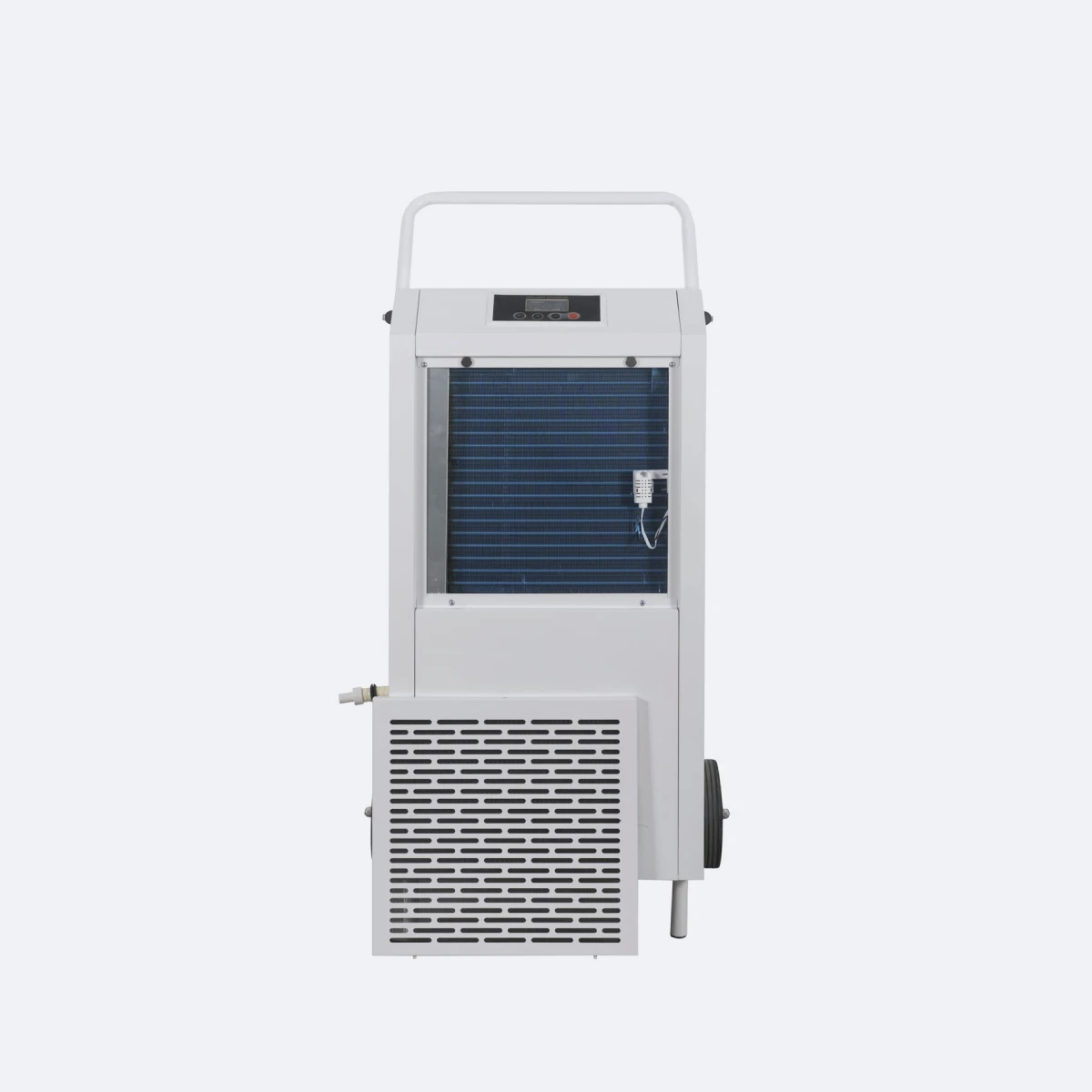
Where the GDH-156E Fits Best
The GDH-156E is sized for 140–160 m² spaces with high moisture loads — large workshops, manufacturing floors, restoration job sites, large basement and parking areas, indoor pool plant rooms, and grow rooms during high-transpiration cycles. As a high capacity dehumidifier in a still-mobile format, it serves buyers who need to move serious extraction capacity between locations: restoration contractors, equipment rental operators, facility maintenance teams handling multiple zones, and OEM partners building branded rental fleets.
Single-unit deployment up to 160 m² works in open-layout spaces. Beyond that, or for heavily compartmented layouts, multi-unit deployment is more effective than oversizing one machine. The 156 L/day capacity is at the upper end of what makes sense for a single-unit portable solution — larger requirements typically move to ducted or three-phase fixed installations.
Why a 2-Wheel Handle Cart, Not a 4-Caster Cabinet
At 49 kg, the GDH-156E sits at the weight threshold where 4-caster cabinet designs start to feel sluggish to reposition, and the 2-wheel handle-cart design becomes the better mobility solution. The two formats serve different deployment patterns:
- 4-caster cabinet — works best when the unit lives in one room and only gets nudged or rotated for cleaning. The four wheels distribute weight evenly but require flat floors with no thresholds, and pushing the unit any real distance is awkward because the user has to walk alongside it.
- 2-wheel handle cart — works best when the unit travels between locations on a regular basis. Tilt back on the two large rear wheels (220 mm pneumatic-style polyamide), grip the handle at chest height, and the unit moves like a luggage cart at walking pace. The large wheels roll over door thresholds, expansion joints, raw concrete and asphalt — surfaces that bind smaller caster wheels.
For the GDH-156E's intended buyers — restoration contractors moving units between job sites, rental fleet operators rotating equipment, facility teams covering multiple zones — the cart format saves real time and reduces back strain during transport. The trade-off: once the unit is in position, the 2-wheel cart needs a stable surface to stand on. It is not as stable on uneven floors as a 4-caster cabinet, and should be parked on a flat area while running.
What "Portable" Means at 49 kg — Be Realistic
49 kg is heavy. A single operator can wheel the GDH-156E on flat floors all day, but lifting it is a two-person job, and carrying it up stairs is not realistic. For multi-floor deployment, the practical workflow is: stage one unit per floor with elevator transport between, or use ramps and dock equipment for level changes. The handle is sized for chest-height grip and reinforced with welded steel reinforcement at the joint with the cabinet — the most common failure mode on lower-grade competitor units is the handle ripping out of the housing after repeated transport.
Compressor-Cycle Refrigeration
The GDH-156E uses a sealed compressor refrigeration cycle. Air enters through the side intake grille, passes across the oxygen-free copper evaporator coil where moisture condenses to liquid water, then is reheated across the condenser coil before exhausting back into the room. Coils are oxygen-free copper tubing with hydrophilic-coated aluminum fins. The 1800 W input drives the high extraction rate — for context, a 70-pint AHAM consumer unit typically draws 600–700 W and extracts 33 L/day under similar test conditions. The GDH-156E delivers roughly 4.5x that extraction at 2.5x the power input, which works out to better moisture-per-kWh than the consumer tier.
Operating Temperature — Why 5–30 °C, Not 38 °C
The 30 °C upper limit on the GDH-156E is the narrowest in our portable range, set 5–8 °C below the limits on smaller capacity units. This is a direct consequence of the 1800 W compressor and the heat it generates inside the cabinet during operation. The internal electronics, sensor PCB and control board need to stay below their thermal envelope, and at high ambient temperatures the unit's own heat output combined with the room temperature can push internal cabinet temperature past safe operating points.
In practical terms: indoor spaces (offices, warehouses, archives, workshops) operating at 18–28 °C ambient pose no issue. Unconditioned spaces in tropical climates that sustain above 32 °C ambient require either a smaller-capacity model or operation during cooler hours. For continuous-duty installations in 30+ °C ambient, the three-phase industrial line in our commercial dehumidifier range uses different thermal management and handles higher ambient temperatures.
R32 or R290 — Refrigerant Choice
Both refrigerants are factory options. Selection should match the destination market regulations and your specific capacity requirements:
R290 (propane) — natural hydrocarbon, ODP of 0, GWP of 3. Required for new equipment going into the EU and UK from 2027 onward under the revised F-gas Regulation (EU 2024/573). Classified as highly flammable (A3), requiring a sealed circuit and strict charge volume limits per IEC 60335-2-40.
R32 — next-generation HFC, GWP of 675, mildly flammable (A2L). Widely permitted in the US, Asia, and most global markets. It safely accommodates larger charge volumes, making it the practical choice for high-capacity industrial units, and is easier to service in regions lacking R290-certified technicians.
Capacity and energy efficiency are highly comparable on both options within the rated working range. While R32 provides an excellent balance of performance and safety for large global operations, R32 faces future phase-downs in strict regulatory markets. For EU orders projected to deliver after 2027, specify R290 at the PO stage to ensure compliance and avoid customs issues.
Drainage
Two drainage paths:
- Internal tank — removable plastic bucket with full-tank float switch. At 156 L/day extraction the tank fills in roughly 35–40 minutes at peak load, useful as a backup path only.
- Continuous gravity drain — 3-meter reinforced PVC hose to the rear G1/2" port (optional on standard orders, included on OEM specifications). Route with continuous downward slope to a floor drain, sink or sump.
No built-in condensate pump on the GDH-156E. For installations needing lift drainage (drain endpoint above the outlet), elevate the unit on a stable platform, fit an external pump on the drain line, or specify an internal pump as an ODM modification.
Auto Defrost
The hot-gas bypass defrost system clears coil frost through the 5–18 °C range where unprotected portable units stall. Minimum working temperature is 5 °C. For sustained operation below 5 °C — winter restoration jobs in unheated structures, cold storage, walk-in freezers — use a desiccant-type rotary dehumidifier instead, where the working principle is adsorption rather than condensation.
Restoration Work — What This Unit Can and Cannot Do
The GDH-156E sits at the capacity threshold where it overlaps with light LGR (low-grain refrigerant) restoration machines. At 156 L/day saturation rating, the AHAM-equivalent capacity falls in the 80–100 PPD range, comparable to entry-level LGR units. The GDH-156E is, however, a refrigerant-cycle portable rather than a purpose-built LGR machine — it lacks the secondary heat exchanger that gives true LGR units their efficiency at low grain depression. For active flood drying as the primary unit, a dedicated LGR with built-in pump, GFCI plug and stackable rotomolded housing is the correct equipment class. The GDH-156E works well as a secondary or finishing unit in restoration work, as the primary dehumidifier for restoration of moderate water losses, and as a daily-driver unit for mold prevention in restored structures.
Build and Safety
1.0 mm cold-rolled steel housing with electrostatic powder coating. Reinforced steel handle assembly welded at the cabinet joint. Internal electrical components receive moisture-proof conformal coating before assembly. Built-in safety: high-pressure cut-out, overcurrent protection, defrost interlock, tank-full shutoff, fault self-protection logic and thermal cut-out on the compressor.
OEM and ODM Service
OEM MOQ is 10 units — branding, color (any RAL or Pantone), power cord and plug type (Type B, F, G, I and others), packaging artwork. For rental-fleet OEM buyers, common specifications include high-visibility color codes, asset tag mounting points, and reinforced corner bumpers. ODM scope covers panel layout, control firmware, refrigerant selection, capacity-rating label and certification routing (CE, RoHS, ETL, SAA). Production lead time 25–35 days after artwork sign-off, FOB Ningbo or Shanghai.
For higher capacity in three-phase fixed-installation format, browse the industrial line in our full commercial dehumidifier range.