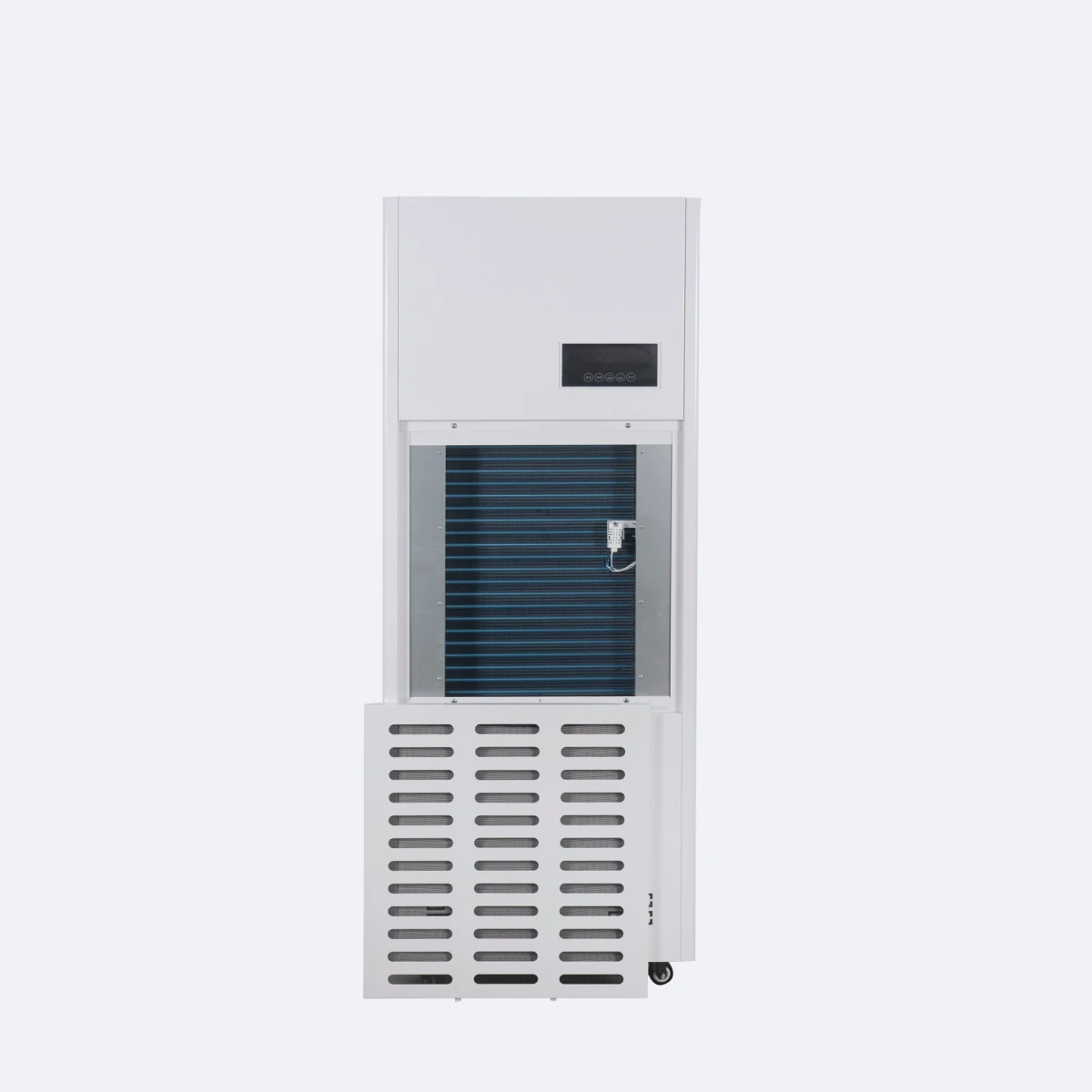
Where the 168L Commercial Dehumidifier Fits Best
The 168L is sized for 160–220 m² spaces with continuous high moisture loads where a single-unit fixed installation makes more operational sense than rotating multiple portable machines between zones. Typical applications: manufacturing floors and machine shops, dedicated document archive halls, large server rooms and IT facilities, indoor pool plant rooms (the mechanical equipment room, not the pool deck itself), heavy workshop bays in light industrial buildings, food processing facilities operating above the cold-chain temperature threshold, and commercial laundry support areas.
It is not designed for water damage restoration work, despite capacity overlap with LGR-class machines. The plumbed drainage requirement, 80 kg weight and 220V/380V hard-wired connection require site preparation before commissioning — that is not the rapid-deployment profile of restoration equipment.
Why This Model Is No Longer Classified as Portable
Above roughly 160 L/day capacity in a refrigerant-cycle design, the engineering trade-offs that make a unit truly portable start to compromise reliability and ongoing performance. The 168L sits past that threshold by design:
- 80 kg net weight. Even with two-wheel cart geometry, 80 kg becomes a two-person move on flat floors and requires lifting equipment for level changes. The cart format that works at 49 kg (the GDH-156E in our range) does not scale to this weight class comfortably for daily mobility.
- No water tank — plumbed drainage only. The internal volume that would house a removable tank is given over to the larger compressor, condenser block and electrical panel. A tank-equipped 168L would need to be emptied every 25–30 minutes at peak load, which is operationally useless. The design commits to plumbed drainage as the only path.
- Dual-voltage power input. 220V single-phase covers smaller commercial installations; 380V three-phase is standard in industrial buildings. The three-phase option matters because three-phase motors run more efficiently at this power level (2.5 kW input), inrush current is lower at startup, and load balances across the building's three-phase system instead of loading a single phase.
- 1589 mm height. Tall cabinet design moves more air through the heat exchanger per unit floor area, which keeps the footprint manageable for indoor placement. Top-discharge airflow distributes dehumidified air better in tall industrial spaces than the side-blower configuration of cart-format portables.
The integrated lower castors are sized for initial placement and occasional repositioning during cleaning or service access — not for daily transport between rooms.
220V Single-Phase or 380V Three-Phase — Choosing the Power Configuration
Both power supplies are factory options selected at order:
- 220V single-phase — uses the same circuit type as standard appliance outlets but on a dedicated 15–20 A branch. Suitable for smaller commercial installations, retrofit projects in buildings without three-phase distribution, and applications where electrical contractor time for three-phase wiring is difficult to schedule. The 2500 W rated input draws roughly 11.4 A at 220V, well within a 15 A circuit's continuous-load rating.
- 380V three-phase — standard industrial distribution voltage in most countries outside North America. The three-phase compressor motor runs more efficiently than the single-phase equivalent, inrush current at startup is lower, and load balances across the building's three-phase system. For industrial buildings already wired for three-phase machine tools, lighting and HVAC, this is the natural choice.
The control board, sensor and LCD panel are identical between the two versions — only the compressor motor specification and the power-input circuit differ. Conversion between the two after delivery is not a field-serviceable change, so confirm the destination's electrical infrastructure before ordering. The terminal block configuration also follows destination market standards (4-wire or 5-wire three-phase) and is set during production based on the order.
Plumbed Drainage — Site Preparation Implications
The 168L has no internal water tank. Condensate flows continuously from the rear G3/4" outlet port through a plumbed drain line to a floor drain, mop sink or sump. Standard installation routes the drain within 3–5 meters of the unit, with continuous downward slope at 1–2 % gradient.
Site preparation checklist before commissioning:
- Drain endpoint available below the unit's outlet height (roughly 200 mm above floor) before unit arrives on site
- For installations where the drain endpoint sits above the outlet, an external condensate pump is required between the unit and the drain line — the 168L has no built-in pump
- Drain line material: reinforced PVC or copper for long-term industrial environments; garden-hose grade tubing fails within a year of continuous flow at this volume
- Avoid placing isolation valves on the drain line — accidentally closing one backs up condensate, trips the high-pressure protection and stops the unit
Compressor-Cycle Refrigeration in Fixed Installation
The 168L uses a sealed compressor refrigeration cycle scaled up for the 2500 W input. Air enters through the side intake grille on the lower section, passes upward across the oxygen-free copper evaporator coil where moisture condenses to liquid water, is reheated across the condenser coil, and exhausts through the top vent at roughly chest height. The upward airflow path inside the tall cabinet moves larger air volumes than the side-blower design used on smaller cart-format units — that is how the unit reaches 1500 m³/h within the footprint.
Coils are oxygen-free copper tubing with hydrophilic-coated aluminum fins. For fixed installations running continuously across multi-year service cycles, copper is the only practical choice — aluminum or mixed-metal coils corrode in damp ambient air and lose extraction performance within 3–4 years of continuous duty.
R32 or R290 — Refrigerant Choice
Both refrigerants are factory options. Selection should match the destination market regulations and your specific capacity requirements:
R290 (propane) — natural hydrocarbon, ODP of 0, GWP of 3. Required for new equipment going into the EU and UK from 2027 onward under the revised F-gas Regulation (EU 2024/573). Classified as highly flammable (A3), requiring a sealed circuit and strict charge volume limits per IEC 60335-2-40.
R32 — next-generation HFC, GWP of 675, mildly flammable (A2L). Widely permitted in the US, Asia, and most global markets. It safely accommodates larger charge volumes, making it the practical choice for high-capacity industrial units, and is easier to service in regions lacking R290-certified technicians.
Capacity and energy efficiency are highly comparable on both options within the rated working range. While R32 provides an excellent balance of performance and safety for large global operations, R32 faces future phase-downs in strict regulatory markets. For EU orders projected to deliver after 2027, specify R290 at the PO stage to ensure compliance and avoid customs issues.
Operating Temperature — 5 to 30 °C
The 168L is rated 5–30 °C working temperature. The 30 °C upper limit follows the same logic as smaller high-capacity models in our range: at 2500 W input the compressor and electrical panel generate significant internal heat, and the upper limit keeps internal cabinet temperature within safe operating range for the electronics and sensor PCB. Industrial spaces typically operate at 18–28 °C, comfortably inside this envelope. Hot manufacturing environments running above 30 °C ambient require either supplementary ventilation in the dehumidifier's installation area, or a different equipment class with active thermal management.
For sustained operation below 5 °C — cold storage, walk-in freezers, unheated archive halls in winter — switch to a desiccant-type rotary dehumidifier. The working principle is adsorption rather than condensation and effective extraction continues down past –20 °C.
Build and Safety
1.0 mm cold-rolled steel housing with electrostatic powder coating. Internal electrical components on the PCB receive a moisture-proof conformal coating before assembly. The lower section integrates a service-access panel for compressor and electrical inspection. Built-in safety: high-pressure cut-out, overcurrent protection on each phase (on the three-phase version), defrost interlock, fault self-protection logic, compressor thermal cut-out and emergency stop button on the control panel.
OEM and ODM Service
OEM MOQ is 10 units — branding, color (any RAL or Pantone), terminal block configuration for the destination market's three-phase standard (4-wire vs 5-wire, neutral and ground configurations), control firmware language, packaging artwork. For installation-channel OEM buyers, common specifications include extended power cord length, lockable service panel covers, and asset-tag mounting brackets for facility maintenance tracking. ODM scope covers panel layout, control logic for BMS integration (Modbus RTU output, dry-contact alarm outputs), refrigerant selection, capacity-rating label and certification routing (CE, RoHS, ETL, SAA, GS depending on target market). Production lead time is 30–40 days after artwork sign-off, slightly longer than the 25–35 days on our portable models due to the additional electrical certification testing required for three-phase variants. FOB Ningbo or Shanghai.
For mobile high-capacity units in cart format, see the high capacity dehumidifier. For other tiers in our full commercial dehumidifier range, browse the category page.