Where the GDH-90E Fits Best
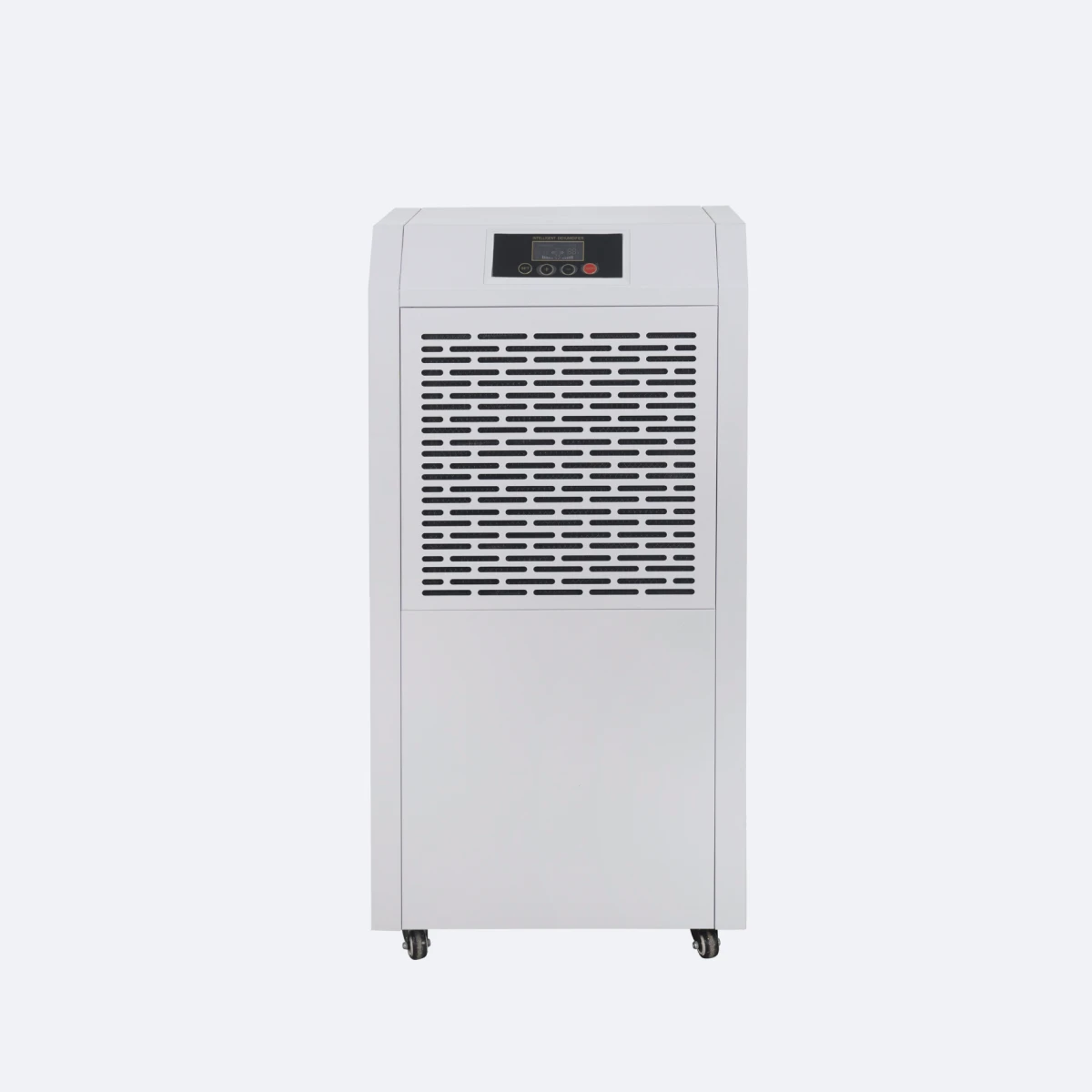
The GDH-90E is sized for 80–120 m² rooms with a moderate-to-high moisture load and no one on staff to empty a water tank every hour. Typical applications: archive halls and document storage rooms, mid-size machine shops, switchgear rooms where electrical equipment generates moisture concerns, server rooms during high-humidity summer months, basement parking areas, indoor pool plant rooms (above the room itself) and large warehouse zones. The 4-caster upright cabinet is more an installed-in-place unit than a frequently moved cart — the 1025 mm height and 45 kg net weight make repositioning possible with one operator, but it is not the design intent.
It is not an LGR (low-grain refrigerant) class restoration machine. For active flood drying, look at LGR 80–170 PPD units with built-in pumps and GFCI plugs. The GDH-90E is for ongoing humidity maintenance, not emergency response.
Drainage Architecture — Why "with Drain Hose" Matters
The drainage path is what determines whether a portable dehumidifier can actually run unattended for weeks, or whether someone has to physically empty a tank multiple times per day. On the GDH-90E, drainage works two ways:
Internal Tank (4.5 L, Backup Path)
Built into the rear lower section is a removable plastic tank with a full-tank float switch. When the tank fills, the float trips a shutoff relay and the unit stops the compressor — the fan runs briefly to clear residual condensate from the coil, then stops. At full extraction (90 L/day), the 4.5 L tank fills in roughly 70–80 minutes. That is useless as the primary drainage path for serious facility duty, but useful as a fallback if the external drain becomes blocked or the hose disconnects.
Continuous Drain via Hose (G1/2" Rear Port, Primary Path)
The rear of the cabinet has a G1/2" threaded port. Connect the 3-meter reinforced PVC drain hose (brass fittings, included on OEM orders, optional on standard orders), route it with continuous downward slope, and end it at a floor drain, utility sink or sump. This converts the unit into an install-and-forget machine — at 90 L/day output the hose handles the volume easily, and the tank float switch becomes overflow protection only.
There is no built-in condensate pump on the GDH-90E. This is a gravity drain system by design. Gravity drainage has three practical constraints buyers should understand before installation:
- Drain endpoint must sit below the outlet height. The G1/2" port sits roughly 850 mm above the floor when the unit is on its casters. The drain endpoint can be at any height up to roughly 800 mm if you want reasonable flow, but ideally is at floor level.
- Continuous downward slope is required. No high spots in the hose run. Water trapped in a low loop will block flow and eventually back up into the cabinet, tripping the float switch even though the external drain still works.
- Hose length is limited by static head. Beyond 3–4 meters of hose run, gravity flow slows and partial backups can happen during high-humidity periods. For longer runs, upgrade to a model with a built-in pump.
Compressor-Cycle Refrigeration in Cabinet Format
The GDH-90E uses a sealed compressor refrigeration cycle in an upright cabinet layout. Air enters through the side intake grille, passes downward across the oxygen-free copper evaporator coil where moisture condenses to liquid, then is reheated across the condenser coil before exhausting through the top vent. The vertical airflow path in the cabinet design moves more air per unit of fan power than the side-blower configuration used on cart-format units — that is why air circulation reaches 1200 m³/h with a 1250 W input.
Coil construction is oxygen-free copper tubing with hydrophilic-coated aluminum fins. Copper resists the corrosive damp ambient air the unit operates in continuously. Plastic-housed consumer units commonly use aluminum or copper-aluminum mixed coils that corrode faster — relevant here because a unit designed for continuous unattended drainage will run for years, not seasonally.
R32 or R290 — Refrigerant Choice
Both refrigerants are factory options. Selection should match the destination market regulations and your specific capacity requirements:
R290 (propane) — natural hydrocarbon, ODP of 0, GWP of 3. Required for new equipment going into the EU and UK from 2027 onward under the revised F-gas Regulation (EU 2024/573). Classified as highly flammable (A3), requiring a sealed circuit and strict charge volume limits per IEC 60335-2-40.
R32 — next-generation HFC, GWP of 675, mildly flammable (A2L). Widely permitted in the US, Asia, and most global markets. It safely accommodates larger charge volumes, making it the practical choice for high-capacity industrial units, and is easier to service in regions lacking R290-certified technicians.
Capacity and energy efficiency are highly comparable on both options within the rated working range. While R32 provides an excellent balance of performance and safety for large global operations, R32 faces future phase-downs in strict regulatory markets. For EU orders projected to deliver after 2027, specify R290 at the PO stage to ensure compliance and avoid customs issues.
Control Panel and Sensor
LCD touch panel shows real-time RH, target RH setting, fan speed and timer status. The integrated humidity sensor reads to ±3 % RH and cycles the compressor at setpoint, so the unit will not over-dry an already-conditioned room. The 24-hour programmable timer supports unattended overnight or weekend runtime. Fault codes appear on the panel for high-pressure, low-pressure, sensor fault and tank-full conditions, which shortens diagnosis time on service calls.
Auto Defrost and Operating Temperature
Minimum working temperature is 5 °C. Below that, the evaporator coil ices faster than the hot-gas bypass defrost cycle can clear it, and extraction drops to near zero. The auto-defrost system keeps extraction stable through the 5–18 °C range where unprotected portable units typically stall. For sustained operation below 5 °C, use a desiccant-type rotary dehumidifier — the working principle is adsorption rather than condensation, and effective extraction continues down past –20 °C.
Build and Safety
The cabinet is 1.0 mm cold-rolled steel with electrostatic powder coating. Internal electrical components receive moisture-proof conformal coating before assembly — this matters when the unit runs in 80–90 % RH ambient continuously, since moisture has to pass through the PCB before reaching the coil. Four polyamide caster wheels rated 50 kg each, two with locks for fixing position once installed. Safety includes high-pressure cut-out, overcurrent protection, defrost interlock, tank-full shutoff and fault self-protection.
OEM and ODM Service
OEM MOQ is 10 units — branding, color (any RAL or Pantone), power cord and plug type (Type B, F, G, I and others), packaging artwork. The 3-meter drain hose can be specified as included (rather than optional) on the BOM, which most OEM customers do. ODM with structural or control-board changes — including the addition of a built-in condensate pump — is quoted per project. Production lead time is 25–35 days after artwork sign-off, FOB Ningbo or Shanghai.
For higher-capacity portable units, integrated-pump models or other formats in the full commercial dehumidifier range, browse the category page.