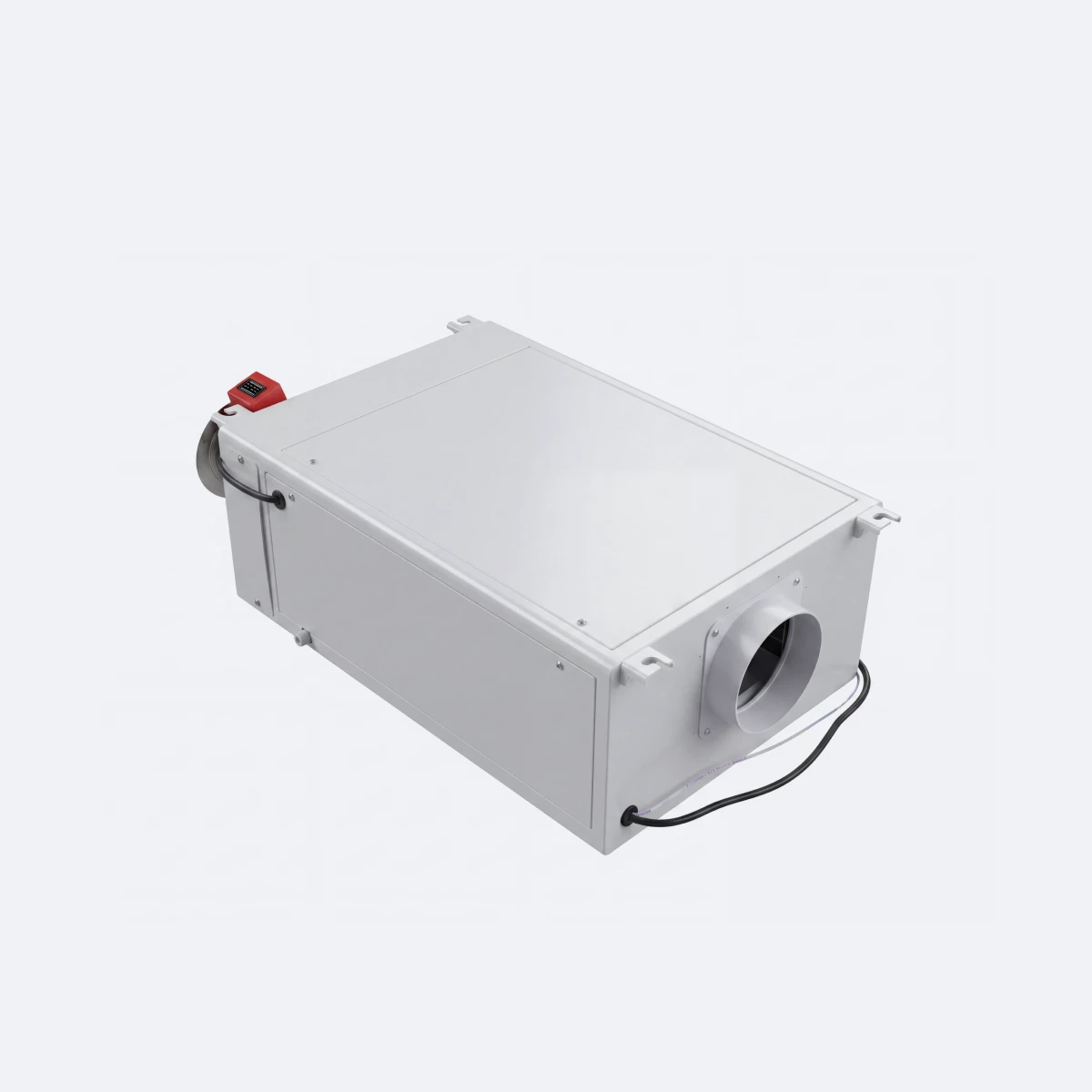
Where the Fresh Air Ducted Series Fits Best
The series is sized for residential whole-house applications and light commercial spaces where both humidity control and indoor air quality improvement are needed. Typical applications: single-family homes with 80–200 m² treated floor area (the 30–90 L/day tiers handle most residential cases), apartments and condominiums with tight building envelopes where conventional ventilation is inadequate, light commercial offices and clinics, hotel guest floors as wing-level units, nurseries and schools where CO₂ levels and air freshness matter, basements and storage areas with high moisture loads that also need ventilation.
The applicable scenarios on the product packaging — residential homes, living rooms, bedrooms and nurseries, offices and light commercial spaces, basements and storage — describe the most common installations. The 138 L/day and 156 L/day tiers extend into the light commercial range where standard residential ducted dehumidifier products are undersized. This series is not classified as an industrial dehumidifier — applications requiring heavy industrial-grade construction, three-phase power or capacities above 156 L/day should use the dedicated industrial range. The product positioning here is residential and light commercial, with sheet metal cabinet construction sized for clean indoor environments rather than corrosive industrial atmospheres.
The 2-in-1 Function — Why Fresh Air Plus Dehumidification Matters
Fresh air integration is the engineering choice that distinguishes this series from a standard ducted dehumidifier. The third duct port — outdoor fresh air inlet at 110 mm diameter on all nine models — connects to the building exterior through a standard outdoor air intake hood. During operation, the unit draws a controlled volume of outdoor air through the fresh air port, mixes it with return air from indoor spaces, processes the combined airstream through the refrigeration coil for moisture removal, then supplies the conditioned dry air back to indoor supply registers.
The benefits compound across four dimensions:
- CO₂ and indoor air quality. Modern tight building envelopes accumulate CO₂ from occupants — CO₂ levels in unventilated bedrooms typically reach 2000–3000 ppm overnight, well above the 1000 ppm IAQ target. Continuous fresh air supply through the dehumidifier brings CO₂ down to acceptable levels without opening windows.
- Single-system simplicity. One unit, one electrical connection, one set of ductwork (with one extra port), one drain. The equivalent functionality from a separate ERV and standalone dehumidifier requires two units, two installations, two service contracts and significantly more ceiling void space.
- Dehumidifies the outdoor air load. In humid climates, raw outdoor air introduces additional moisture that a standalone ERV cannot remove. This unit processes the fresh air along with the return air, handling the moisture load from both sources in a single coil pass.
- Energy efficiency versus separate systems. Mixing return air with fresh air before refrigeration processing uses the existing refrigeration cycle to handle both moisture sources, avoiding the duplicated coil and fan in a standalone ERV configuration.
Nine Capacity Tiers — Sizing for Residential and Light Commercial
The nine capacity tiers offer fine-grained sizing across the residential and light commercial range:
- 30 L/day — single rooms: master bedrooms, home offices, nurseries (10–25 m²)
- 40 L/day — larger bedrooms or paired-room applications (25–40 m²)
- 50 L/day — studio apartments, small offices (40–55 m²)
- 60 L/day — mid-size apartments, single-floor zone coverage (55–75 m²)
- 70 L/day — larger apartments, small whole-house residential (75–95 m²)
- 80 L/day — standard whole-house residential (95–115 m²)
- 90 L/day — larger family homes (115–135 m²)
- 138 L/day — large residential or light commercial (135–180 m²)
- 156 L/day — light commercial: small offices, clinics, light commercial zones (180–220 m²)
The smaller tiers (30–50 L/day) work well as a small ducted dehumidifier for single-zone applications where a 90+ L/day whole-house unit would be oversized and inefficient. For the 138 L/day and 156 L/day tiers, sizing approaches whole-house residential coverage with ventilation — see the portable dehumidifier for whole house for a non-ducted comparison if installation constraints make ducting impractical.
Three-Port Ductwork — How the Fresh Air Connection Works
The unit has three duct connections, which is what distinguishes it from a standard two-port ducted dehumidifier:
- Indoor Return Air Duct (158 mm on 30–50 L/day models, 190 mm on 60+ L/day models) — draws indoor air from return registers in the conditioned spaces. Located on one end of the cabinet.
- Indoor Air Outlet (158 mm or 190 mm matching the return port) — supplies conditioned dry air to supply registers in the conditioned spaces. Located on the opposite end of the cabinet.
- Outdoor Fresh Air Inlet (110 mm on all nine models) — draws outdoor air through an exterior intake hood, typically routed through the wall or roof to the unit. The fresh air port is positioned on the same end as the return air port to minimize ductwork complexity in the ceiling void.
The smaller fresh air port (110 mm versus 158/190 mm for indoor return) reflects design intent — fresh air provides ventilation, not bulk air conditioning. Typical fresh air rates of 230–600 m³/h depending on the tier equal roughly 4–10 % of total circulation airflow. This rate matches ASHRAE 62.2 residential ventilation requirements (roughly 7.5 L/s per person plus 0.05 L/s per m² floor area) for most household sizes.
For installations where the outdoor fresh air function is not needed, the fresh air port can be capped at installation — the unit then operates as a standard recirculating ducted dehumidifier. This gives the installer flexibility for retrofit projects where adding an outdoor air intake is impractical.
Concealed Ceiling-Mounted Installation
The cabinet is sized for installation above suspended ceilings, in attic spaces, or in utility room locations with the supply and return registers in conditioned spaces below. The horizontal cabinet layout (830 × 365 × 240 mm on 30–50 L/day models, 830 × 485 × 280 mm on 60–90 L/day, 830 × 545 × 280 mm on 138–156 L/day) fits standard ceiling voids and attic crawl spaces. The 240–280 mm cabinet height requires a minimum ceiling void of 300 mm clear including vibration isolation mounts and ductwork clearance.
Installation routes return air ductwork from indoor return registers to the cabinet's return port, supply ductwork from the outlet port to indoor supply registers, and fresh air ductwork from the fresh air inlet through an exterior wall or roof hood. The condensate drain port routes to a building drain line or external condensate pump. Concealed installation keeps the equipment out of sight from the conditioned spaces — only the supply, return and outdoor fresh air intake grilles are visible.
Compressor-Cycle Refrigeration with All-Copper Coils
The series uses a sealed R32 compressor refrigeration cycle. Air enters through the return duct mixed with fresh air from the outdoor port, passes across the oxygen-free copper evaporator coil where moisture condenses, is reheated across the condenser coil, and exits through the supply duct. The all-copper coil construction with hydrophilic-coated aluminum fins provides better service life than aluminum-tube assemblies common in lower-cost units — important in ducted applications where the unit is concealed and service access requires opening the ceiling.
R32 Standard, R410A for Legacy Replacement
R32 (HFC single-component, GWP 675, A2L mildly flammable) is standard across all nine tiers, replacing R410A as the default configuration to align with regulated markets — EU under the revised F-gas Regulation (EU 2024/573), UK, Japan under the Fluorocarbons Emissions Control Law, Australia, and the accelerating HFC phase-downs across North America and China under the US AIM Act and equivalent frameworks. Single-component composition also eliminates the fractionation risk associated with blended refrigerants during charge and top-up service — a meaningful maintenance advantage for concealed ceiling equipment on multi-year service cycles where each service call requires roof access and downtime. R410A (HFC blend, GWP 2088, non-flammable) remains available as an ODM configuration from MOQ 200 units for legacy replacement projects in markets operating existing R410A service infrastructure — note that R410A is under phase-down schedules across the EU, UK, US, and other regulated markets, with most new-build projects specifying R32 to align with 2027–2032 regulatory milestones. R290 is not offered on this series — concealed ceiling installations make leak detection difficult, and the fresh air integration draws outdoor air into the unit, which complicates the sealed-system safety analysis required for hydrocarbon refrigerants in occupied spaces.
Drainage
Continuous gravity drainage from a rear drain port — no internal water tank. The drain hose routes to a building condensate drain line, condensate manifold or external condensate pump if the drain endpoint sits above the unit's outlet height (typical for ceiling-mounted installations). The condensate pump is not included with the unit; specify it in the OEM BOM if your installation channel needs the kit factory-bundled. For installations in ceiling voids near bathrooms or utility rooms with existing condensate drainage from HVAC equipment, tie-in to the existing manifold is the simplest approach.
How This Compares to Standard Ducted Dehumidifier and ERV/HRV Systems
How this product compares to alternatives in the same general category:
- This series (Fresh Air Ducted Dehumidifier) — handles both dehumidification and outdoor fresh air supply in a single unit. Right for: residential whole-house and light commercial where IAQ and humidity both matter.
- Standard ducted dehumidifier — pure recirculating dehumidification, no fresh air. Right for: commercial spaces with separate ventilation system already in place, or larger zones (90–168 L/day capacity tiers) where pure dehumidification is the priority.
- ERV / HRV system — pure ventilation with energy recovery, limited dehumidification. Right for: cold or moderate climates where humidity load is modest and ventilation is the primary requirement.
- Separate dehumidifier + ERV — full performance on both functions but two units, two installations, two service contracts, more ceiling void space, higher upfront cost. Right for: large commercial projects where each function needs maximum capacity independently.
For commercial-scale spaces without fresh air requirements, the standard ducted dehumidifier covers 80–220 m² with larger capacity per unit. For residential whole-house applications where ventilation matters as much as humidity, the fresh air integration series is the right product class.
Build and Safety
0.8–1.0 mm cold-rolled sheet metal cabinet with electrostatic powder coating. Internal electrical components receive moisture-proof conformal coating before assembly. Each unit is leakage-tested at full extraction conditions before shipping — leakage-free operation matters for concealed ceiling installations where any water leak would damage ceiling tiles and surrounding building structure. Built-in safety: high-pressure cut-out, overcurrent protection, defrost interlock, fault self-protection logic, compressor thermal cut-out.
OEM and ODM Service
As a Chinese commercial and industrial dehumidifier manufacturer with full-spectrum OEM and ODM capabilities, we support brand customization from MOQ 10 units per model. OEM scope covers branding, cabinet color (any RAL or Pantone for any visible surfaces), plug type or terminal configuration for the destination market, control firmware language, and packaging artwork. For installation-channel OEM buyers, common specifications include extended power cord length, factory-bundled condensate pump and outdoor fresh air intake hood, dedicated mounting brackets matching local ceiling grid standards, and pre-fitted return air filters with replacement schedules documented in the operating manual.
ODM scope covers alternative refrigerant (R32 from MOQ 200), structural modifications (different cabinet dimensions for non-standard ceiling voids, modified duct port sizes for specific HVAC standards), BMS integration (Modbus RTU from MOQ 50, BACnet/KNX from MOQ 200), control firmware customization for specific facility control requirements, and certification routing (CE, RoHS, ETL, SAA depending on target market). Production lead time is 25–35 days after artwork sign-off, FOB Ningbo or Shanghai.
For other capacity tiers and configurations, browse the full commercial dehumidifier lineup.