search
Search

Enter keywords to search for products, blog posts, and more.


Home > Portable Commercial Dehumidifier with Handle (GDH-50E / GDH-58E)

Portable Commercial Dehumidifier with Handle (GDH-50E / GDH-58E)

Portable Commercial Dehumidifier with Handle (GDH-50E / GDH-58E)

Product Overview
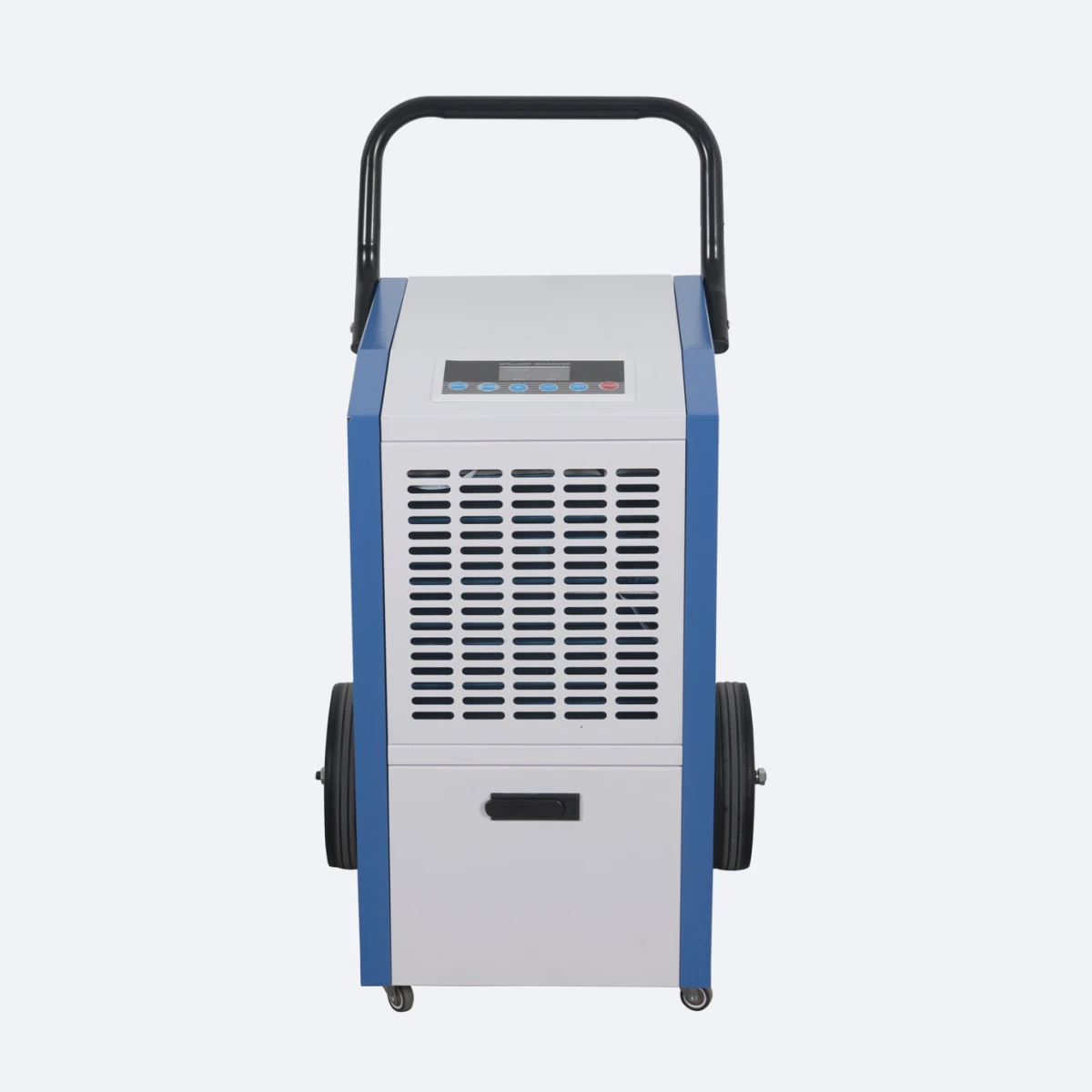
The GDH-50E and GDH-58E are compact portable commercial dehumidifiers with a built-in handle and rear wheels, sized for daily humidity control in warehouses, archives, workshops, vaults, switchgear rooms, basements and garages. Both share the same 380 × 480 × 835 mm chassis and 31 kg frame, differing in extraction capacity — 50 L/day and 58 L/day at 30 °C / 80 % RH — and recommended coverage area (40–60 m² and 40–80 m²).

Where this configuration fits
Most units on the market are either consumer-grade plastic-housed boxes or 80–170 PPD LGR restoration machines. This series sits between the two: heavy-duty enough for continuous unattended operation in facility environments, but small enough that one operator can wheel it through a standard 800 mm doorway without dollies or two-person lifts. A 4 L internal tank handles short power-outage scenarios; the gravity drain hose port supports 24/7 runtime.

Core build points

  • All-copper condenser and evaporator with hydrophilic fin coating
  • R290 or R134a refrigerant — selectable at order
  • Thickened powder-coated sheet-metal housing with PCB moisture-proof treatment
  • LCD touch panel, ±3 % RH precision humidity sensor, 24-hour timer
  • Auto defrost, fault self-protection, ≤ 40 dB(A) operating noise
  • OEM/ODM supported — branding, voltage, plug type, color customizable

For larger spaces or sub-zero operation, see our rotary dehumidifier series. For the full commercial dehumidifier lineup, browse the category page.

Technial Parameters

SpecificationGDH-50EGDH-58E
Dehumidification Capacity (30°C / 80% RH)50 L/day58 L/day
Power Supply220V / 50Hz220V / 50Hz
Rated Power700 W730 W
Noise Level≤40 dB(A)≤40 dB(A)
Airflow500 m³/h550 m³/h
Working Humidity Range30% – 80% RH30% – 80% RH
Recommended Coverage Area40 – 60 m²40 – 80 m²
Working Temperature5 – 38 °C5 – 38 °C
Drainage MethodWater Tank + Drain HoseWater Tank + Drain Hose
Product Dimensions (L × W × H)380 × 480 × 835 mm380 × 480 × 835 mm
Packing Dimensions470 × 500 × 790 mm470 × 500 × 790 mm
RefrigerantR290 / R134aR290 / R134a
Net / Gross Weight31 / 33 kg31 / 33 kg

Product Details

Where the GDH-50E and GDH-58E Fit Best

This series is sized for 40–80 m² spaces with a moderate-to-high moisture load — typical conditions in document archives, switchgear rooms, server rooms, warehouse aisles, vault storage, light workshops and home or commercial garages. It is not an LGR (low-grain refrigerant) class machine for flood restoration; if you need 80–170 PPD restoration capacity, the design intent here is different. What this unit does well is run quietly for weeks at a 30–60 % RH setpoint, where consistent low-noise low-touch operation matters more than peak extraction.

As a portable industrial dehumidifier in the compact category, the GDH series fills the gap between household 20-pint plastic units and the 50 kg+ rotomolded restoration machines. The 31 kg weight, 380 × 480 mm footprint and rear wheels make it a true small portable dehumidifier in operational terms — one person, one trip, no lifting equipment. At the same time, the all-copper coil and steel housing keep it firmly in the industrial-grade build tier, not the consumer tier.

Compressor-Cycle Refrigeration with All-Copper Coils

The GDH series runs a sealed compressor refrigeration cycle — the same operating principle as a window air conditioner, optimized for condensation rather than cooling. Warm humid air is pulled across an oxygen-free copper evaporator coil where moisture condenses out, then reheated slightly by the condenser coil before being returned to the room. As a portable compressor dehumidifier for small spaces, this configuration extracts moisture far faster than peltier or rechargeable desiccant types in the same room volume, and it needs no installation work like a whole-house ducted system would.

Coil construction matters more than most buyers realize. The condenser and evaporator use oxygen-free copper tubing with aluminum fins and a hydrophilic coating. Copper handles thermal cycling and corrosive damp ambient air far better than the aluminum-tube assemblies found in lower-cost portable units — relevant here because facility-grade machines cycle on and off across multi-year service life. The hydrophilic fin coating sheds condensate film quickly, which keeps airflow resistance low as humidity climbs.

R290 or R134a Refrigerant — How to Choose

Both refrigerants are factory options. The right choice depends on your destination market and after-sales setup:

  • R290 (propane) — natural hydrocarbon, ODP of 0, GWP of 3. Required for export to the EU and several Asian markets under low-GWP regulations (EU F-gas). Charge volume stays under 150 g per unit, with the sealed circuit meeting IEC 60335-2-40 safety construction requirements.
  • R134a — HFC refrigerant, non-flammable, still accepted in many markets outside the EU. Easier to service where R290-trained technicians are scarce.

Capacity and energy consumption are essentially identical on both options within the rated working range. Refrigerant selection is locked at order.

Control Panel and Humidity Sensor

The LCD touch panel shows real-time RH, target RH, fan speed and timer status. The integrated humidity sensor reads to ±3 % RH and triggers compressor cycling once the target is reached, so the unit will not over-dry an already-conditioned room. The 24-hour timer supports unattended overnight or weekend operation. Fault codes appear on the panel when the controller detects high-pressure, low-pressure, sensor fault or tank-full conditions, which shortens diagnosis time on a service call.

Drainage — Tank and Continuous Hose

Two drainage paths are built in:

  • Internal 4 L tank — removable bucket with full-tank float switch. Unit auto-shuts when the bucket fills.
  • Continuous gravity drain — corrosion-resistant 3 m drain hose connects to the rear G1/2" port. The hose must run downward from outlet height with continuous slope to a floor drain, utility sink or sump.

The drain hose is reinforced PVC with brass fittings, rated for long-term operation in industrial environments where ordinary clear PVC tubing tends to crack or kink within months.

Auto Defrost and Low-Temperature Operation

Minimum working temperature is 5 °C. Below that point, refrigerant-cycle dehumidifiers form frost on the evaporator coil faster than the defrost cycle can clear it, and extraction drops sharply. The auto-defrost system here uses hot-gas bypass to clear coil frost on schedule, which keeps extraction stable through the 5–18 °C range where unprotected portable units typically stall. For sustained operation below 5 °C — cold storage, unheated archives in winter, walk-in freezers — switch to a desiccant-type rotary dehumidifier instead. The working principle is different (adsorption rather than condensation), and effective extraction continues down past –20 °C.

Build and Protection

The outer housing is 1.0 mm thickened cold-rolled steel with electrostatic powder coating. Internal electrical components receive a moisture-proof conformal coating before assembly — this matters when the unit runs in 90 %+ RH ambient air for extended periods, since that moisture has to pass through the PCB before it reaches the coil. Built-in safety includes high-pressure cut-out, overcurrent protection, defrost interlock and tank-full shutoff.

OEM and ODM Service

Standard customization includes badge and logo silk-screening, color code (RAL or Pantone), power cord and plug type for the destination market (Type B, F, G, I and others), and packaging artwork. ODM scope covers panel layout, control firmware language, refrigerant selection, capacity-rating label and certification routing (CE, RoHS, ETL, SAA depending on target market). MOQ for OEM is 50 units per model; ODM with structural changes is quoted case-by-case. Production lead time is 25–35 days after artwork sign-off, FOB Ningbo or Shanghai.

For higher-capacity portable units or large-room desiccant models, browse our full commercial dehumidifier range.

FAQs

How large an area can the GDH-50E and GDH-58E cover?

The GDH-50E is rated for 40–60 m² and the GDH-58E for 40–80 m² at 30 °C / 80 % RH. Actual coverage in your space depends on insulation, air change rate, ceiling height and ambient humidity. A sealed archive room at 25 °C / 70 % RH lets a single unit reach the setpoint within a few hours. An unsealed garage with frequent door openings cycles the unit more often, and effective coverage drops toward the lower end of the range. For ceiling heights above 3 m, derate the figure by roughly 15 % per additional meter.

What is the difference between R290 and R134a refrigerant options?

R290 (propane) is a natural refrigerant with very low global warming potential and is required for export to the EU and several Asian markets under low-GWP regulations. R134a is an HFC refrigerant that is non-flammable and easier to service in regions without R290-trained technicians. Capacity and energy consumption are essentially the same on both options within the rated range. We select the refrigerant at order based on your destination market and after-sales service plan.

How does the continuous drain hose connection work?

The rear of the unit has a threaded G1/2" port that accepts the supplied 3-meter reinforced PVC hose. Connect the hose, route it with a continuous downward slope, and end it at a floor drain, utility sink or sump. There is no built-in pump on this series, so the drain point must sit below the outlet height. If the floor drain is higher than the unit, either elevate the dehumidifier on a stable platform or use the internal tank.

Can this portable commercial dehumidifier operate below 5 °C?

No. Below 5 °C the evaporator coil ices faster than the hot-gas auto-defrost can clear it, and effective extraction drops to near zero. For cold rooms, unheated archives in winter, walk-in cold storage and similar sub-5 °C environments, use a desiccant rotary dehumidifier — those work by sorption rather than condensation and stay effective down to –20 °C and below. This is a fundamental limitation of refrigerant-cycle units, not specific to this product.

Is this unit suitable for water damage restoration?

Not as a primary unit. Water damage restoration work typically calls for LGR-class machines rated 80–170 PPD with built-in pumps, GFCI plugs and stackable rotomolded housings — a different equipment class. The GDH-50E and GDH-58E are sized for ongoing humidity maintenance in facility spaces. They can support a restoration job as secondary units during the final drying phase, but they are not designed as flood-response machines.

What is your MOQ and lead time for OEM/ODM orders?

MOQ is 10 units per model for OEM (logo, color, plug type, packaging). ODM with structural or control-board changes is quoted per project — typical MOQ 200–500 units depending on tooling cost. Production lead time is 25–35 days after artwork and sample sign-off. Shipping FOB Ningbo or Shanghai, with full CIF/DDP service available. Standard certifications already in place include CE and RoHS; ETL, SAA and other regional marks can be added with timeline impact.

Is the GDH series a compressor-type or desiccant dehumidifier, and where does it sit in the portable category?

It is a sealed compressor-cycle unit, positioned as a portable compressor dehumidifier for small spaces in the 40–80 m² range. Within the broader portable industrial dehumidifier category, this means it sits in the compact tier — smaller and more mobile than 80–170 PPD LGR restoration machines, but built tougher than consumer plastic-housed units. As a small portable dehumidifier with industrial-grade construction, the design priority is multi-year continuous operation in damp ambient conditions, not peak extraction during flood response. Compressor-cycle units extract far more moisture per kWh than peltier or rechargeable desiccant types in the same room volume, and they need no installation work. If your application is below 5 °C or under 20 m², a rotary desiccant model or a smaller capacity tier is usually the better fit.


Amy

General Manager