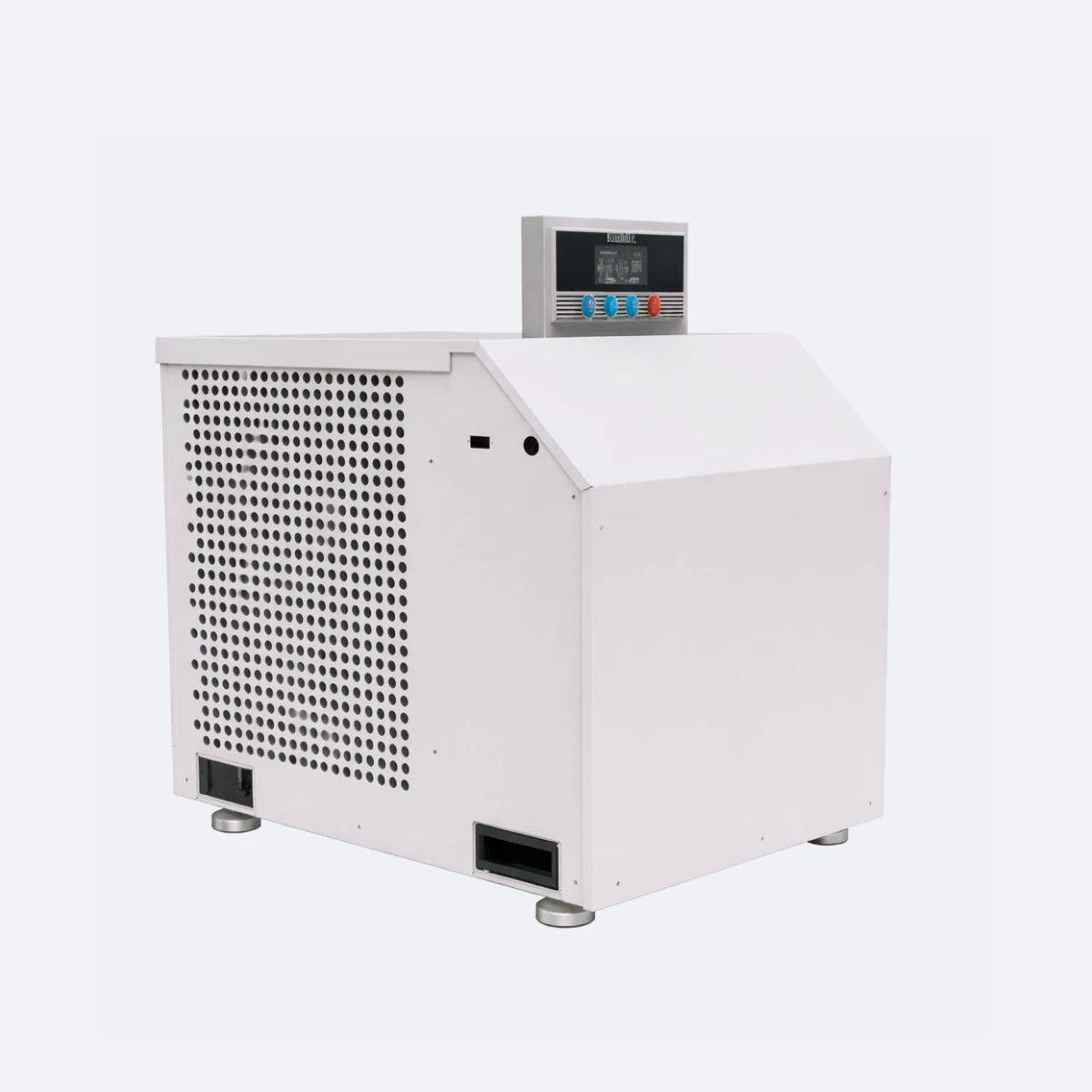
Where the Industrial Greenhouse Dehumidifier Series Fits Best
The 225 / 335 / 506 PPD range is engineered for industrial-scale controlled environment agriculture where continuous 24/7 operation, multi-zone deployment across large facilities, and compliance documentation drive the procurement decision. Typical installations include commercial cannabis cultivation facilities (Tier 2 and Tier 3 licensed operators, multi-state operator (MSO) production, Canadian LP standard designs), vertical farming operations at industrial scale (multi-tier lettuce, herb, and leafy green production), industrial mushroom production facilities (button, oyster, shiitake at commercial cropping scale), post-harvest and drying room operations for cannabis flower, hemp, tea, and other high-value crops, and industrial hemp processing facilities.
The ceiling-mounted format matters at this scale: cultivation floors, drying racks, curing benches, and processing tables occupy every available square foot in industrial cultivation operations, and floor-standing dehumidifiers compete with revenue-generating cultivation surface. Suspending the industrial greenhouse dehumidifier from the ceiling structure keeps all floor space productive while positioning the equipment above the growing zone where the moisture load concentrates. For facilities without adequate ceiling structural capacity, the alternative floor-standing options in the industrial dehumidifier range serve the same capacity envelope with different deployment geometry.
Why Industrial Duty Cycle Matters vs Standard Commercial Greenhouse Equipment
Standard commercial greenhouse dehumidifier equipment is engineered for seasonal duty cycles typical of horticultural greenhouses — heavy summer humidity load, moderate shoulder-season operation, lighter winter demand, service intervals aligned to seasonal maintenance windows. Industrial cultivation operates on a fundamentally different duty cycle profile:
- Continuous flowering-room operation. Cannabis flowering rooms hold 55–65% RH at 24–27°C continuously for the 8–10 week flowering cycle. Vertical farming leafy green rooms hold 60–70% RH at 18–22°C continuously through the 30–60 day production cycle. Industrial mushroom fruiting rooms hold 80–95% RH at 15–20°C continuously through the multi-week cropping period. These are not seasonal loads — they are continuous industrial loads with the dehumidifier running at 60–100% of nameplate capacity for weeks at a time.
- Harvest-cycle drying loads. Post-harvest drying rooms for cannabis and hemp hold 55–60% RH at 15–18°C for 7–14 days per drying batch, running the dehumidifier at near-maximum capacity throughout the drying cycle to remove the substantial moisture load from freshly-harvested biomass. Curing rooms extend this sustained load pattern across 30–60 days per batch at 60–62% RH.
- Multi-year continuous operation. Standard commercial equipment engineered for 8000–10000 hour seasonal service cycles reaches end-of-life in 2–3 years of industrial cultivation operation. Industrial-grade equipment engineered for 50000+ hour continuous operation provides the 6–10 year service life that industrial cultivation ROI analysis assumes.
- Compliance documentation requirements. Licensed cannabis facilities under state and provincial regulations, GMP-tier facilities producing hemp or medical products, and export-oriented cultivation operations under GACP or EU-GMP require equipment specification, calibration, and validation documentation that consumer-grade or standard commercial equipment cannot support without significant retrofit work.
The 225 / 335 / 506 PPD industrial greenhouse dehumidifier range is engineered specifically for these industrial requirements — sealed refrigeration circuits designed for continuous operation, control electronics rated for multi-year uninterrupted service, hydrophilic-coated coils that resist biofilm growth under sustained high-RH conditions, and the documentation package (specification sheets, calibration certificates, refrigeration circuit test records) that regulated cultivation facilities need for facility validation.
Three Capacity Tiers — Sized for Industrial Cultivation Zone Loads
The three-tier structure maps to typical industrial cultivation zone sizes and moisture load profiles:
- 225 PPD (106 L/day metric) — individual cultivation rooms, drying rooms. Sized for single flowering rooms up to approximately 40 lights (16 kW canopy load), drying rooms handling up to 100 lb of fresh biomass per batch, small mushroom fruiting rooms up to 20 m² floor area, or vertical farm production zones up to 30 m² growing area. This is the workhorse tier — typical multi-room cannabis facilities deploy multiple 225 PPD units, one per flowering room, for zone-level control that a centralized larger unit cannot match.
- 335 PPD (166 L/day) — mid-sized cultivation zones and mid-scale drying halls. Sized for larger flowering rooms up to 60 lights (24 kW canopy), drying rooms handling 150 lb per batch, larger mushroom rooms up to 30 m², or full-canopy vertical farm production zones. This tier serves the "standard commercial" scale that most licensed cannabis facilities design around — matching the room dimensions typical of purpose-built cultivation architecture.
- 506 PPD (239 L/day) — large industrial cultivation halls and industrial drying operations. Sized for large flowering halls up to 100 lights (40 kW canopy), industrial drying rooms handling 250+ lb per batch, larger commercial mushroom production zones up to 50 m², or multi-zone vertical farm production halls. This is the industrial-scale tier — the largest single-unit capacity in the ceiling-mounted format, sized for the largest single-room applications before distributed multi-unit deployment becomes the more efficient approach.
For cultivation halls above 100 lights or industrial drying operations above 300 lb per batch, distributed deployment of multiple 506 PPD units across the space provides better RH uniformity and built-in redundancy vs single oversized equipment. The RS-485 Modbus BMS interface supports coordinated multi-unit deployment across the facility.
Application: Commercial Cannabis Cultivation Facilities
Licensed cannabis cultivation is the largest single application category for industrial greenhouse dehumidifier equipment in North American markets. Each stage of the cannabis production cycle has distinct RH targets and moisture load characteristics:
- Propagation and vegetative stages (65–75% RH at 22–25°C). Higher RH targets, moderate moisture load. Typically served by 225 PPD units, one per propagation or veg room.
- Flowering rooms (55–65% RH at 24–27°C). Lower RH target as flower matures, moisture load driven by both plant transpiration and lighting-induced dry-bulb temperature. High-density flowering rooms with 20–40 lights per room typically need 225–335 PPD per room; larger flowering halls at 60+ lights need 506 PPD.
- Late flowering and pre-harvest (45–55% RH). Aggressive RH reduction to promote resin production and prepare for harvest. Peak dehumidifier load period, running near maximum capacity for 7–14 days per cycle.
- Drying rooms (55–60% RH at 15–18°C). Post-harvest drying is the most dehumidifier-intensive stage — freshly-harvested biomass contains 75–80% water by weight, virtually all of which must transfer to air and out through the dehumidifier over the 7–14 day drying cycle. Industrial drying operations typically use dedicated 506 PPD units per drying room, sized for the peak initial moisture load.
- Curing rooms (60–62% RH, 30–60 days per batch). Sustained but moderate moisture load. Typically served by 225–335 PPD units depending on curing room floor area.
Multi-facility cannabis operators (MSOs) standardize on this industrial greenhouse dehumidifier configuration across facilities in different states or provinces for procurement consistency, spare parts standardization, and training uniformity — one dehumidifier platform serves all facility types with tier selection matching each specific room's load profile.
Application: Vertical Farming and Industrial-Scale Indoor Agriculture
Vertical farming operations grow leafy greens, herbs, and specialty crops in stacked hydroponic systems with LED lighting under fully controlled climate conditions. RH targets typically hold 60–70% for lettuce and leafy greens, 65–75% for herbs, 50–60% for strawberries and higher-value fruit crops. The dehumidifier load characteristics differ from cannabis in three ways: continuous transpiration from densely-planted stacked systems generates sustained moisture load without the harvest-cycle peaks; the multi-tier vertical layout requires distributed dehumidification since single-unit central cooling creates RH gradients between the top and bottom tiers; the LED-plus-hydroponic energy balance means transpiration is a larger fraction of total heat balance than in soil-based cultivation.
The ceiling-mounted 225 / 335 / 506 PPD range distributes across the vertical farm floor plan with one unit per zone, coordinating through the RS-485 Modbus BMS interface for facility-wide humidity control. For large vertical farm facilities (Plenty, Bowery, AeroFarms, InFarm and similar scale), multi-zone deployment with 4–20 units per facility is typical, with each unit sized to its zone's plant density and lighting load.
Application: Industrial Mushroom Production Facilities
Commercial mushroom cultivation operates under distinctive moisture conditions — cropping rooms hold 80–95% RH at 15–20°C during fruiting, then drop to 60–70% RH during harvest and cleanout, cycling every 2–4 weeks per production cycle. The high-RH fruiting environment challenges standard dehumidifier equipment because condensate loads are high, condensate carries organic material from the mushroom substrate, and the humid corrosive environment attacks unprotected internal components.
The industrial greenhouse dehumidifier range serves commercial mushroom production with several features that matter operationally: hydrophilic coil coating that resists biofilm growth under sustained high-RH conditions, corrosion-resistant powder-coated cabinet suitable for the mushroom-house environment, ceiling-mounted format that keeps floor space free for substrate blocks and harvest carts, and the reliable extraction capacity to drive room RH down during the harvest transition without extended room downtime. Typical mushroom facilities deploy 335–506 PPD units per fruiting room depending on room size and cropping cycle intensity.
Application: Post-Harvest Drying, Curing, and Processing Rooms
Post-harvest drying is the highest-intensity moisture load in cultivation operations. Freshly-harvested cannabis biomass at 75–80% water by weight releases most of that moisture in the first 3–5 days of drying at the 55–60% RH / 15–18°C targets that produce quality flower — sustained peak dehumidifier operation throughout the drying cycle. Industrial hemp drying operates on similar principles at larger scale, with drying halls handling 500+ lb of fresh material per batch.
For industrial drying operations, the 506 PPD tier provides the peak extraction capacity that the initial 3–5 days of drying require, while the wide operating envelope (5–45°C) supports elevated-temperature drying protocols where growers use higher ambient temperatures (18–20°C) to accelerate initial moisture removal before dropping to the 15–18°C target for the final drying and curing stages. For drying operations that specifically require the -3 to 60°C wider temperature envelope of the temperature-controlled range, see the temperature-controlled industrial dehumidifier for higher-temperature drying and curing configurations.
VPD Precision Control at Industrial Cultivation Scale
Vapor Pressure Deficit (VPD) — the difference between saturation vapor pressure and actual vapor pressure at leaf temperature — determines transpiration rate, nutrient uptake, and photosynthetic efficiency in cannabis and vertical farming crops. Standard cultivation targets 0.8–1.2 kPa VPD during flowering, 0.4–0.8 kPa during vegetative growth, with tight ±0.1 kPa control precision separating optimal-yield operations from average-yield operations.
The 225 / 335 / 506 PPD range supports precision VPD control through the ±3% RH accuracy specification (verified with imported humidity sensors), the RS-485 Modbus BMS interface that reports real-time RH, temperature, and calculated VPD to the facility environmental control system, and the multi-mode operating logic that coordinates dehumidification with the room's HVAC and lighting cycles to maintain target VPD across day/night transitions. For facilities running published cultivation SOPs with documented VPD targets by cultivar, the industrial greenhouse dehumidifier range provides the control precision that enables the SOPs to actually deliver their target yields.
MERV-13 Filtration for Regulated Cultivation Environments
The MERV-13 filtration stage on the dehumidifier air intake serves two operational purposes in industrial cultivation. First, particle capture: MERV-13 removes ≥85% of particles in the 1–3 μm range including most mold spores, pollen, dust, and bacterial particles — important in cultivation environments where cross-contamination from mold spores (Botrytis, powdery mildew, Fusarium) causes crop loss. Second, dehumidifier coil protection: cultivation air carries plant debris, soil particles, and organic matter that accumulates on cooling coils and reduces heat exchange efficiency over time. MERV-13 pre-filtration extends coil service intervals and maintains rated capacity over the equipment's service life.
For facilities with tighter cleanliness requirements (GMP cannabis production, certain vertical farming operations targeting food service or export markets), the filtration stage upgrades to MERV-16 as an OEM modification (removes ≥95% of particles in the 0.3–1 μm range, capturing bacteria and most viruses). For applications with even tighter requirements, HEPA-grade filtration is available as an ODM addition though this reduces airflow and rated PPD capacity — the trade-off should be evaluated against the specific facility requirement.
Multi-Zone Deployment and Facility BMS Integration
Industrial cultivation facilities rarely deploy single dehumidifiers — the typical facility runs 4–20 industrial greenhouse dehumidifier units across cultivation rooms, drying halls, curing zones, and processing spaces, with each unit sized to its zone's specific load. The RS-485 Modbus RTU communication interface on every unit supports multi-unit deployment through several operational modes: individual per-zone control (each unit responds to its zone's local sensor and setpoint), coordinated multi-zone control (facility BMS coordinates units across zones for load balancing during peak demand), and centralized monitoring (facility management platform tracks runtime hours, filter status, refrigeration circuit health, and fault codes across all units).
For facilities using established environmental control platforms — TrolMaster, Argus, Priva, Autogrow, or custom BMS installations — the standard Modbus RTU interface integrates without protocol-conversion hardware. For BACnet/IP or KNX integration, firmware conversion is available as an ODM modification from MOQ 50 units. For facilities running proprietary vendor platforms (certain cannabis-specific facility management systems), we support register map documentation and integration testing to verify communication before shipping.
Duty Cycle and Reliability for 24/7 Industrial Cultivation Operation
Industrial cultivation operations have zero tolerance for extended equipment downtime — a dehumidifier failure during flowering can drive RH above 65% within hours, and RH excursions above 70% during late flowering create powdery mildew and Botrytis conditions that cause immediate crop loss. Standard commercial equipment engineered for 8000–10000 hour cycling duty reaches early failure under continuous industrial operation.
The 225 / 335 / 506 PPD range is engineered for 50000+ hour continuous operation service life through several component-level decisions: sealed compressor with continuous-duty motor windings and thermal protection, refrigeration circuit sized for sustained maximum-capacity operation without margin degradation, defrost cycle logic optimized for continuous operation vs cycling, control electronics with wide-temperature-range components and moisture-proof conformal coating, and the corrosion-resistant construction throughout the internal water-contact path. For facilities with strict uptime requirements, the standard 12-month warranty extends to 24 months with the industrial cultivation warranty package (available as an OEM modification with facility use certification), providing spare-parts stocking guarantees and 48-hour response service commitment.
Distinguishing from Standard Greenhouse Dehumidifier and Related Equipment
Choose based on facility scale, duty cycle, compliance requirements, and installation format:
- This industrial greenhouse dehumidifier (225 / 335 / 506 PPD, ceiling-mount, industrial duty cycle) — Right for: licensed cannabis facilities (Tier 2/3), vertical farming at industrial scale, industrial mushroom production, post-harvest drying and curing operations, multi-facility MSO standardization, applications requiring RS-485 BMS integration and compliance documentation.
- Standard greenhouse dehumidifier (225 / 335 / 506 PPD, standard configuration) — Right for: general commercial greenhouses, horticultural operations, propagation houses, seasonal cultivation applications, and general commercial installations without the industrial duty cycle and compliance documentation requirements. Same physical product family with configuration and documentation appropriate to the standard commercial buyer.
- Ducted dehumidifier — Right for: facilities with existing ductwork infrastructure or centralized air handling where whole-facility dehumidification through ductwork is preferred over per-zone ceiling-mounted equipment.
- Industrial dehumidifier (floor-standing, 180–1440 L/day) — Right for: facilities without adequate ceiling structural capacity for suspended units, applications needing capacity above 506 PPD per unit, mobile or relocation-flexible dehumidification.
- Temperature-controlled industrial dehumidifier — Right for: elevated-temperature drying and curing operations (typically 30–50°C ambient) where standard 5–45°C equipment operates at the edge of its envelope. Wider temperature envelope with dedicated engineering for elevated-temperature dehumidification.
- Industrial dehumidifier for warehouse (ceiling-mount, 180–288 L/day) — Right for: general industrial dehumidification without the cultivation-specific features (MERV filtration, VPD control, cannabis-specific application engineering) that the industrial greenhouse range provides.
Build, Compliance Documentation, and OEM/ODM Service
Heavy-gauge steel cabinet with corrosion-resistant powder-coated finish suitable for humid cultivation environments. Copper refrigeration coil with hydrophilic fin coating for accelerated condensate runoff and biofilm resistance. Internal electrical components with moisture-proof conformal coating for the sustained high-RH operating environment. Full safety protection suite: high-pressure and low-pressure cut-out on the refrigeration circuit, compressor thermal protection, automatic defrost cycle, condensate overflow protection with control-loss failsafe, and fault self-protection with real-time alarm to the RS-485 BMS interface. Each unit is fully function-tested at the factory including refrigeration circuit pressure verification, airflow measurement, PPD extraction verification under AHAM standard conditions, control firmware functional test, RS-485 Modbus protocol verification, and MERV-13 filter fit-check before shipping.
Compliance documentation package standard with every unit: specification sheet with certified performance data, refrigeration circuit test records, control electronics QA certificate, MERV-13 filter certification (particle capture efficiency per ASHRAE 52.2), and refrigerant handling documentation for the destination market. For regulated cultivation facilities (licensed cannabis, GMP hemp production, export cultivation), extended documentation packages are available including IQ/OQ validation protocols, calibration certificates traceable to national standards, and sanitary design documentation quoted per project.
OEM scope from MOQ 10 units per model: branding (logo, model badge), cabinet color in standard or custom RAL colors, control firmware language (English, Spanish, French, Portuguese available), packaging artwork, filter media specifications (MERV-13 standard, MERV-16 upgrade available), condensate pump inclusion or exclusion, and cultivation-specific documentation packages. ODM scope: 460V/60Hz three-phase specification from MOQ 50 for larger facility installations, BACnet MS/TP or KNX BMS protocol customization from MOQ 50, HEPA filtration stage addition (with airflow derating) from MOQ 50, alternative refrigerant (R32) from MOQ 200, IQ/OQ validation documentation for regulated cultivation quoted per project, structural and cabinet modifications quoted per project, and certification routing (CE, ETL, cETLus, SAA depending on target market). Production lead time is 30–45 days after artwork sign-off. FOB Ningbo or Shanghai.
For related equipment across the cultivation and cleanroom category, browse the full commercial dehumidifier lineup.