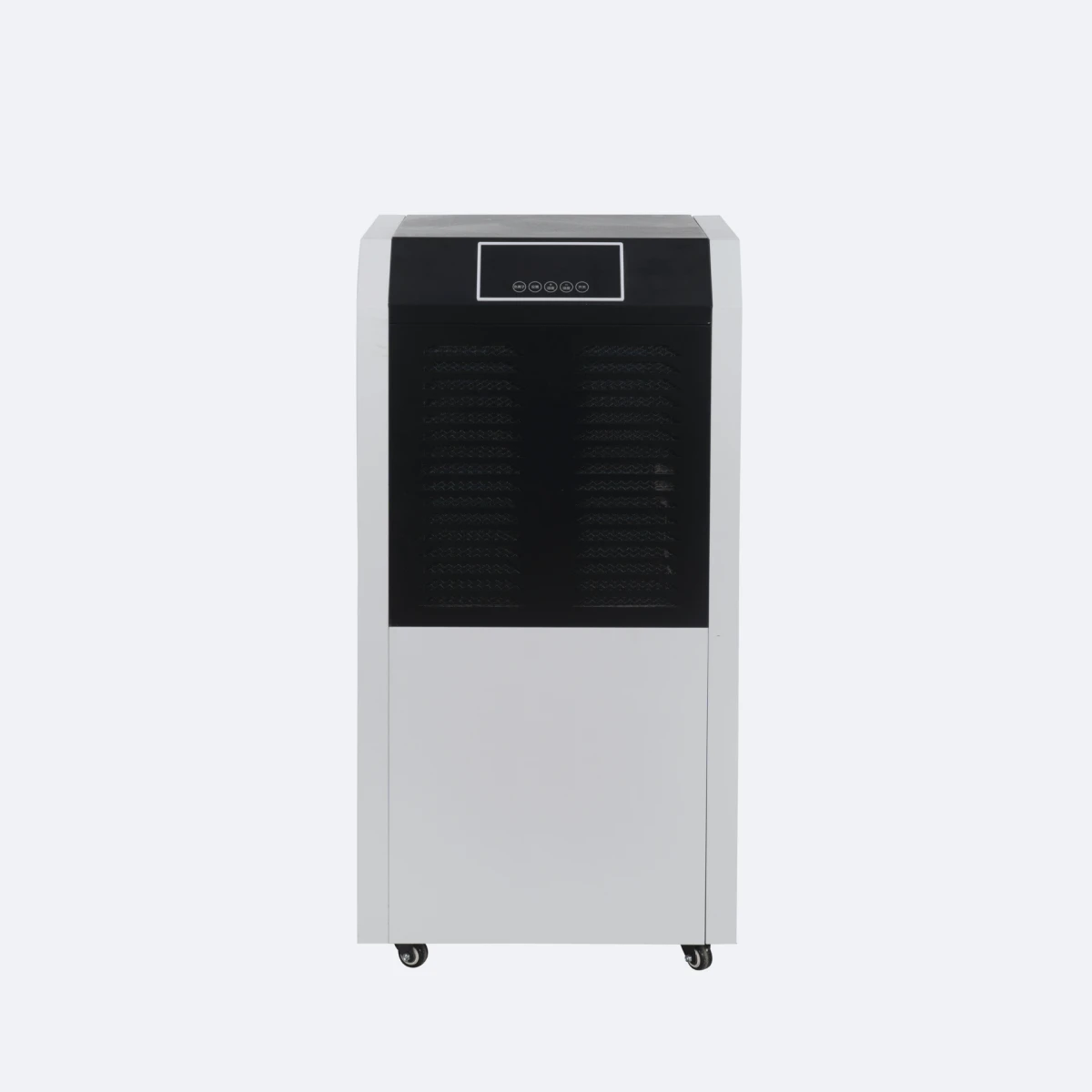
Where the GDH-138E Fits Best
The GDH-138E is sized for 120–140 m² coverage at typical residential humidity loads — single-floor open-layout homes, larger apartments and lofts, small commercial offices and shops, and as a primary dehumidifier in vacation rental properties where renters won't tolerate ducted-system maintenance interruptions. As a portable dehumidifier for whole house duty, it works best in spaces with reasonable airflow continuity between rooms. Heavily compartmented multi-bedroom homes with all interior doors closed will develop moisture pockets in distant rooms even with the unit running at full capacity. That is not a unit limitation — it is a fundamental constraint of point-source dehumidification.
For two-story homes or rigidly compartmented layouts, practical guidance is either: (a) run a single GDH-138E on the lower floor where moisture loads are highest and let natural air circulation handle the upper floor, or (b) deploy two units, one per floor. For continuous summer-long deployment in humid climates (US Southeast, coastal Southeast Asia, the UK, much of continental Europe), the GDH-138E is sized to run continuously through the season without thermal stress.
Portable vs Ducted Whole-House — The Real Trade-offs
A ducted whole-house dehumidifier integrates with the home's HVAC ductwork, pulling air from return ducts, removing moisture, and supplying drier air back through the supply registers. Units in this category from brands like AprilAire, Santa Fe and Ultra-Aire typically extract 70–130 PPD AHAM-rated capacity, install by an HVAC contractor at roughly $1,800–3,500 plus labor, and stay with the building.
A portable whole-house dehumidifier like the GDH-138E delivers comparable daily extraction in the same coverage tier, but with fundamentally different deployment economics:
- No installation work. Plug into a standard 220V/50Hz outlet, connect the optional drain hose to a floor drain, and the unit is running. Installation time is about 10 minutes.
- Relocatable. Roll the unit between floors during seasonal transitions, or take it to a new property when the family moves. Ducted systems stay with the building.
- Lower upfront cost with no contractor labor. For property managers handling multiple rental units, one portable per property is cheaper than ducting each one.
- Single-point coverage. Ducted systems distribute treatment through ductwork to every register. The portable treats the room it sits in plus adjacent rooms with airflow continuity. This is the trade-off — open-layout homes favor portable, heavily compartmented homes favor ducted.
Why 138 L/Day Matches Whole-House Coverage
Whole-house dehumidifier sizing in residential contexts typically calls for 70–130 PPD AHAM-rated capacity. The GDH-138E is rated 138 L/day at 30 °C / 80 % RH, the standard saturation test condition used in Asian and European markets. This rating places the unit in the upper-mid range of whole-house capacity in real deployment. At this output, a single unit can pull a 120–140 m² home from 70–75 % RH down to a 45–50 % RH target within 12–18 hours, then cycle at maintenance load drawing roughly 800–1000 W average during steady-state operation.
The 1200 m³/h air circulation rate is what makes whole-house coverage feasible. Smaller portables at 600 m³/h cover the room they sit in but cannot push dehumidified air far enough to treat connected rooms. 1200 m³/h provides roughly three to four air changes per hour in a 130 m² × 2.5 m home, which is the standard sizing target for whole-house dehumidifier circulation.
Compressor-Cycle Refrigeration
The GDH-138E uses a sealed compressor refrigeration cycle in an upright cabinet layout. Air enters through the side intake grille, passes downward across the oxygen-free copper evaporator coil where moisture condenses to liquid, then is reheated across the condenser coil before exhausting through the top vent. Coils are oxygen-free copper tubing with hydrophilic-coated aluminum fins — copper resists the corrosive damp ambient air the unit operates in continuously through humid seasons. Plastic-housed consumer units commonly use aluminum or mixed coils which corrode faster, a real concern for a machine that will run for months at a time.
R32 or R290 — Refrigerant Choice
Both refrigerants are factory options. Selection should match the destination market regulations and your specific capacity requirements:
R290 (propane) — natural hydrocarbon, ODP of 0, GWP of 3. Required for new equipment going into the EU and UK from 2027 onward under the revised F-gas Regulation (EU 2024/573). Classified as highly flammable (A3), requiring a sealed circuit and strict charge volume limits per IEC 60335-2-40.
R32 — next-generation HFC, GWP of 675, mildly flammable (A2L). Widely permitted in the US, Asia, and most global markets. It safely accommodates larger charge volumes, making it the practical choice for high-capacity industrial units, and is easier to service in regions lacking R290-certified technicians.
Capacity and energy efficiency are highly comparable on both options within the rated working range. While R32 provides an excellent balance of performance and safety for large global operations, R32 faces future phase-downs in strict regulatory markets. For EU orders projected to deliver after 2027, specify R290 at the PO stage to ensure compliance and avoid customs issues.
Operating Temperature — Note the 35 °C Upper Limit
The GDH-138E is rated 5–35 °C working temperature, with the upper limit set 3 °C below the 38 °C ceiling on smaller capacity portables in our range. This is a real spec difference, not a typo. The 1500 W compressor generates more internal heat in the cabinet during operation, and the 35 °C upper limit is the conservative line for keeping the internal electronics within their operating envelope when ambient air is already hot. Practical translation: a 30–32 °C home interior during summer poses no issue. An unconditioned attic, sunroom, or unshaded outdoor area that hits 38 °C+ requires either a smaller capacity unit or operation during cooler hours.
Drainage
Two drainage paths are built in:
- Internal tank — removable plastic bucket with full-tank float switch. At 138 L/day extraction the tank fills in roughly 45–50 minutes at peak load, so realistically this is a backup path only.
- Continuous gravity drain — 3-meter reinforced PVC hose to the rear G1/2" port (optional on standard orders, included on OEM specifications). Route the hose with continuous downward slope to a floor drain, utility sink or sump.
There is no built-in condensate pump on the GDH-138E. For installations where the drain endpoint sits above the outlet height, the cabinet can be elevated on a stable platform, an external pump fitted on the drain line, or a built-in pump added as an ODM modification.
Auto Defrost and Low-Temperature Operation
The hot-gas bypass defrost system clears coil frost through the 5–18 °C range. Minimum working temperature is 5 °C. Below that, refrigerant-cycle dehumidifiers form frost on the evaporator coil faster than the defrost cycle can clear it, and extraction drops to near zero. For sustained operation below 5 °C — basements in unheated winter conditions, walk-in cold storage — use a desiccant-type rotary dehumidifier instead. The working principle is adsorption rather than condensation, and effective extraction continues down past –20 °C.
Build and Safety
1.0 mm cold-rolled steel housing with electrostatic powder coating. Internal electrical components receive moisture-proof conformal coating before assembly. Four polyamide caster wheels rated 50 kg each (well above the 48 kg net weight), two with locks for fixing position once installed. Safety includes high-pressure cut-out, overcurrent protection, defrost interlock, tank-full shutoff and fault self-protection.
OEM and ODM Service
OEM MOQ is 10 units — branding, color (any RAL or Pantone), power cord and plug type (Type B, F, G, I and others), packaging artwork. For consumer-channel resellers, packaging with retail UPC barcodes and English or localized-language manuals is included in the standard OEM scope. ODM with structural or control-board changes — adding a built-in condensate pump, WiFi control board, or modified drainage layout — is quoted per project. Production lead time 25–35 days after artwork sign-off, FOB Ningbo or Shanghai.
For different capacity tiers in the same cabinet format, browse the full commercial dehumidifier lineup.