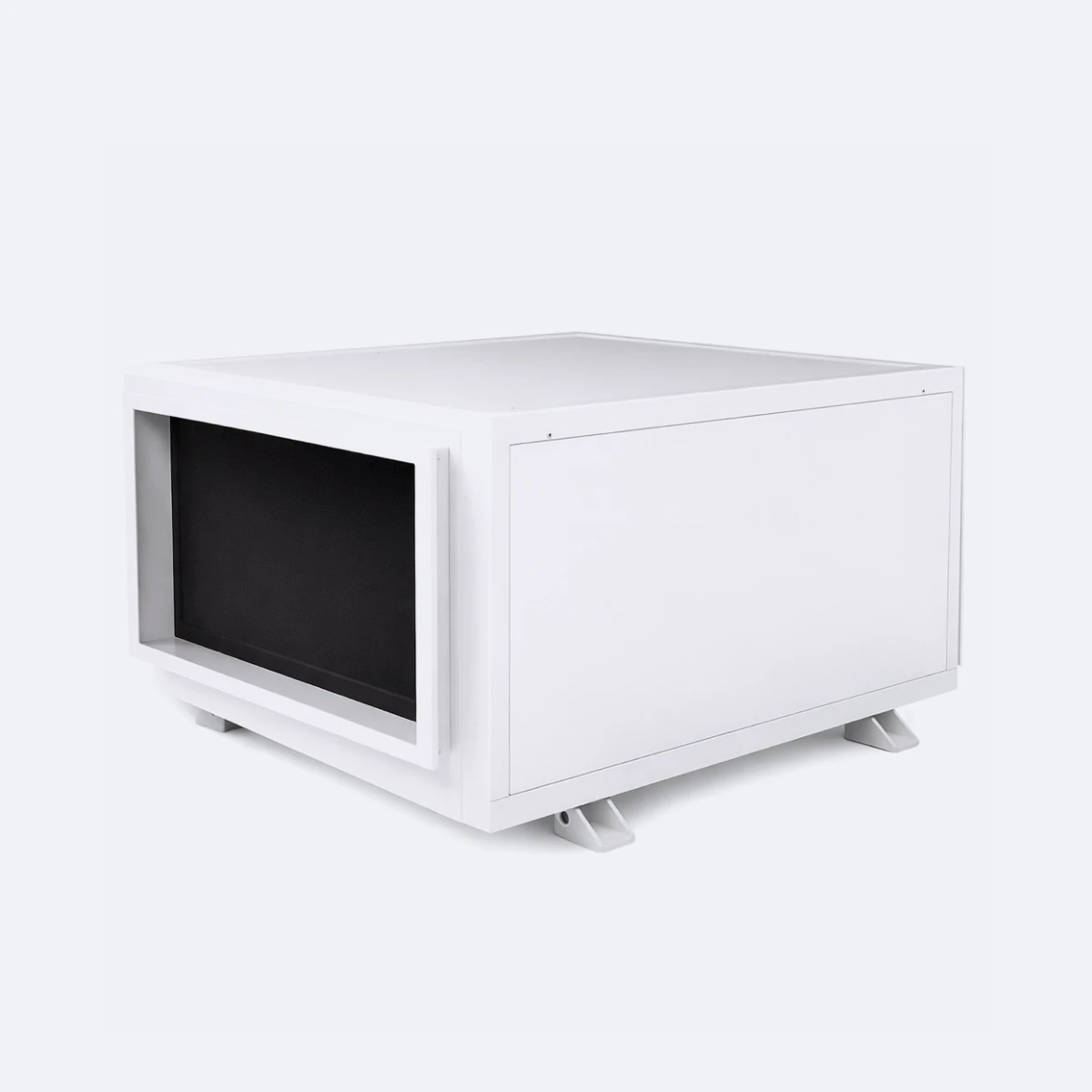
Where the GDH-CE380 to GDH-CE720 Series Fits Best
The applicable scenarios on the product specification — food processing and drying rooms, pharmaceutical and GMP workshops, precision electronics and semiconductor assembly, industrial heat treatment and metallurgy, chemical industry, energy facilities, and wood and furniture manufacturing — share two operational characteristics at this capacity tier: large single-zone areas from 350 to 900 m² per unit, and ambient temperatures reaching or exceeding 40 °C during process operation where standard 5 to 38 °C industrial equipment would shut down on thermal protection.
This is not a general-purpose warehouse dehumidifier. For large warehouses, distribution centers, archives, and clean industrial spaces operating at 15 to 30 °C ambient year-round, the standard industrial dehumidifier range serves at lower cost. The GDH-CE380 to GDH-CE720 series adds value in large precision processing zones with elevated ambient temperature: mega-warehouses adjacent to metallurgy or heat-treatment operations, pharmaceutical bulk-production floors at 35 to 50 °C ambient during granulation shifts, large-hall food processing operations combining thermal load and packaging areas, multi-line semiconductor manufacturing with distributed heat-generating processes, and large chemical facility zones where reactor rooms and process equipment produce sustained elevated ambient temperatures.
For smaller rooms below 350 m² per zone, step down to the GDH-CE180 to GDH-CE288 tier at lower cost. For installations exceeding 900 m² or with continuous heavy moisture loads, deploy multiple GDH-CE units in parallel — the distributed approach provides more uniform coverage than a single oversized unit and provides built-in redundancy for critical applications.
The 5 to 60 °C Envelope at Large Capacity — What Makes the Wide Range Work
Achieving 60 °C sustained operation reliably at 380 to 720 L/day extraction requires specific engineering choices amplified at high capacity. Standard industrial dehumidifiers use commercial-grade compressors, standard fin-tube heat exchangers, and PCB-mounted electronics rated to 70 °C junction temperature — all of which exceed their design envelope somewhere between 40 and 45 °C ambient. At the airflow rates involved at this tier (up to 8500 m³/h through the process coil), the heat rejection load on the condenser is substantially higher than at smaller capacity. The GDH-CE380 to GDH-CE720 series uses higher-pressure-rated compressor specifications designed for elevated condenser saturation pressure at large refrigerant charge (2.1 to 4.8 kg per unit), condenser heat exchange surface sized to the compressor capacity, industrial-grade electronic components rated to 85 °C+ junction temperature, and enhanced internal cooling paths for compressor and motor. Sustained operation at 50 to 60 °C ambient across the full 380 to 720 L/day extraction range is the design point.
Ultra-High-Airflow Concealed Ceiling Installation
Each unit installs above the treated zone's ceiling structure or inside a plenum void, with process air ducted from return grilles at the warmest ceiling zones (where hot humid air stratifies) through the evaporator coil and back to the room through supply grilles distributed across the treated area. At 4000 to 8500 m³/h airflow rates, the supply duct network must be sized to distribute conditioned air uniformly — the fan's high static pressure enables long duct runs (typically up to 30 to 50 meters equivalent length in properly sized systems).
Gravity drainage handles condensate through a continuous drain hose routed to the facility's plumbing lines. At the higher extraction capacities of this tier (up to 720 L/day condensate output), the drain line sizing and slope become critical — undersized or inadequately sloped drain lines can back-flood into the condensate pan. The concealed installation position and gravity drainage eliminate the need for condensate pumps in most layouts; where the plumbing endpoint sits above the unit's drain outlet, a condensate lift pump is added at the drain outlet.
The wall-mounted wired LCD controller connects to the concealed unit via a low-voltage signal cable, positioning humidity setpoint adjustment, timer scheduling, and fault code display at ground level for operator access. For facilities requiring BMS integration, Modbus RTU is available as an ODM option — humidity setpoint, mode, and fault status all reportable to the facility building management system.
Four Capacity Tiers — Large Processing Halls
Fine-grained capacity structure from 380 to 720 L/day, sized to cover large single-zone footprints in industrial processing facilities:
- GDH-CE380 (380 L/day, 350 – 500 m²) — mid-sized pharmaceutical bulk production floors, larger food processing lines with adjacent packaging, mid-sized electronics manufacturing bays, larger wood-drying kilns
- GDH-CE480 (480 L/day, 450 – 600 m²) — full-size pharmaceutical bulk production floors, large multi-station food processing halls, larger electronics fabrication areas, light industrial precision halls
- GDH-CE600 (600 L/day, 500 – 700 m²) — large pharmaceutical production halls, multi-line food processing facilities with thermal zones, large heat-treatment shops, multi-bay electronics manufacturing floors
- GDH-CE720 (720 L/day, 700 – 900 m²) — largest single-unit installations in this tier — full data-center supporting zones, large battery production halls, mega-warehouses adjacent to metallurgy operations, and full pharmaceutical bulk-production complexes
For installations exceeding 900 m² or with continuous heavy moisture loads, distributed multi-unit deployment of two or three GDH-CE720 units typically outperforms oversizing a single point. The distributed approach also provides built-in redundancy critical for pharmaceutical and cleanroom operations where humidity control failure has direct operational consequences.
Application: Large-Scale Food Processing and Drying Facilities
Full-scale food processing operations combine elevated ambient temperatures (drying rooms and curing chambers typically 30 to 50 °C, thermal processing zones 40 to 55 °C) with large single-zone footprints (500 to 900 m² per production hall) and tight RH control requirements. Standard industrial equipment stalls above 38 °C ambient — exactly during peak production shifts where humidity control matters most. The GDH-CE380 to GDH-CE720 range serves these processes at industrial scale:
- Meat curing and dry-aging halls — sustained 12 to 20 °C at 65 to 80 % RH; wide envelope handles seasonal startup and emergency operation
- Bakery production and cooling halls — 25 to 35 °C at controlled RH for dough consistency across multi-line facilities
- Vegetable and grain drying operations — 40 to 55 °C at gradient-controlled RH across large drying halls
- Fish and seafood processing — 25 to 35 °C at 55 to 70 % RH across multi-station cutting and packaging lines
- Beverage bottling and packaging plants — controlled RH preventing label adhesion issues and pressure fluctuations
Application: Pharmaceutical GMP Bulk Production Floors
Pharmaceutical bulk production operates under specific regulatory frameworks — USP <1116>, EU GMP Annex 1, and ICH Q7 for active pharmaceutical ingredient production. Large bulk-production floors combine elevated ambient temperatures (35 to 55 °C during fluid-bed drying, granulation, and spray-drying operations) with large single-zone footprints requiring uniform humidity control across the full production hall.
The GDH-CE380 to GDH-CE720 range serves the elevated-temperature production areas at bulk-production scale:
- Full-scale fluid bed drying halls — 350 to 700 m² zones with ambient 35 to 50 °C during drying cycles
- Granulation and vacuum-drying suites — 40 to 55 °C at large scale
- Spray drying halls — ambient up to 50 to 70 °C in the immediate equipment area, at large-hall footprint
- Depyrogenation and glass-wash areas — 40 to 50 °C adjacent zones at production scale
- Bulk formulation and mixing halls — 25 to 40 °C, moisture-load managed to prevent hygroscopic material clumping
For room-temperature pharmaceutical environments (capsule filling, packaging, finished goods storage), the standard industrial dehumidifier range is the appropriate sizing — using the high-temperature ceiling-mounted series in those rooms is over-specified and adds unnecessary cost.
Application: Industrial Heat Treatment and Metallurgy
Heat-treatment operations at industrial scale — large annealing furnaces, mass tempering operations, industrial quenching lines, foundry finishing halls — produce sustained ambient temperatures from 40 to 60 °C across large adjacent processing footprints, alongside high moisture loads from quenching oils, cooling fluids, and post-treatment cleaning operations. The GDH-CE380 to GDH-CE720 range maintains dry-air conditions across these large elevated-temperature zones:
- Large tempering-oven adjacent halls — 40 to 55 °C, 500 to 900 m² footprint
- Multi-station quenching and cooling floors — 25 to 40 °C with high moisture load
- Foundry cleanup and inspection halls — 30 to 50 °C, mixed moisture and particulate loads
- Post-treatment finishing and coating lines — 25 to 35 °C, condensation control critical for surface finish quality
Application: Large-Scale Electronics and Semiconductor Manufacturing
Electronics manufacturing at industrial scale operates variable ambient temperatures across large production floors with elevated-temperature zones where standard equipment cannot run continuously: reflow soldering areas at 40 to 50 °C during process operation, burn-in test halls at 50 to 60 °C for accelerated life testing, PCB curing and bake-out at 40 to 55 °C, and multi-line final inspection under sustained lighting heat load. The IPC J-STD-033 standard for moisture-sensitive component handling sets specific humidity targets that this equipment maintains across the variable ambient conditions of large-scale electronics production.
For sub-1 % RH dry rooms in semiconductor cleanroom fabrication and lithium-battery cell assembly, desiccant rotary dehumidification is the required technology — see the rotary dehumidifier range. The GDH-CE380 to GDH-CE720 refrigerant-cycle series serves the adjacent supporting zones and higher-humidity electronics areas up to 60 °C ambient at industrial scale.
Application: Chemical Industry, Energy Facilities, and Wood Manufacturing
Large chemical and energy facilities operate mixed-temperature production zones with humidity control requirements dictated by the chemistry involved: 30 to 45 % RH for hygroscopic reagent handling, 40 to 55 % RH for general process areas, controlled dewpoint for battery electrolyte assembly and fuel-cell membrane handling. Standard industrial dehumidifier equipment is limited to the 5 to 38 °C envelope; the GDH-CE380 to GDH-CE720 range extends operation to the 40 to 60 °C conditions common in large reactor rooms, extrusion halls, and battery formation cycling floors.
Wood and furniture manufacturing at industrial scale — commercial kiln operations drying 30 to 60 °C green lumber, large finishing halls maintaining 40 to 55 % RH across multi-line operations — uses this tier for full-facility coverage per zone. Sizing typically matches one unit per kiln or per finishing hall.
All three models use R32 refrigerant (HFC single-component, GWP 675, A2L mildly flammable) with factory-sealed circuits as the standard configuration. R32 is the established compliance choice across regulated global markets — EU under the revised F-gas Regulation (EU 2024/573), UK, Japan under the Fluorocarbons Emissions Control Law, Australia, and increasingly across North America, China, and other markets phasing out legacy HFC blends. Single-component composition eliminates the fractionation risk associated with blended refrigerants during charge and top-up service — a meaningful maintenance advantage for precision equipment operating on multi-year service cycles in mission-critical cleanroom, pharmaceutical, and data center installations. Charge volumes on this range are compact — approximately 900 g on the GDH-CE180 and 1100 g on both the CE240 and CE288 — keeping installations well below the IEC 60335-2-40 charge limits for occupied spaces, and simplifying permitting in most jurisdictions. For facility safety policies that require additional ventilation analysis for A2L refrigerant in confined cleanroom or laboratory installations, we provide the charge and ventilation reference data required for the assessment.
For facility safety standards that specifically prohibit any flammable refrigerant in occupied production areas — a policy still applied in certain pharmaceutical validated cleanrooms, sterile manufacturing suites, and legacy-specification data centers — R410A is available as an ODM configuration from MOQ 200 units. R410A (HFC blend, GWP 2088, non-flammable) remains a valid selection where facility policy overrides GWP considerations, though it is under phase-down schedules across the EU, UK, US, and other regulated markets — most new-build projects specify R32 or absorb the safety analysis needed to permit R32 in occupied spaces to align with 2027–2032 regulatory milestones.
Compressor-Cycle Refrigeration with All-Copper Coils at Large Capacity
All four models use sealed compressor refrigeration cycles with all-copper evaporator and condenser coils sized to the extraction capacity. Copper construction provides better thermal conductivity than aluminum-tube assemblies — important for maintaining extraction performance across the wide 5 to 60 °C envelope where coil temperature differentials change significantly with ambient. The hydrophilic fin coating accelerates condensate runoff at the higher extraction rates involved at this tier, preventing standing water on coil surfaces that would create bacterial growth conditions inappropriate for pharmaceutical and food processing applications. Each unit includes the standard protection set plus enhancements specific to wide-envelope large-capacity operation: high-pressure cut-out with extended trip threshold for 60 °C upper operation, enhanced hot-gas bypass defrost, overcurrent protection on each phase, defrost interlock, compressor thermal cut-out with industrial-grade temperature sensing, and phase-loss detection.
Ceiling-Mounted Installation Requirements at Large Capacity
Concealed ceiling installation at this capacity tier requires structural attachment points capable of supporting 210 to 275 kg per unit plus dynamic load from operation. Standard drop-ceiling grid is inadequate; attach directly to structural beams or purpose-installed suspension frames engineered for the unit weight. Plenum access clearance of 800 mm minimum above and beside the unit is required for filter changes, coil inspection, and refrigeration circuit servicing. The supply and return duct network must be sized for 4000 to 8500 m³/h at rated external static pressure — undersized ducting will overload the fan and reduce actual air delivery. Electrical service at the installation location is 380V/50Hz three-phase at rated power (5.5 to 11.5 kW per unit) — most large industrial facilities have this available in existing distribution. Condensate drainage routed through a slope of at least 1:100 with drain-line sizing matched to the peak extraction rate.
OEM and ODM Service
As a Chinese industrial dehumidifier manufacturer with full-spectrum OEM and ODM capabilities for the High Temp Ceiling Mounted range, we support brand customization from MOQ 10 units per model. OEM scope covers branding, cabinet color (standard white or gray finish typical for concealed installations), plug type or terminal block configuration for the destination market's electrical standard, control firmware language, and packaging artwork.
ODM scope covers refrigerant selection (R32 from MOQ 200), BMS integration (Modbus RTU from MOQ 50, BACnet/KNX from MOQ 200), control firmware customization for facility-specific automation, humidity sensor calibration certificates for regulatory compliance documentation, IQ/OQ documentation packages for pharmaceutical applications (quoted per project), extended power cord lengths, factory-bundled condensate lift pumps and drain hose kits, dedicated mounting hardware for specific ceiling structures, and certification routing (CE, RoHS, ETL, SAA, GS depending on target market). Production lead time 30 to 45 days after artwork sign-off for the large-capacity tier, given longer sheet metal fabrication and refrigeration circuit pressure testing cycles. FOB Ningbo or Shanghai.
For other capacity tiers and installation formats, browse the full commercial dehumidifier lineup.