Fog rolling out of a freezer doorway, ice sheets on the floor, frost creeping across evaporator coils, and defrost cycles that never seem to end are not separate problems. They are one problem: moist air reaching cold surfaces. Industry field data puts roughly 90% of the moisture load in a cold storage facility at two entry points: door openings and fresh air ingress. Control the moisture before it gets inside, and the frost, ice, and fog disappear with it.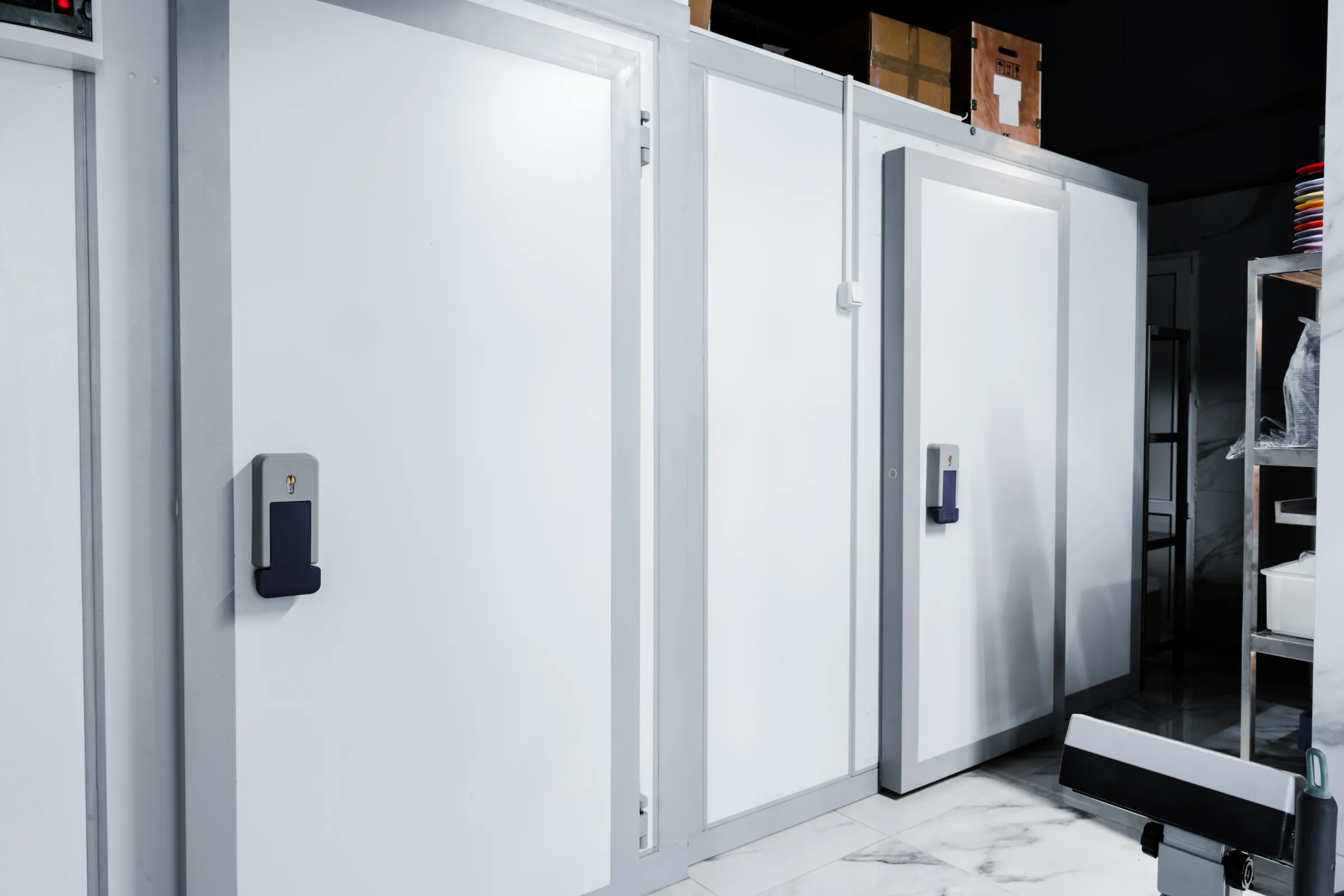
This guide explains how cold storage dehumidification actually works: where the load comes from, why conventional refrigerant dehumidifiers fail at low temperatures, and the ante-room drying method that has become standard practice across food distribution and pharmaceutical cold chains.
Where the Moisture Actually Comes From
Cold air holds very little moisture, which leads many operators to assume a cold room is naturally dry. The physics work the other way. Every time a door opens, warm humid air rushes in at the top of the opening while dense cold air spills out at the bottom. That incoming air immediately contacts surfaces sitting at -18°C or below, and its moisture has nowhere to go except onto those surfaces as frost.
The load concentrates at the dock. Door cycles, truck dock openings, conveyor apertures, and any mechanical ventilation supply the bulk of the moisture. Product respiration, packaging, and personnel add smaller contributions, but a facility that seals its infiltration paths has already removed most of the problem. This is why effective cold storage dehumidification is an air management exercise first and an equipment selection exercise second.
What Uncontrolled Moisture Actually Costs
Frost is the visible symptom. The costs accumulate behind it:
- Evaporator efficiency loss. Ice on coil fins insulates the heat exchange surface and blocks airflow. The refrigeration plant runs longer to hold the same temperature, then burns additional energy on defrost cycles to melt what should never have formed.
- Temperature instability. Every defrost cycle injects heat into the room. Facilities fighting heavy frost often see summer defrost schedules double their winter frequency, with product temperature swinging on every cycle.
- Floor ice and safety exposure. Ice sheets at door thresholds are among the most common slip and vehicle hazards in cold chain operations, and ice falling from ceiling structure is a documented injury risk.
- Operational friction. Fog at doorways cuts visibility for forklift traffic. Frost obscures pallet barcodes, forcing manual scans. Ice removal becomes a recurring labor line.
- Product damage. Frost on packaging degrades cartons and labels, and repeated condensation-freezing cycles compromise product presentation and shelf life.

Why Refrigerant Dehumidifiers Fail in the Cold
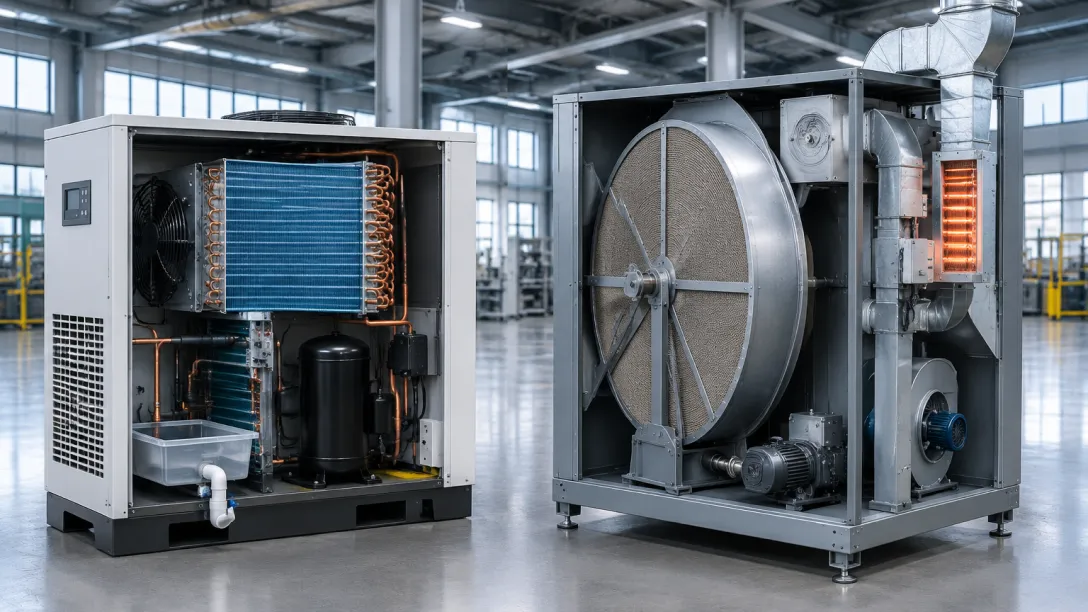
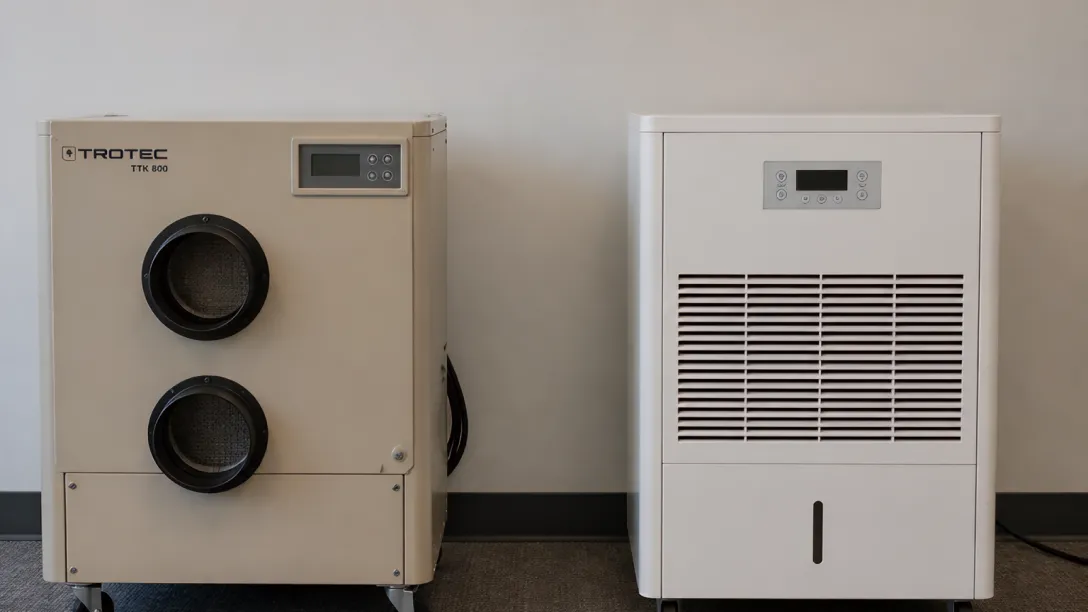
A refrigerant (compressor) dehumidifier works by condensing moisture onto a cold coil. That mechanism is efficient in warm rooms and collapses as temperature falls: the coil ices over, the unit spends its run time in defrost, and moisture removal drops to a fraction of the nameplate figure. Published performance comparisons tell the story directly:
| Dehumidifier Type | Moisture Removal at 20°C, 60% RH | Moisture Removal at 5°C, 60% RH | Practical Lower Limit |
|---|---|---|---|
| Refrigerant (compressor) | ~1.5 kg/h | ~0.2 kg/h | Struggles below 5–10°C; coils ice up; floor of 35–40% RH |
| Desiccant (rotor) | ~1.0 kg/h | ~1.0 kg/h | Stable to -20°C and below; dew points of -20°C and deeper achievable |
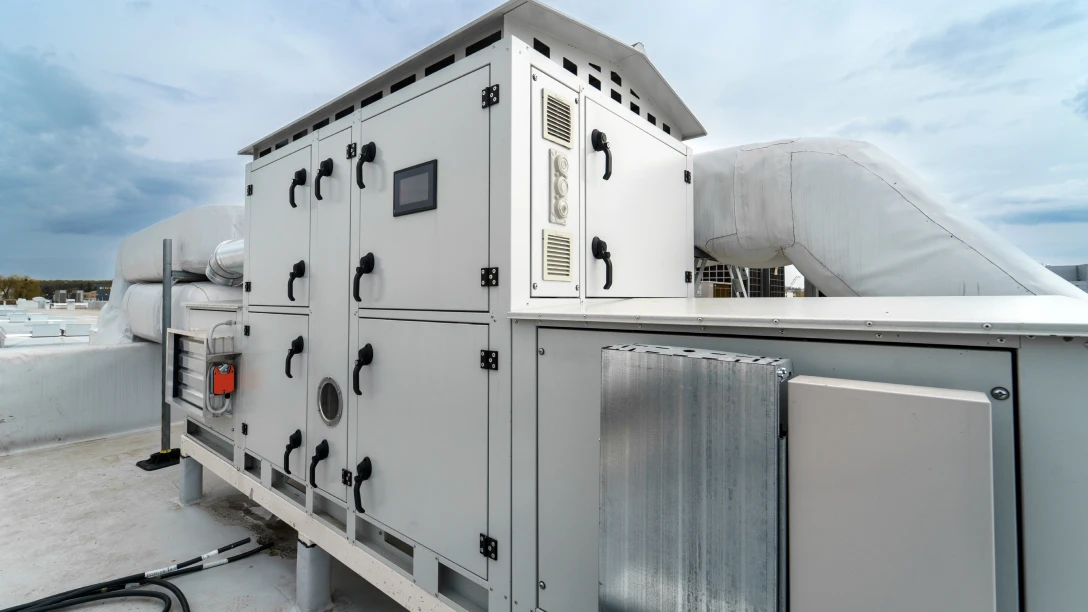
A desiccant dehumidifier removes moisture by adsorption onto a rotating desiccant wheel rather than by condensation, so its performance is essentially independent of room temperature. The same unit that dries a 5°C chiller room will dry the ante-room of a -25°C freezer. The trade-off is regeneration energy: desiccant wheels are reactivated with heat, which makes correct placement and control strategy important. But in genuinely cold spaces, there is no real alternative: refrigerant technology simply stops working.
The Working Method: Dry the Air Before It Enters
The single most important design principle in cold storage dehumidification is counterintuitive: do not put the dehumidifier in the cold room. Trying to dry air that is already inside the chamber means fighting the full infiltration load at the lowest possible temperature, at the worst possible efficiency.
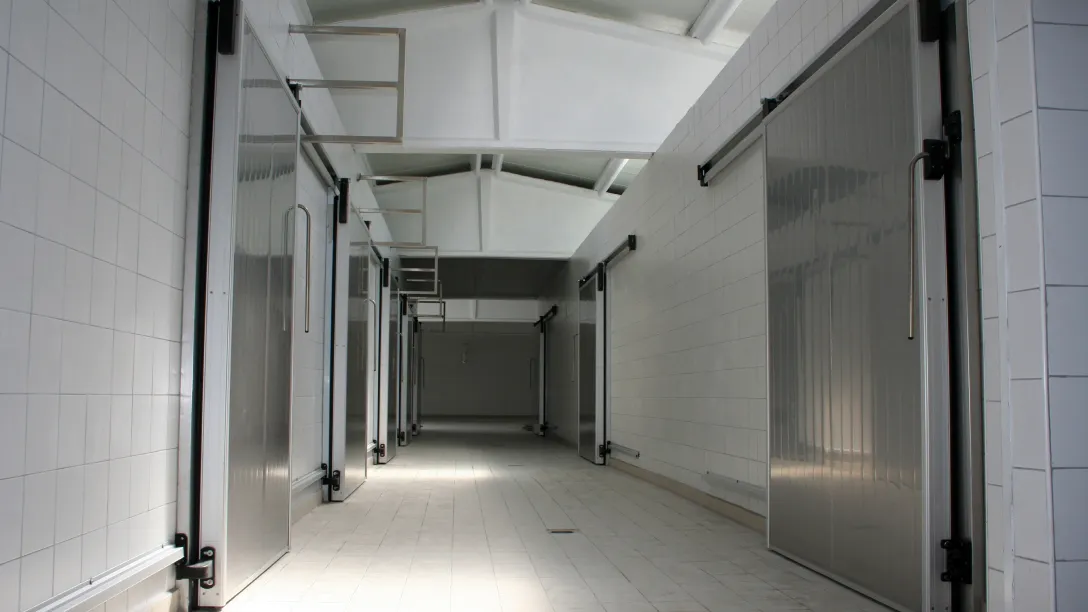
The proven configuration dries the buffer zone instead. A desiccant dehumidifier installed in the loading bay or airlock maintains that space at a controlled humidity, and dry air is ducted to discharge above the cold room doorways. When the door opens and cold dense air spills out along the floor, the air drawn in at the top of the opening comes from that dry curtain rather than from the humid warehouse or dock. Because the incoming air now has a dew point below the temperature of every surface inside the room, frost physically cannot form.
Dew point targets in practice: supplying air at -20°C to -25°C dew point above freezer doors is documented industry practice in supermarket distribution cold chains, with loading bays typically held around 40% RH at 3°C. Applications for freezer and cold room dehumidification are built around exactly this architecture. The same logic protects chilled food storage where condensation on packaging rather than deep frost is the primary concern.
Sizing and Specification Notes
Capacity selection starts with the infiltration load, and the load starts with the doors. The inputs that drive the calculation:
- Door count, size, and opening frequency. A dock door cycling fifty times a shift dominates the load calculation; a rarely opened storage door barely registers.
- Target dew point. Set the supply dew point at least several degrees below the coldest surface temperature in the room. A -25°C freezer calls for supply air near -25°C dew point or lower at the door curtain.
- Ante-room volume and leakage paths. Conveyor apertures, unsealed penetrations, and pressure imbalances all feed moisture past the dried zone.
- Regeneration and exhaust routing. Desiccant regeneration produces a warm, moisture-laden exhaust stream that must be ducted out of the conditioned zone, and the heat input should be accounted for in summer conditions.
Physical infiltration control multiplies the equipment's effectiveness. Strip curtains, fast-acting doors, dock seals, and airlocks reduce the volume of air the dehumidifier must treat, and none of them consume power. For continuous cold chain duty, a high-capacity desiccant system running unattended with dew point control is the standard architecture.
The Measurable Returns
Operators who dry their ante-rooms report the same cluster of results: defrost frequency drops sharply, summer schedules can often revert to winter schedules, and evaporator efficiency and room temperature stability recover, fog at doorways clears, floor ice disappears along with the associated incident reports, and ice removal labor is reallocated. The refrigeration plant stops spending compressor hours freezing infiltrated moisture and then melting it again. Across a multi-site cold chain, those savings compound into a payback that facilities teams consistently describe as attractive rather than marginal.
Get a Cold Storage Moisture Assessment
Send us your cold room temperatures, door count and cycle frequency, dock layout, and a description of the frost or ice symptoms you are seeing. Our engineers will return an infiltration load estimate, a dew point target, and a recommended desiccant configuration with placement layout. Contact the technical team to start the assessment.
Frequently Asked Questions
What causes ice and frost buildup in a cold storage room?
Warm humid air entering through door openings, dock apertures, and ventilation. That air contacts surfaces below freezing and deposits its moisture as frost on coils, walls, ceilings, and floors. Door openings and fresh air ingress account for roughly 90% of the total moisture load in a typical facility.
Can I use a regular refrigerant dehumidifier in a freezer or cold room?
Below about 5–10°C, a refrigerant dehumidifier loses most of its capacity, with measured performance falling from roughly 1.5 kg/h at 20°C to about 0.2 kg/h at 5°C, because its coil ices over and run time goes to defrost. Cold storage requires desiccant dehumidification, which dries by adsorption and holds its performance down to -20°C and below.
What dew point do I need to prevent frost in a freezer room?
The dew point of the air entering the room must sit below the temperature of the coldest surface inside it. For a -25°C freezer, industry practice supplies dry air at -20°C to -25°C dew point above the door openings, which makes frost formation physically impossible regardless of how often the doors cycle.
Should the dehumidifier go inside the cold room?
No. Drying air that is already inside the chamber is the least efficient approach. The standard method dehumidifies the loading bay or airlock and ducts dry air to discharge above the cold room doors, so any air drawn in during door cycles is already too dry to frost.
Does dehumidification really reduce defrost cycles and energy use?
Yes. Most coil frost is frozen infiltration moisture. Remove the moisture before it enters and evaporator coils stay clear, heat transfer efficiency holds, and defrost frequency falls. Operators commonly report returning from summer defrost schedules to winter schedules, with the refrigeration plant's runtime dropping alongside.
What else should I do besides installing a dehumidifier?
Attack infiltration directly: strip curtains or fast-acting doors on high-cycle openings, dock seals, maintained airlocks, and sealed penetrations. Every cubic meter of humid air kept out is air the dehumidifier never has to dry, which shrinks both the equipment size and the running cost.