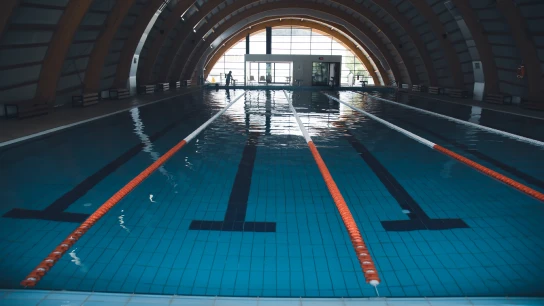
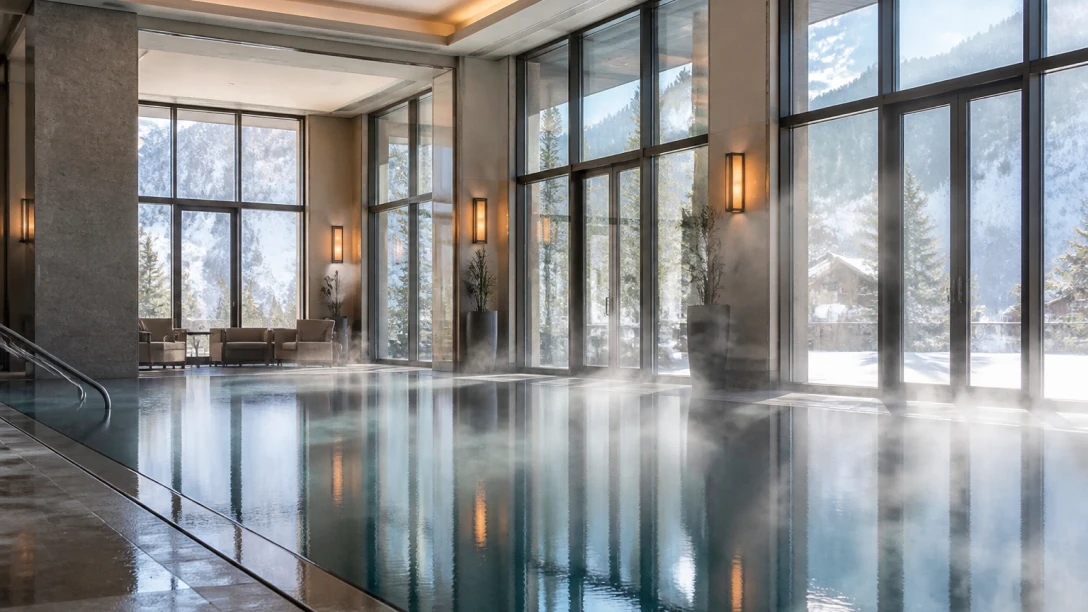
Sizing a dehumidifier for an indoor pool is a moisture-load calculation, not a room-size guess. The pool surface evaporates continuously, 24 hours a day, and that evaporation typically accounts for 60–80% of the total latent load in a pool hall. Get the evaporation number right, add occupant and ventilation moisture, and the correct equipment capacity falls out of the arithmetic.
This guide walks through the standard method used across the natatorium industry, based on ASHRAE Handbook HVAC Applications Chapter 6, with a worked example you can adapt to your own facility.
Why Standard Air Conditioning Cannot Handle a Pool Hall
A typical commercial space has a sensible heat ratio (SHR) of 0.65–0.80, meaning most of the cooling work is temperature reduction. A pool hall runs an SHR of 0.30–0.50. More than half the load is moisture. An air conditioner sized by floor area will drop the air temperature quickly, satisfy its thermostat, and shut off, leaving humidity to climb toward saturation.
The consequences are predictable: condensation on glazing and cold structure, corrosion of steel members and light fittings accelerated by airborne chloramines, mold in concealed cavities, and swollen or delaminating finishes. A dedicated swimming pool dehumidifier is engineered for exactly this profile: high latent removal, heat recovery, and corrosion-protected components.
Set the Design Conditions First
Three setpoints drive everything downstream:
- Air temperature 2–4°F (1–2°C) above water temperature. Warm air raises the room's vapor pressure, which narrows the evaporation driving force at the water surface and keeps bathers comfortable when they leave the pool. A common hotel target is 84°F air over 82°F water.
- Relative humidity 50–60%. Design at 50% RH for winter, when cold envelope surfaces make condensation the binding constraint, and 60% RH for summer, when humid outdoor air adds latent load. Equipment capacity is usually governed by the summer case; glazing selection is governed by the winter case.
- Water temperature by use. Competition pools run 78–80°F, recreational pools 80–82°F, hotel pools 82–84°F, therapy pools 86–94°F, and spas 100–104°F. Every degree of water temperature increases evaporation.
The Core Calculation: Pool Surface Evaporation
The industry-standard evaporation equation from ASHRAE Chapter 6 is:
ER (lb/h) = 0.1 × A × AF × (Pwater − Pair)
Where A is the exposed water surface area in square feet, AF is the activity factor, Pwater is the saturation vapor pressure at the water surface temperature, and Pair is the partial vapor pressure of the room air. The SI form is ER (kg/h) = 0.0457 × A (m²) × AF × (Pwater − Pair) in kPa. Note that pool depth never appears in this equation. Only the surface evaporates, so a 4-foot pool and a 10-foot pool of equal area impose the same load.
The activity factor is the single most influential selection you make. It captures agitation from swimmers, and it scales the load almost linearly:
| Pool Application | Activity Factor (ASHRAE Table 2) |
|---|---|
| Residential pool | 0.5 |
| Hotel pool | 0.8 |
| Public / community pool | 1.0 |
| Competition pool | 1.5 |
| Water park / wave pool / therapy pool | 2.0 |
Choosing 0.5 when the facility really operates at 1.0 undersizes the equipment by half. When in doubt, classify by peak usage, not average usage.
Add the Loads People Forget
Pool evaporation dominates, but three smaller loads decide whether the system holds setpoint on the worst day:
- Occupants. People on the deck release moisture: roughly 0.155 lb/h per seated spectator, 0.205 lb/h at moderate activity, up to 0.53 lb/h for highly active groups. Active swimmers are already captured inside the activity factor, so count deck occupants only.
- Ventilation air. ASHRAE 62.1 calls for 0.48 cfm/ft² over the pool surface, 0.06 cfm/ft² over the deck, plus 7.5 cfm per spectator. In a humid summer climate, this outdoor air can contribute 30–40% of the total latent load. In winter it is dry and actually assists dehumidification.
- Wet surfaces. Damp decks, splash zones, and water features add 5–15% on top of the calculated evaporation.
Worked Example: A Mid-Size Hotel Pool
Take a hotel pool 50 ft × 25 ft, water surface 1,250 ft², water at 80°F, room air at 82°F, summer design at 60% RH, activity factor 0.8, in a humid coastal climate.
The vapor pressure difference between the 80°F water surface and the 60% RH room air is about 0.37 in Hg. Evaporation is therefore 0.1 × 1,250 × 0.8 × 0.37 ≈ 37 lb/h, equivalent to roughly 39,300 BTU/h of latent load. Add 30 guests on the deck at moderate activity (about 6,500 BTU/h) and 900 cfm of humid outdoor air (about 28,800 BTU/h at a 47 gr/lb humidity ratio difference). The total latent load comes to approximately 74,500 BTU/h, or about 70 lb/h of moisture removal duty.
Apply the industry selection margin of 1.05–1.30× and the project calls for a unit rated around 75–90 lb/h at pool-room conditions. That is the capacity class of a commercial pool dehumidifier; larger public or competition facilities move into industrial-rated systems with ducted distribution.
Condensation Control Is an Air Distribution Problem
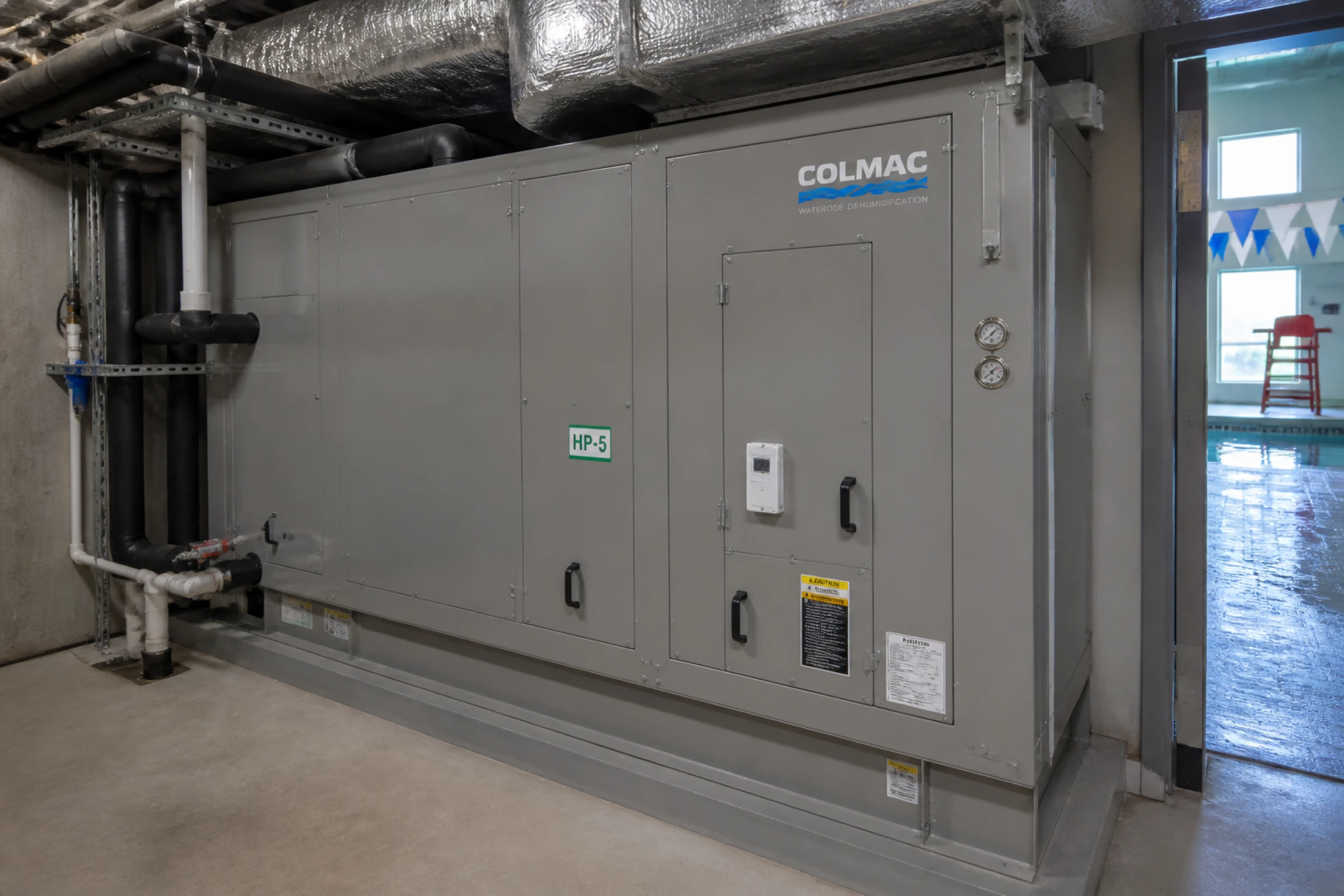
Even a correctly sized unit will fail if dry air never reaches the cold surfaces. Supply air should be directed across exterior glazing and perimeter walls, because those surfaces drop below the room dew point first. Return grilles belong high in the space, where warm humid air accumulates. Rooms with long glass facades or irregular geometry generally need a ducted layout; compact halls can be served by a single ceiling- or wall-mounted indoor pool dehumidifier.
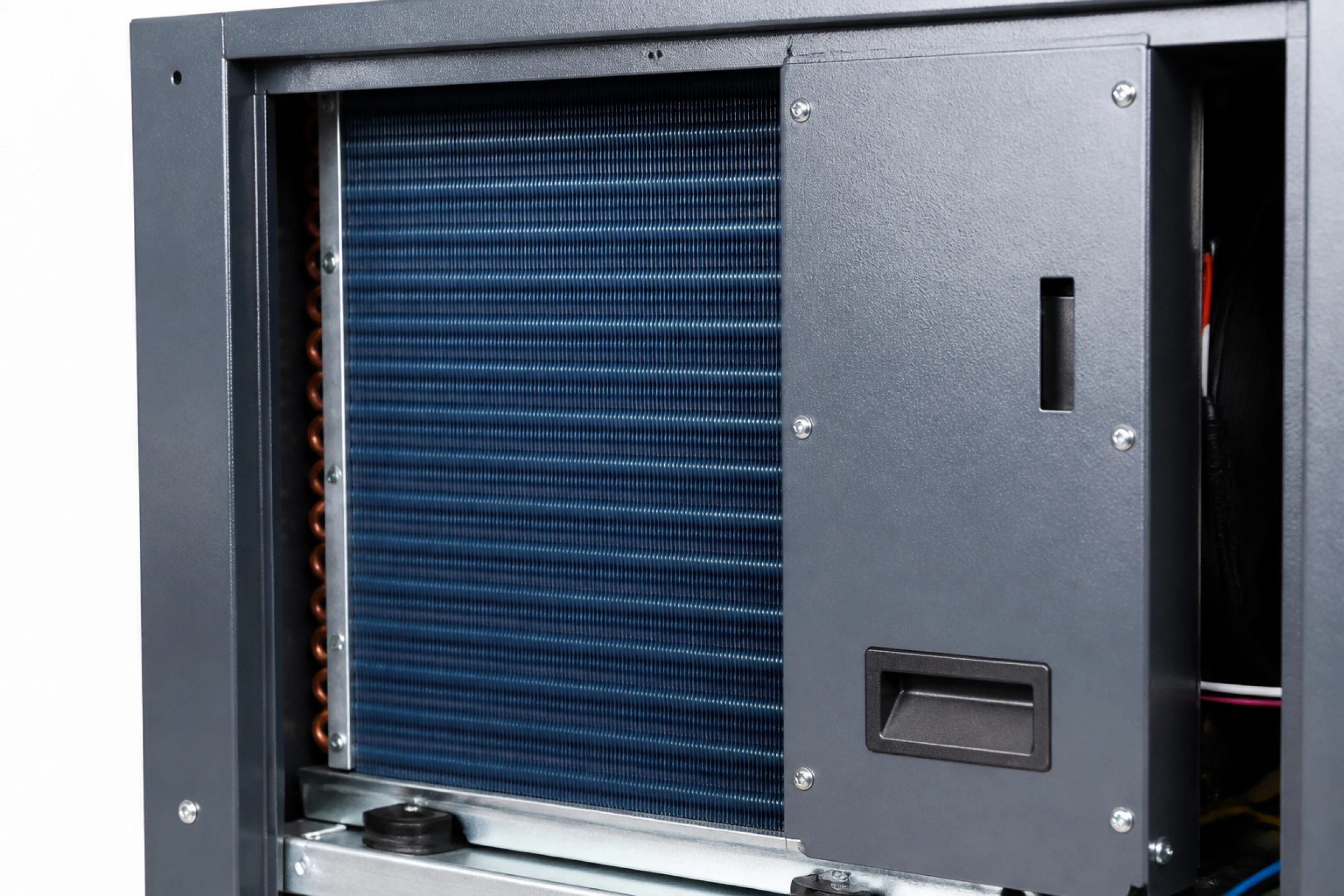
Chloramine-laden air is aggressive to copper, aluminum, and painted steel. Specify epoxy-coated coils and powder-coated or corrosion-protected cabinets as standard; our corrosion-resistant configurations cover the construction details for this duty. The same chemistry that eats equipment attacks roof structure and window frames, which is why holding 50% RH in winter protects the building as much as the machine. Layout guidance for hospitality facilities is summarized on our indoor pool application page.
Cut the Load and the Power Bill
Two measures materially change operating economics. A pool cover used during unoccupied hours cuts evaporation by 60–90%, which shrinks overnight duty and can allow a smaller base unit. And because a refrigeration-cycle dehumidifier condenses water, it rejects heat; ducting that heat back to the supply air is free reheat, and diverting it through a heat exchanger to the pool circuit can cover 30–50% of water heating demand. On a pool evaporating 50 lb/h through a 2,000-hour season, published industry analyses put the recovered energy value around $2,350 per year against electric water heating, which is why heat recovery usually pays for itself inside the first year.
Get a Sizing Calculation for Your Pool
Send us the pool dimensions, water temperature, target room conditions, glazing area, and expected occupancy. Our engineers will return the evaporation calculation, total latent load, and a recommended unit with airflow layout. Contact the technical team to start the calculation for your facility.
Frequently Asked Questions
What humidity level should an indoor pool room be?
Maintain 50–60% RH. Design at 50% for winter so window and wall surfaces stay above the dew point, and allow up to 60% in summer when outdoor ventilation air carries more moisture. Above 60%, condensation and corrosion risk climb quickly; below 50%, pool evaporation and water heating costs increase with little comfort benefit.
How do you calculate what size pool dehumidifier you need?
Use the ASHRAE evaporation equation: ER (lb/h) = 0.1 × pool surface area (ft²) × activity factor × vapor pressure difference between the water surface and room air. Then add occupant moisture, ventilation air load, and 5–15% for wet deck surfaces. Convert the total to moisture removal duty and apply a 1.05–1.30× selection margin.
Can I use a regular air conditioner or comfort dehumidifier in a pool room?
Neither is built for the job. A pool hall's sensible heat ratio of 0.30–0.50 means most of the work is moisture removal, and comfort equipment satisfies its temperature setpoint long before humidity is controlled. Standard units also lack the corrosion protection that chloramine-laden pool air demands, so coils and cabinets fail early.
Why is there condensation on my pool room windows?
The glass surface temperature has fallen below the room air's dew point. The fix combines three measures: hold 50% RH in winter, keep room air 2–4°F above water temperature to slow evaporation, and wash the glazing with supply air so the glass stays warm. If condensation persists, the dehumidification capacity or the air distribution layout needs review.
Does a pool cover really reduce dehumidification costs?
Yes. A cover on the water during unoccupied hours reduces evaporation by 60–90%. Since evaporation is 60–80% of the total moisture load, covering overnight meaningfully shrinks both the dehumidifier's running hours and the pool's water heating bill. Size the system for uncovered occupied hours, but count on the cover for the overnight duty cycle.
Can a pool dehumidifier heat the pool water?
A unit with heat recovery can. The refrigeration cycle releases heat as it condenses moisture, and that heat can be diverted through a heat exchanger into the pool circuit, typically covering 30–50% of water heating demand. Against electric water heating, the recovered energy commonly repays the heat recovery option within a year.