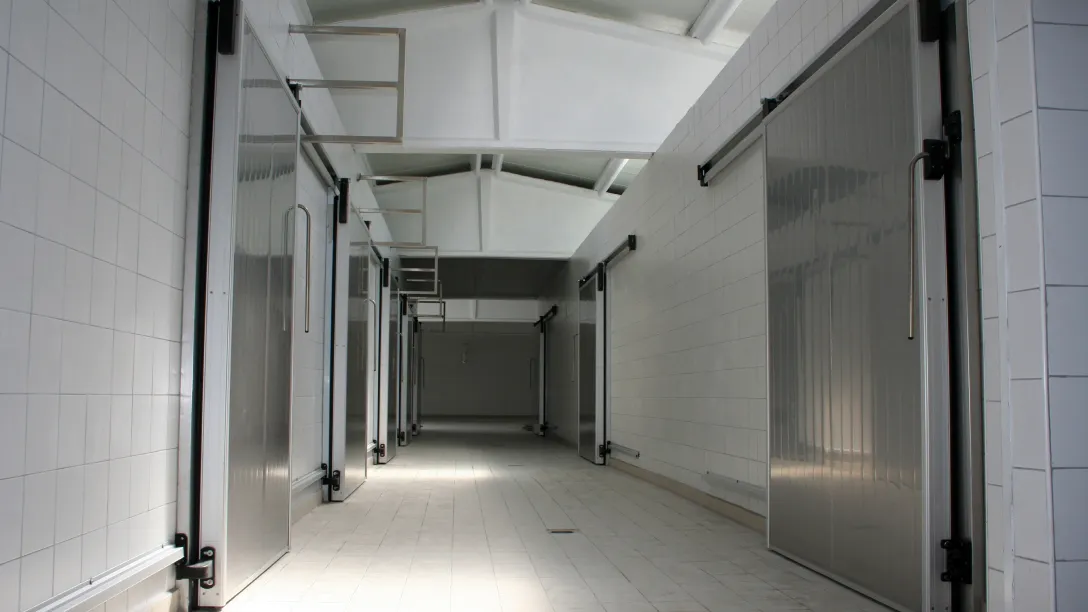
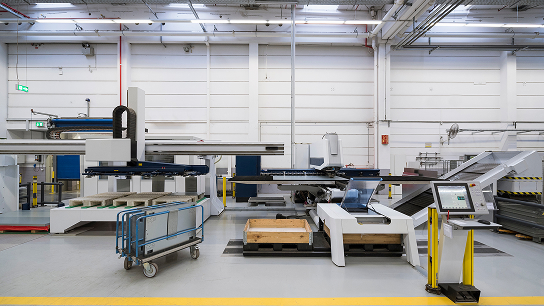
Warehouse humidity damage is slow, quiet, and usually discovered by your customer instead of by you. Cartons arrive with softened corners, metal parts ship with the first bloom of rust, labels lift, and the return or claim lands weeks after the moisture did its work. Industry analyses consistently find that annual losses from humidity damage in storage run three to five times the cost of the dehumidification system that would have prevented them.
This guide covers how to set the right humidity target for what you actually store, why relative humidity alone can still leave you with condensation, and how to size dehumidification for large warehouse volumes using moisture load rather than floor area.
Two Warehouse Types, Two Different Problems
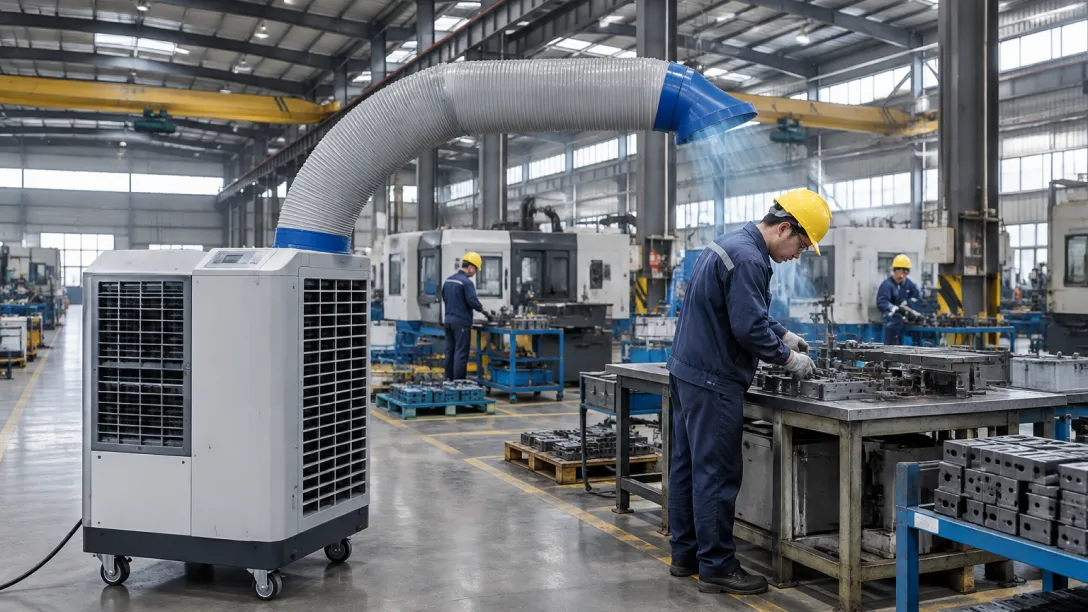
Before any calculation, classify the facility. A passive warehouse, such as archive storage, long-term reserve stock, or museum repositories, sees infrequent access and minimal goods movement. Its moisture load is small and mostly structural, and a modest, stable system holds conditions for years. An active warehouse such as a distribution center, logistics hub, or production buffer cycles dock doors all day. There, infiltration through door openings dominates the load, and the equipment decision starts at the dock, not at the thermostat.
Most sizing failures come from treating an active warehouse like a passive one. The room volume is the same; the moisture burden is not.
What Humidity Actually Does to Stored Goods
Cardboard and paper packaging lose stacking strength as they absorb moisture. Above roughly 65% RH, corrugated board softens measurably, pallets lean, and bottom layers crush. Held at 45–55% RH, cartons retain around 80% of their design strength.
Metal goods and tooling follow a corrosion curve that turns steep above 60% RH and flattens toward zero near 35% RH. That is why steel and cast iron storage specifications call for a maximum of 40% RH, and why "the warehouse felt dry" is not a control strategy.
Electronics and printed circuit boards face corrosion and condensation risk at high humidity and electrostatic risk at very low humidity; the working band for storage is 30–45% RH. Pharmaceutical and hygroscopic goods typically specify 30–40% RH. And across all categories, sustained humidity above 60% supports mold growth on organic materials, which is why the EPA's general guidance is to keep indoor humidity below 60%, ideally 30–50%.
Set the Target by What You Store
| Stored Goods | Recommended RH | Primary Risk Being Controlled |
|---|---|---|
| Steel and cast iron products | Max 40% | Corrosion |
| Aluminum and non-ferrous metals | Up to 50% | Surface oxidation, staining |
| Cardboard packaging and paper goods | 45–55% | Strength loss, deformation, label lift |
| Electronics and PCBs | 30–45% | Corrosion above, ESD below |
| Pharmaceutical and hygroscopic stock | 30–40% | Product degradation |
| General mixed goods | 45–60% | Mold and condensation prevention |
In a mixed-goods facility, set the target by the most sensitive stock in the building, or split the building into zones with separate control. In dry winter climates the problem can also run in reverse: over-dry air below 30% RH raises static and brittleness issues, which is when warehouse humidification enters the specification.
The Condensation Trap: RH Is Not the Whole Story
A documented case makes the point cleanly: a metal products warehouse held a compliant 40% RH, yet condensation still formed on the roof every clear night. The roof sheeting radiated heat to the cold sky, its surface temperature fell below the air's dew point, and water condensed onto stock below a ceiling that "met specification." The control goal had been written as "maintain relative humidity" when the real goal was "prevent condensation on surfaces."
The practical rule: keep the air's dew point at least 2–3°C below the temperature of the coldest surface in the building. Find that surface with an infrared thermometer: roof sheeting, roller doors, cold floor slabs in spring, goods arriving cold from transport. Then set the dew point target from it. This is also why spring is the dangerous season in unheated warehouses: warm humid air moves in while slabs and stock are still cold, and everything sweats.
Sizing: Moisture Load, Not Floor Area
Dehumidifier capacity is a moisture-removal rating, and the correct question is how much water the system must remove per hour under real conditions. The calculation has four parts:
- Volume and infiltration. Calculate volume (area × clear height), then apply an air change assumption: 0.2–0.5 ACH for a tight building, 0.5–1.5 ACH for frequent door activity. Infiltration moisture load = 4.5 × CFM × (Wout − Win), using local summer design conditions rather than annual averages.
- Internal sources. Personnel at roughly 0.2–0.3 lb/h each, wet goods or pallets arriving, washdown, LP-gas forklift combustion, and any open water or wet process.
- Structural moisture. New concrete slabs evaporate construction moisture for months; uninsulated metal envelopes add vapor diffusion load.
- Conversion and margin. 1 lb/h of removal duty equals about 12 pints per day or 24 liters per day of rated capacity. Add a 15–25% margin for door activity peaks and seasonal spikes.
A quick sense-check for warm warehouses above 15°C: light-duty low-traffic buildings run roughly 0.08–0.12 pints/day per square foot, moderate traffic 0.12–0.18, and heavy dock activity 0.18–0.25. A 50,000 ft² distribution warehouse at 0.15 lands near 7,500 pints per day, which in practice means multiple high-capacity dehumidifiers distributed across the floor rather than one large unit. Distribution matters as much as capacity: plan for 3–5 air turnovers per hour, with ceiling-mounted or ducted units to keep aisles and racking from becoming dead zones. Where floor space is at a premium, an industrial warehouse unit with high static pressure can serve long aisles through ducting.
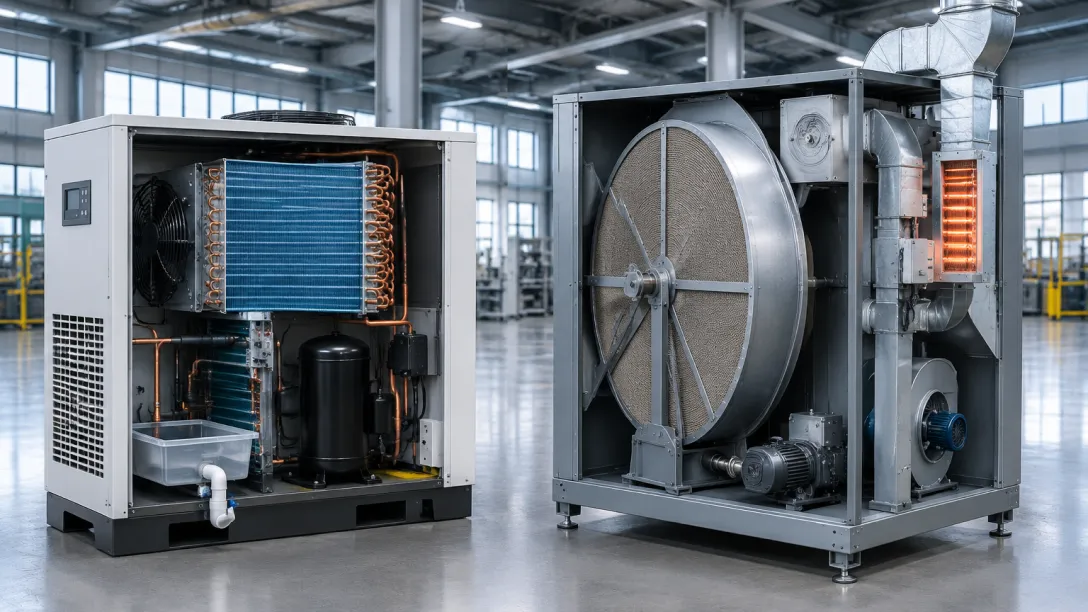
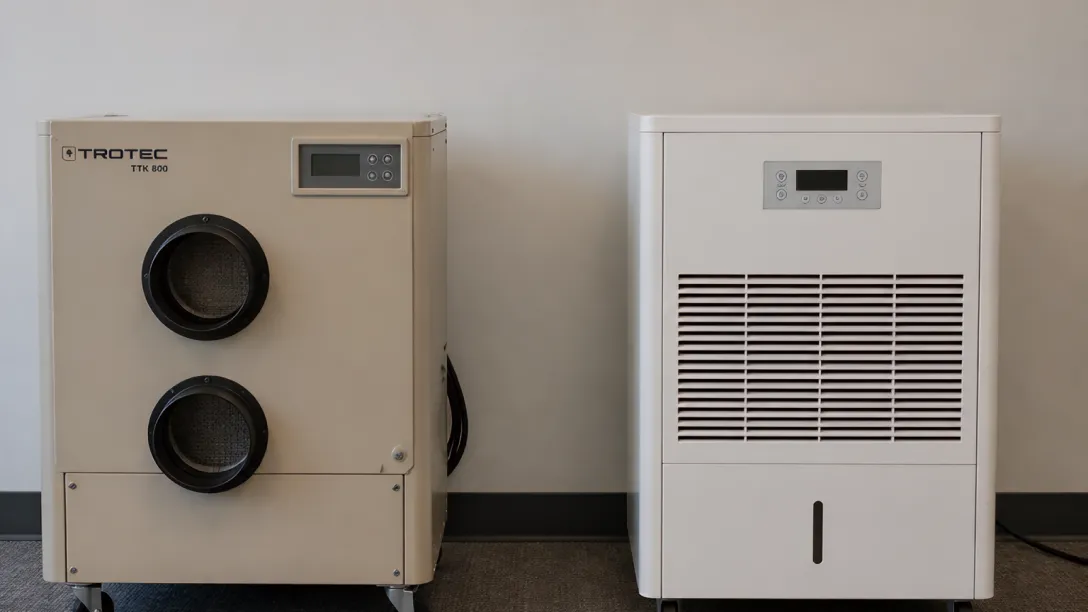
Technology choice follows temperature and target. Refrigerant dehumidifiers are the economical answer above about 10°C. Below that, or where the target runs under 40% RH or is dew point based, refrigerant capacity falls away and a desiccant dehumidifier carries the load. Many large facilities end up hybrid: refrigerant units for the warm season bulk load, desiccant for cold zones and tight targets. Application-specific layouts are covered on our warehouse dehumidification page.
Reduce the Load Before You Buy the Machine
Every cubic meter of humid air kept out of the building is air the dehumidifier never has to dry. Dock seals and shelters, strip curtains on high-cycle doors, disciplined door-closing policy, sealed envelope penetrations, and drainage that keeps ground moisture away from the slab all shrink the infiltration term in the sizing equation. In an active warehouse, these measures routinely pay back faster than the equipment itself.
Get a Moisture Load Assessment for Your Warehouse
Send us the building dimensions, what you store, door count and daily cycles, and the symptoms you are seeing, such as soft cartons, rust bloom, condensation, or mold odor. Our engineers will return a moisture load estimate, a target specification, and an equipment layout with zoning. Contact the technical team to start.
Frequently Asked Questions
What humidity level should a warehouse be?
It depends on what you store. General mixed goods are safe at 45–60% RH. Cardboard and paper hold their strength at 45–55%. Steel storage calls for a maximum of 40%, electronics 30–45%, and pharmaceutical stock 30–40%. In a mixed facility, set the target by the most sensitive goods or create separate controlled zones.
At what humidity does metal start to rust in storage?
Corrosion accelerates measurably above 60% RH and falls toward zero as humidity approaches 35%. That is the engineering basis for the common 40% RH maximum specified for steel and cast iron storage. Temperature swings matter as much as the average: a cold metal surface can condense moisture even when room RH looks compliant.
Why is there condensation in my warehouse even though humidity seems controlled?
Because surfaces, not air, condense water. Roof sheeting radiating to a clear night sky, cold floor slabs in spring, and goods arriving cold from transport can all sit below the air's dew point while the RH reading looks fine. Control dew point instead: hold it at least 2–3°C below the coldest surface temperature, verified with an infrared thermometer.
How do I calculate what size dehumidifier a warehouse needs?
Size by moisture load: building volume times an infiltration rate (0.2–0.5 ACH tight, up to 1.5 ACH for active docks), plus internal sources like personnel, wet goods, and washdown, converted at roughly 12 pints per day per lb/h of load, with a 15–25% margin. As a quick check, warm warehouses run 0.08–0.25 pints/day per square foot depending on dock activity. Floor area alone is not a sizing method.
Refrigerant or desiccant dehumidifier for a warehouse?
Refrigerant units are the economical choice above roughly 10°C with moderate RH targets. Choose desiccant for cold or unheated buildings, targets below 40% RH, or dew point-based condensation control, since refrigerant capacity collapses at low temperature. Large or mixed facilities often run both.
Will a dehumidifier fix existing mold in a warehouse?
No. Dehumidification stops the conditions mold needs to grow, namely sustained humidity above about 60%, but existing growth must be cleaned and the affected material assessed separately. The equipment prevents recurrence; it does not remediate.