Ask a grower what humidity their greenhouse runs and you will get a relative humidity number. Ask a plant the same question and the answer is vapor pressure deficit. RH alone misleads because the same 70% reading means aggressive transpiration at 28°C and near-stagnation at 18°C. VPD combines temperature and humidity into the single number that actually drives how a crop drinks, feeds, and resists disease. Managing a greenhouse by VPD rather than by RH is the difference between reacting to climate and controlling it.
This guide explains how VPD works as a control variable, the targets that apply by growth stage, why the night period decides your disease pressure, and how to choose between ventilation and mechanical dehumidification on energy grounds.
Why VPD, Not Relative Humidity
Vapor pressure deficit is the gap between the moisture currently in the air and the maximum the air could hold at its current temperature. That gap is the engine of transpiration: the larger the deficit, the faster the plant pulls water and dissolved nutrients from the root zone and releases moisture through its leaves. Transpiration is how the crop feeds itself and how it cools itself.
For most greenhouse crops, the workable band runs from about 0.4 kPa to 1.6 kPa. Below 0.4 kPa the air is too humid: transpiration stalls and fungal disease pressure builds. Above 1.6 kPa the air is too dry: the plant transpires faster than its roots can supply, closes its stomata, and shuts down photosynthesis to protect itself. The healthy middle shifts with the crop and its growth stage, but the boundaries are consistent.
The Two Failure Modes
Too humid: the crop stops feeding and disease moves in. When VPD collapses toward zero, transpiration slows or stops, and with it the transport of calcium to young leaves and developing fruit. The result is tip burn in lettuce and blossom end rot in tomatoes and peppers, appearing in crops whose nutrient solution is perfectly formulated. At the same time, humid air cooling to its dew point deposits free water on leaves, flowers, and glazing. Botrytis and powdery mildew need exactly that surface moisture to germinate.
Too dry: the crop defends itself by stopping growth. When VPD spikes, stomatal closure protects the plant from desiccation at the cost of carbon uptake. Growth stalls, leaf edges scorch, and hot dry conditions accelerate pests such as spider mites. Propagation houses see it first: unrooted cuttings and seedlings have no root system to support aggressive transpiration, which is why young plant areas demand the lowest VPD in the facility.
VPD Targets by Growth Stage
The bands below are the widely used working targets for greenhouse and indoor production. Exact optima vary with species, cultivar, and light intensity, but the progression is universal: low VPD for young plants, rising steadily as the canopy matures and fruit load develops.
| Growth Stage | Target VPD (air) | Why |
|---|---|---|
| Propagation / seedlings / clones | 0.4–0.8 kPa | Weak or absent roots cannot support transpiration; low VPD prevents desiccation |
| Vegetative growth | 0.8–1.2 kPa | Drives steady transpiration and nutrient flow for leaf and stem development |
| Flowering / fruiting | 1.2–1.6 kPa | Higher VPD helps dense flowers and fruit shed moisture, suppressing mold in the canopy |
Serious VPD control also accounts for leaf temperature, which typically runs a few degrees below air temperature under lights or strong sun. Leaf VPD, calculated at the leaf surface rather than in the air, is the more precise number. Either way, the discipline is the same: pick the target, then hold temperature and humidity together to hit it.
The Night Decides Your Disease Pressure
Daytime humidity problems are visible and manageable. The damage is done at night. Transpiration all day loads the air with moisture; after sunset the glazing radiates heat to the cold sky, crop surfaces cool below the air around them, and humid air condenses on whatever surface drops to the dew point first. Once free water sits on a leaf or flower, the infection clock starts. Extension guidance across greenhouse crops converges on one rule: keep the canopy dry from dusk to dawn.
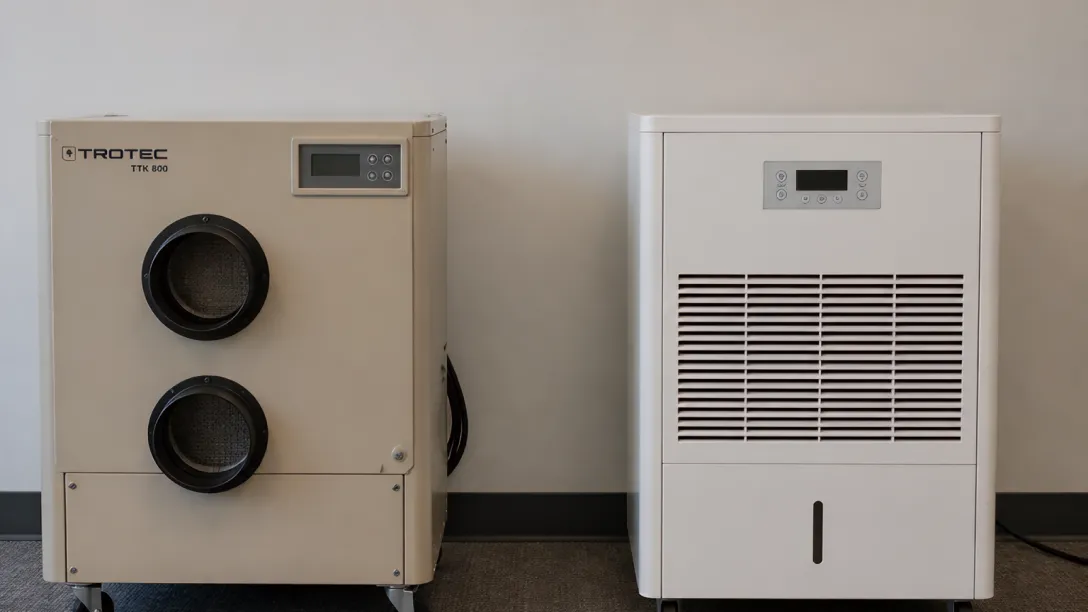
The measured impact of night dehumidification is significant. In a controlled study on tomato solar greenhouses, mechanical condensation dehumidification held night RH near 80%, roughly 14 percentage points below untreated houses, shortened the nightly duration above the 85% RH danger line, and cut Botrytis disease index by 85% and disease incidence by 74%. Few chemical programs deliver numbers like that, and this one works by physics rather than chemistry. Dedicated greenhouse dehumidification equipment exists precisely because the night load is a machinery problem, and application layouts for greenhouse humidity control are built around the dusk-to-dawn duty cycle.
Dehumidify or Ventilate: Run the Energy Arithmetic
The traditional humidity fix is heat-and-vent: open the vents, dump the humid air, heat the incoming cold air, repeat two or three times an hour through the evening. It works, and every grower should know how to do it. It also throws away everything you paid to put into that air: the heat, and in enriched houses, the CO2. Ventilation defeats enrichment, which is why sealed CO2 operations cannot rely on it.
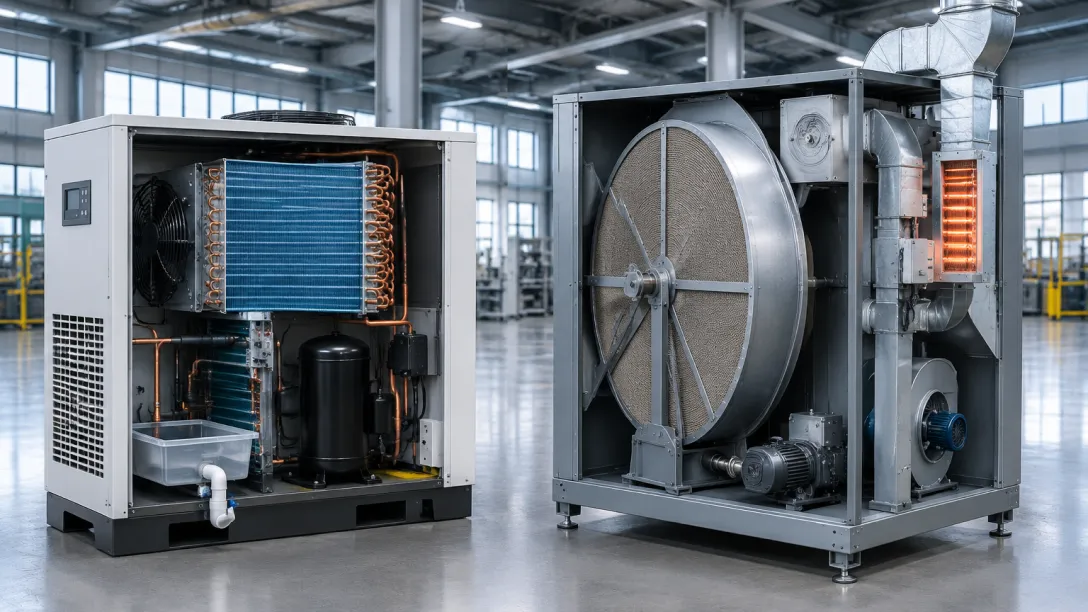
A season-long energy study on a 1,037 m² Venlo tomato greenhouse quantified the choice. The baseline house needed 310 kWh/m² of climate energy. Controlling humidity by ventilation alone pushed that to 440 kWh/m², an increase of 42%. Mechanical dehumidification with heat recovery brought it down to 237 kWh/m², 24% below the baseline, while holding humidity stable. The mechanism is simple: a greenhouse dehumidifier removes moisture by condensing it, and the electricity it consumes plus the latent heat it recovers stays inside the house as usable heat. The condensate it produces is effectively distilled water, which many operations route back to irrigation.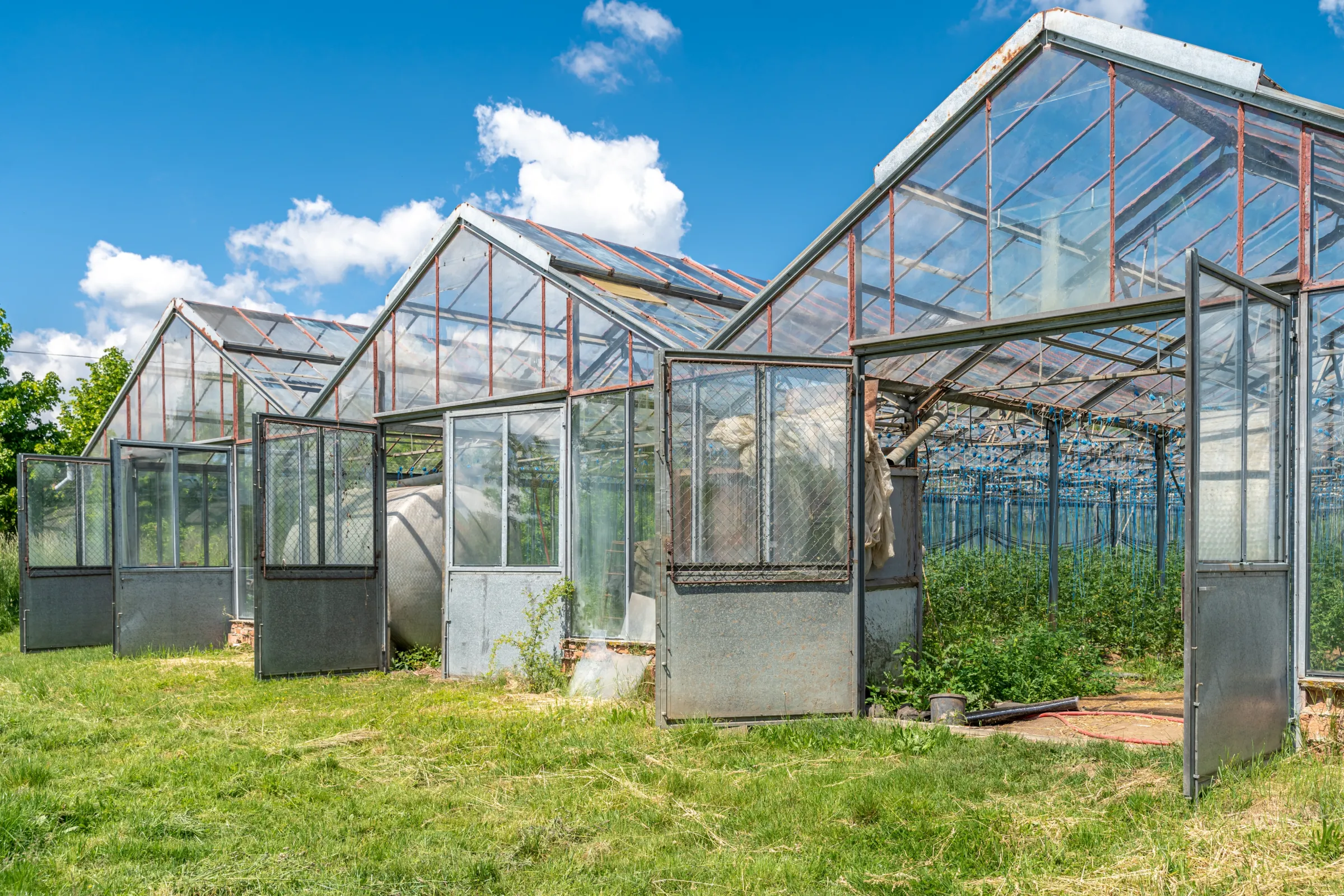
Ventilation still owns certain hours: hot humid days when the house needs cooling and moisture removal together, and mild dry days when outdoor air is a free resource. The efficient strategy blends both against a VPD target rather than treating either as the whole answer. Canadian trials comparing the approaches found mechanical dehumidification effective year-round with total energy use lowest among the options, dehumidification running cost around 10% of annual heating cost, and crop loss reductions that paid for the difference.
Humidification Has Its Place Too
The mirror problem appears in propagation areas and in hot dry climates, where VPD runs too high. The correction is controlled fog: fine droplets that evaporate in the air and pull VPD down without wetting leaf surfaces. Trials in naturally ventilated greenhouses found fogging above the canopy brought VPD from a stressful 2.17 kPa back to 0.97 kPa, inside the optimal band. The same dry fog principle used in industrial humidification applies here, and greenhouse humidification systems sized for propagation and nursery duty hold young plants in their 0.4–0.8 kPa window through the vulnerable early weeks.
A Practical Control Checklist
- Measure at canopy height. A sensor at the ridge reads a different climate than the crop lives in. Place temperature-humidity sensors in the canopy and log continuously.
- Move air horizontally. HAF fans break the stagnant boundary layer at leaf surfaces and eliminate the cold wet corners where condensation starts.
- Purge before sunset. Vent accumulated daytime moisture and pull RH below about 80% before closing screens and vents for the night; trapping moist air under a closed screen is an invitation to condensation.
- Keep crop surfaces above dew point. Modest pipe heating through the night costs less than the disease it prevents.
- Time irrigation early. Water in the morning so foliage dries before night cooling, and avoid late-afternoon overhead watering entirely.
- Calibrate the instruments. A VPD calculated from a drifted sensor is a wrong number executed with confidence. Verify sensors on a schedule.
Get a Humidity Plan for Your Greenhouse
Send us your greenhouse dimensions, crop and growth stage, heating and ventilation setup, and the symptoms you are seeing, whether that is Botrytis pressure, tip burn, or unstable VPD. Our engineers will return a moisture load estimate and an equipment recommendation matched to your night duty cycle. Contact the technical team to start.
Frequently Asked Questions
What humidity should a greenhouse be?
Most crops do well between 60% and 85% RH during the day, but RH alone is the wrong control number. The same RH drives very different transpiration at different temperatures. Control to VPD instead: roughly 0.4–0.8 kPa in propagation, 0.8–1.2 kPa in vegetative growth, and 1.2–1.6 kPa through flowering and fruiting.
What is a good VPD for greenhouse crops?
The workable band for most crops is 0.4 to 1.6 kPa. Below 0.4 kPa, transpiration stalls, calcium transport fails, and fungal disease pressure builds. Above 1.6 kPa, plants close their stomata and growth stops. Exact targets vary by crop and stage, so treat the band as the boundary and the stage table as the starting point.
Why does my greenhouse get condensation at night and how do I stop it?
The glazing and crop surfaces radiate heat to the night sky and cool below the dew point of the humid daytime air. Prevention is a sequence: purge moisture with a short vent cycle before closing up, keep air moving through the canopy with horizontal fans, hold modest heating overnight to keep surfaces above dew point, and run mechanical dehumidification through the dusk-to-dawn window when ventilation is not practical.
Is a dehumidifier better than venting for greenhouse humidity control?
For night control and for CO2-enriched houses, yes on energy grounds. A season-long Venlo tomato study measured 440 kWh/m² for ventilation-only control against 237 kWh/m² for dehumidification with heat recovery, a 24% saving below the uncontrolled baseline. Ventilation remains the right tool on hot humid days when cooling and drying are needed together. Most efficient operations blend both against a VPD target.
Can high humidity really cause calcium deficiency when my nutrient solution is correct?
Yes. Calcium moves with transpiration flow. When humidity is high and VPD collapses, transpiration slows and calcium never reaches young leaves and developing fruit, producing tip burn and blossom end rot despite a perfectly formulated feed. The fix is atmospheric: restore transpiration by bringing VPD back into range.
Can I reuse the water a greenhouse dehumidifier collects?
Yes. Dehumidifier condensate is effectively distilled water, and commercial operations commonly route it back into irrigation storage. On a house removing hundreds of liters per night, the recovered water is a meaningful offset to irrigation demand as well as a humidity control benefit.