Data center cooling receives most of the engineering attention in facility design, but humidity control causes a disproportionate share of hardware failures. Relative humidity that drifts too low raises the frequency of electrostatic discharge events that damage memory modules and network interfaces. Humidity that drifts too high, or air that contacts surfaces below the dew point, drives condensation and corrosion on copper traces and silver solder contacts. Both failure modes are invisible until equipment starts returning errors.
This guide covers the humidity limits defined by ASHRAE thermal guidelines, the mechanisms that push a server room out of compliance, and the humidification and dehumidification technologies used to hold the envelope. It reflects the conditions our engineers encounter when specifying data center cooling and humidity control systems for colocation facilities, enterprise server rooms, and edge sites.
What Humidity Does to IT Hardware
Electrostatic discharge risk rises sharply as relative humidity falls. At 20% RH, a person walking across a raised floor can accumulate a charge of several thousand volts; at 40% RH the same activity produces a fraction of that charge. Dry air does not generate static, but it removes the thin moisture film on surfaces that allows charges to dissipate safely. The result is a higher rate of latent ESD damage: components weakened by a discharge that fails weeks later, logged as an unexplained hardware fault.
At the upper end of the scale, the mechanism is different. Moisture itself does not corrode energized electronics at 60% or even 70% RH, provided every surface stays above the dew point. The damage starts when humid air reaches a cold surface, such as the inlet of a server fed by an underfloor plenum or a chilled supply duct, and condensation forms. Once liquid water films appear, ionic contamination on the board becomes conductive, and copper and silver corrosion accelerates. Gaseous pollutants such as sulfur compounds, common in urban air, compound the effect at high humidity.
The ASHRAE Envelope in Practice
ASHRAE Technical Committee 9.9 publishes the thermal guidelines that most IT equipment warranties reference. The recommended envelope for class A1 to A4 equipment is deliberately narrow, while the allowable envelopes give operators room for short excursions and economizer strategies.
| Parameter | Recommended Envelope | Notes |
|---|---|---|
| Supply air temperature | 18°C to 27°C | Measured at IT equipment inlet |
| Dew point | -9°C to 15°C | Absolute moisture limit, independent of temperature |
| Relative humidity | Maximum 60% | RH alone is not a valid control variable; dew point governs |
| Rate of temperature change | Under 5°C per 15 minutes for tape storage | Prevents condensation during rapid load swings |
Two practical points follow from the table. First, control should be based on dew point, not relative humidity alone, because RH at the server inlet changes with every temperature adjustment even when the actual moisture content of the air is unchanged. Second, the recommended envelope translates to roughly 40% to 60% RH at typical inlet temperatures, which is why the 40% to 55% band remains the working setpoint range in most facilities.
How Server Rooms Lose Humidity Control
Humidity excursions in a sealed data center trace back to a small set of causes. Infiltration through door openings, cable penetrations, and an unsealed building envelope carries outdoor moisture in or out; in winter, cold outdoor air holds almost no water vapor, so every air exchange dilutes room humidity. A missing or damaged vapor barrier in walls and raised floors makes this exchange continuous rather than episodic.
The second cause sits inside the cooling system itself. A precision air conditioner that overcools air to satisfy a temperature call will condense moisture on its coil and dehumidify the room as a side effect, even when humidity is already low. Facilities then run humidifiers to replace the water their cooling units just removed, paying for the same moisture twice. Correctly matched sensible cooling capacity, or dedicated industrial precision air conditioner units with independent temperature and humidity control loops, eliminates this conflict.
Humidification Technologies Compared
Ultrasonic Humidification
Ultrasonic humidifiers use piezoelectric transducers vibrating at high frequency to break water into a fine aerosol of 1 to 5 micron droplets, which evaporate into the airstream almost instantly. The technology has two decisive advantages in data centers. Energy consumption is a small fraction of electrode or resistive steam generation, because no boiling is involved, and the evaporation absorbs heat from the air, delivering a small adiabatic cooling credit against the cooling load. An industrial ultrasonic humidifier sized for the room can therefore reduce both the humidification energy bill and the compressor runtime.
The operating requirement is water quality. Ultrasonic units aerosolize whatever is dissolved in the supply water, so reverse osmosis or deionized feed is mandatory to prevent mineral dust settling on equipment. With proper pretreatment, maintenance reduces to transducer cleaning on a scheduled interval.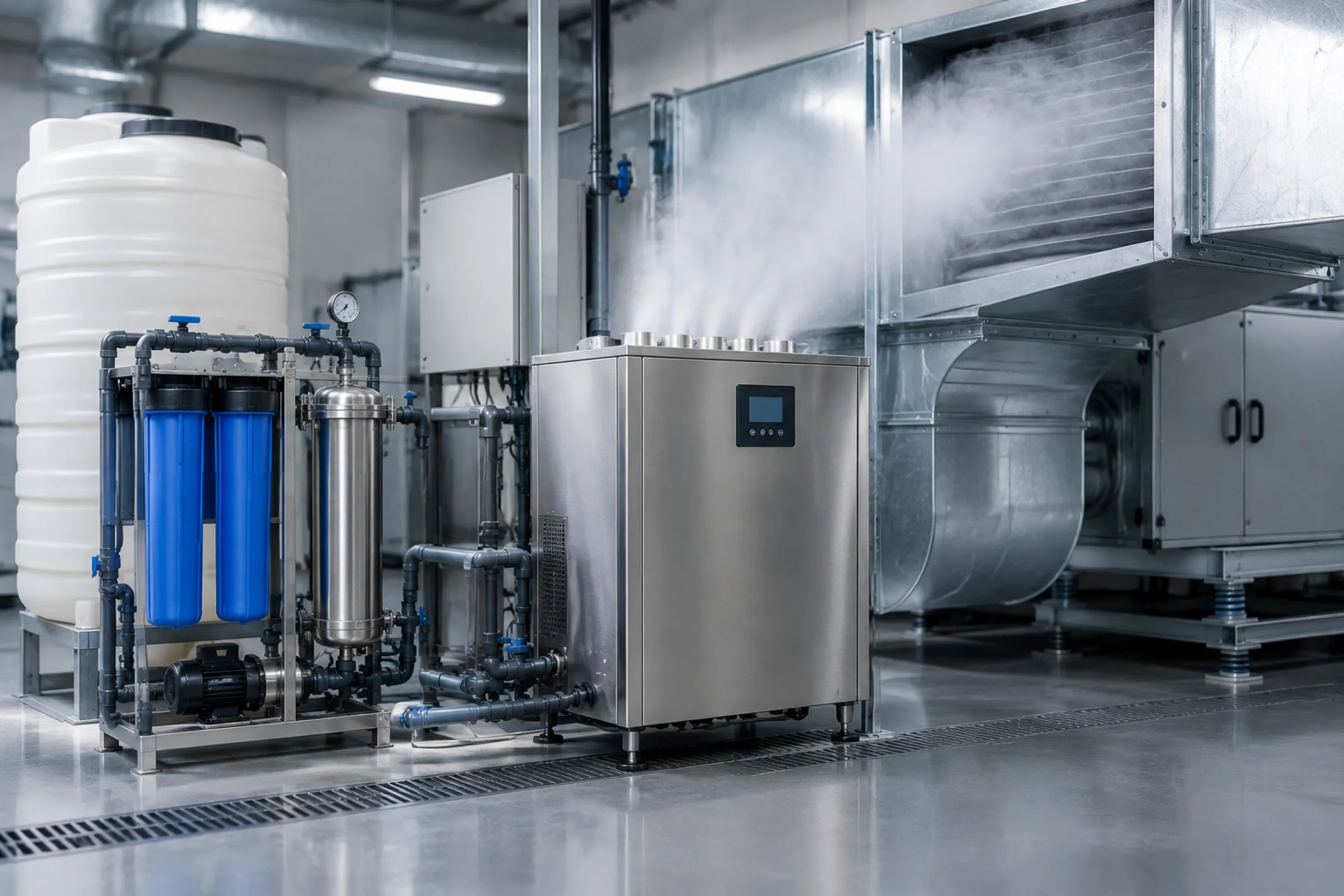
Evaporative Humidification
Evaporative systems pass air through a wetted media and add moisture without generating droplets, which makes them tolerant of ordinary treated water and immune to white dust. Energy use is similarly low. The trade-offs are a larger physical footprint, periodic media replacement, and the need for biocidal water treatment to keep the wetted surfaces clean. For new builds with space in the air handler, evaporative sections integrate well; for retrofits and distributed humidification, ultrasonic units are usually the practical choice. Both options are covered on the ultrasonic humidifier category page and in our application notes for electronics manufacturing, where the same ESD physics applies.
Dehumidification and Combined Control
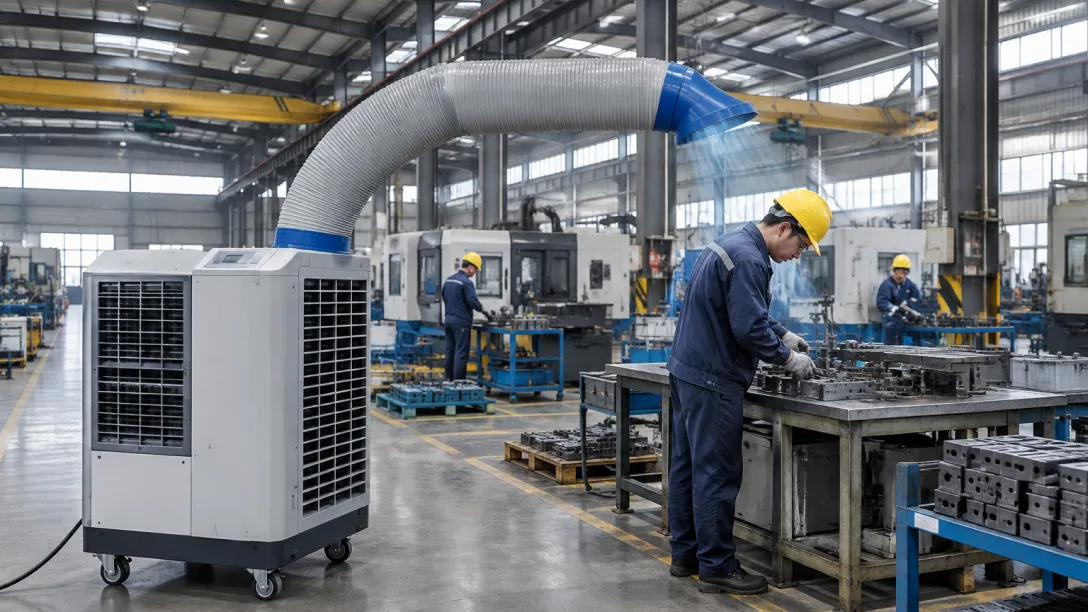
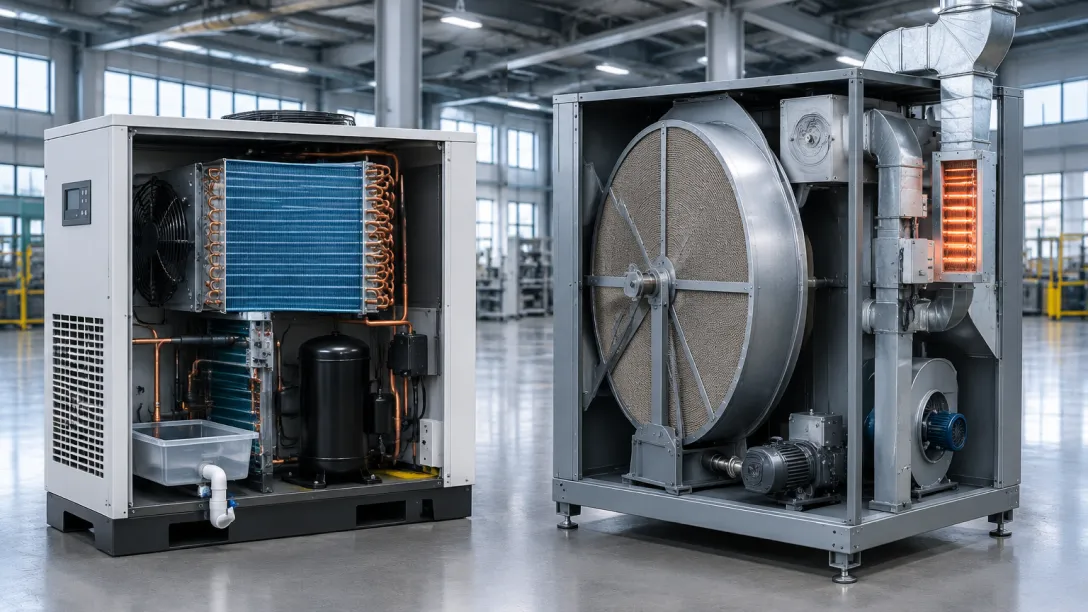
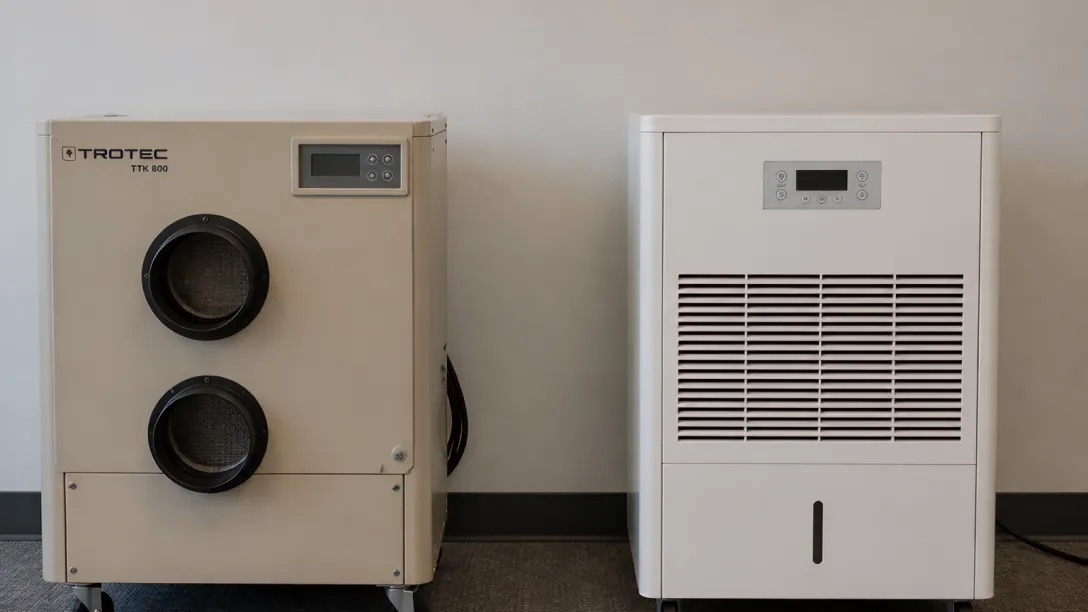
Dehumidification demand in data centers is concentrated in humid climates and in facilities with high outdoor air fractions. Where a room requires both functions across the year, a humidifier-dehumidifier combo unit consolidates both into one control platform and one cabinet, which simplifies the control logic and removes the risk of the two functions fighting each other. For edge sites and small server rooms where a full precision system is oversized, a server room spot cooler handles the thermal load while a compact humidifier holds the lower RH limit.
Seasonal Control Strategy
Humidity load in a data center is not constant across the year, and the control plan should reflect the two opposing seasons. Winter operation is a humidification problem: outdoor air at -5°C and 80% RH holds so little water vapor that, once heated to 24°C, its relative humidity falls below 10%. Every cubic meter of ventilation or infiltration air dilutes room moisture, and the humidification system carries its peak load during the coldest weeks. Summer operation inverts the problem. Outdoor air in humid climates arrives carrying 15 to 20 grams of water per kilogram of dry air, and any infiltration or fresh air intake becomes a dehumidification load that lands directly on the cooling coils.
Facilities with air-side or water-side economizers face an additional transition risk. When the economizer opens to admit cool outdoor air, the room dew point can swing several degrees within minutes. Control logic should verify that incoming air falls inside the dew point envelope before increasing the outdoor air fraction, and should ramp the exchange gradually enough for the humidification or dehumidification equipment to track the change.
Monitoring and Redundancy Requirements
Humidity sensors in data centers fail quietly; a drifting sensor looks identical to a stable room. Specify at least two independent dew point or RH sensors per room, located at representative rack inlets rather than on walls, with calibration on an annual cycle. Alarm thresholds should sit inside the control band: if the setpoint is 45% RH with a ±5% control range, alarms at 35% and 65% give operators time to respond before the envelope is breached.
Redundancy follows the same logic as cooling. A single humidifier is a single point of failure during winter, when outdoor air at -5°C and 80% RH delivers almost no moisture after heating to room temperature. N+1 humidification capacity, or at minimum a spare transducer set and media stock on site, keeps a component failure from becoming an ESD event.
Specification Checklist
- Define the control variable: dew point primary, RH secondary, with setpoints documented against the ASHRAE recommended envelope.
- Calculate the humidification load: infiltration plus ventilation air, evaluated at winter design conditions for the site.
- Audit the cooling units: confirm that temperature control is not forcing continuous dehumidification.
- Select the technology: ultrasonic for distributed retrofit and energy efficiency, evaporative for central air handler integration; steam only where the other two cannot meet the duty.
- Specify water treatment: RO or DI feed for ultrasonic, biocidal treatment for evaporative media.
- Instrument and alarm: dual sensors at rack inlets, annual calibration, alarm thresholds inside the control band.
Our engineering team performs the load calculation and equipment selection as part of every quotation. Send your room layout, cooling configuration, and site design conditions through the contact page, and we will return a sized humidity control schedule with the load figures documented.