Commercial construction and large-scale property restoration operate under strict financial timelines. In these sectors, schedule overruns directly translate to massive capital losses, liquidated damages, and delayed facility commissioning. The primary biological and physical bottleneck preventing the advancement of interior finishing phases—specifically flooring installation, millwork, and painting—is latent structural moisture. Thousands of gallons of water are physically introduced into a building's envelope during the pouring of concrete slabs and the application of drywall joint compound. This trapped water must be mechanically evacuated from the structure.
Relying on natural evaporation via open windows or standard HVAC systems is a catastrophic engineering miscalculation. Natural drying fluctuates wildly with external weather conditions and often requires months to reach acceptable material moisture thresholds. Furthermore, operating a building's permanent HVAC system to dry construction dust and moisture voids equipment warranties and guarantees premature coil failure. Project managers eliminate this bottleneck by deploying active, specialized climate control. This technical paper details the thermodynamics of construction materials, the calculation of vapor pressure differentials, and the specific equipment sizing protocols required to accelerate construction schedules using industrial dehumidification.
The Thermodynamics of Concrete Moisture and ASTM Compliance
Concrete is a porous matrix composed of Portland cement, aggregates, and water. The chemical process of hydration—where cement reacts with water to form the solid structural matrix—consumes only a fraction of the total water introduced during the mixing phase. The remaining water, known as the "water of convenience," is added strictly to ensure the physical workability and flow of the wet concrete during the pour. Once the slab sets, this massive volume of excess water remains trapped within the capillary network of the concrete.
Industry standard drying times dictate that concrete requires approximately 30 days of natural drying per inch of slab thickness to reach equilibrium. For a standard 6-inch commercial slab, this equates to six months of waiting before non-permeable flooring (such as epoxy, vinyl composition tile, or engineered hardwood) can be safely installed. If flooring is applied over a wet slab, the trapped moisture vapor attempts to escape upward, generating massive hydrostatic pressure. This pressure chemically breaks down flooring adhesives, causes osmotic blistering in epoxy coatings, and leads to catastrophic flooring delamination.
Flooring manufacturers strictly enforce warranty compliance through standardized moisture testing, specifically the ASTM F2170 standard. This protocol involves drilling holes into the slab and inserting in-situ relative humidity (RH) probes. Most modern adhesives require the internal slab RH to register below 85%, and sometimes as low as 75%. To forcefully accelerate this moisture emission and meet ASTM testing deadlines, contractors must isolate the slab and deploy a high-capacity dehumidifier. By radically suppressing the ambient humidity in the room, the equipment creates a severe vapor pressure deficit, pulling the moisture out of the concrete capillaries at a highly accelerated rate.
Drywall, Joint Compound, and Microbial Risk Mitigation
The interior framing and partition phase introduces a second massive moisture load into the building envelope. Drywall installation requires the application of joint compound (mud) to tape and finish seams. Joint compound consists primarily of water and gypsum dust. In a large commercial project, tons of wet compound are applied across thousands of linear feet of wall space.
If the ambient environment is stagnant and highly humid, the water within the joint compound cannot evaporate. The taping process stalls, preventing sanding and painting crews from advancing. More critically, the paper facing of standard drywall is highly susceptible to microbial growth. If the ambient relative humidity within the building remains above 70% for more than 48 to 72 hours, airborne mold spores will germinate on the damp paper. This results in catastrophic material loss, requiring the complete teardown and replacement of newly installed drywall. Managing this high-risk phase mandates the continuous operation of a rugged, heavy-duty dehumidifier on every floor to extract the moisture as rapidly as it is applied, permanently disrupting the biological window for mold proliferation.
Vapor Pressure Dynamics and Boundary Layer Disruption
The physical extraction of moisture from construction materials is dictated by vapor pressure. Water always seeks equilibrium, migrating from areas of high vapor pressure (wet concrete or damp drywall) to areas of low vapor pressure (dry air). If the ambient air inside the construction site reaches 100% relative humidity, equilibrium is achieved, and all evaporation ceases immediately, regardless of the room temperature.
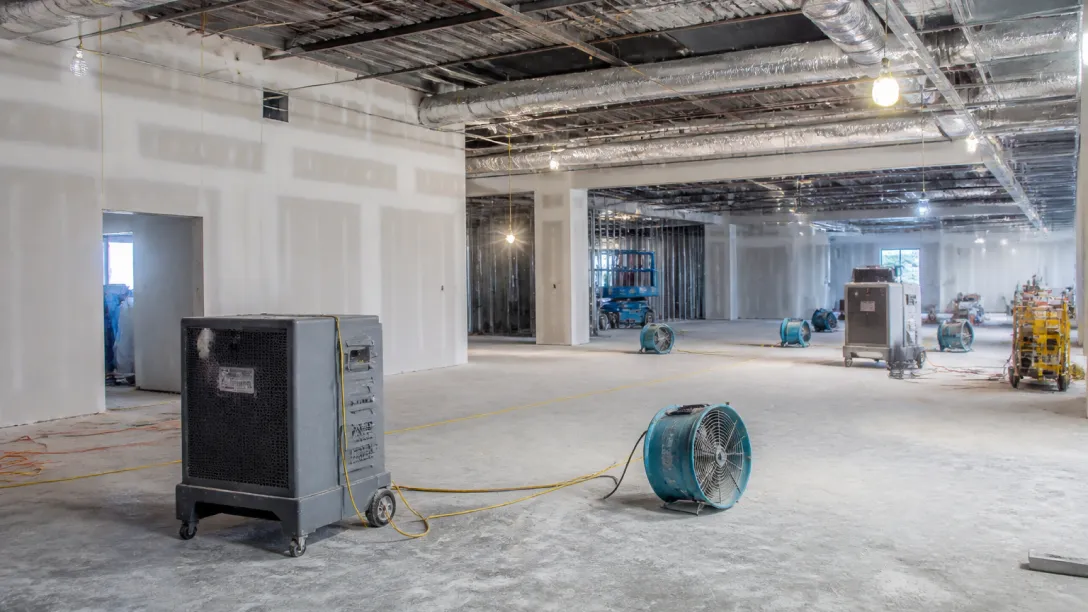
Effective construction drying requires a two-part mechanical strategy. First, dehumidifiers strip the moisture from the air, artificially lowering the ambient vapor pressure. Second, high-velocity axial air movers (fans) are deployed across the surfaces of the wet materials. As moisture evaporates, it forms a microscopic layer of saturated air directly against the wet surface, known as the boundary layer. This boundary layer insulates the material and slows further evaporation. The air movers physically strip away this wet boundary layer, constantly exposing the material to the dry air generated by the dehumidifier, thereby maximizing the rate of vapor transfer.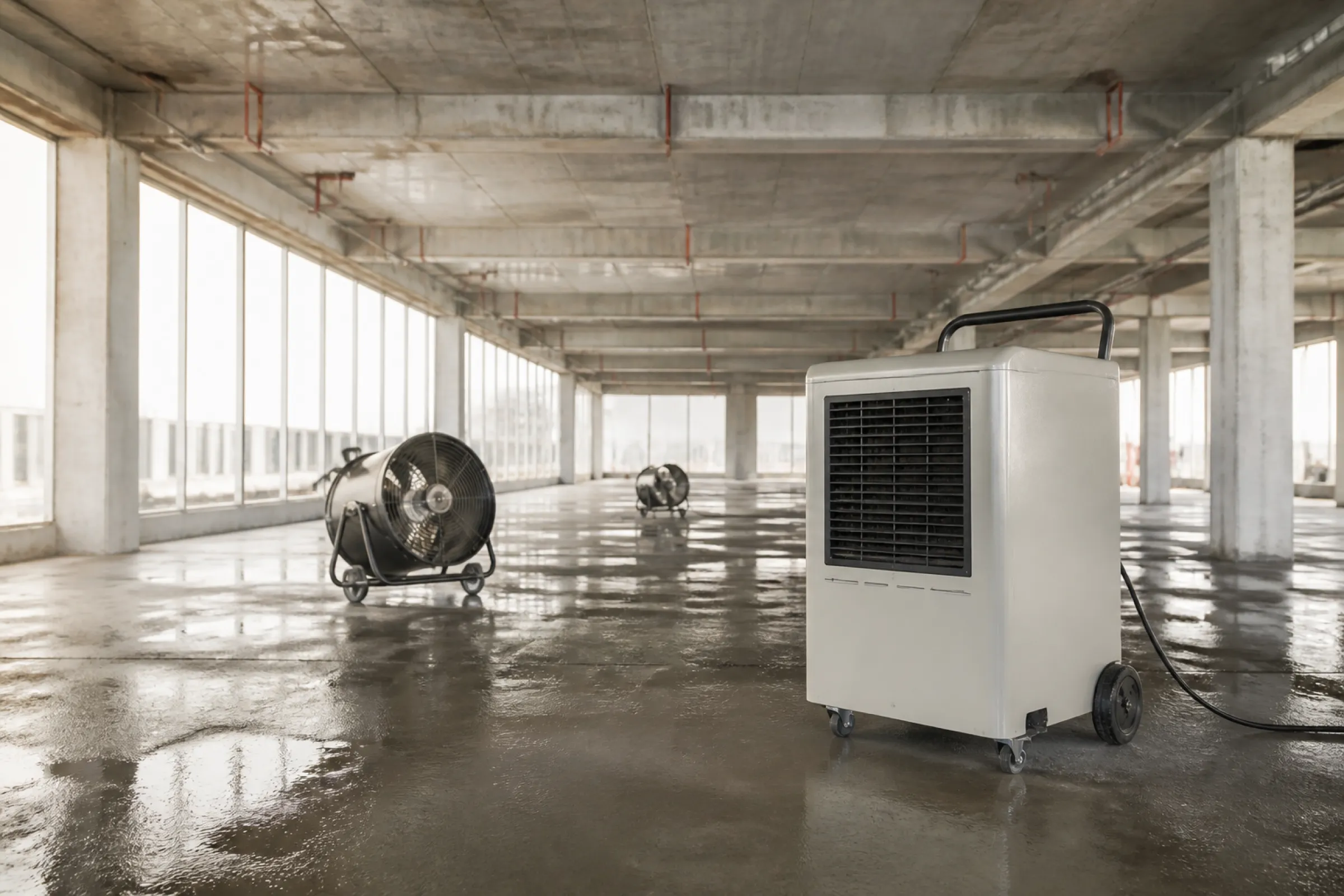
Calculating Dehumidifier Requirements (Pints Per Day)
Sizing dehumidification equipment for construction drying or commercial water damage restoration requires precise mathematical calculations. Equipment capacity is universally measured in Pints Per Day (PPD) of water removal under AHAM (Association of Home Appliance Manufacturers) conditions, which are defined as 80°F (26.7°C) and 60% Relative Humidity.
Contractors utilize specific formulas based on the porosity of the wet materials and the total cubic footage of the affected space. The industry categorizes drying environments into Classes. New construction drying with heavy concrete and plaster loads is typically calculated as a Class 4 environment (deeply bound water in low-porosity materials). The standard formula for estimating required PPD in a Class 4 scenario is:
Total Cubic Feet / 30 = Required AHAM Pints Per Day
For example, drying a newly poured 10,000 square foot floor with a 10-foot ceiling (100,000 cubic feet) requires a massive moisture extraction capability.
100,000 / 30 = 3,333 Pints Per Day.
To achieve this, the site manager must deploy a calculated fleet of specialized drying units. Utilizing equipment capable of automated, unmonitored operation is critical. Integrating a portable dehumidifier with drain hose allows the extracted water to be continuously pumped out of the building directly into drains or exterior trenches, eliminating the labor cost and downtime associated with manually emptying water collection buckets.
Low Grain Refrigerant (LGR) vs. Standard Technology
For demanding construction environments, standard commercial refrigeration units are insufficient. Standard units lose their moisture-extraction efficiency when the ambient humidity drops below 55% RH. However, extracting deeply bound water from concrete requires driving the ambient humidity down to 30% or lower.
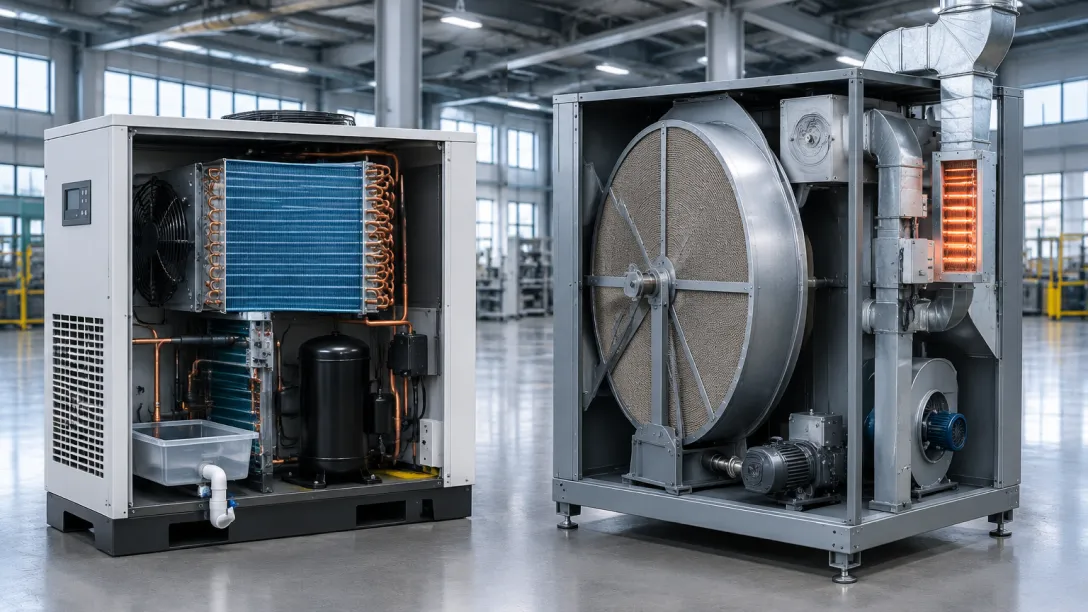
To achieve this, restoration professionals utilize Low Grain Refrigerant (LGR) dehumidifiers. LGR technology features an internal air-to-air heat exchanger that pre-cools the incoming air before it hits the primary evaporator coil. This double-cooling effect allows the machine to extract moisture even in highly challenging, extremely dry, and high-temperature conditions. LGR units represent the gold standard for fleet equipment in commercial drying operations.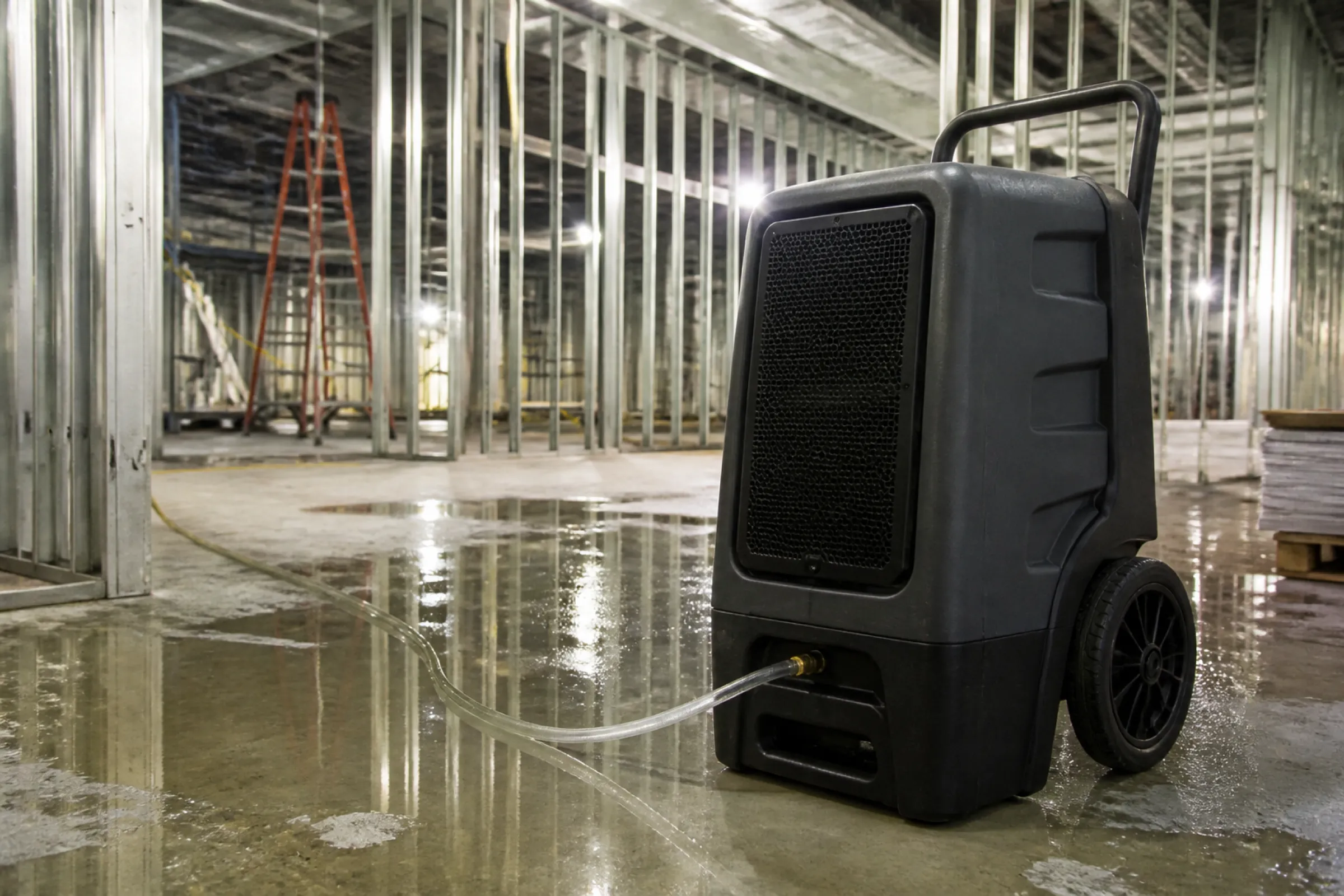
Equipment Fleet Logistics and Durability
Construction sites are hostile environments characterized by heavy foot traffic, airborne silica dust, and frequent equipment relocation. Flimsy metal casings or residential-grade plastics will shatter under job site abuse. Equipment rental businesses and general contractors build their fleets using machines housed in roto-molded high-density polyethylene.
Mobility is equally critical. Workers must constantly shift equipment as different zones of the building advance through the finishing phases. Deploying a portable commercial dehumidifier with handle and heavy-duty semi-pneumatic wheels allows a single technician to maneuver the equipment up stairs and across uneven subfloors safely. Furthermore, fleet-ready equipment features built-in amp meters and daisy-chain electrical outlets, allowing multiple units to operate on a single high-voltage job site circuit without tripping breakers.
Implement Engineered Construction Drying
Schedule adherence in commercial construction relies on the mathematical elimination of trapped moisture. Allowing critical path finishing trades to wait on natural concrete curing or drywall drying results in unacceptable financial penalties and guarantees future warranty failures. Implementing a calculated fleet of heavy-duty, continuous-drain dehumidifiers ensures that your project parameters remain under absolute mechanical control. To analyze your project's cubic footage, calculate total required AHAM moisture extraction, and specify the exact LGR or desiccant equipment necessary for your site, consult our specialized climate engineering division.
Frequently Asked Questions
Why does concrete take so long to dry naturally?
Concrete mixtures require a specific amount of water for the chemical hardening process (hydration), but a massive amount of excess "convenience water" is added solely to make the heavy mixture pourable. Once the concrete sets, this excess water is trapped deep within a microscopic capillary network. It takes approximately 30 days per inch of slab thickness for this deep moisture to slowly migrate to the surface and evaporate naturally.
What is ASTM F2170 testing for concrete slabs?
ASTM F2170 is the industry-standard test for measuring the internal moisture of a concrete slab before installing flooring. Technicians drill holes into the slab and insert digital relative humidity (RH) probes. Flooring manufacturers require the internal RH to be below a strict threshold (usually 75% to 85%) to validate the warranty. If the slab fails this test, commercial dehumidifiers must be used to force the moisture out.
Why is moisture control critical during drywall installation?
Applying joint compound to drywall introduces hundreds of gallons of water into the building. If the air is stagnant and humid, this mud will not dry, halting all sanding and painting work. More dangerously, if the ambient humidity stays above 70% for a few days, airborne mold spores will permanently infect the damp paper facing of the drywall, requiring a complete and costly tear-out.
How do contractors calculate how many dehumidifiers they need?
Contractors use mathematical formulas based on the total volume (cubic feet) of the space and the porosity of the wet materials. For dense materials like concrete and plaster (Class 4 drying), the standard rule is to divide the total cubic footage by 30. The resulting number dictates the total "Pints Per Day" (PPD) of moisture removal capacity required from the dehumidifier fleet.
What is an LGR dehumidifier and why is it used in construction?
LGR stands for Low Grain Refrigerant. Standard dehumidifiers stop working effectively when the room humidity drops to medium levels. LGR units contain a special internal heat exchanger that pre-cools the air. This allows the machine to pull moisture out of the air even in extremely dry, hot, and challenging conditions, which is necessary to extract the deeply bound water in concrete.
Why must construction dehumidifiers have continuous drain hoses?
In large-scale drying operations, a high-capacity machine can extract over 150 pints (18 gallons) of water per day. If the unit uses a standard collection bucket, a worker would have to manually empty it every few hours, and if forgotten, the machine shuts off, halting the drying process. Continuous drain hoses utilize internal pumps to automatically push the extracted water directly into building drains or outside trenches, ensuring 24/7 unmonitored operation.