Every dehumidifier specification eventually lands on the same fork: refrigerant or desiccant. The short answer most buyers need first: refrigerant (compressor) dehumidifiers condense moisture onto a cold coil and are the efficient choice for warm spaces with moderate targets; desiccant dehumidifiers adsorb moisture onto a rotating drying wheel and are the only effective choice for cold spaces, low humidity targets, and deep dew point processes. Everything else in the decision follows from two numbers: the temperature of your space and how dry the air actually needs to be.
This guide compares the two technologies on measured performance, operating cost, and maintenance, then reduces the choice to a two-question filter you can apply to any facility.
How Each Technology Removes Moisture
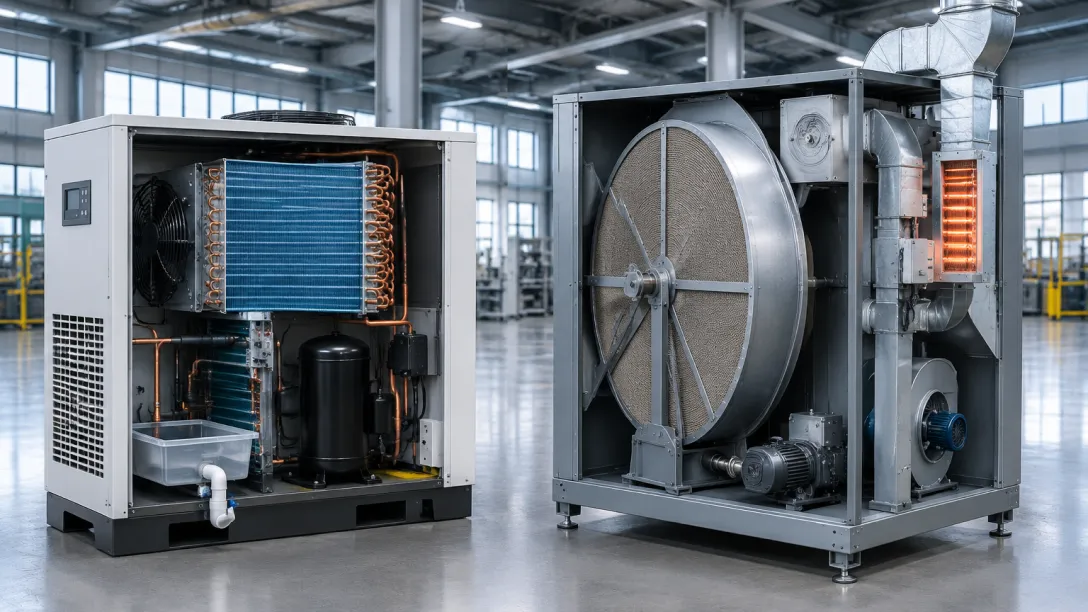
A refrigerant dehumidifier works like an air conditioner run in reverse: a fan draws room air across an evaporator coil held below the air's dew point, moisture condenses out and drains away, and the dried air is reheated as it passes the condenser. The physics are efficient as long as the coil stays above freezing and the incoming air carries plenty of moisture.
A desiccant dehumidifier never cools anything. Process air passes through a slowly rotating wheel impregnated with an adsorbent material that pulls water vapor directly out of the airstream. A separate heated airstream, typically at 80–160°C, regenerates the wheel and carries the collected moisture out as exhaust. Because nothing depends on a cold surface, performance holds at temperatures and humidity levels where refrigerant machines physically cannot operate.
The Performance Curve: Where Each Technology Holds Up
Measured output makes the difference concrete. Comparing the two technologies at standard conditions and then in the cold:
| Dehumidifier Type | Moisture Removal at 20°C, 60% RH | Moisture Removal at 5°C, 60% RH |
|---|---|---|
| Refrigerant (compressor) | ~1.5 kg/h | ~0.2 kg/h |
| Desiccant (rotor) | ~1.0 kg/h | ~1.0 kg/h |
The refrigerant unit wins decisively in warm air and collapses in cold air, because its coil approaches freezing and run time shifts to defrost. Below about +5°C, evaporator icing is a physical barrier, and even specialized low-grain refrigerant (LGR) designs bottom out near 0.5–1°C. Desiccant output is essentially flat with temperature, holding steady down to -20°C and beyond. The same split applies to dryness: refrigerant systems reach a practical floor around 35–40% RH, while desiccant systems routinely deliver 20–30% RH and, in industrial multi-rotor configurations, dew points of -50°C or lower for battery dry rooms and pharmaceutical processes.
Head-to-Head on Cost and Upkeep
| Dimension | Refrigerant | Desiccant |
|---|---|---|
| Drying method | Condensation on a cold coil | Adsorption on a heated regeneration wheel |
| Effective temperature range | Optimal 15–25°C; marginal below 10°C; blocked near 5°C | -20°C to 40°C+, output stable across the range |
| Achievable dryness | Practical floor 35–40% RH | 20–30% RH standard; deep dew points with multi-rotor systems |
| Energy per kg of water | About 0.5–1.5 kW | About 1–3 kW (regeneration heat) |
| Heat added to the space | Modest (compressor heat) | Noticeable, roughly 10–15°F air temperature rise |
| Upfront cost | Lower | Higher, commonly 20–30% more |
| Maintenance | Coil and filter cleaning, refrigerant checks | Filter changes; rotor inspection, replacement typically every 3–5 years |
| Typical service life | 7–10 years | 10+ years |
| Best applications | Warm warehouses, pools, production halls, general 40–60% RH control | Cold storage, pharma, battery dry rooms, low-temperature food processing, tight targets |
Two rows in that table deserve attention because they cut both ways. Desiccant regeneration heat is a cost in a warm room and free heating in a cold one. And refrigerant's lower purchase price only converts to lower lifecycle cost when the unit runs inside its effective temperature band; a cheap machine that ices up every winter morning is not cheap to own.
The Two-Question Filter
Apply these in order and the right technology usually selects itself:
- Question one: what temperature does the space run at? Consistently above about 15°C, refrigerant belongs on the shortlist. Below 10°C for meaningful periods, desiccant moves to the front. Between those points, LGR refrigerant models extend the compressor option downward and deserve a look.
- Question two: how dry must the air be? General control in the 40–60% RH band is refrigerant territory in warm spaces. Targets at or below 35% RH, any dew point specification, or documented continuous control for GMP or process validation point to desiccant regardless of temperature.
Warm warehouse with damp cartons: refrigerant. Freezer-adjacent dock with frost risk: desiccant. Pharmaceutical store at 30% RH: desiccant. Production hall at normal conditions: refrigerant, with commercial refrigerant units covering the moderate end and industrial desiccant systems carrying the tight-target zones.
When the Answer Is Both
Large facilities rarely present one condition. A site with a warm packaging hall, a chilled prep room, and a cold store is three decisions, not one, and zoning each with the right technology beats forcing a single platform everywhere. ASHRAE's low-dew-point guidance also formalizes the staged approach: a refrigerant section pre-cools and strips the bulk moisture cheaply, then a desiccant stage finishes to the deep dew point. The hybrid captures refrigerant efficiency where it works and desiccant reach where it does not, and it is the standard architecture behind serious dry room projects.
Selection Mistakes That Cost Money
- Assuming desiccant is always the premium answer. In warm, wet spaces it pays a regeneration energy penalty for capability you will never use.
- Assuming refrigerant covers every moisture problem. Its capacity falls steeply as rooms cool, and below its floor it stops being a dehumidifier and becomes a fan with a defrost cycle.
- Ignoring low-temperature symptoms until the unit ices. Coils frosting on winter mornings is the room telling you the technology is outside its envelope.
- Comparing nameplate ratings. Capacity is quoted at standard conditions, usually 27–30°C and 60% RH. Demand output figures at your actual temperature and target before comparing quotes.
- Treating it as a label decision. Refrigerant and desiccant are responses to a temperature profile and a dryness target, not brand tribes.
Get a Technology Recommendation for Your Facility
Send us your space temperature range, target humidity or dew point, and the moisture symptoms you are solving. Our engineers will return a technology recommendation with capacity sizing and, where it makes sense, a zoned or staged configuration. Contact the technical team to start.
Frequently Asked Questions
Which is better, a desiccant or refrigerant dehumidifier?
Neither wins universally. Refrigerant dehumidifiers are more energy-efficient in warm spaces with moderate targets of 40–60% RH. Desiccant dehumidifiers are the effective choice for cold spaces, targets below about 35% RH, and dew point-controlled processes. Match the technology to your room temperature and dryness target.
At what temperature do refrigerant dehumidifiers stop working?
Output falls steeply below 10–15°C, standard models struggle below about 5°C because the evaporator coil ices over, and operation effectively stops near freezing. LGR models extend useful operation to around 0.5–1°C. Below that, only desiccant technology removes moisture effectively.
Do desiccant dehumidifiers use more electricity?
Yes, in warm conditions: roughly 1–3 kW per kilogram of water removed versus 0.5–1.5 kW for refrigerant, because the wheel must be regenerated with heat. In cold conditions the comparison reverses in practice, because the refrigerant unit's capacity collapses while the desiccant keeps removing moisture at rated output.
How dry can each type make the air?
Refrigerant systems reach a practical floor around 35–40% RH. Desiccant systems routinely deliver 20–30% RH, and industrial multi-rotor configurations achieve dew points of -50°C and below for lithium battery dry rooms and pharmaceutical processes.
Do desiccant dehumidifiers heat the room?
Yes. Regeneration heat and the adsorption process raise discharge air temperature by roughly 10–15°F. In cold stores and unheated buildings that is a bonus. In warm or heat-sensitive spaces it must be accounted for in the cooling load, or managed with integrated post-cooling.
Can I combine both technologies in one facility?
Yes, and it is often the best answer. Zone-based designs put refrigerant units in warm areas and desiccant units in cold or tight-target areas. Staged designs use refrigerant pre-cooling to remove bulk moisture and a desiccant stage to reach deep dew points, capturing the efficiency of both where each performs best.
Which type lasts longer?
Desiccant systems typically exceed 10 years of service with rotor replacement every 3–5 years. Refrigerant units run about 7–10 years, with coil cleaning and refrigerant checks as the main upkeep. In both cases, running the machine inside its intended temperature envelope matters more to lifespan than the technology choice itself.